Rare 1823 Half Dollar Errors (List & Pictures)
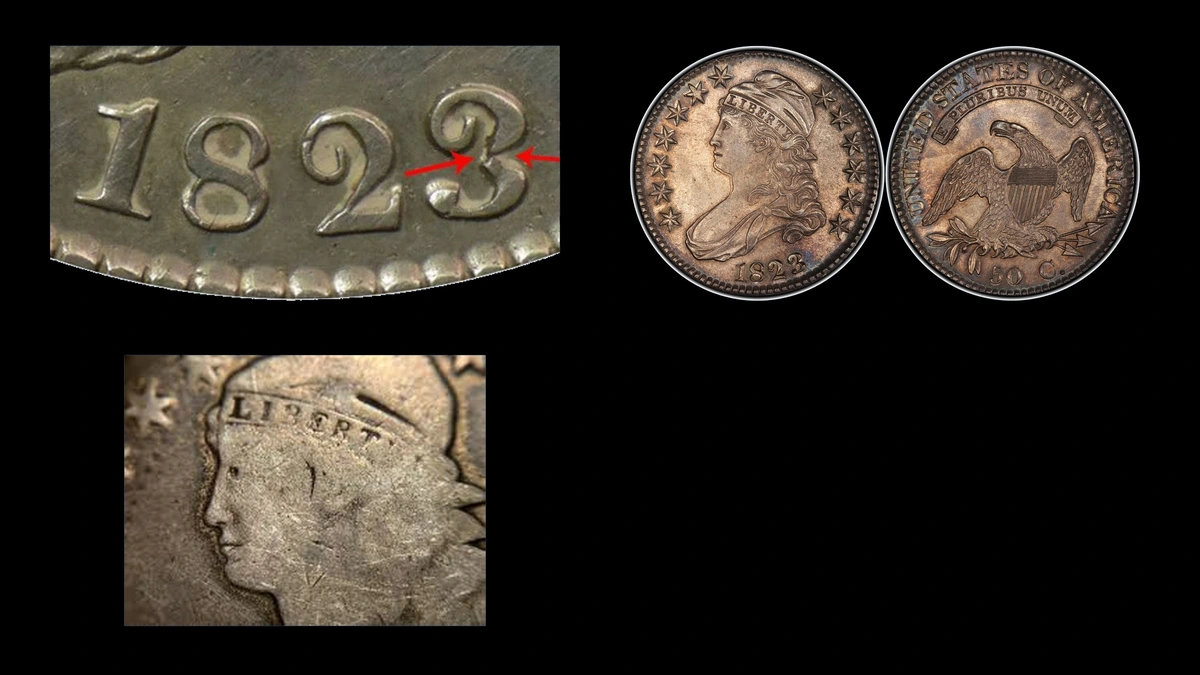
A date close-up answers only part of the search for 1823 half dollar errors. The five groups below include unusual 3 shapes, transferred shield detail, and overlapping strikes, with worn-coin estimates of $200–$3,000.
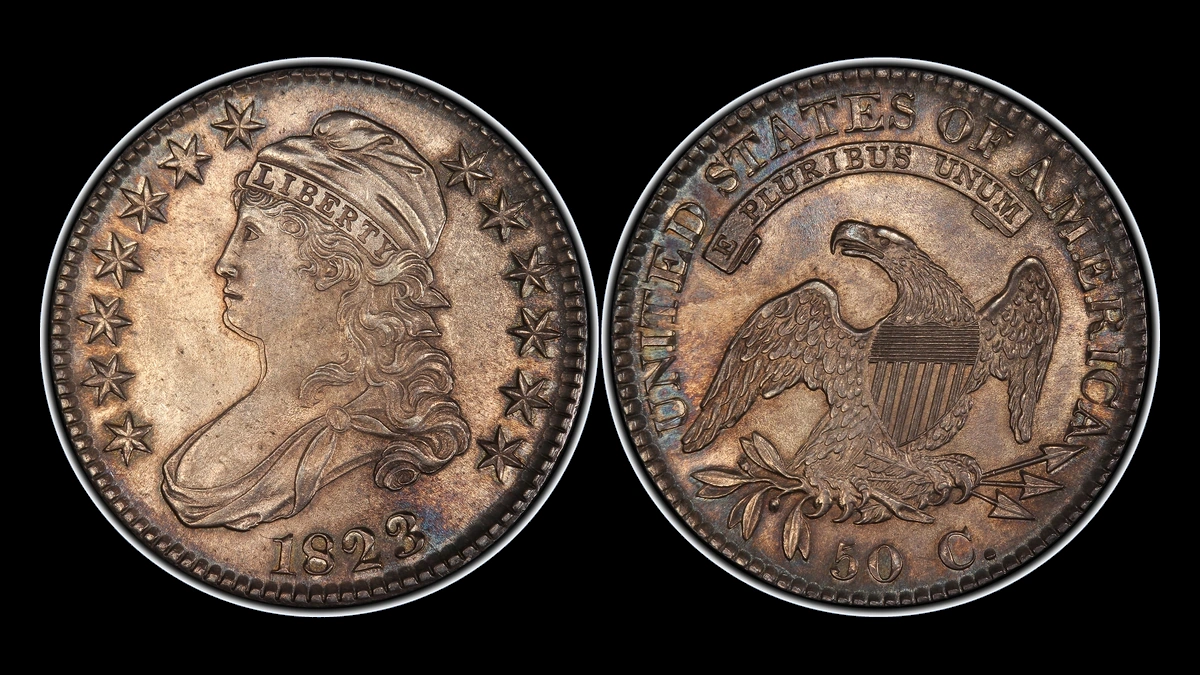
The documented $64,625 Broken 3 result from February 2016 belongs to exceptional unworn condition. Begin with the final digit, then inspect the portrait and both complete designs before connecting a feature with a price.
| Inspection area | Distinctive clue | Category | Worn-coin estimate |
|---|---|---|---|
| Center of final 3 | Weak join or uneven repair | Broken and Patched 3 | $300–$2,000 |
| Right side of 3 and adjacent rim | Swollen, distorted digit | Ugly 3 | $400–$3,000 |
| Below Liberty’s ear | A faint shield shape | Clashed dies | $200–$700 |
| Both complete faces | Slightly shifted impressions | Double strike | $1,500–$2,500 |
| Overlapping design remnants | A far-off-center earlier strike | Reported off-center first strike | $1,000–$2,000 |
Standard unworn measurements are 13.48 grams and approximately 32.5 mm across, with lettering around the edge. Keep both face photographs with the edge record so a tightly cropped mark does not lose its identity.
1. 1823 Half Dollar A Weak or Repaired Middle in the 3: Broken and Patched 3 Error
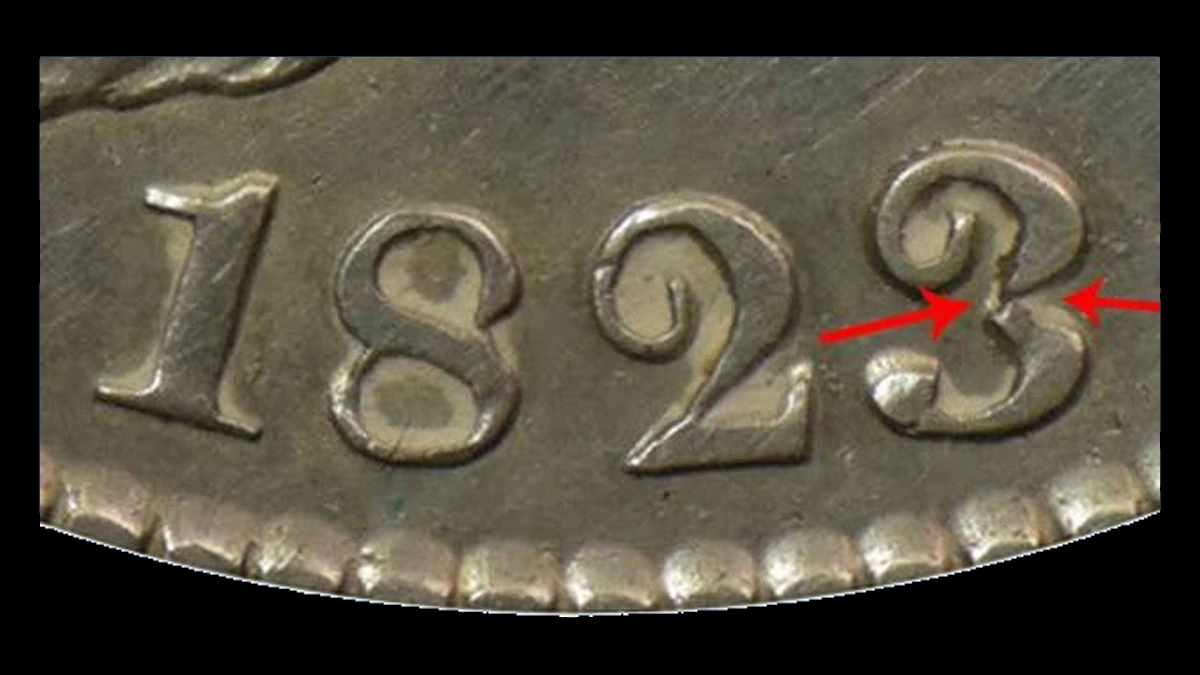
Look at the connection between the top and bottom of the final digit. The Broken 3 has a weak or disconnected-looking middle resulting from a poor original impression in the die.
A repair to that same steel stamping tool produced the Patched 3. Its connection is stronger but uneven where the correction was made.
These are two stages of the digit’s formation and repair. Neither name means 1823/2, which would require evidence of an older 2 under the 3.
How to Identify
Compare examples with similar wear so the middle connection is judged fairly. A worn date may not show the join as clearly as a sharply preserved reference.
For Broken 3, match the weak connection; for Patched 3, match the uneven filled-in join. The rest of the digit should also agree rather than merely showing one interruption.
Examine the silver around the date for damage. A scratch across a normal 3 cuts its shape but does not repeat a feature created in the die.
What It’s Worth
Estimated range: $300–$2,000 for worn Broken or Patched 3 examples. A PCGS XF45 Patched 3 sold listing reached $1,550 in April 2026.
The Broken 3 MS65+ record is $64,625 from February 2016. A separate Patched 3 graded MS66 brought $40,250 in April 2009.
Both records belong to exceptionally preserved unworn coins. Their condition prevents them from serving as ordinary prices for any weak or repaired-looking 3.
2. 1823 Half Dollar A Swollen Right Side of the Digit: Ugly 3 Error
The Ugly 3 changes the overall outline differently: its right side looks enlarged and misshapen. Keep the nearby rim in view when comparing it.
Lance Keigwin’s illustrated study explains the shape through a die crack rising from the rim into the digit. Other published accounts describe engraving work, so the explanation of its formation is not uniform across sources.
How to Identify
The illustrated comparison of the 1823 digit forms places Ugly, Broken, Patched, and normal 3s together. Match the complete enlarged outline rather than applying the names interchangeably.
Examine the right side and any raised route toward the rim under magnification. Several lighting angles help prevent a shadow from exaggerating the apparent swelling.
A later blow can flatten and spread an ordinary digit. Check the neighboring surface for displaced metal before attributing the characteristic Ugly 3 shape.
What It’s Worth
Estimated range: $400–$3,000 for worn examples. Ordinary 1823 XF sales around $350–$450 and the $1,550 Patched 3 listing provide nearby market context rather than direct Ugly 3 transactions.
The Pogue collection’s exceptional MS65 Ugly 3 sold for $35,250 in February 2016. That high unworn grade accounts for a very different comparison level from worn or damaged coins.
3. 1823 Half Dollar A Shield Shape Under Liberty’s Ear: Clashed Dies Error
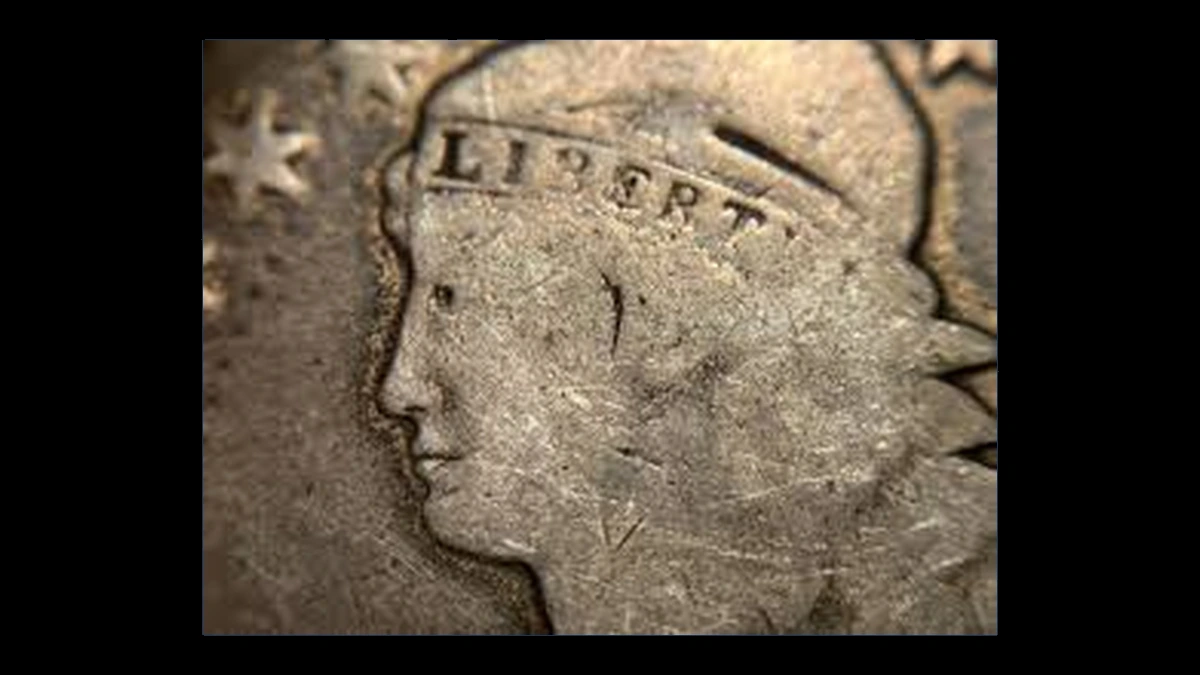
Move upward from the date to the area beneath Liberty’s ear. A collector’s illustrated 1823 shows a faint shield trace there, even though the shield belongs to the reverse design.
The front and back dies had met without a blank between them. That contact marked one tool with part of the other’s design, leaving the transferred shape available to strike onto later coins.
How to Identify
Compare the faint trace with the shield on the back and with the documented clash view. Several related portions of the shield provide stronger evidence than one extra line near the head.
Move a lamp across the area and see whether the shape remains recognizable. A bright scratch or one favorable shadow may appear convincing in only a single view.
Retain a full front photograph beside the close-up. The position beneath the ear is part of the identification, not just the resemblance to a shield.
What It’s Worth
Estimated range: $200–$700 for worn coins with a recognizable shield trace. The estimate values the half dollar as a whole, including surface quality.
2026 sold listings include ordinary PCGS XF40 and XF45 examples at $350 and $449.99. Neither listing establishes a sale of the illustrated clash.
Those lightly worn coins provide same-year context. The visibility of the shield and the coin’s preservation still need individual comparison.
4. 1823 Half Dollar Small Shifts Repeated on Both Faces: Double Strike Error
For the documented NGC XF40, both faces show the design in slightly different positions. The coin moved a small amount before receiving another blow.
An older error catalog also describes repeated stars and date details on an 1823. That report has not been established as the same specimen, so its wording should not be merged with the XF40 history.
How to Identify
Lay full-face pictures together and follow one duplicate detail into its neighbors. The separation should fit a coherent shift within each design.
For the XF40 comparison, check that both faces show the small movement described. On other reported examples, stars and the date are useful areas to begin the inspection.
A single misshapen 3 is insufficient evidence for another strike. Flat shelves or unrelated marks also need to be distinguished from surviving parts of two impressions.
What It’s Worth
Estimated range: $1,500–$2,500 for comparable worn double strikes. The NGC XF40 sold for $1,645 in October 2016.
A later Heritage description cites that result alongside an 1819/8 PCGS XF45 double strike sold for $2,280 in July 2025. The latter is a newer same-series comparison from another year and grade.
It does not update the sale history of the 1823. Each coin’s degree of separation and surfaces remain relevant to the price.
5. 1823 Half Dollar Earlier Design Beneath a Later Strike: Off-Center First Strike Error
A separate reported 1823 received a first blow about sixty percent off center before being struck again. Much of that first impression was covered by the later design.
The account describes PCGS VF Details, meaning a worn coin with a problem that prevents a normal numerical grade. Its sixty-percent figure belongs to this report, not to the XF40 coin above.
How to Identify
Look for earlier design remnants extending outside or lying beneath the later impression. Their positions should explain the proposed sequence of two strikes.
The final outline or a wide rim alone cannot measure how far the first strike was off center. Both faces and the visible overlap need to be examined together.
A cut-out edge section does not create two struck designs. Similarly, a sunken backward impression from a later object pressed into the coin has a different origin.
What It’s Worth
Estimated range: $1,000–$2,000 for a comparable worn example with clear first-strike remains. The year guide reports a $1,495 asking price for the described piece.
The asking figure is not a completed transaction. The $1,645 sale in the preceding section belongs to a different 1823 and cannot be combined with this reported displacement as one specimen’s record.
Conclusion
Begin with the whole shape of the 3, then look beyond the date for a transferred shield or repeated impressions. Those locations distinguish die preparation and damage from events during striking.
Worn-coin estimates span $200–$3,000. Keep the $1,495 offer separate from the $1,645 sale, and reserve the $64,625 Broken 3 record for its exceptional level of preservation.