Rare 1824 Dime Errors (List & Pictures)
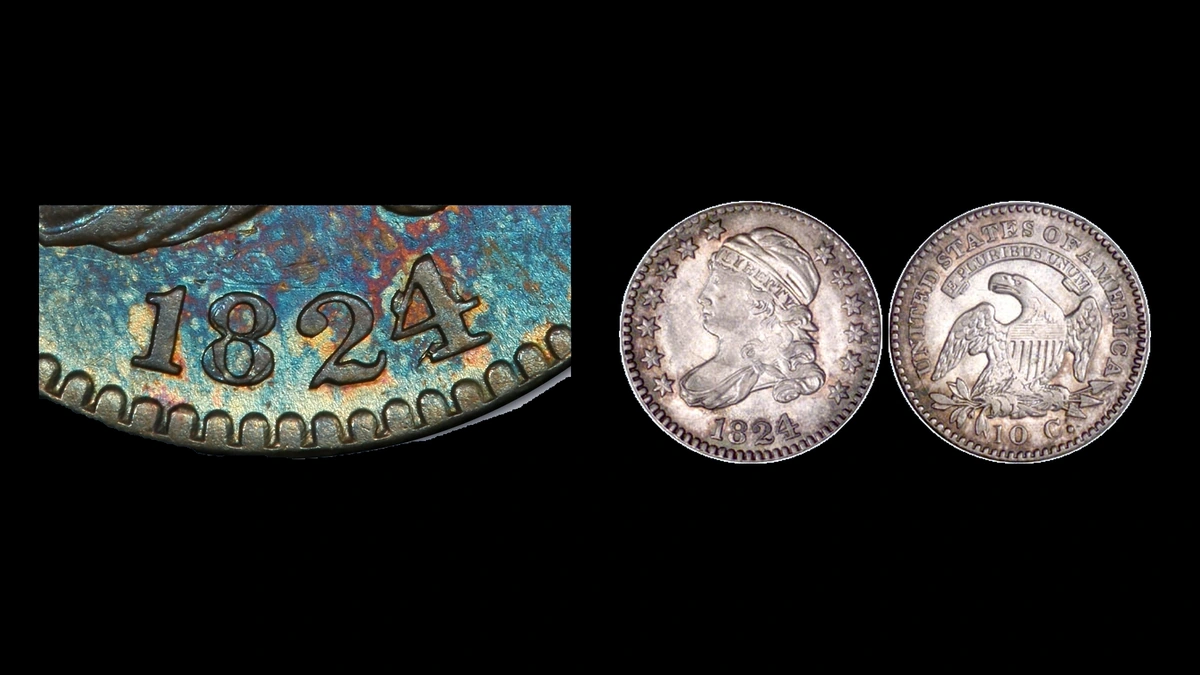
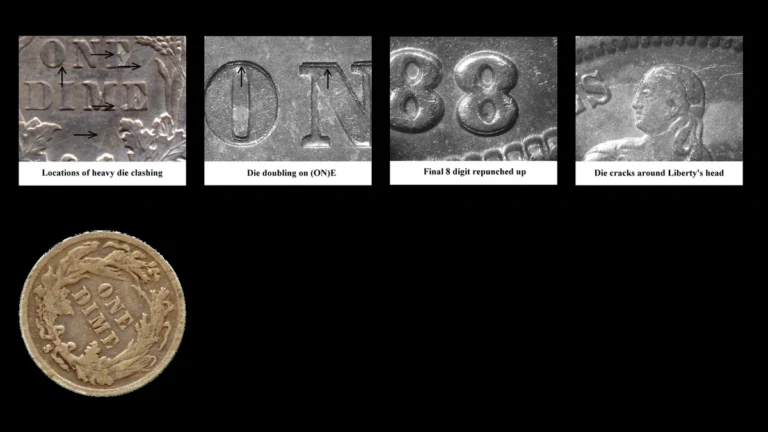
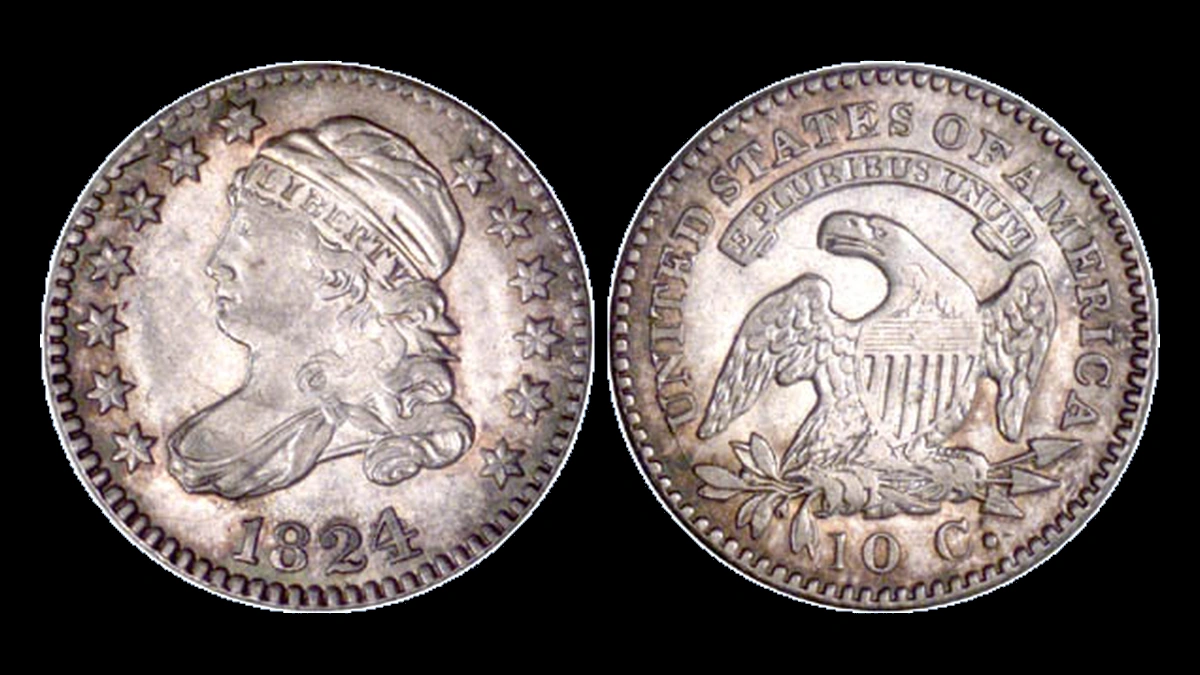
Every 1824 dime carries traces of a 2 beneath its final 4, while some also display clash marks or a die crack. These 1824 dime errors have estimated whole-coin values of $200–$1,600 for worn examples, with an 1824/2 selling for $1,017.50 in 2025.
Read the date first, inspect the area above Liberty’s cap next, and then investigate any unfamiliar design traces.
| Where to look | Feature | Estimated worn-coin range |
|---|---|---|
| Final date digit | 4-over-2 overdate | $200–$1,300 |
| Above stars six and seven toward the cap | Obverse die crack | $250–$1,600 |
| Faint extra shapes on either face | Clashed dies | $250–$1,500 |
1. 1824 Dime An older numeral survives beneath 4: 4-over-2 Overdate Error
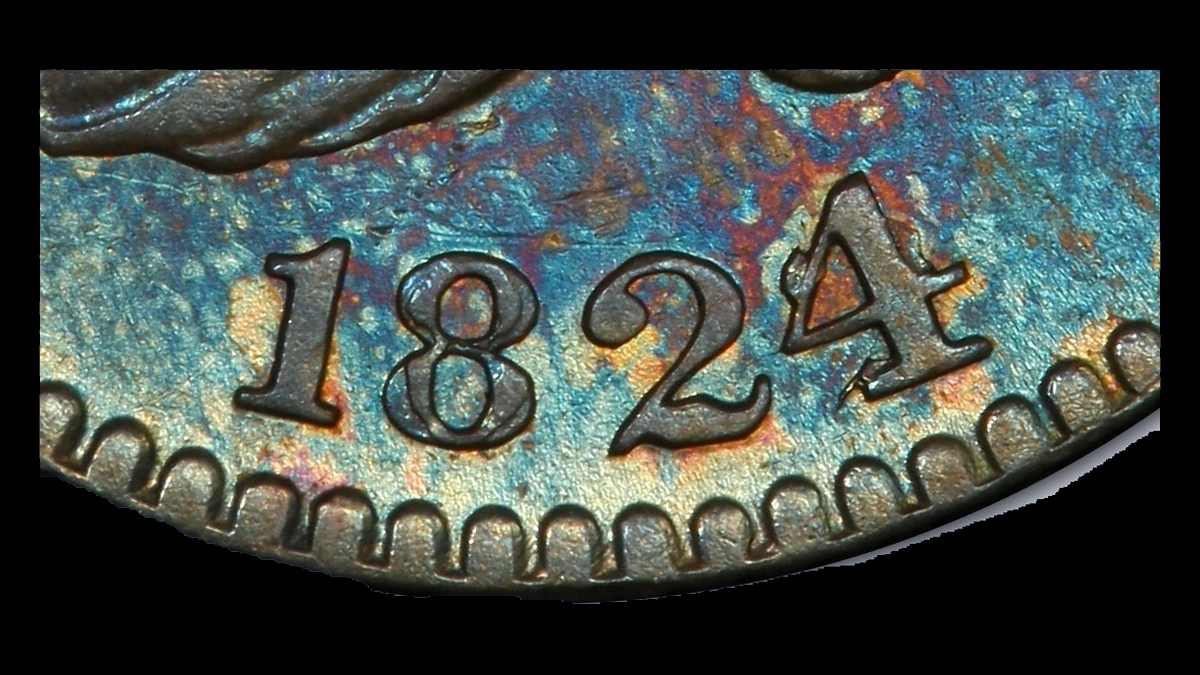
The final digit tells a story about the tool used to make the coin. An unused die dated 1822 was changed by punching a 4 over its last 2, leaving portions of the earlier numeral behind.
A die is the steel tool that stamps the design into a blank. Here the changed tool produced the same 4-over-2 feature on every 1824 dime, which explains the familiar 1824/2 notation.
Two reverse dies were paired with this one obverse. Differences in the 1 of 10C help distinguish those reverses, but both share the overdate.
How to Identify
Keep the complete date in view while focusing on the last numeral. Under a 10× magnifier, compare its remaining lower-number strokes with a clear 1824/2 reference example.
Change the lighting before accepting a dark edge as a remnant of the 2. The evidence should belong to the raised numeral rather than a shadow, scrape, or stain beside it.
After matching the overdate, inspect the reverse’s 1 in 10C if you want to distinguish the die pairing. Do not treat a different reverse as evidence that its date was altered by a different process.
The original coin specifications are about 2.70 grams, approximately 19 millimeters, and roughly 89.2% silver, with a grooved edge. Measurements of an accessible coin can support identification, allowing for wear, but cannot replace the numeral comparison.
What It’s Worth
Many worn examples fall within an estimated $200–$1,300 whole-coin range. A VF35 example with CAC quality approval sold at GreatCollections for $1,017.50 in 2025.
VF35 indicates circulation wear with substantial detail remaining. Because every dime dated 1824 has the overdate, its value is already part of the coin’s identity rather than an extra premium to add afterward.
A scarcer reverse pairing or a higher grade may require a different comparison. Exceptional unworn examples are outside the intended scope of this worn-coin estimate.
2. 1824 Dime A ridge runs above the upper stars: Obverse Die Crack Error
Look in the area above stars six and seven, then toward the open field above Liberty’s cap. A reported raised line occupies that route on an 1824 dime.
The ridge formed when silver entered a narrow crack in the obverse die during striking. This later damage to the tool can coexist with the overdate, which was already present when the die was prepared.
The description identifies a star-to-cap route, not an established continuation all the way to the rim. An unseen extension should not be added to the diagnosis.
How to Identify
Illuminate the field above the two stars from a low angle and follow any visible ridge toward the cap. A die crack should rise above the surface; a scratch is cut into it.
Try a second light direction if a line appears in only one photograph. Dirt and shadows can conceal the surface shape or create a misleading impression of continuity.
Keep track of where the line is clear and where wear interrupts it. Match only the route supported by visible metal, with the surrounding stars and cap providing orientation.
What It’s Worth
The supplied estimate is $250–$1,600 for a worn whole coin showing the crack. A readable ridge and preserved nearby design make the feature easier to evaluate.
The $1,017.50 VF35 sale in 2025 provides a same-year condition comparison. The supplied record does not establish this crack on that auction coin, so it is not a confirmed sale of the reported crack-bearing specimen.
The range combines the early dime’s underlying value with interest in the visible die damage. It is not a separate amount to add to the overdate’s value.
3. 1824 Dime Faint shapes resemble the opposite side: Clashed Dies Error
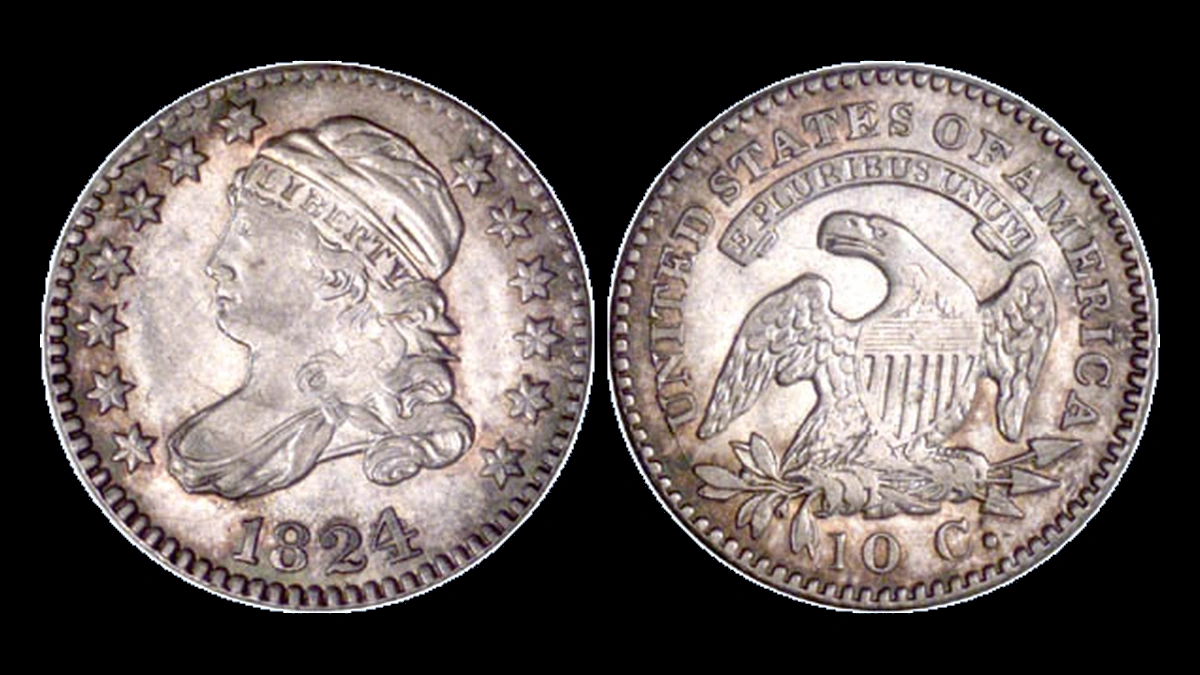
An 1824/2 JR-1 collection coin is reported with light clash marks on both faces. Their useful characteristic is a relationship to the opposite design, rather than simply looking like extra lines.
A clash occurs when the dies strike each other without a blank between them. The damaged dies may then stamp borrowed design traces onto subsequent coins.
This does not require the individual coin to move and receive a second impression. It records an earlier contact between the two tools.
How to Identify
Take upright photographs of both faces, retaining the surrounding design around each faint mark. Compare the mark with the relevant shape from the opposite face and with an actual attributed 1824 example.
Under magnification, vary the light to see whether the shape continues beyond a single bright or dark line. Scratches and flat doubled edges need their own explanations and should not be grouped as clashes automatically.
The reverse die also served in other years. A later coin made with it may carry a different feature, so shared use of the tool does not establish that feature on an 1824 dime.
What It’s Worth
Recognizable light clashes on worn examples have an estimated $250–$1,500 whole-coin range. Condition and the clarity of the transferred shapes both affect a useful comparison.
The same $1,017.50 sale can offer general context for a VF35 1824/2. It does not confirm clash marks on the coin sold.
If a coin carries an overdate, a crack, and a clash together, it still has one overall value. Adding the three estimates would count the underlying dime repeatedly.
Conclusion
The overdate is expected on every 1824 dime; the other marks require separate visible evidence. A raised star-to-cap line supports the reported crack, while a clash should reproduce a recognizable part of the opposite design.
Use the estimated $200–$1,600 span for worn whole coins, and keep general same-year sales distinct from confirmed sales of a particular crack or clash.