Rare 1829 Penny Errors (List & Pictures)
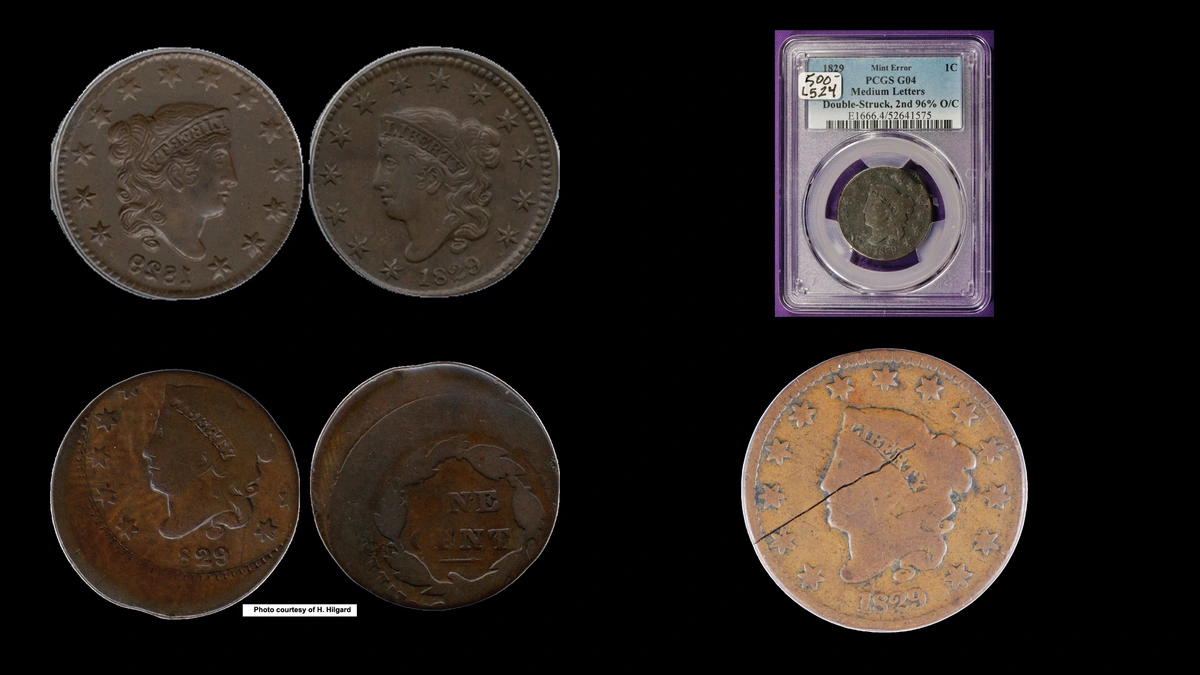
A second date on an 1829 cent can be a mirror image pressed into the copper, rather than evidence of another ordinary strike. Checking the depth and direction of the design helps distinguish the two.
Estimated values for 1829 penny errors span $35–$35,000, including a rare rotated Proof that sold for $23,000 in November 2006. Compare the designs first, then the rim and metal, keeping ordinary circulated cents separate from specially made Proofs.
| What to inspect | Possible feature | Estimated range |
|---|---|---|
| Mirrored sunken reverse portrait | Full brockage | $3,000–$15,000 |
| Extra reverse image beneath centered design | Double strike | $400–$6,000 |
| Bare crescent or missing edge | Off-center strike or clip | $75–$8,000 |
| Raised star lines or rim patches | Die cracks and cuds | $35–$3,000 |
| Hair outline, blurred UNIT, or copper opening | Clash, struck-through, or cracked blank | $50–$5,000 |
| Reverse tilt | Rotation on ordinary or Proof coins | $50–$35,000, with separate Proof comparisons |
1. 1829 Penny A Sunken Portrait Replaces the Wreath: Full Brockage Error
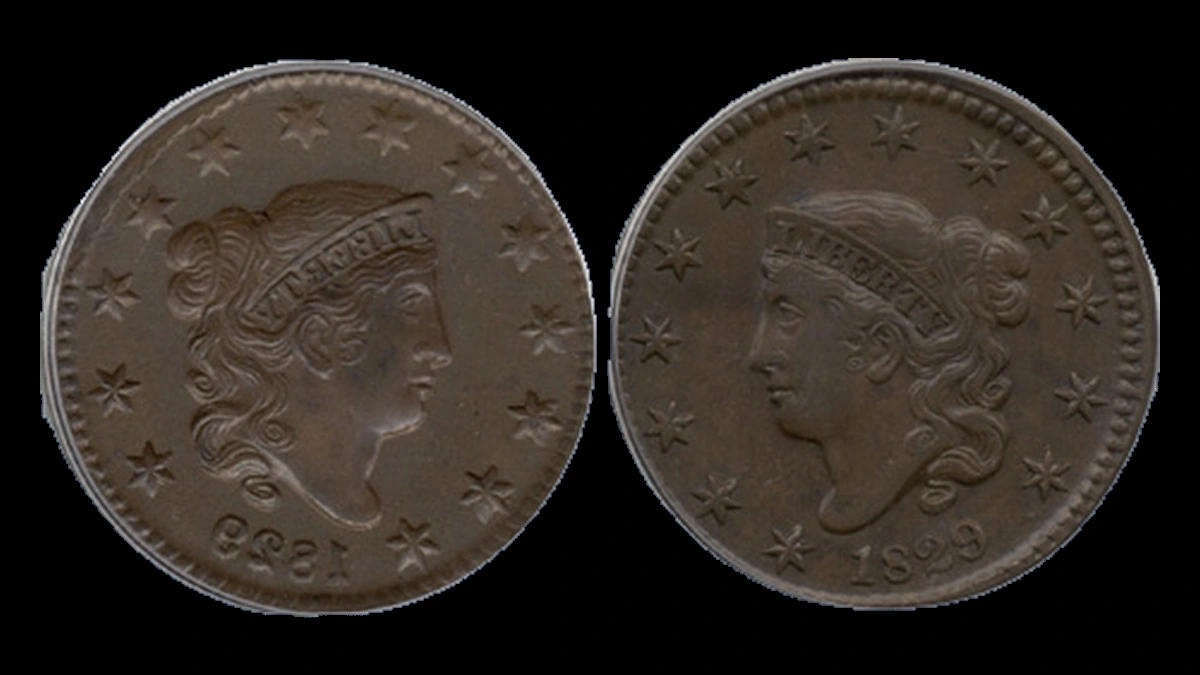
A full reverse brockage shows Liberty, stars, and date backward and recessed where ONE CENT and the wreath should be. A previously struck coin remained in the press and impressed its raised front into the next blank.
How to Identify
Compare the normal raised front date with the mirrored incuse date under side lighting. The complete reversed portrait and stars matter too, since one backward mark does not establish a full brockage.
The normal reverse design is absent, so actual wreath-letter size cannot be read from this face. For a valuable candidate, the edge and metal flow need specialist examination to distinguish original striking from finished coins squeezed together later.
What It’s Worth
$3,000–$8,000 is the estimate for worn but clear reverse brockages, rising to roughly $8,000–$15,000 for stronger lightly worn examples. Original surfaces and mirror-image completeness influence the comparison.
A PCGS AU55 N-8 sold for $6,900 at Heritage on April 29, 2006. Mint Error News separately printed a $12,500 valuation for an illustrated AU55 example; that is not another confirmed sale of an established identical specimen.
2. 1829 Penny Earlier Reverse Details Survive Beneath a Centered Strike: Double Strike Error
The PCGS VF20 auction example has additional design at the lower-right reverse. Heritage proposed an initial reverse strike 40% off-center toward 6 o’clock, followed by a centered strike on both faces.
The catalog also suggested another blank blocked the front during the first blow. That is a reconstruction of the event, not a separately confirmed extra error.
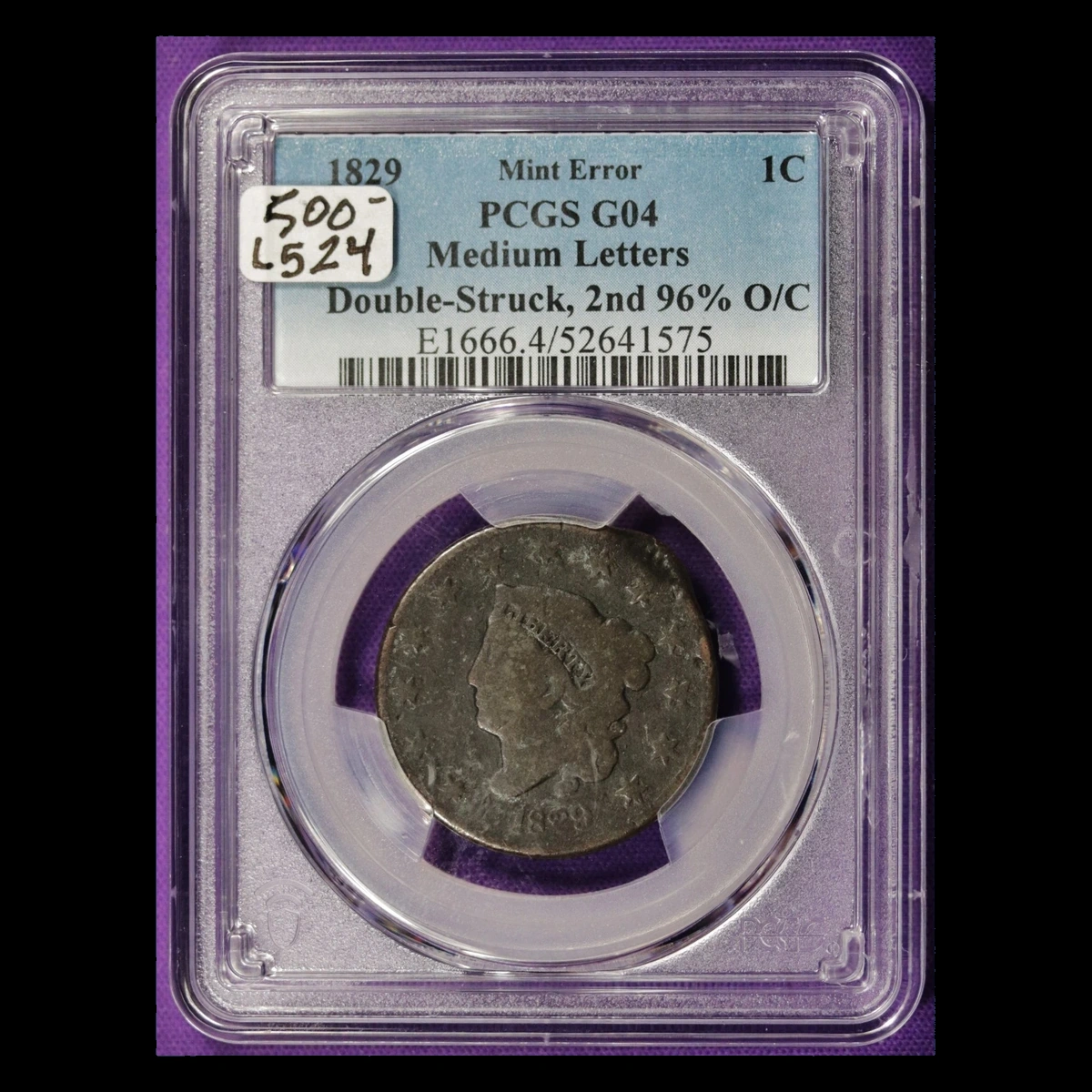
How to Identify
Trace the surviving earlier letters or wreath beneath the later centered reverse. The coin may lack an obvious bare crescent after the later blow, so the overlapping design supplies the key evidence.
Compare the front for contact or flattening consistent with the proposed blocking blank. Any claimed sequence must explain both faces rather than rely on one indistinct letter.
What It’s Worth
$400–$2,500 is the estimate for worn double strikes, with stronger preserved examples roughly $2,500–$6,000. Readable separation of the impressions makes a useful comparison.
The VF20 specimen was listed as not sold in Heritage’s July 2002 archive. A separate dealer’s $500 listing for a heavily worn PCGS G4 is an offer, not a verified completed transaction.
3. 1829 Penny One Displaced Design Leaves an Unstruck Crescent: Off-Center Strike Error
The recorded Large Letters PCGS VG10 cent is 25% off-center. A separate 1829 example described by Henry Hilgard combines an off-center strike with a clip.
How to Identify
Include the whole outline and readable date, then compare both designs with the original unused copper. One misplaced blank should explain their missing outer detail.
The Hilgard specimen cannot inherit the auction coin’s 25% measurement or an unspecified striking direction. Its clipped gap is absent metal, whereas its off-center crescent still contains copper.
What It’s Worth
$500–$2,500 is the estimate for recognizable worn examples, with stronger pieces approximately $2,500–$8,000. Surface quality and date survival remain important.
The 25% off-center PCGS VG10 sold for $1,380 on December 23, 2024. Hilgard’s compound coin requires its own complete assessment rather than that price plus a second full clip estimate.
4. 1829 Penny A Missing Edge Accompanies an Off-Center Design: Clipped Planchet Error
Hilgard’s 1829 example has a gap near 6:30 on the front and 11:30 on the reverse. The same missing section appears at different clock positions when viewed from opposite sides.
The incomplete blank also entered the press off-center. Calling this a double error means two different problems, not proof that it received two strikes.
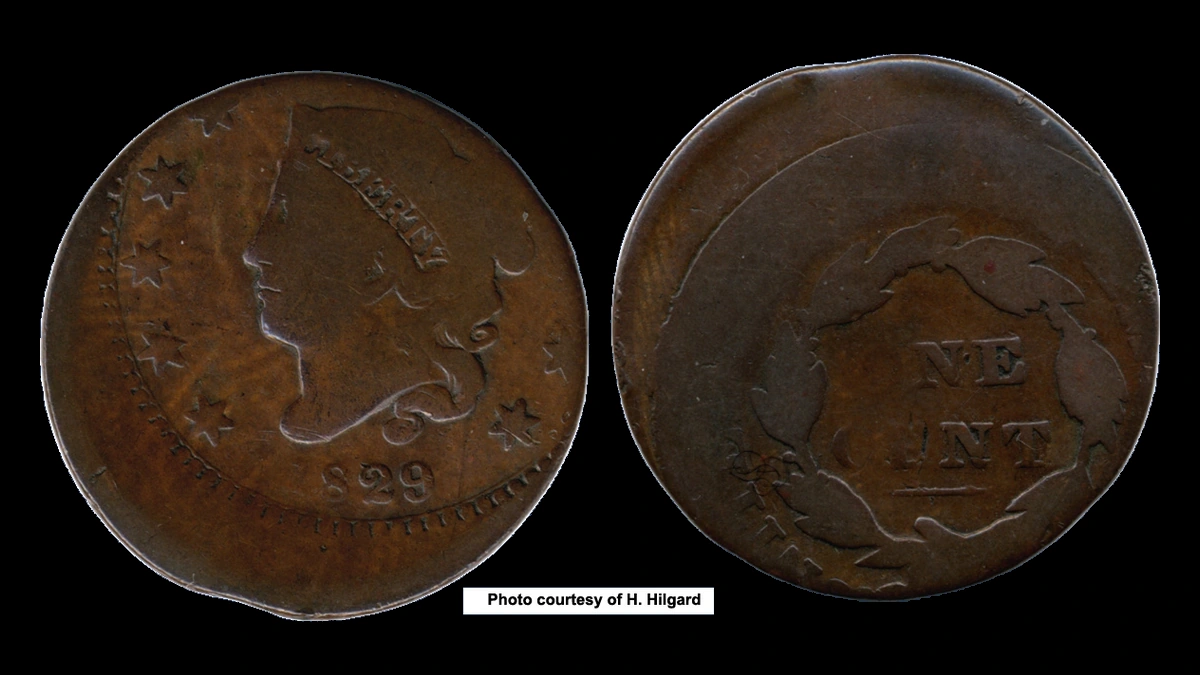
How to Identify
Inspect the gap’s rim transitions for strike-shaped metal rather than saw cuts, filing, or a sheared wall through completed detail. No clip percentage is supplied for this specimen.
A normal loose large cent is about 10.89 g and roughly 28 mm across; record intact spans and allow for wear or missing copper. Use those references for basic identity while protecting fragile areas and leaving certified specimens sealed.
What It’s Worth
$75–$500 is the estimate for a modest original clip on a worn 1829 cent. A clear clip combined with an off-center strike can fit roughly $500–$2,500 for the entire coin.
The article names an August 2002 auction appearance without a realized price used here. These are estimates, not a reported completed amount for the pictured compound specimen.
5. 1829 Penny Star Lines or Several Rim Patches Rise Above the Surface: Die Damage Error
N-2 has front cracks joining stars one through four and eleven through thirteen. A separate N-7 report describes reverse spoke-like cracks, while N-8 carries three rim-connected cuds.
How to Identify
For N-8, examine front patches between stars seven and eight and between nine and above ten, then the reverse break above CA in AMERICA. These locations belong to that die pairing rather than the other crack patterns.
Use side lighting to distinguish raised die metal from a scratched groove or a rim folded onto the face. Count stars consistently from the lower left and keep the different varieties’ photographs separate.
What It’s Worth
$35–$400 is the estimate for modest cracks on worn cents, with clearer breaks or stronger preservation roughly $250–$3,000. Counting cuds does not determine value by itself.
A three-cud N-8 graded PCGS AU50 sold for $810 in September 2020. Its light wear and actual surviving patches are part of that whole-coin comparison.
6. 1829 Penny Hair-Bun Curves Appear Inside the Right Wreath: Die Clash Error
An old N-1 catalog description identifies Liberty’s hair-bun outlines inside the reverse wreath’s right side. Die contact without a blank transferred portions of the front design onto the reverse die.
How to Identify
Compare the front hair shape with the unexpected reverse contour at a consistent scale. Follow it through spaces between leaves rather than treating a normal wreath curve as transferred portrait detail.
The documented example was MS62 Brown, so its faint marks were on an unworn surface. Wear, scratches, or rough copper can make another coin’s apparent match less convincing.
What It’s Worth
$75–$600 is the estimate for recognizable clashes on worn cents, while attractive unworn examples can fit roughly $1,000–$4,000. The underlying coin’s preservation accounts for much of the difference.
The historical catalog text, reproduced by a collector, listed the MS62 Brown N-1 at $2,800. That listed amount is not a newly verified completed auction result.
7. 1829 Penny UNIT Is Locally Blurred: Struck-Through Material Error
The Twin Leaf N-1 has a catalog-described interruption at UNIT in UNITED. Material prevented the reverse die from transferring full detail in that area.
How to Identify
Compare the affected letters with neighboring detail and the front’s high points. The catalog distinguishes this local patch from generally weak reverse details that can occur on other N-1 coins.
Grease was suggested rather than conclusively identified. Scratches from abrasive cleaning and broad circulation wear offer other explanations, so the actual interruption must be established before naming its cause.
What It’s Worth
$50–$400 is the estimate for worn examples with a clear localized struck-through area. Well-preserved unworn coins may fit roughly $1,000–$5,000 as complete specimens.
The Twin Leaf coin was PCGS MS63 Brown, but no sale amount is supplied here. Missing detail can reduce appeal, so its high-condition estimate is not automatically an added premium for blurred letters.
8. 1829 Penny An Opening Splits the Copper Itself: Cracked Planchet Error
A dealer lists a worn Large Letters 1829 cent as having a cracked blank. Its opening is a physical separation in the copper, distinct from a raised ridge copied from a cracked die.
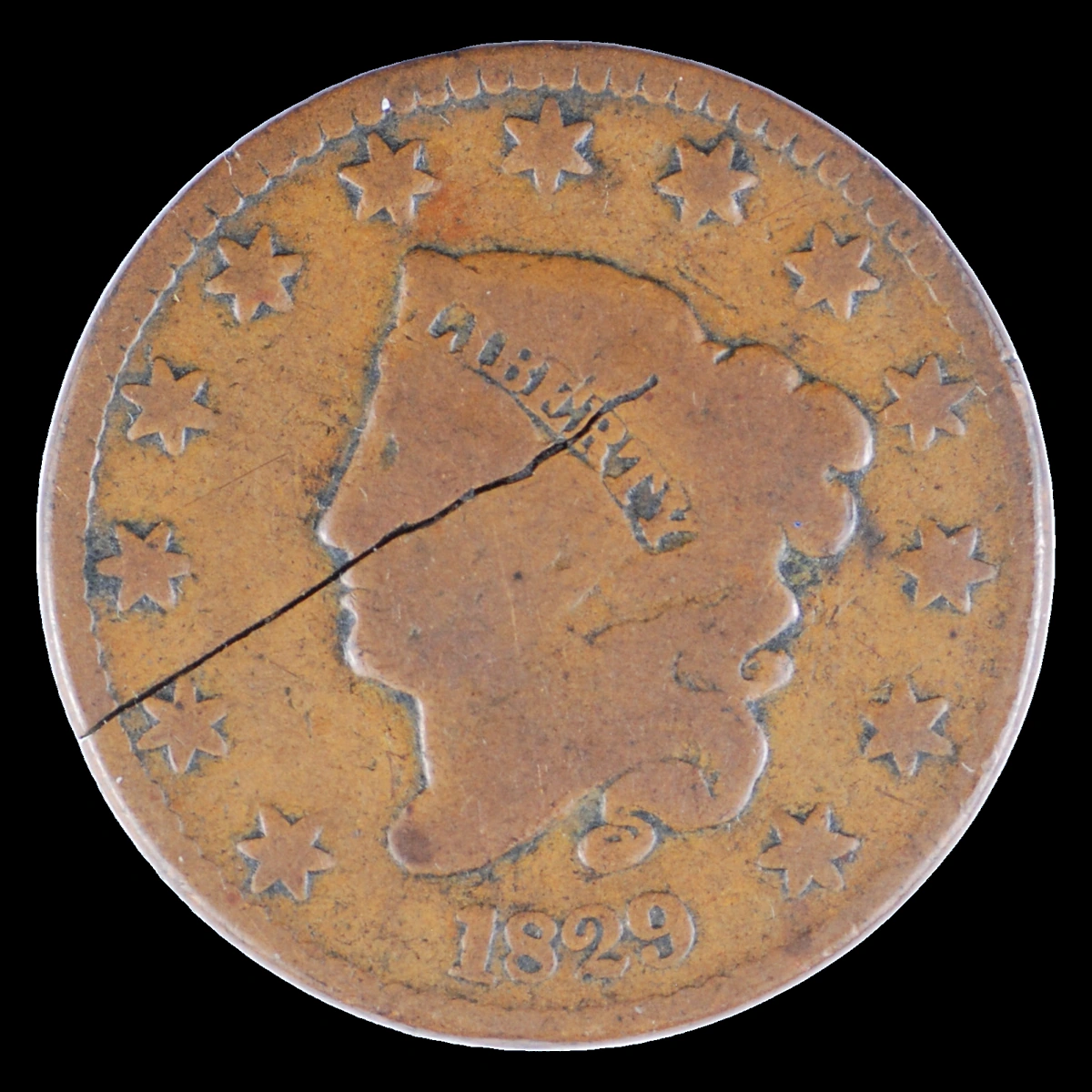
How to Identify
Compare the opening across both faces and the edge without bending it wider. Striking shaped around a preexisting gap differs from a crease or tear cutting through completed lettering after minting.
The seller records 29 mm rather than the roughly 28 mm general reference, without specifying the crack’s star or letter location. A split can leave nearly normal weight if no copper is lost, and the short listing alone does not settle when it formed.
What It’s Worth
$100–$600 is the estimated whole-coin range for worn examples with a clear original crack. A later break from bending belongs outside that mint-error comparison.
The dealer listing asks $395 for a Very Good example. That is an asking price, not an auction result.
9. 1829 Penny The Reverse Tilts on an Ordinary Coin or Proof: Rotated Dies Error
A collector records a slight five-degree turn on an ordinary N-2, while a separate N-6 Proof has about 30 degrees of counterclockwise rotation. Proof manufacture and die alignment are separate characteristics.
How to Identify
Set Liberty upright, flip top to bottom on a fixed axis, and measure the reverse against an upright guide. Repeat without independently straightening the face photographs.
A seller’s ordinary rotated specimen has no supplied measured angle, and a shiny surface alone cannot establish Proof identity. Leave a certified Proof sealed and keep its manufacturing attribution separate from its rotation measurement.
What It’s Worth
$50–$600 is the estimate for ordinary circulated examples, with strong unworn coins roughly $600–$3,000. A mild five-degree lean may add little to either coin’s ordinary value.
The NGC PR64 Brown N-6 Proof sold for $23,000 on November 29, 2006. Its separate estimated whole-coin tier is $15,000–$35,000, chiefly reflecting rare Proof manufacture and preservation rather than a surcharge for the 30-degree turn.
Conclusion
For 1829, a mirrored date, an earlier reverse strike, and two different errors on one blank describe different events. Use the surviving design and actual metal boundary to explain the coin before applying a catalog label.
The $35–$35,000 estimates include ordinary worn pieces and a rare Proof. Keep unsold lots, dealer offers, published valuations, and completed sales distinct, and assess combined features as one complete specimen.