Rare 1840 Dollar Errors (List & Pictures)
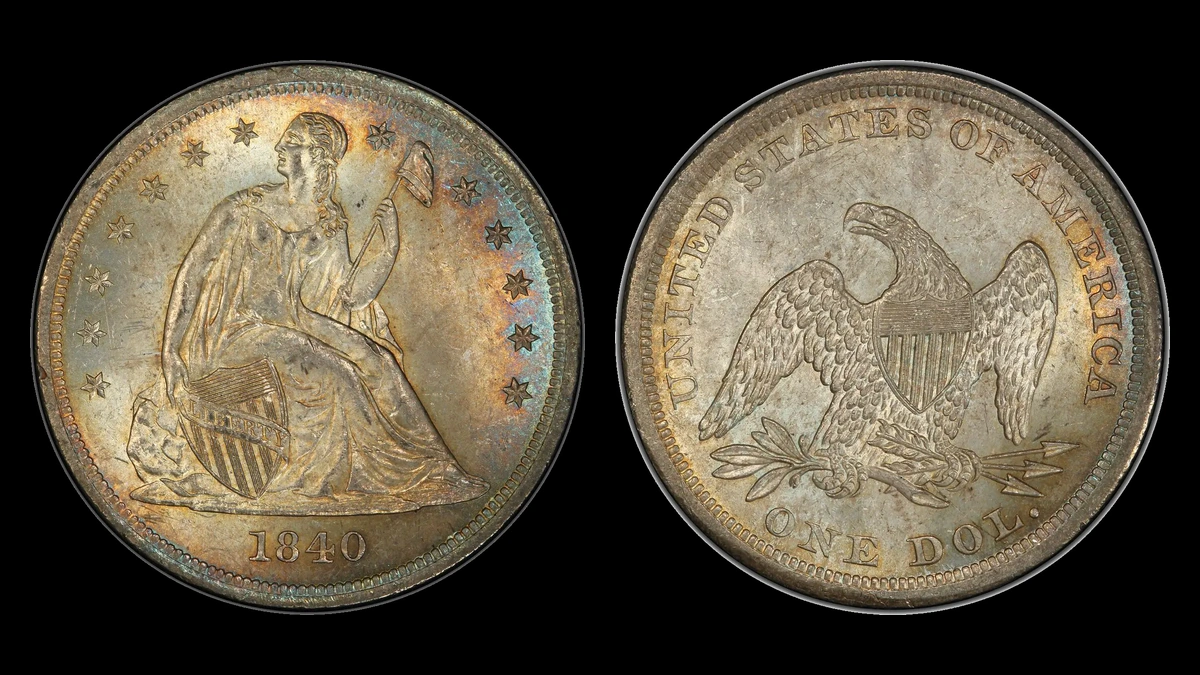
Three reverse landmarks help identify the documented feature in this 1840 Liberty Seated dollar error guide: the border, the denomination’s final L, and the lowest arrowhead. Whole-coin estimates span $400–$60,000 across very different conditions.
A separate 1840 dollar graded MS64 sold for $57,600 in January 2022; that is a same-year condition comparison, not a sale of the museum’s die-crack example. Follow the line’s complete route and check whether it rises above the silver.
1840 Dollar A raised line joins the border and arrowhead: reverse die crack Error
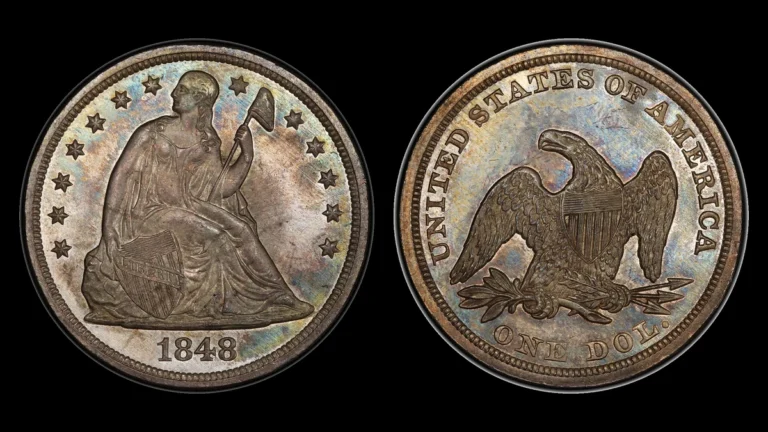
The denomination beneath the eagle provides the center of the identification. A thin line reaches the right edge of the L in DOL and continues between the reverse border and the lowest arrowhead.
This route is documented on an ordinary-strike 1840 dollar in the American Numismatic Society collection. The feature is not described as exclusive to specially made Proof coins.
Its origin lies in the reverse die, the steel tool that stamped the design. Pressure forced silver into a split in that tool, producing a narrow raised copy on the coin.
The term die crack therefore describes damage to the tool. It does not mean the dollar itself has opened or fractured.
How to Identify
Hold the reverse upright and locate the last L in the denomination. Keep the border and lowest arrowhead in the same photograph so the entire reported route remains visible.
Under magnification, start at the right edge of that L and follow the line outward to the border. Return to the letter and trace it inward toward the lowest arrowhead.
Checking in both directions helps avoid attributing a short incidental scratch that touches only one landmark. The connected path is more useful than a single line-to-letter contact.
Move the lighting across the surface to determine whether the feature is a ridge. A scratch cuts below the silver, while a true crack through the blank separates the coin’s metal.
Compare the line with the surrounding design rather than rubbing or probing it. Wear may weaken its appearance, but the visible portions should still support the recorded route.
A close view should remain connected to a full reverse photograph. That context prevents an isolated mark near a letter from standing in for the complete museum-described feature.
What It’s Worth
$400–$60,000 is the supplied estimated range for genuine 1840 dollars with the matching feature, from worn pieces through exceptional unworn examples. It values the complete coin rather than assigning a fixed payment for the raised line.
PCGS records an MS64 dollar at $57,600 in January 2022. The supplied record does not establish that auction coin as the American Numismatic Society specimen or confirm it as the same cracked-die example.
The sale is useful for understanding how strongly preservation can affect this early dollar’s value. Cleaning, deep marks, and circulation wear make another coin a weaker comparison even when its crack is easy to see.
Conclusion
Use the denomination’s L as the junction between the border and lowest arrowhead, then verify that the connecting feature stands above the surface. The route and height together provide a better identification than a dramatic-looking line alone.
The broad value range reflects the complete early dollar’s condition. Keep the museum’s documented die feature separate from the $57,600 MS64 auction comparison when deciding what another example might be worth.