Rare 1854 Half Dollar Errors (List & Pictures)
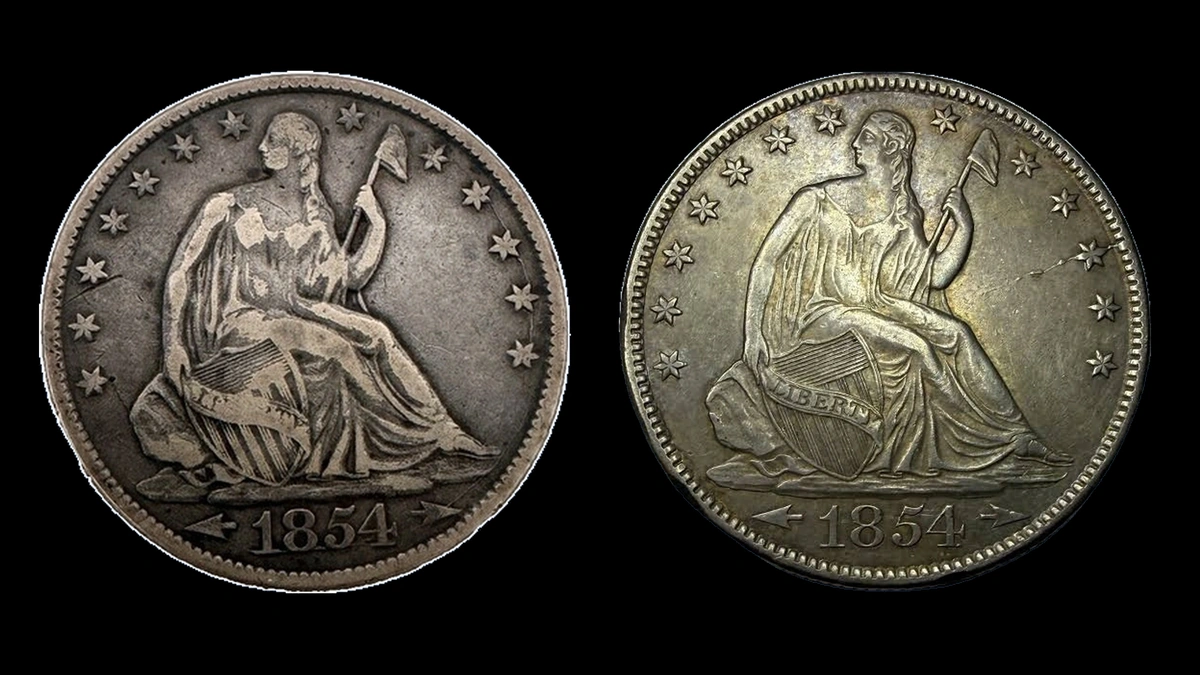
Sometimes the eagle’s angle is the clue; sometimes faint eagle detail survives under a missing layer of silver. The six 1854 half dollar errors below require different views of the same basic design.
Estimated values span $75–$1,000, with an ordinary AU55 1854-O’s $720 December 2025 sale providing condition context rather than an error record. Check alignment, the front date and lines, then the reverse surface.
| Observation | Check | Category | Estimated value |
|---|---|---|---|
| Eagle remains tilted after a fixed flip | Both faces together | Rotated reverse | $75–$800 |
| Extra numeral strokes | 1854-O date | Repunched date | $175–$700 |
| Ridges through rock, arrow, date, or stars | Philadelphia front | Die cracks | $200–$1,000 |
| Repeated opposite-design traces | Both faces | Reported multiple clashes | $150–$400 |
| Raised irregular reverse patches | New Orleans back | Crumbled die | $150–$600 |
| Faint design on a lower exposed surface | New Orleans eagle and lettering | Detached lamination | $200–$750 |
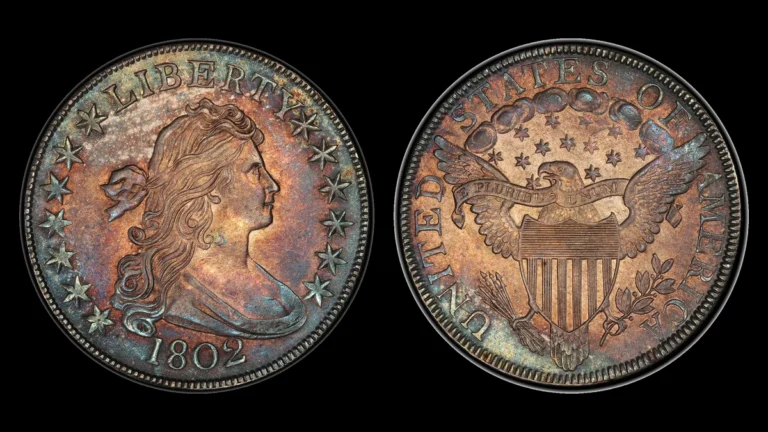
The arrows beside the date are normal design elements. Basic unworn specifications are about 12.44 grams and 30.6 mm, with a grooved edge; O below the eagle means New Orleans, while Philadelphia coins have no mintmark.
1. 1854 Half Dollar The Eagle Leans After a Controlled Flip: Rotated Reverse Error
Two 1854-O reports describe different clockwise rotations. One owner estimated about thirty degrees on a Good 6 coin without a measuring device, while a separate About Uncirculated example was reported at forty-five degrees.
Rotation concerns the direction of one face relative to the other. Both designs can otherwise remain centered and complete.
How to Identify
Place Liberty upright in a support that keeps the coin from slipping. Flip top to bottom without introducing a sideways twist and observe the eagle’s final position.
Repeat the same movement before measuring the tilt with a protractor or fixed angle guide. A repeatable offset is stronger evidence than two separately straightened photographs.
Confirm the arrows, date, and O on the same coin. Keep the reported thirty-degree and forty-five-degree examples separate rather than treating either angle as a rule for all 1854 halves.
What It’s Worth
Estimated range: $75–$800 from heavily worn Good examples to lightly worn AU coins. The large condition difference matters alongside the measured rotation.
Ordinary 1854-O sales include $342 for PCGS AU50 in January 2026 and $720 for NGC AU55 in December 2025. These are preservation comparisons, not sales of the two reported rotated coins.
2. 1854 Half Dollar A Date Digit Carries an Extra Stroke: Repunched Date Error
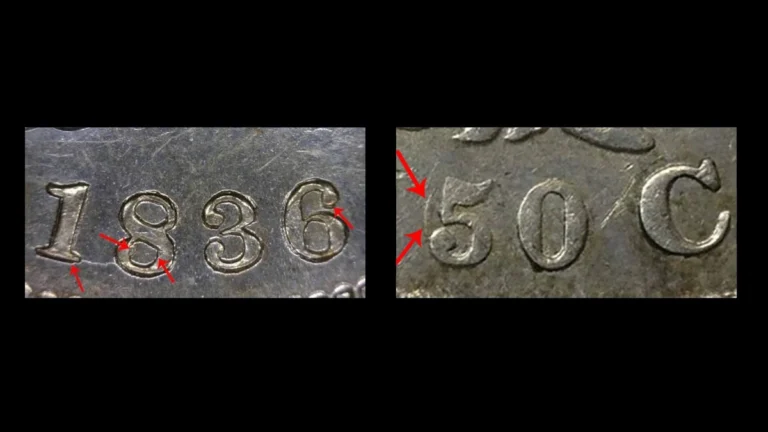
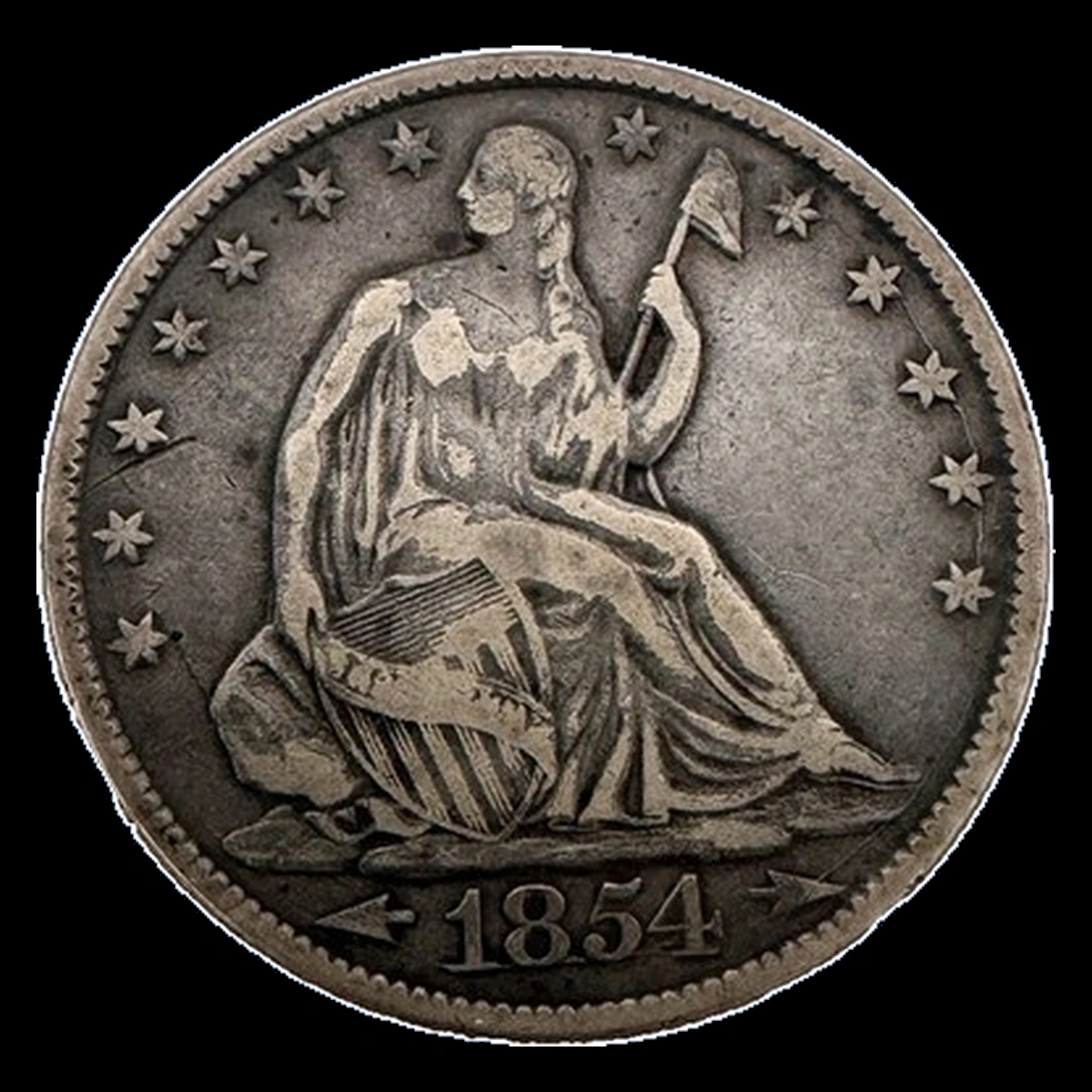
Paul Kluth’s published 1854-O has a date described as recut or repunched. The additional numeral detail belongs to the tool that stamped the coin.
An earlier punch placement or reworking can leave a surviving stroke beside the final number. The report does not describe a change from another year or doubling across the entire front design.
How to Identify
Include the complete date and both arrows before enlarging a digit. The arrow shapes and marks beside them should not be confused with an earlier numeral fragment.
Follow the extra stroke in the published date photo and compare its curved or straight numeral shape. The source assigns no precise direction, and the separate 1855/4 overdate cannot supply one.
Check for a flat striking ledge or a cut in the silver as alternative explanations. Confirm that the matching reverse belongs to an O-marked 1854.
What It’s Worth
Estimated range: $175–$700 for identified circulated examples with visible date detail. Ordinary 1854-O results of $228 at PCGS XF45 in March 2025 and $342 at AU50 in January 2026 provide condition context.
No sale amount is assigned to Kluth’s coin. It also has the detached lamination described later, so those two features should not be valued by adding two full coin prices.
3. 1854 Half Dollar Raised Routes Through the Arrow and Stars: Die Cracks Error
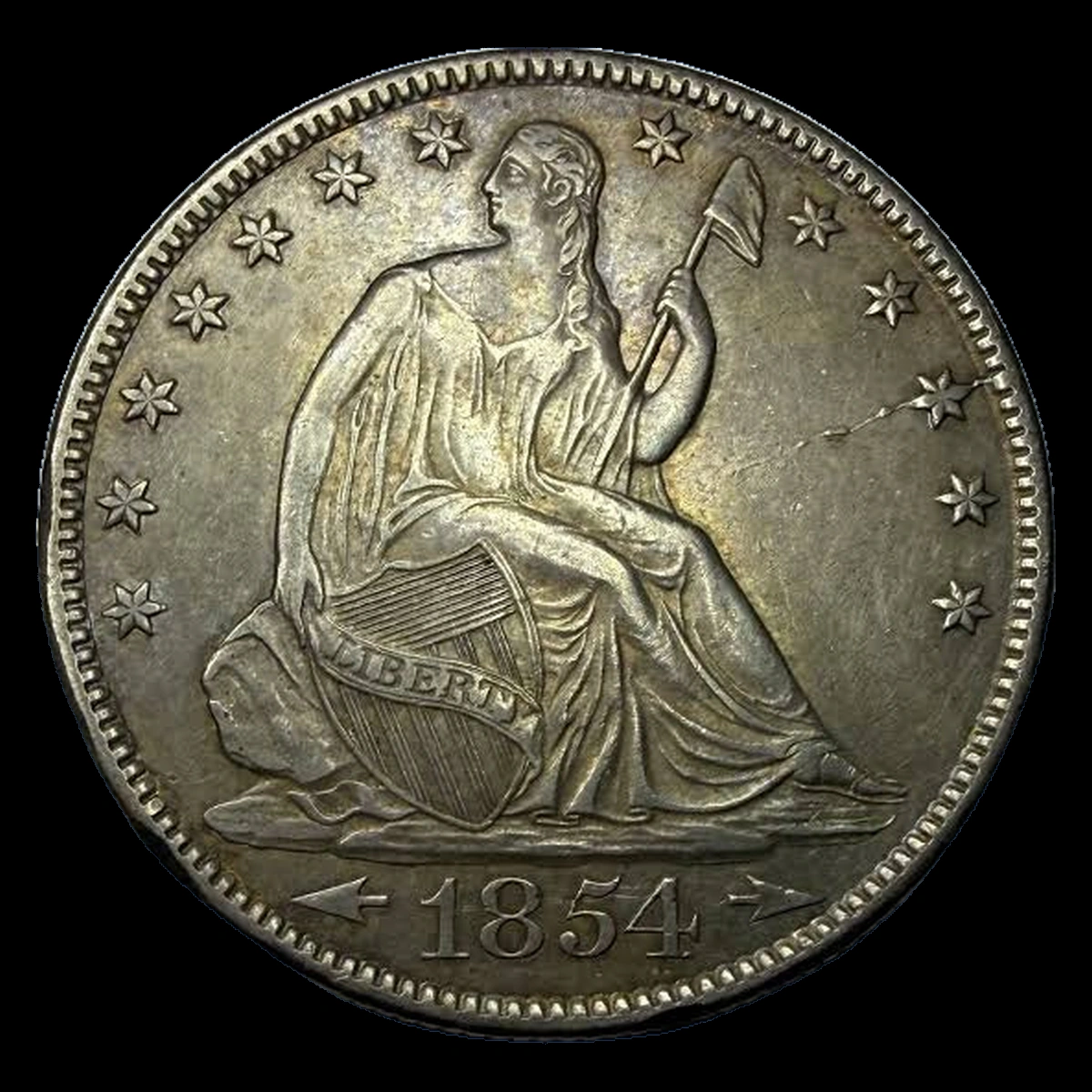
A Philadelphia reference has a line from the rim across the pointed rock and nearby arrow to the bottoms of 1 and 8. A separate raised route connects stars two through five.
The owner’s registry description records both on a PCGS AU58+ coin. Silver entering cracks in the steel die produced these ridges during striking.
How to Identify
Trace the rim-to-rock route through the arrow and into the date area. Once that matches, inspect stars two through five independently.
Side lighting should show the lines rising above the surrounding surface. A scratched groove or corrosion channel can cross the same general area without reproducing those raised routes.
Keep a full reverse view to confirm the absence of a mintmark. The Philadelphia paths should not be combined with the New Orleans reverse defects in this guide.
What It’s Worth
Estimated range: $200–$1,000 for circulated Philadelphia examples with readable cracks. A lightly worn AU coin can belong toward the upper portion.
The registry gives no purchase price for its AU58+ example. The ordinary New Orleans AU55 result at $720 is only a different-mint condition comparison, not a sale of this Philadelphia pattern.
4. 1854 Half Dollar More Than One Set of Faint Shapes: Reported Multiple Clashes Error
A seller interpreted several extra lines on an 1854 half as repeated die clashes. The supplied report does not settle the coin’s mint or confirm that interpretation.
When dies collide without a blank between them, they can acquire traces of each other’s designs. Repeated contact can leave shifted copies that later appear together on a coin.
How to Identify
First match one suspected outline with a shape from the opposing design. A faint line becomes more meaningful when its location and form can be explained.
To support multiple clashes, find another displaced copy of that transferred shape. Several unrelated scratches or crack lines do not establish more than one collision.
Photograph both faces and the mintmark area. Repeated die contact does not mean the coin itself necessarily received repeated strikes.
What It’s Worth
Estimated range: $150–$400 for an identified circulated candidate. Clear transferred design is needed before the upper allowance becomes relevant.
Ordinary 1854-O PCGS XF40 examples brought $169 and $186 at Heritage in March 2025. These compare general circulation condition, while the seller’s clash report leaves its mint unconfirmed.
5. 1854 Half Dollar Irregular Raised Areas on the Eagle Side: Crumbled Reverse Die Error
A collector describes an 1854-O with a crumbled reverse die, housed as ANACS EF45 Cleaned. The raised defects and the later cleaning are separate aspects of the coin.
Small pieces lost from the tool leave recesses that silver can fill. The resulting broad or irregular patches differ from the narrow ridge made by a simple crack.
How to Identify
Use the collector’s entire reverse photograph to locate each patch. The text does not assign every defect to a specific wing, letter, or rim point.
Inspect the boundaries for continuity with the original silver. Solder, glue, or deposits sitting on the surface can also look raised but have another origin.
Confirm the O and the date arrows, then compare the surrounding design as well as the rough area. An isolated close-up may hide evidence of material added after striking.
What It’s Worth
Estimated range: $150–$600 for circulated examples with recognizable reverse defects. Cleaning generally weakens the comparison with an otherwise similar coin having original surfaces.
A normal PCGS XF45 1854-O sold for $228 in March 2025, while an ANACS VF35 Details Cleaned brought $114 in April 2026. Neither supplies a transaction price for the collector’s crumbled-die specimen.
6. 1854 Half Dollar An Eagle Beneath a Missing Silver Layer: Detached Lamination Error
On Kluth’s 1854-O, a missing surface layer reaches the eagle’s head, upper-right wing, and portions of the lettering. Faint design remains on the lower exposed area.
The February 2010 E-Gobrecht account describes this localized detached lamination. A weak internal layer separated and came away; the report does not describe the entire coin splitting in half.
How to Identify
Compare faint detail inside the affected area with stronger detail outside it. Then follow the boundary between the intact surface and the exposed lower layer.
A natural sheet-like separation should be distinguished from tool lines and a gouged base left by scraping. Color or roughness alone cannot establish a lost original layer.
Do not lift or remove any remaining metal. Weight may reflect missing silver, but circulation wear also reduces it, so measurements support rather than replace the surface examination.
What It’s Worth
Estimated range: $200–$750 for a circulated coin with a substantial original detached layer. A clear boundary and recognizable surrounding eagle design make the feature easier to assess.
The ordinary XF45 and AU50 comparisons at $228 and $342 are not sales of Kluth’s coin. The stronger allowance concerns the pronounced flaw and must not be applied to later scraping or corrosion.
Conclusion
An alignment test, complete date view, traced ridge, and layered surface boundary answer different questions about an 1854 half. Keep the normal arrows in view without treating them as errors.
Estimated values of $75–$1,000 rely heavily on mint and condition. Ordinary auction results provide useful context, while the reported clashes, registry cracks, and published lamination retain their own evidence limits.