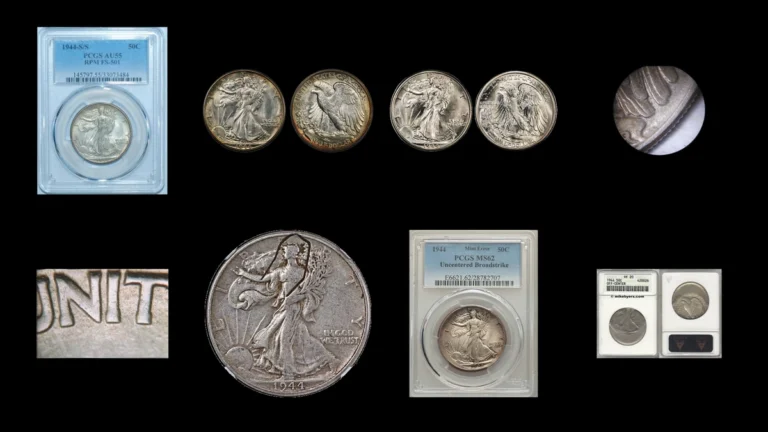
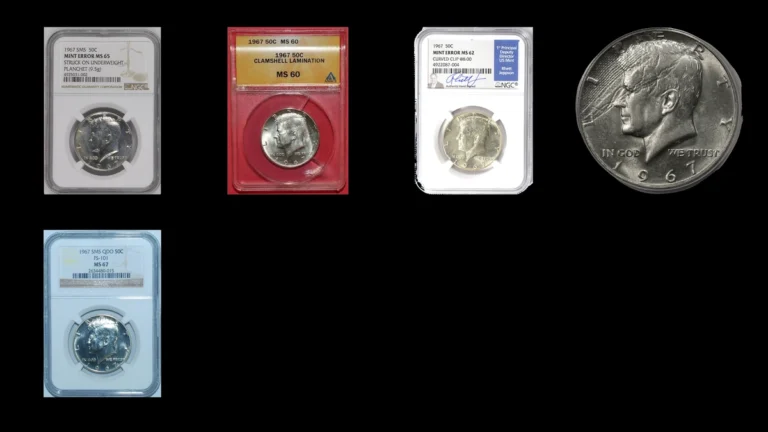
Rare 2013 Half Dollar Errors (List & Pictures)
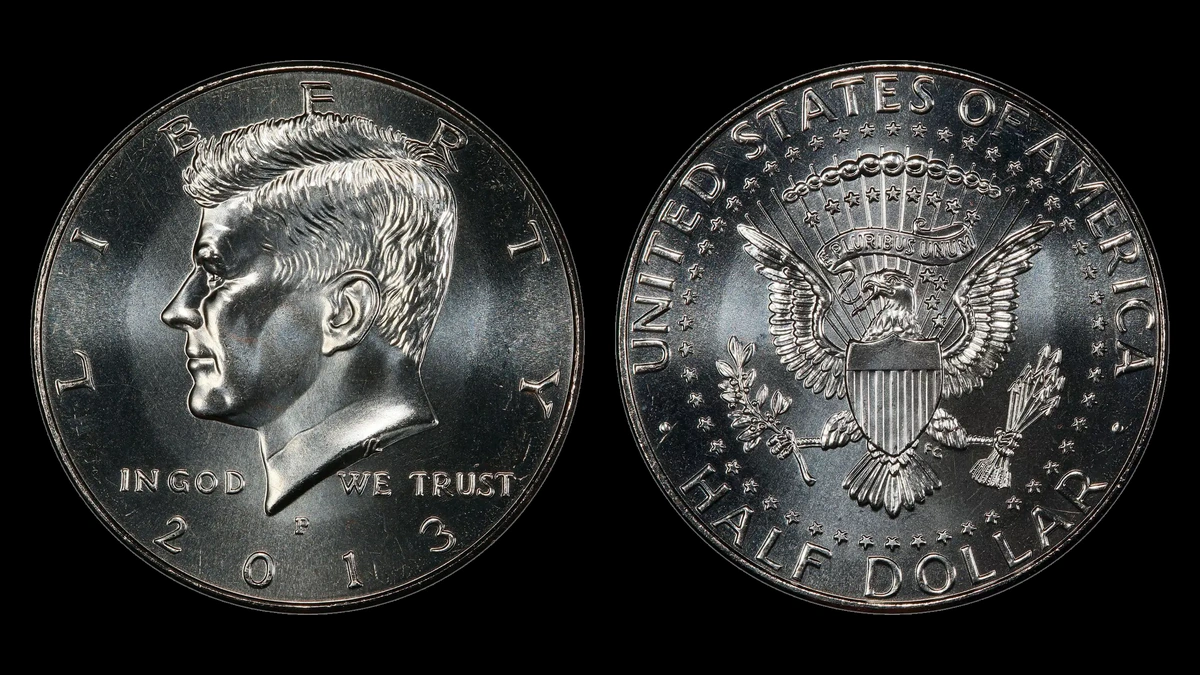
The available guides name several 2013 half dollar errors, but they do not supply matching certified auction specimens. Their categories are useful inspection questions rather than proof that a particular candidate is genuine.
Estimated values span $10–$3,500. Supplied older comparisons reached $2,880 for both a 1974 wrong-blank half and a 1973-S multiple-strike Proof.
Begin with raised or recessed marks, then examine separating metal, gaps, shifted designs, and the blank itself.
| Physical clue | Reported category | Estimated value if confirmed |
|---|---|---|
| Thin raised ridge | Die crack | $10–$75 |
| Raised patch meeting the rim | Cud | $50–$400 |
| Trace resembling opposite design | Die clash | $20–$150 |
| Local depressed interruption | Struck through | $25–$500 |
| Lifting layer | Lamination or layer separation | $30–$250 |
| Missing outline metal | Clip | $25–$200 |
| Full design on spread metal | Broadstrike | $10–$300 |
| Unstruck crescent | Off-center strike | $35–$800 |
| Separate impression positions | Multiple strike | $500–$2,000 |
| Incompatible blank size or metal | Wrong planchet | $1,500–$3,500 |
P and D halves use clad metal, while S Proofs can be clad or 90% silver. Their normal weights are 11.34 and 12.50 grams respectively, with a diameter around 30.6 millimeters and grooved edges.
A Proof is specially made for collectors. Its expected silver content or finish should be established before an unusual weight or surface becomes an error claim.
1. 2013 Half Dollar An irregular ridge stands above the surface: Die Crack Error
A die fracture can accept metal during striking and leave a raised line on the coin. The guides include a Denver discussion but do not establish one fixed route through the design.
The candidate therefore needs its own connected path and original surface evidence. Color alone is less useful than whether the line rises or cuts downward.
How to Identify
Change the light angle and trace the mark across adjacent detail without rubbing it. A scratch is recessed, while a fiber or residue may rest on the surface.
Distinguish the ridge from fine die-polishing lines and ordinary design elements. Normal measurements support the coin’s identity but cannot confirm the cause of a line.
What It’s Worth
A modest clear crack on a collectible clad half has an estimated $10–$75 range. The Denver guide’s broad minor-error discussion around $20–$100 supplies general context.
No certified 2013 crack sale is established. A long readable ridge may be more appealing than a faint mark, but it still needs confirmation before the estimate applies.
2. 2013 Half Dollar A featureless raised area connects to the rim: Cud Error
A piece breaking from a die’s edge leaves an opening that coin metal can fill. The resulting raised patch, called a cud, replaces intended detail near the border.
The 2013 list supplies no certified specimen’s mint, letter, or clock position. An isolated internal bump belongs to a different question because the rim connection is central here.
How to Identify
Follow the raised area to the rim under side lighting and inspect whether it is integral metal. Glue, solder, or an impact-folded edge can imitate an added patch.
Check the opposite face for related weakness without assuming a location from the guide. The intended design should fail to form in the raised area rather than merely be covered by a deposit.
What It’s Worth
A genuine rim cud on an ordinary clad half has an estimated $50–$400 range. Size, missing design, and surface quality determine useful comparisons.
A dramatic 1973-S in NGC PR67 Cameo sold for $2,040 in March 2022. Its large break and collector Proof finish explain why that other-year sale is not a minimum for a small 2013 patch.
3. 2013 Half Dollar An extra outline resembles the other face: Die Clash Error
The Denver guide reports faint transferred shapes without locating one specific mark on Kennedy’s face. A clash can begin when the dies meet without a blank and acquire traces of each other’s designs.
Subsequent coins may reproduce only part of the opposing picture. A whole eagle or portrait is unnecessary, but a recognizable shape relationship is still needed.
How to Identify
Confirm D below Kennedy’s neck and photograph both faces at matching scale. Compare the extra outline with a correctly mirrored opposing design to test position and direction.
The Denver guide provides the broad report rather than an exact diagnostic map. A random scratch or sunken impression from another finished coin needs a different explanation.
What It’s Worth
Clear clashes on collectible 2013-D halves have an estimated $20–$150 range. Recognizable transferred detail and original surfaces support stronger comparisons.
A much stronger 1973-S in PCGS PR68 Deep Cameo sold for $720 in October 2022. Deep Cameo denotes strong design-to-field contrast, and that older Proof does not set a Proof-level price for faint Denver traces.
4. 2013 Half Dollar A small area lacks detail or carries an impression: Struck Through Error
An obstruction can prevent design from forming or press its own texture into the blank. The 2013 discussion uses grease, cloth, and wire as possible examples without identifying three certified coins.
The actual impression must establish any material claim. A vague weak letter does not identify its cause simply because one of those objects is mentioned in a guide.
How to Identify
Inspect the transition between sharp surrounding detail and the interrupted area. Change the light to reveal a pressed pattern, while checking for scrape trails or metal pushed into an impact lip.
Compare wear on nearby exposed high points. Local missing design beside original sharp surfaces poses a different question from broadly rubbed detail.
What It’s Worth
The estimate is $25–$500, starting with the guide’s $25–$50 for modest impressions and allowing more for larger clear marks. Preservation and visible evidence matter throughout.
A 1992-D NGC MS64 struck through an edge-groove fragment realized $336 in July 2021. Its identifiable object impression provides context without naming the material involved in a 2013 candidate.
5. 2013 Half Dollar A flap lifts from the struck surface: Lamination or Layer Separation Error
The 2013 report describes peeling on ordinary clad halves. A local layer within the metal may separate, or an outer layer may detach from the core, and those boundaries need not expose the same material.
This concerns the blank’s metal rather than an object blocking a die. An attached flap may preserve the most useful evidence of where separation occurred.
How to Identify
Leave the flap in place and photograph its remaining attachment from the side. Follow how the layer meets the original struck picture.
Scrape tracks, chemical roughness, or a cut can initiate peeling after minting. A copper-colored stain or low weight without a structural boundary cannot establish original layer failure.
What It’s Worth
A collectible clad coin with clear original separation has an estimated $30–$250 range. Visibility and an intact attached layer can matter more than color alone.
A 1998-P NGC MS63 with defective obverse cladding sold for $149 in March 2023. That related Kennedy-series defect remains a different-year comparison whose actual structure must be matched carefully.
6. 2013 Half Dollar Metal was absent before the design formed: Clipped Planchet Error
A punch overlapping a previous hole can produce a curved gap, while a strip-edge overlap can leave another shape. The incomplete blank then receives the coin’s design.
The year report does not establish certified 2013 examples of every possible clip form. Mint, finish, number of gaps, and extent of loss must come from the candidate.
How to Identify
Inspect the two ends of the missing section for design and rim metal formed beside an existing space. Saw marks, a sharp lip, or a cut through completed details may indicate later alteration.
Compare weight with the correct metal standard and measure intact portions without forcing calipers across the gap. Opposite-rim weakness can support the diagnosis but is not its only evidence.
What It’s Worth
Genuine collectible clips have an estimated $25–$200 range. The 2013 report provides a category rather than a traced clip sale.
A 1998-D PCGS MS63 with three clips totaling 10% sold for $99 in March 2025. Its three-gap arrangement, percentage, and grade cannot be copied onto the 2013 candidate.
7. 2013 Half Dollar The full picture survives inside wider metal: Broadstrike Error
A collar that fails to restrain the blank allows outward spreading during striking. The collar normally controls width and forms the grooves on the edge.
The reported 2013 broadstrike has no specific measured specimen behind the description. An unusually wide border therefore needs evidence beyond apparent size.
How to Identify
Compare with a normal half and follow all outer design elements on both faces. The main picture should remain complete within the expanded metal.
Inspect the edge and design for natural spreading instead of crushed letters or impact texture from later flattening. A smooth edge alone cannot explain how the coin widened.
What It’s Worth
The overall estimate is $10–$300, beginning with the year guide’s $10–$20 for slight broadstrikes. Clearer substantial spreading provides the basis for stronger comparisons.
A 1998-P NGC MS65 broadstrike on a Type One blank sold for $106 in January 2010. That older coin also lacked the usual blank rim preparation, so its combined error is not a direct 2013 result.
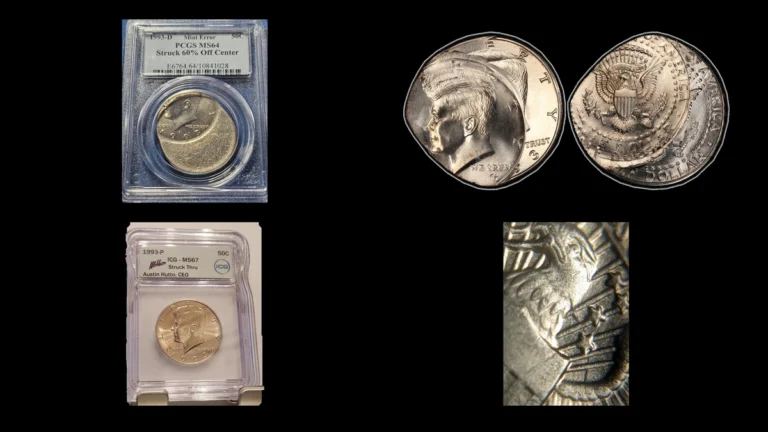
8. 2013 Half Dollar A shifted design leaves an unstruck crescent: Off-Center Strike Error
The guide discusses minor displacement, while larger percentages illustrate possibilities rather than measurements of certified 2013 specimens. The coin itself must establish its shift and surviving identity.
Unstruck metal on one part of the outline and missing intended design opposite it record the same displaced blank. Only one uneven face can instead involve one misaligned die.
How to Identify
Align both photographs to the same physical edge and compare the designs and bare areas. Inspect apparent blank metal for abrasive removal of an earlier finished picture.
Read the date and mint evidence before assigning the year or direction. A wide-looking photographed rim alone cannot establish the percentage of an off-center strike.
What It’s Worth
Collectible confirmed offsets have an estimated $35–$800 range, from a small clear shift to a stronger dated example. The readable identity matters alongside displacement.
A 1999-D NGC MS66 struck 65% off center brought $552 in March 2023. That older coin’s mint, grade, and measured offset do not become details of the broad 2013 report.
9. 2013 Half Dollar Design remnants occupy more than one position: Multiple Strike Error
A later blow can flatten part of an earlier portrait or date while preserving enough remnants to show movement. The 2013 guide provides no established strike count, rotation, or collar position for a particular coin.
Proofs normally receive repeated aligned blows for sharp detail. An error attribution requires movement or another abnormal event rather than the simple fact of multiple blows.
How to Identify
Choose a repeated detail and follow both versions into the surrounding design. Several related remnants should agree with one proposed movement between strikes.
Compare both faces and the edge before suggesting a flip or rotation. One flat shelf or extra width cannot establish an additional design impression.
What It’s Worth
The estimate is $500–$2,000, using the guide’s $500–$900 as a starting point and allowing more for clearly displaced pictures. The comparison assumes a confirmed collectible example.
A 1973-S NGC PR66 Cameo with its second strike 25% off center realized $2,880 in March 2023. That documented older Proof sequence does not supply the unknown number or position of strikes on a 2013 candidate.
10. 2013 Half Dollar Size and metal do not fit the intended half: Wrong Planchet Error
The guide uses a nickel blank to explain how the half-dollar design could overfill another denomination’s metal. It does not identify a certified 2013 nickel-blank example.
A real candidate needs its own blank identification from weight, dimensions, composition, and design boundaries. Normal silver Proof weight is not evidence of the wrong blank.
How to Identify
Establish the intended mint issue and composition before comparing measurements. Check for trimming, missing layers, grinding, or plating that could alter a normal coin after striking.
A specialist should match the actual metal and dimensions to another blank. The oversized design should end naturally at its original boundary rather than at a cut-down edge.
What It’s Worth
A substantial professionally identified wrong-blank 2013 half has an estimated $1,500–$3,500 range. The guide’s $1,500–$2,500 provides the initial scale rather than a completed transaction.
A 1974 Kennedy on a Taiwan five-dollar blank sold for $2,880 in September 2023, graded PCGS AU55. Its identified foreign blank is neither evidence of a 2013 discovery nor proof of the guide’s nickel illustration.
Conclusion
A raised ridge, separating layer, missing section, and shifted design each require a different physical test. Begin with that visible evidence before choosing one of the guide’s reported categories.
The supplied sale comparisons belong to older coins with identified features. Preserve their different dates, finishes, and mechanisms while keeping a 2013 candidate’s actual metal and original surfaces central to the attribution.