Rare 1854 Penny Errors (List & Pictures)
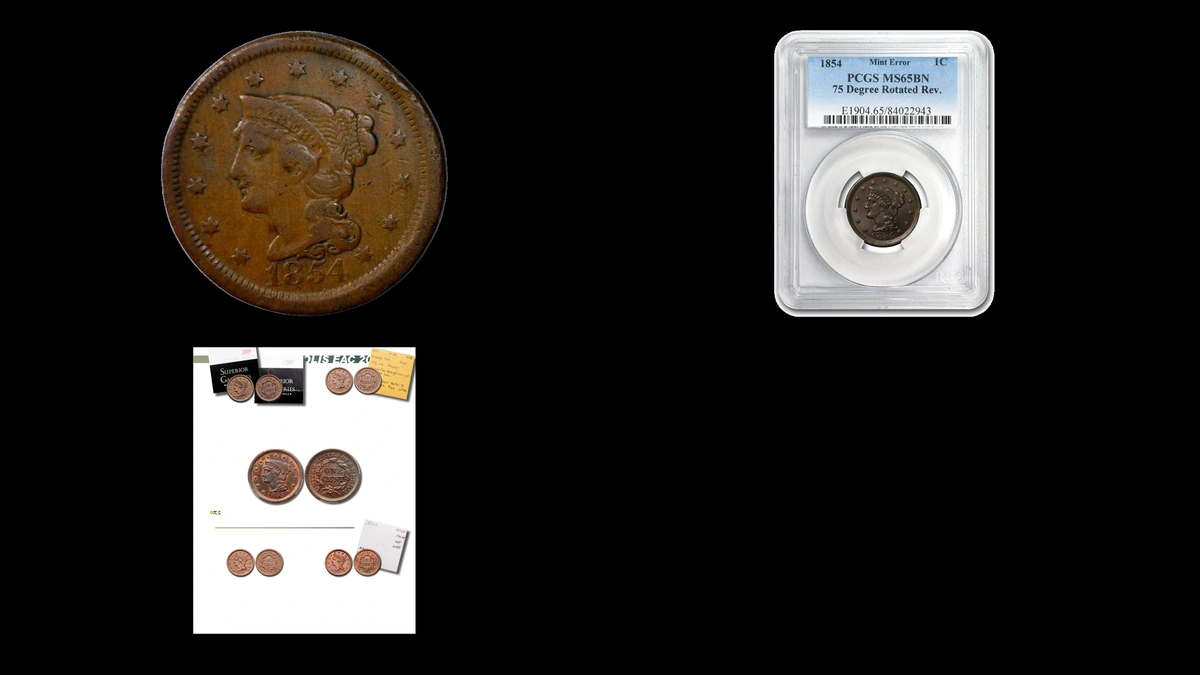
An 1854 penny is a large copper cent, so its outline and weight differ greatly from later small cents. A shifted face, sideways back, and peeling layer each need their own checks.
These 1854 penny errors have estimated whole-coin values of $20–$45,000, with rare Proofs at the top. A different PR65 Red and Brown Proof sold for $28,200 in June 2014; that figure reflects the complete collector coin, not the value of a small metal flaw.
1. 1854 Penny The Front Shifts while the Back Stays Centered: Misaligned Die Error
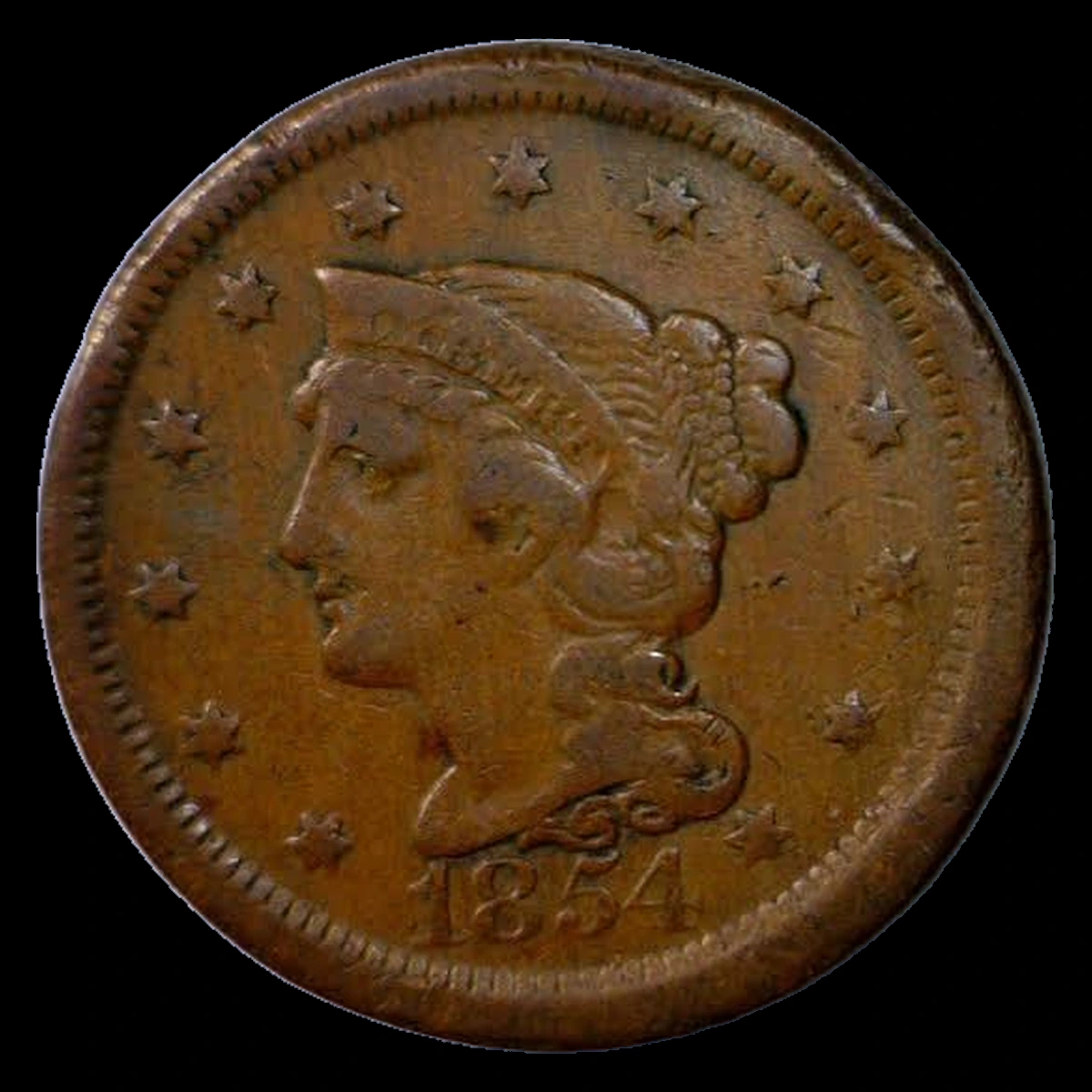
One die can move sideways from its intended position without the blank moving between both dies. An auction example has its front shifted toward one-thirty, while a separate collector’s N-8 coin was reported with a smaller front misalignment.
How to Identify
Compare straight-on photographs of both faces at the same size. A centered back is essential to this one-sided explanation.
Inspect the narrow front border for filing or metal pushed inward by damage. A slightly uneven margin or a tilted photograph does not automatically establish a collectible error.
A normal 1854 large cent weighs about 10.89 grams and measures 27.5 millimeters across, with a plain edge. These are the useful standards for this copper coin.
What It’s Worth
$25–$600 is an estimate for collectible examples with a clear shift and differing preservation. A minor misalignment may leave the coin close to its ordinary value.
The $1,527.50 same-year off-center sale discussed later involved roughly half the design missing the blank. That much larger, two-sided displacement is not a direct price for a small front-die shift.
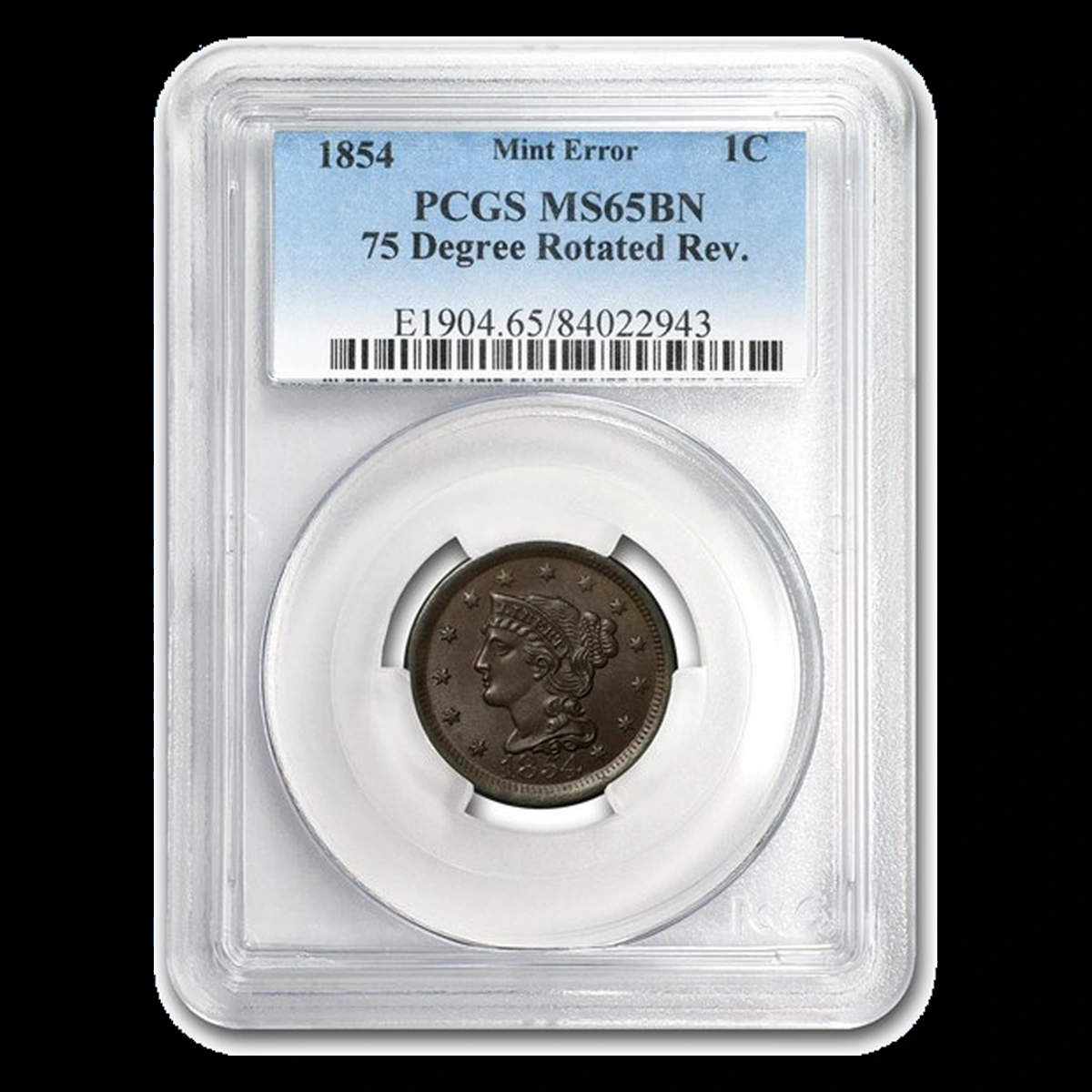
2. 1854 Penny The Back Tilts after a Controlled Flip: Rotated Dies Error
A die can turn without moving sideways. A collector reported an 1854 back rotated about 110 degrees counterclockwise, while the faces could remain centered.
How to Identify
Hold the portrait upright and flip the coin top to bottom without twisting it sideways. Repeat from the same starting point to check whether ONE CENT returns to the same tilted position.
The reported 110-degree angle was preliminary and belongs to that coin. Measure the actual specimen rather than assigning the number from two independently rotated photographs.
Inspect the edge for a join between pieces. Centered faces alone cannot prove that their unusual relationship was made at the Mint.
What It’s Worth
$30–$700 is an estimated range for a clearly demonstrated rotation with differing condition. Nineteenth-century rotations often carry a modest premium rather than an automatic high price.
An 1858 Flying Eagle cent with rotated dies, graded Fine 12, sold for $154 in June 2026. It is a smaller copper-nickel coin, so the larger 1854 cent still needs its own base-value and condition comparison.
3. 1854 Penny About Half the Picture Misses the Blank: Off-Center Strike Error
The documented example shifted toward ten-thirty and is roughly 50% off center. Its date and denomination remain visible even though UNITED and LIB extend beyond the metal.
How to Identify
Follow the surviving date and ONE CENT, then compare the missing design with the unused metal on both faces. The whole arrangement should fit one misplaced blank.
The ANACS VF20 grade describes circulation wear. Its exact die-pair number was tentative, which should not be turned into a firm variety attribution from the displacement alone.
A normally centered back would point toward a different one-sided alignment problem. Inspect the plain area and edge for grinding that removed completed design.
What It’s Worth
$300–$4,000 is an estimate across genuine examples with different displacement and preservation. The ANACS VF20 coin sold for $1,527.50 on September 7, 2016.
Its readable year provides a useful same-date comparison. Corrosion, edge damage, and remaining detail still matter; the percentage is not a fixed pricing formula.
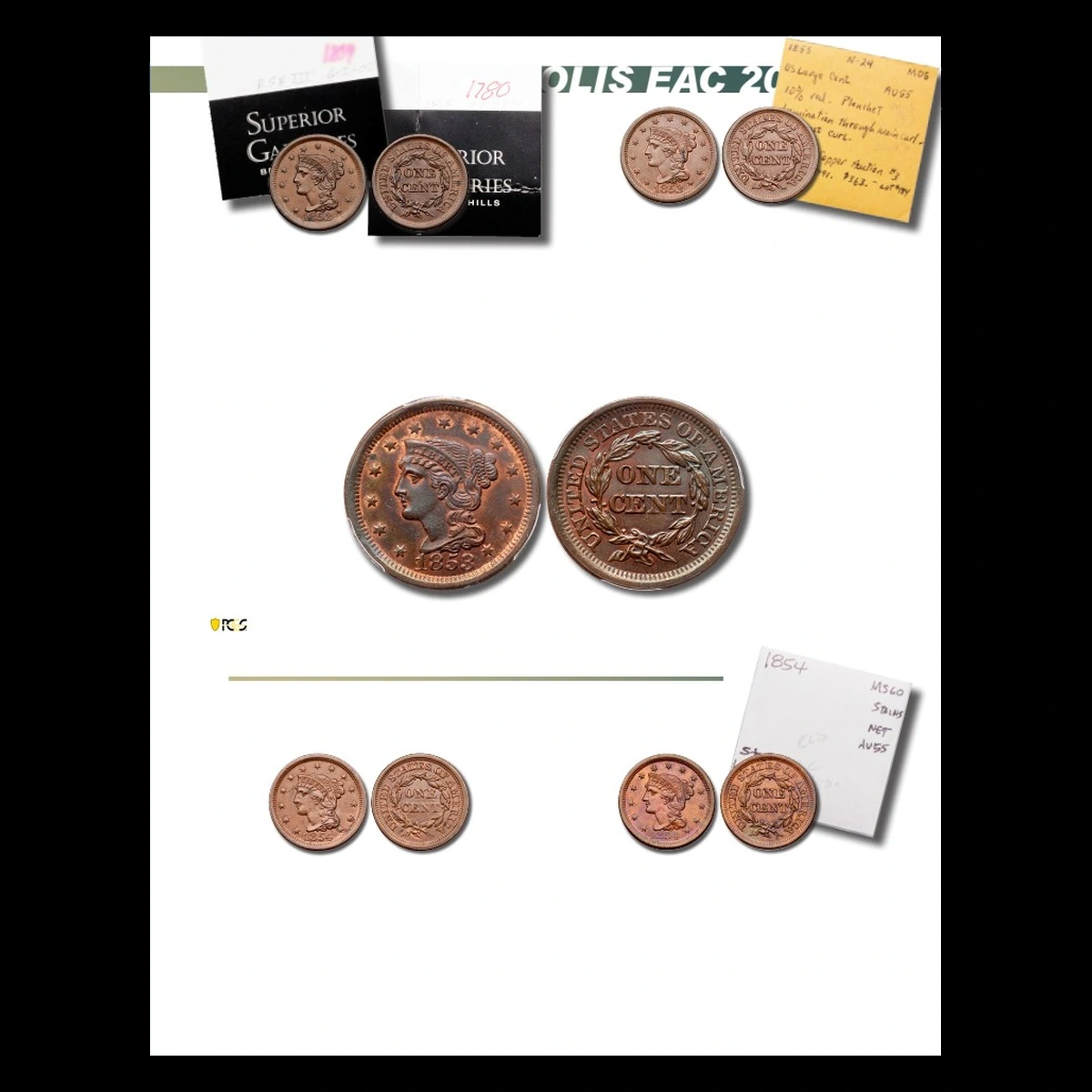
4. 1854 Penny A Faint Opposite-Design Outline Appears: Die Clash Error
The recorded N-18 cent has clashes on both faces. The dies struck one another without a blank, leaving marks that later appeared beside the normal portrait and wreath.
How to Identify
Compare a surviving curve with a real part of the opposite design. An isolated low spot, scratch, or straight line is not enough to reconstruct a hidden portrait.
Keep both faces in the comparison because the N-18 record describes marks on each. Their physical shapes should remain visible as the light changes, even if the highlights move.
What It’s Worth
$20–$500 is an estimated range for identifiable clashes across different conditions. Faint traces may contribute only a modest amount to the ordinary cent’s value.
The much more dramatic off-center coin’s $1,527.50 result is not a clash-price comparison. Recognizable transferred shape and original preservation are the relevant features here.
5. 1854 Penny A Layer Opens across the Back: Lamination Error
A collector’s N-8 cent was reported with broad back lamination. Weakness within the copper allowed a layer to separate from the surrounding metal.
How to Identify
Find the actual opening or attached layer boundary under side lighting. A dark stain or corrosion patch can look rough without showing a separating sheet.
The report does not describe a whole coin split into two discs. Leave any loose flap untouched and keep measuring tools away from fragile copper.
A retained layer can leave the weight near normal. A gouge that cuts through finished design or pushes metal beside a cut has a different origin.
What It’s Worth
$25–$800 is a working estimate for clear laminations on collectible ordinary cents. A broad visible boundary can interest error collectors, while extensive loss or damaged surfaces may reduce appeal.
An 1857 Flying Eagle cent with a defective blank, graded MS61, sold for $610 in June 2026. Its smaller size, different metal, and different defect make it a broad comparison, not a direct sale for the reported N-8.
6. 1854 Penny A Small Border Flaw Appears on a Proof: Defective Blank Error
The recorded NGC Proof-66 Red and Brown coin has a natural flaw near the first two stars at the lower-left border. It lies outside the small border teeth.
The defect began in the blank before the coin received its specially prepared Proof finish. That rare finish and fine preservation explain much of the coin’s value.
How to Identify
Keep the certified Proof sealed and compare the flaw’s actual position beside the first two stars. Avoid touching the reflective faces to obtain fresh measurements.
The N-12 die pair also produced ordinary circulation coins. That catalog number alone cannot establish Proof manufacture or justify a Proof price for a flawed circulated penny.
Normal dimensions do not settle the finish either. The feature must belong to a professionally identified Proof before the higher comparison is meaningful.
What It’s Worth
$15,000–$45,000 is an estimate for a comparable well-preserved 1854 Proof as a whole coin. It is not a separate premium for the small border flaw.
PCGS records a different PR65 Red and Brown Proof at $28,200 in June 2014. That supports the general scale of Proof value without assigning its sale to the particular Proof-66 specimen.
Conclusion
Compare both faces before choosing between a misaligned die, a rotated back, and an off-center blank. They change different relationships even when the first photograph simply looks uneven.
For a rough surface, find the real layer boundary or original flaw. The rare Proof belongs in its own whole-coin price comparison, and its tiny defect does not give an ordinary large cent the same value.