Rare 1843 Half Dollar Errors (List & Pictures)
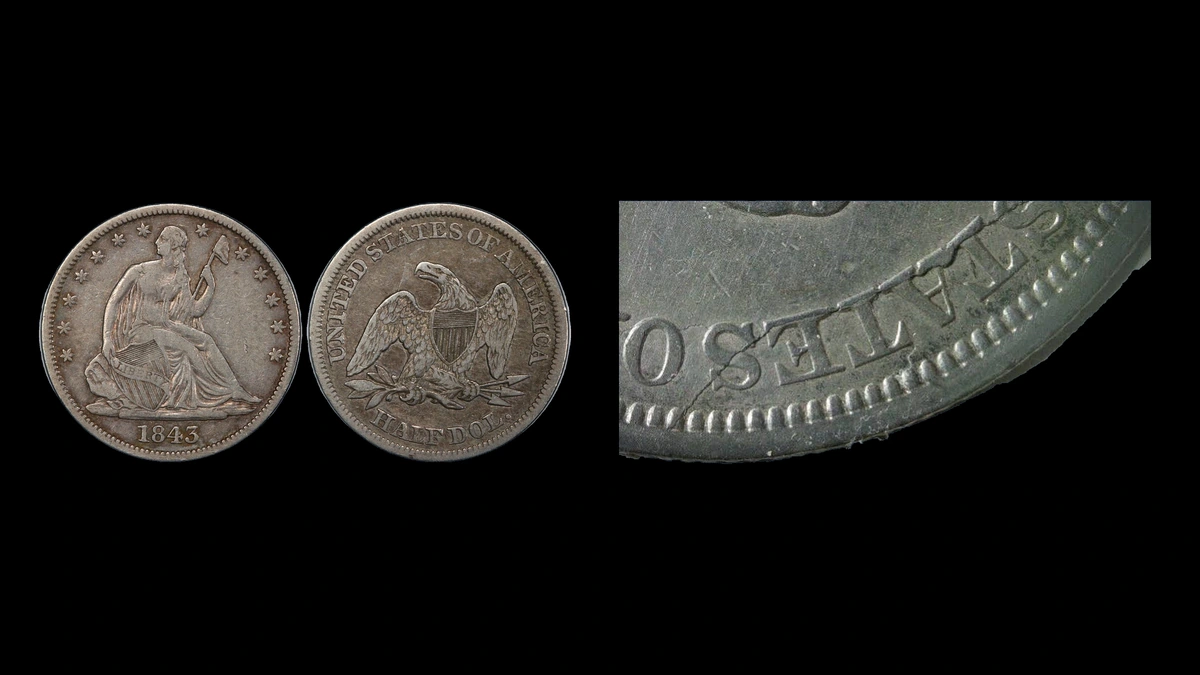
A broad blank crescent and a tiny remnant under the 4 require different views of an 1843 half dollar. This guide to 1843 half dollar errors moves from the outline through the date and front detail to the reverse.
Estimated values range from $250–$7,500. A Philadelphia MS64 with a long reverse crack sold for $3,407.50, while the larger $6,500 off-center figure below was a dealer’s asking price.
| Visible clue | Location | Feature | Estimated value |
|---|---|---|---|
| Large blank margin | Whole coin | Off-center strike | $5,000–$7,500 |
| Raised patch touching rim | Philadelphia date area | Cud | $400–$1,500 |
| Extra digit strokes | Date, with mint-specific pattern | Repunched date | $300–$3,500 |
| Repeated front contours | Matched Philadelphia design | Doubled die obverse | $300–$800 |
| Unwanted folds | Below Liberty’s elbow | Die clash | $250–$600 |
| Raised long or lettering-area lines | Reverse, with separate mint patterns | Die cracks | $300–$4,000 |
O below the eagle identifies New Orleans; Philadelphia halves have no mintmark. Standard unworn specifications are about 13.36 grams and 30.6 mm, with grooves along the edge.
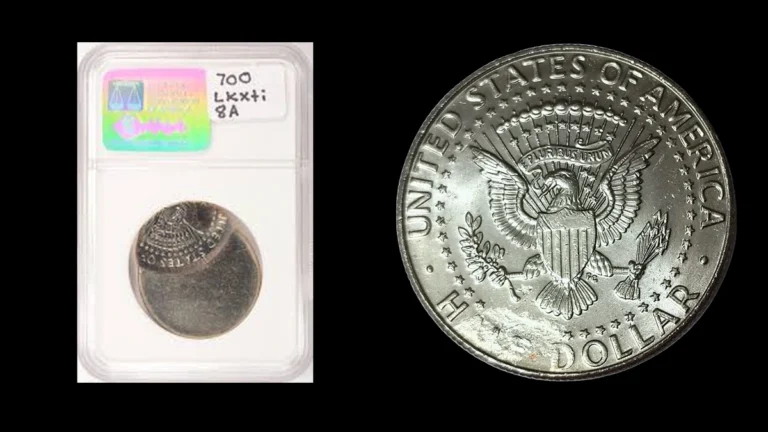
1. 1843 Half Dollar A Broad Unstamped Crescent: Twenty-Five-Percent Off-Center Strike Error
Fred Weinberg’s historical listing describes an NGC VG8 half struck twenty-five percent off center. A large unstruck area remains beside a design that extends beyond the available metal.
The blank was out of position when the dies struck. VG8 denotes heavy circulation wear, while No Motto describes the normal reverse without IN GOD WE TRUST.
How to Identify
Keep the complete date and outline visible on both faces. The location of missing design should agree with the blank crescent across the coin.
If only one face is displaced, investigate a misaligned die instead. A narrow rim alone cannot establish that the blank was off center.
Inspect the plain area and its edge for filing or cutting. Later metal removal differs from silver that was present but never received an impression.
What It’s Worth
Estimated range: $5,000–$7,500 for an authenticated 1843 with comparable displacement and readable date. The reference is a same-year offering rather than an auction.
The historical Weinberg listing asked $6,500. Surface damage, remaining detail, and the arrangement of the shifted design can change how closely another coin compares.
2. 1843 Half Dollar A Mound Joining the Rim Beside the Date: Cud Error
Bugert’s Philadelphia table records a broad raised date-area patch attached to the rim. This is the form of die break called a cud.
A piece broke from the edge of the stamping tool, leaving space that filled with silver. The resulting mound can obscure detail instead of merely drawing a thin line through it.
How to Identify
Photograph the date, patch, and rim together. Their connected boundaries matter more than an isolated close-up of raised metal.
Check the edge grooves and nearby design for crushing from an impact. Added solder may show a seam or different texture instead of continuous original silver.
Compare the whole date-side outline with the reference. An arbitrary lump beside an 1843 date does not identify the recorded cud.
What It’s Worth
Estimated range: $400–$1,500 for circulated examples with a clear, substantial date-area cud. Heavier wear and later damage can weaken the comparison.
Ordinary Philadelphia XF sales around $310–$425 provide the basic coin context. No sale of Bugert’s particular cud reference is supplied, so the upper figure remains an estimate.
3. 1843 Half Dollar Another Stroke Beneath the 4: Repunched Date Error
On the Philadelphia variety, a remnant below the 4’s crossbar records an earlier lower placement of that digit. Bugert describes the direction as repunched south.
The Newtown Collection’s New Orleans coin has a separately described double-punched date. Both involve additional date-punch impressions in the die, but their exact strokes must be matched independently.
How to Identify
Read the mintmark before selecting a close-up. For Philadelphia, inspect immediately beneath the 4’s horizontal bar while retaining the rest of 1843 for orientation.
On an O coin, compare the actual extra date contours with a New Orleans reference. Do not transfer Philadelphia’s lower-stroke direction to that different die without evidence.
A curved or straight piece of an earlier numeral differs from a flat shelf or a later cut. This is repeated placement of the same date, not proof that a different year was changed to 1843.
What It’s Worth
Estimated range: $300–$3,500 across circulated examples through comparable unworn coins. An identified 1843-O doubled-date XF40 sold for $366 in July 2026.
The Newtown MS63 with CAC approval had sold for $3,290 in January 2015. Its lack of circulation wear makes it a different price comparison from the XF40.
4. 1843 Half Dollar Repeated Detail Beyond the Date: Doubled Die Obverse Error
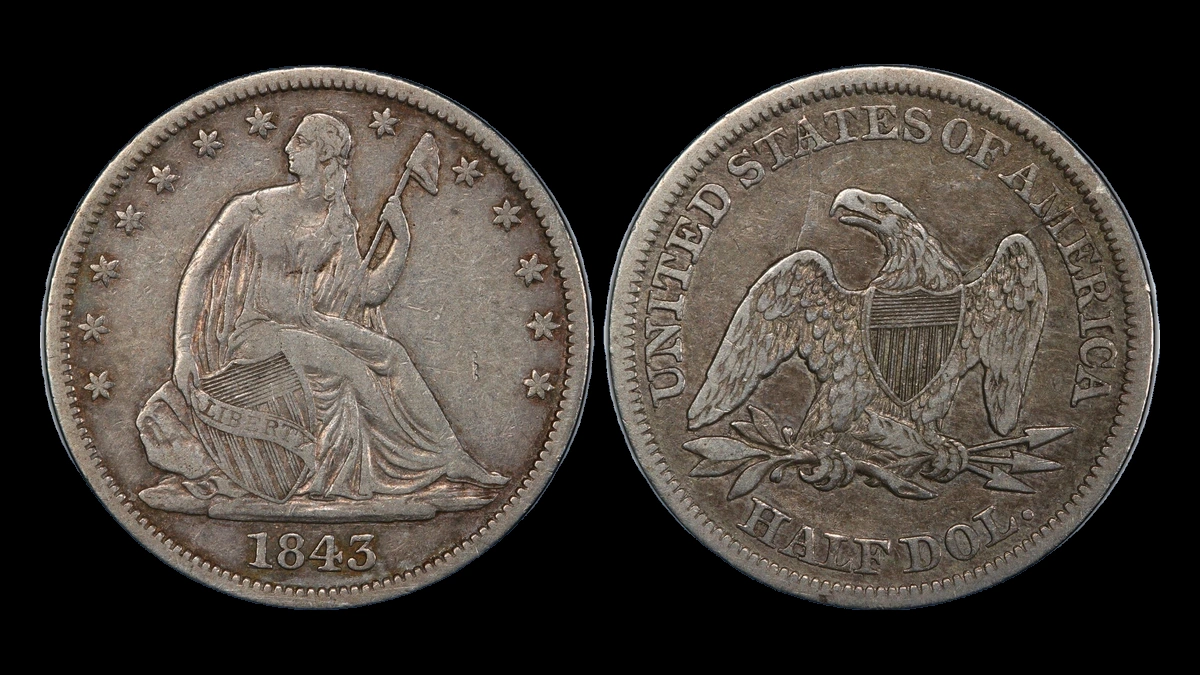
Bugert’s 1843 Philadelphia table also records doubled front dies. In this case the repeated design was in the steel stamping tool before it impressed a coin.
The table does not provide one universal location or direction for every example. Date repunching alone therefore cannot establish the separate doubled-front attribution.
How to Identify
Select an identified example from the Philadelphia reference and compare the same area at equal size. Follow the repeated contour where it joins the main design.
A flat ledge can result from die movement during a strike, while a scratch changes the finished coin later. Neither automatically matches the rounded duplicate design in a doubled die.
Confirm 1843 and the absence of an O. The full design match is more useful than assigning a variety to any extra-looking stroke.
What It’s Worth
Estimated range: $300–$800 for identified circulated examples. Clear, easy-to-demonstrate duplication and sound surfaces support the stronger end.
The ordinary Philadelphia XF results around $310–$425 remain baseline comparisons. They are not sales of the specific doubled front, and cleaning or heavy wear can reduce usefulness of any comparison.
5. 1843 Half Dollar Extra Contours Among the Elbow Folds: Clashed Dies Error
The documented Philadelphia clash area lies beneath Liberty’s elbow. An unwanted shape may be partly hidden among normal drapery lines.
The two dies can touch when no blank separates them, transferring pieces of their designs to each other. Later coins can carry those extra contours along with the intended image.
How to Identify
Begin with a normal Philadelphia front so the expected cloth folds are clear. Keep the whole elbow area in the photograph instead of isolating one suspicious line.
Compare the extra contour with the opposite design under several lighting angles. A scratch cuts into the coin and need not resemble any opposing feature.
The date and no-mintmark reverse should remain part of the record. An extra-looking fold on another year or mint cannot establish this particular reference.
What It’s Worth
Estimated range: $250–$600 for circulated Philadelphia halves with readable clash traces. Preserved detail and undamaged surfaces help buyers assess the mark.
Ordinary XF sold listings include $310 in June 2025 and $425 in April 2026. Neither is presented as an elbow-clash sale or an isolated clash premium.
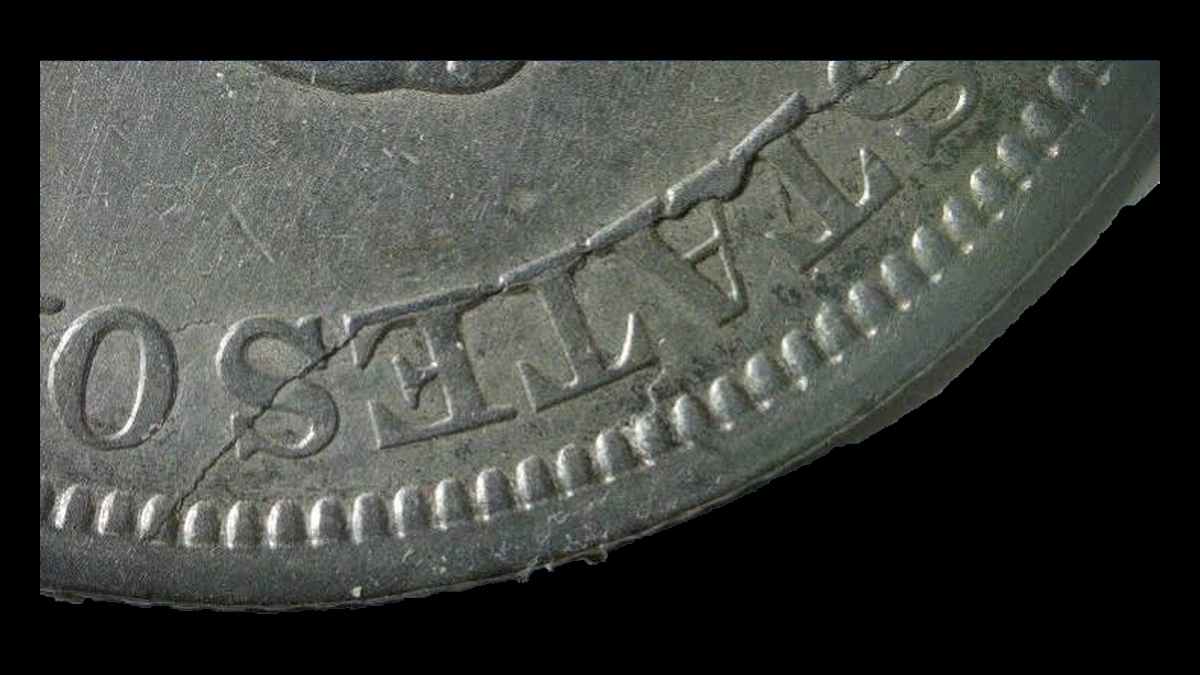
6. 1843 Half Dollar A Long Reverse Ridge or Lines Through Letters: Die Cracks Error
The Newtown Philadelphia coin has a nearly vertical raised line across the eagle side. Its New Orleans companion instead has cracks within HALF DOL.
A separate O-mint report describes routes around DO and D ST plus one near the rock support and lower-left shield. These are different crack maps from different examples.
Each ridge formed where silver entered a fracture in a working die. The coin did not need to split along the resulting raised line.
How to Identify
Identify the mint, then trace the corresponding route under side light. Philadelphia’s near-vertical reverse line should not be combined with New Orleans lettering paths.
Use the separate DO, D ST, and rock-support report only for the example it describes. Do not require every mentioned crack to occur on one coin.
Check for raised relief rather than a cut with dragged or displaced edges. Keeping the full coin in view helps separate a matching die route from a chance scratch through the eagle.
What It’s Worth
Estimated range: $300–$4,000 extends from readable circulated examples to similarly attractive unworn pieces. The Newtown catalog records $3,407.50 for Philadelphia MS64 CAC in May 2018.
It also records $3,290 for New Orleans MS63 CAC in January 2015, the coin already discussed under date repunching. These figures value whole coins, and the second coin’s two features do not create two independent auction values.
Conclusion
The outline establishes the off-center strike, the date area separates repunching from a cud, and the front and reverse patterns guide the die comparisons. Philadelphia and New Orleans references should stay distinct throughout.
Estimates of $250–$7,500 include different conditions and evidence types. Keep the $6,500 advertised offering separate from recorded auction results, and value coins carrying several features only once.