Rare 1879 Dime Errors (List & Pictures)
An 1880 Proof dime sold for $4,800 in November 2025, providing a different-year comparison for the collector finishes discussed here. Estimated whole-coin values for 1879 dime errors range from $150 to $5,000.
Separate Proofs from circulation strikes before comparing their date outlines and wreath cracks. A regular 1879 dime contains 90% silver, weighs 2.50 grams, and measures 17.9 millimeters.
1879 Dime Earlier outlines inside the date: repunched date Error
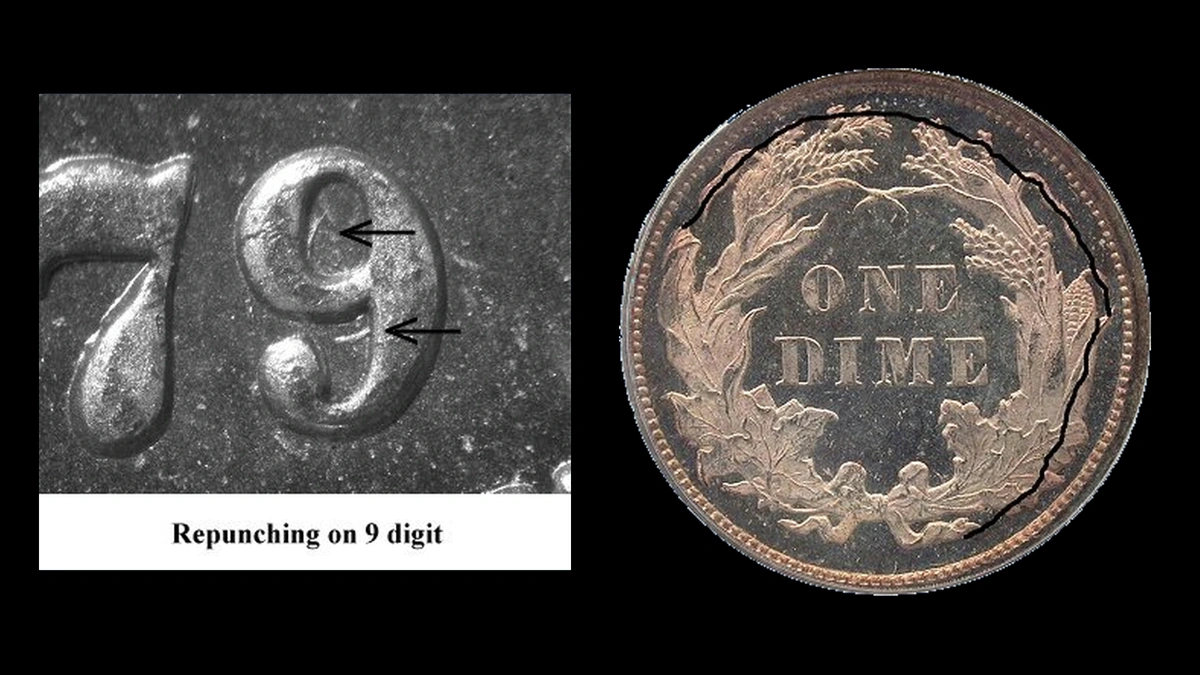
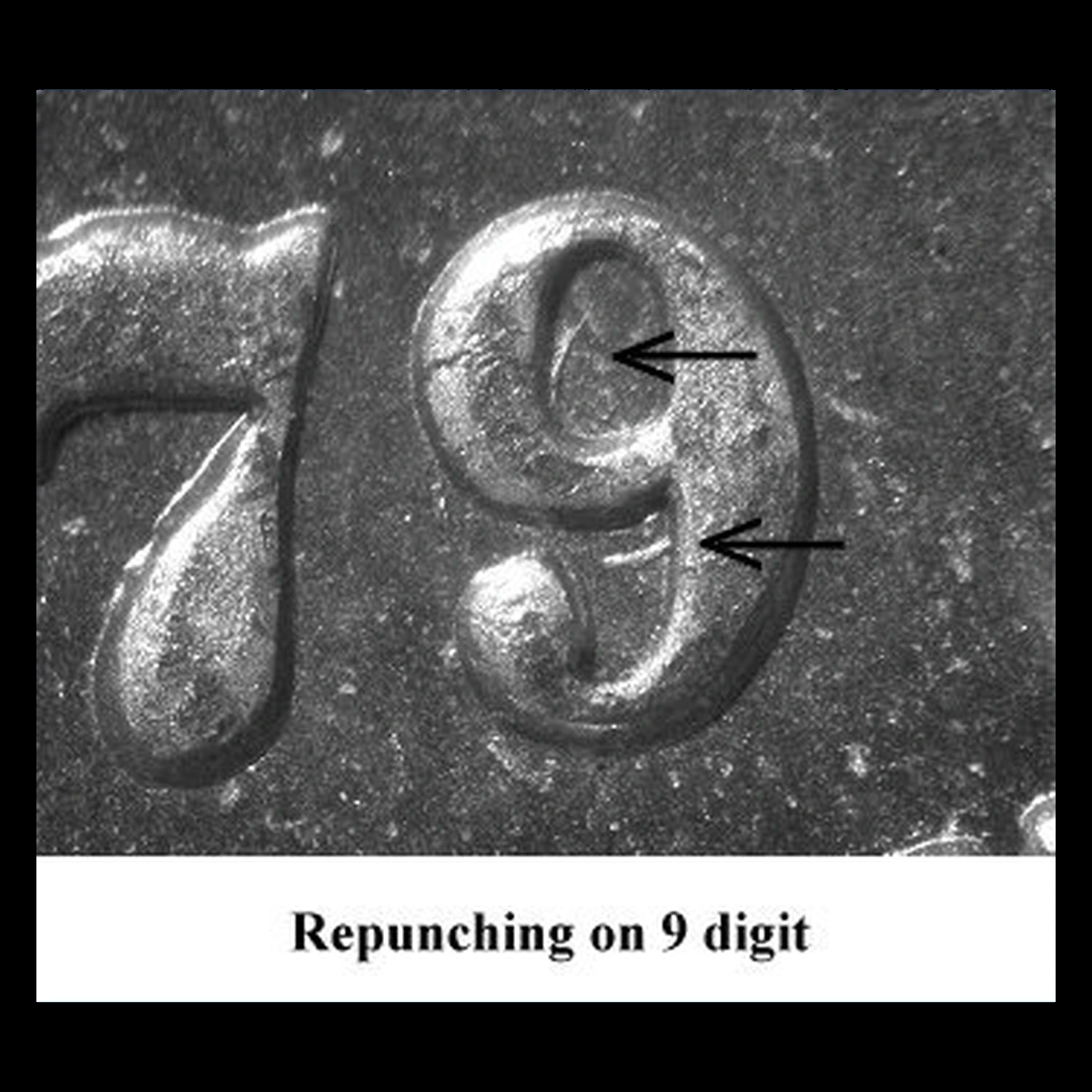
The most useful starting point is the final 9: an extra curve can remain inside it or near its upper edge. These remnants record a repeated date entry in the die that stamped the coin.
The F-103 Proof and related F-103a circulation variety show this feature. Another date pattern instead has traces above and below the 1 and beneath the loops of the 8.
How to Identify
View all four digits together before enlarging a suspected mark. Then decide whether the evidence concerns the 9 or the separate 1-and-8 pattern.
For the first group, match the extra curves inside and above the 9 to an attributed F-103 or F-103a image. Do not require those coins to have the additional 1-and-8 features from the other pattern.
A convincing remnant should preserve part of an earlier numeral’s shape. A thick stroke, a bright reflection, or a flat shelf along a number does not establish repunching by itself.
The coin should be a Philadelphia issue without a mintmark. Also determine whether it is a Proof, made specially for collectors, or a regular circulation strike before selecting a comparison.
What It’s Worth
Estimated whole-coin values are $150–$3,000 from worn through well-preserved unworn circulation coins, and $400–$5,000 for collectible Proofs. The small repeated outlines are not separately worth those amounts.
An ordinary 1879 NGC MS65 sold for $840 in September 2022. No repunched-date attribution is supplied for that unworn coin, making it a general condition benchmark.
The 1880 PR68 sale at $4,800 in November 2025 concerns an exceptionally preserved Proof of another year. It helps explain the different market for fine Proofs, but does not document a sale of an 1879 repunched date.
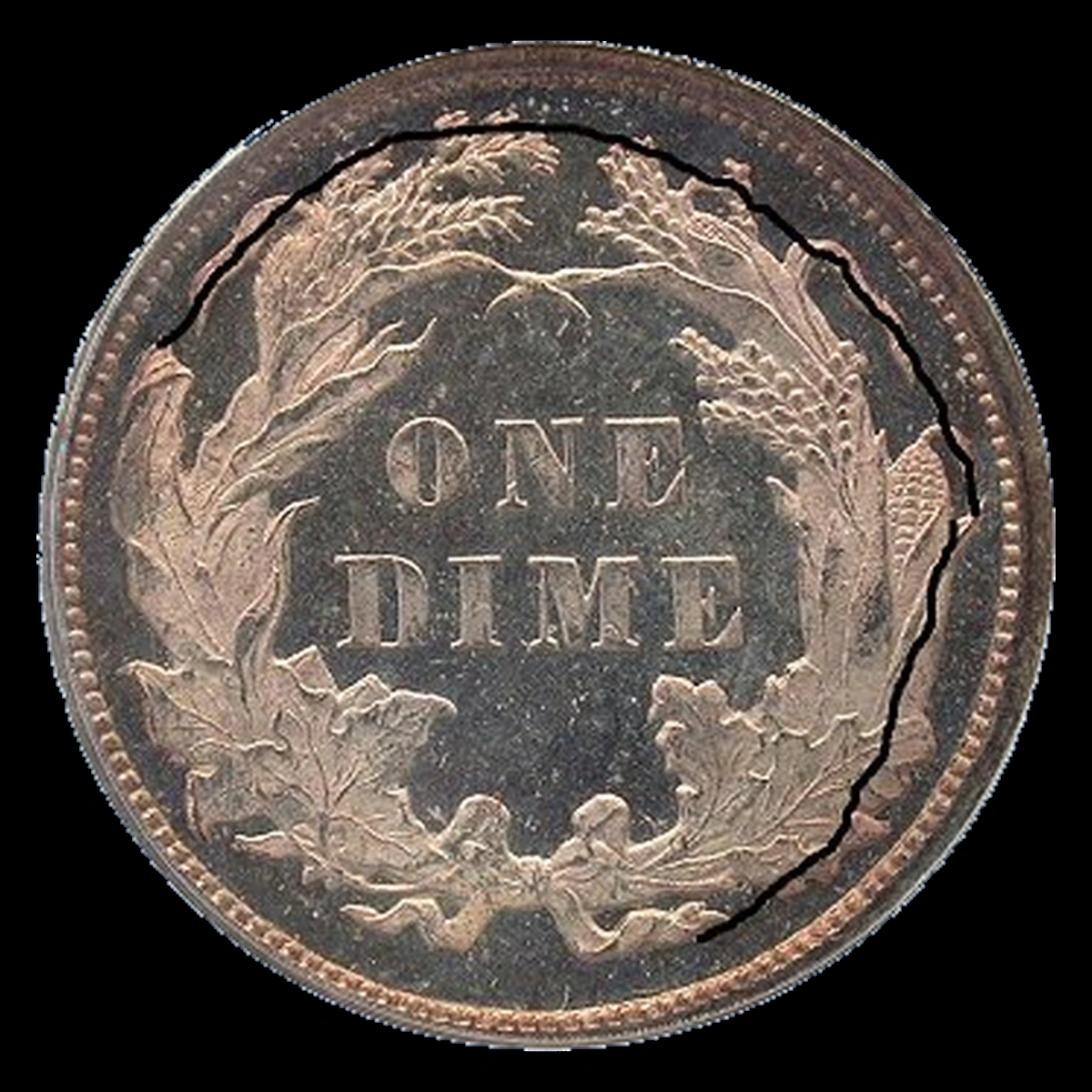
1879 Dime Fine raised lines around the wreath: reverse die cracks Error
Turn the dime over and examine the leaves rather than assuming every thin line is a scratch. Some raised lines represent cracks in the die, filled by metal when the coin was struck.
The F-101 Proof has a pattern along the outer leaf edges. F-105 circulation coins have a different route through the wreath, so the two patterns should be considered separately.
How to Identify
Under low-angle light, trace one suspected ridge from a clear starting point. A raised line can cast a narrow shadow, whereas a scratch cuts into the surface.
Choose the appropriate Proof or circulation example in the 1879 variety photographs. Follow its actual route rather than joining nearby unrelated lines into a larger imagined network.
Marks left while preparing a die can also appear on a coin, but they are not automatically cracks. The position and shape must agree with the particular feature you are identifying.
A raised crack trace does not mean that the silver dime itself has split. Check the nearby rim and edge separately if you see a cut, impact, or an opening in the coin.
What It’s Worth
The estimated ranges remain $150–$3,000 for circulation examples and $400–$5,000 for Proofs. These are complete-coin estimates in which preservation and original surfaces generally outweigh the small cracks.
The $840 MS65 sale is useful same-year context, but its record does not identify either crack pattern. The $4,800 PR68 result belongs to an 1880 Proof and cannot establish an 1879 crack premium.
When comparing prices, match finish and condition before considering the line through a leaf. A correct variety identification makes the description more precise without turning a general auction comparison into an exact error sale.
Conclusion
An 1879 dime can preserve traces from two different stages of die use: repeated date entry during preparation and cracking during service. Each feature needs a match to its own variety.
Keep the Proof and circulation evidence separate throughout the inspection. The supplied sales establish useful whole-coin context, but neither provides a measured premium for the repeated digits or the wreath cracks described here.