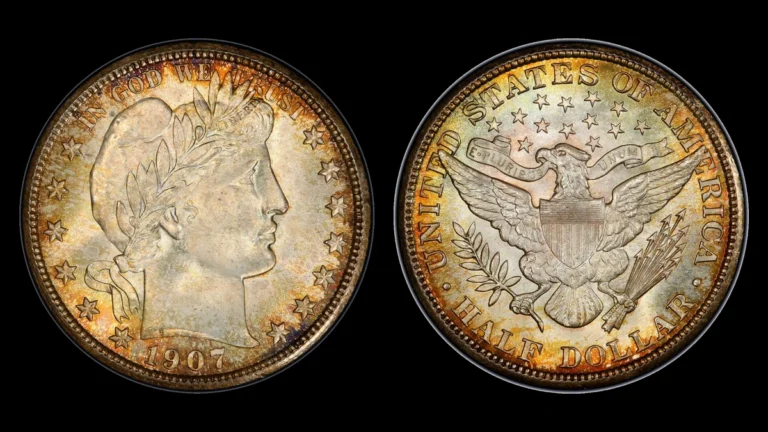
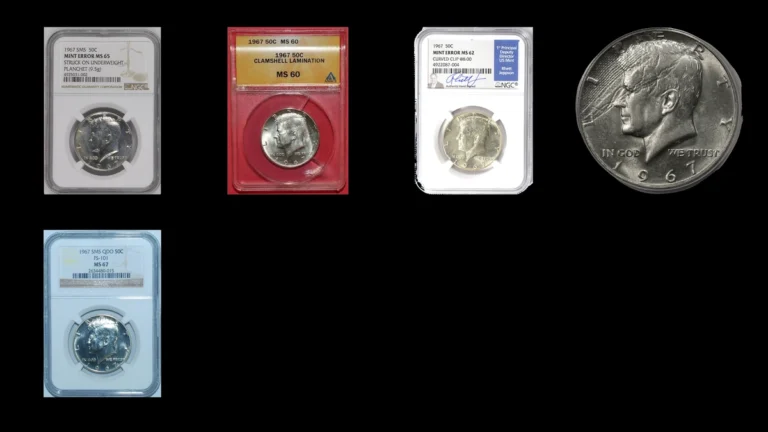
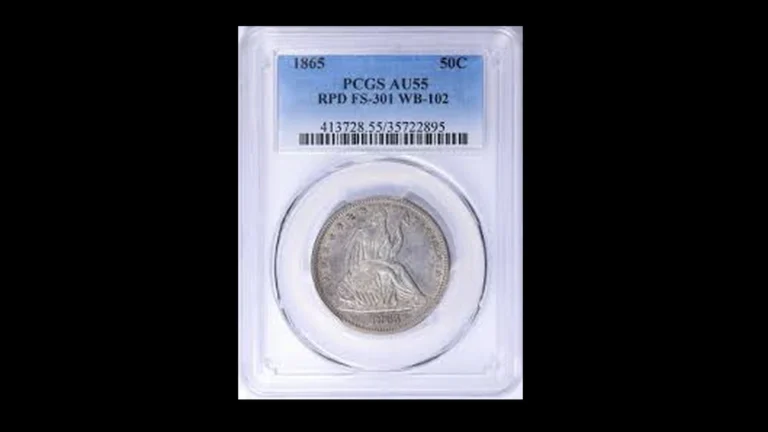
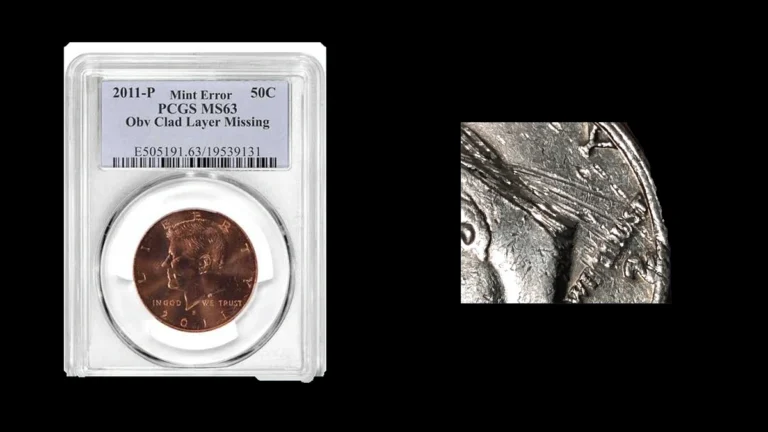
Rare 1870 Half Dollar Errors (List & Pictures)
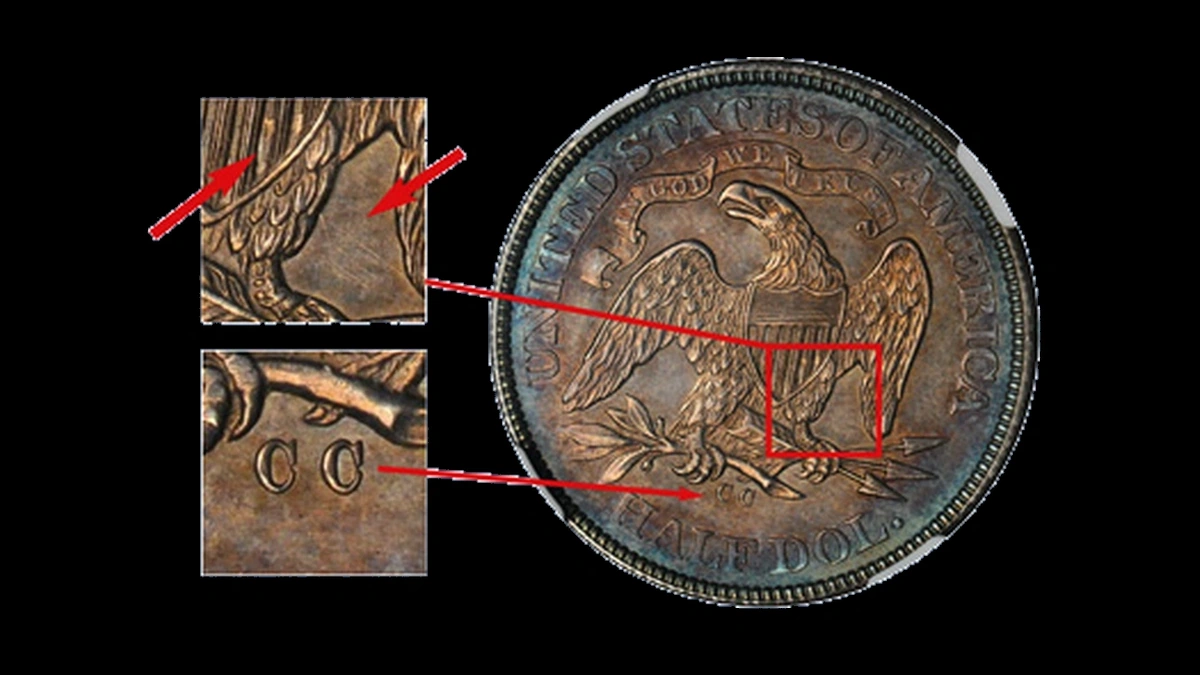
Mintmarks are central to the 1870 half dollar errors below: the repeated 1 belongs to a Philadelphia report, the halo-shaped flaw to San Francisco, and the documented shield marks and crack to Carson City.
Estimated values range from $150–$25,000, with a lightly worn 1870-CC selling for $22,200 in July 2023. Check the date and surfaces before moving to the shield and reverse lettering.
| Visible feature | Where and which mint | Category | Estimated value |
|---|---|---|---|
| Extra piece of the first 1 | Philadelphia date | Repunched date | $150–$1,600 |
| A halo-shaped irregular area | Reported San Francisco coin | Planchet flaw | $500–$1,200 |
| Faint outlines inside the shield | Carson City reverse | Die clash | $1,500–$25,000 |
| A ridge through MER | Carson City reverse lettering | Die crack | $1,500–$25,000 |
An unworn 1870 half normally weighs about 12.44 grams and measures 30.6 mm, with a grooved edge. These basic checks support examination of a loose coin, while the mintmark and actual feature determine the right variety comparison.
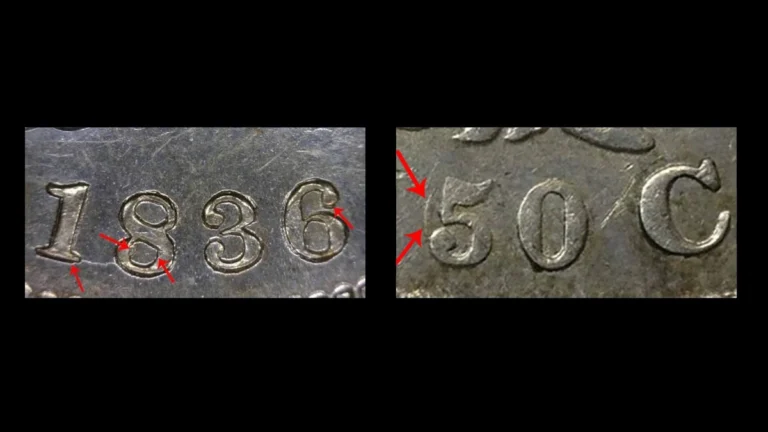
1. 1870 Half Dollar An Earlier Stroke Beside the 1: Repunched Date Error
Philadelphia’s WB-1 is the reference for the repeated first digit. Only part of an earlier 1 needs to survive for repunching to be visible.
The extra stroke originated while the date was being punched into the die, the steel tool that stamped the coins. When another impression landed slightly differently, the uncovered remnant became part of the final tool.
How to Identify
Hold the whole 1870 date in view and center attention on the first 1. Compare the surviving fragment with an identified repunched-1 example rather than assuming a direction from an unrelated date.
Check the height and shape under changing light. A recognizable piece of an earlier numeral is stronger evidence than general thickness or a flat shelf along its edge.
An impact can push a lip against the number, often leaving a disturbed area beside it. A scratch adds a cut, which should be separated from the raised date remnant.
Confirm that the reverse has no mintmark before using the Philadelphia WB-1 comparison. The S and CC features later in this guide concern different coins.
What It’s Worth
Estimated range: $150–$1,600 spans a worn problem coin through a well-preserved example without circulation wear. The supplied results illustrate why surface condition matters.
The recorded sales include $149 for a cleaned PCGS VF Details repunched-1 coin in June 2026 and $1,560 for a PCGS MS62 with CAC approval in June 2025. “Details” flags a condition problem, so the lower result is not an undamaged VF benchmark.
2. 1870 Half Dollar A Ringlike Patch in the Silver: Reported Planchet Flaw Error
A dealer described a “halo” on an 1870-S as a planchet flaw and reduced the asking price because of it. A planchet is the metal blank that receives the coin design.
The description does not specify which face carries the patch or identify a hole, split, or peeling layer. The physical evidence on the coin must establish any narrower name.
How to Identify
Rotate the coin beneath a lamp to decide whether the halo has physical depth or is only a ring of color. A patch’s visibility does not by itself show that the silver blank was defective.
Study how nearby struck detail crosses or borders the area. Cuts, pushed metal, and altered texture can point to later impact, cleaning, or chemical effects.
The Skyline dealer description provides no exact location to check. Full views of the actual dated S coin are needed before focusing on the reported halo.
What It’s Worth
Estimated range: $500–$1,200 for a comparable example. Skyline asked $947 and described the coin as BU, a dealer term indicating an unworn appearance.
That amount is an asking price, and BU is not a numerical grading-service result. The discount is also a useful reminder that an original blank flaw can reduce appeal instead of automatically adding value.
3. 1870 Half Dollar Extra Shapes Within the Shield: Clashed Dies Error
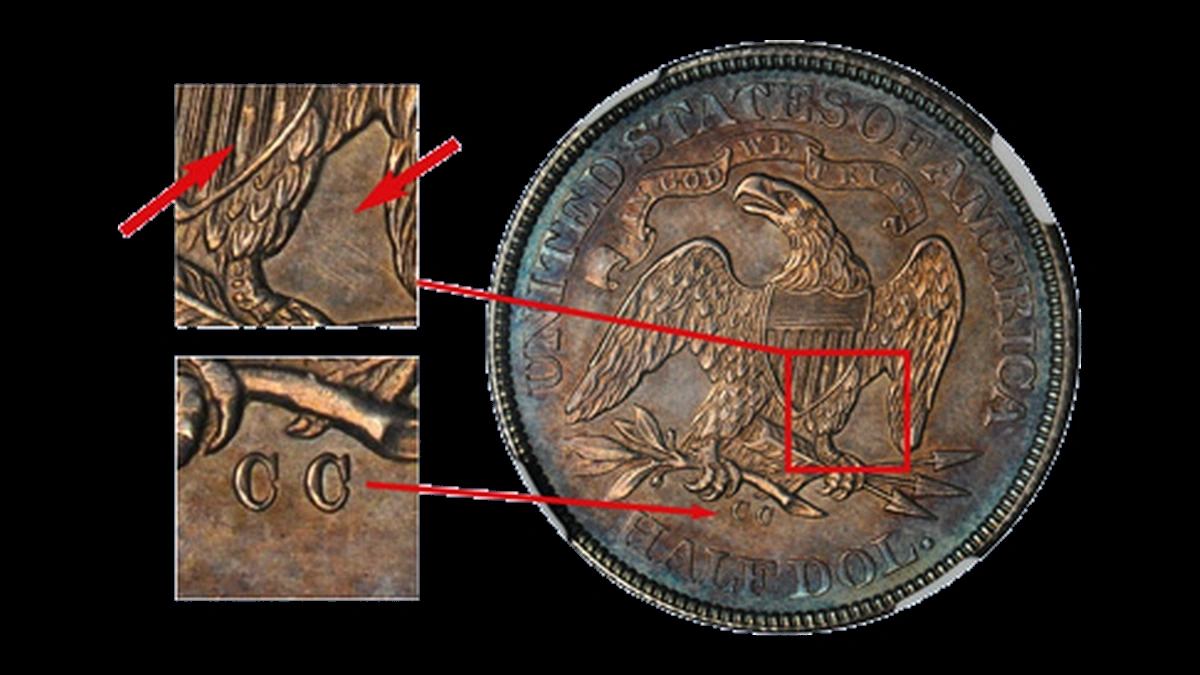
The shield on the auctioned 1870-CC AU53 contains repeated clash outlines. Another WB-1 reference places traces at the lower-right shield and below the wing on the viewer’s right.
Those descriptions should remain tied to their individual examples. They document transferred shapes from the opposite design rather than a single universal arrangement for every 1870-CC.
A clash occurs when the two dies meet without a blank between them and mark each other. Later coins can carry the transferred detail even after just one normal strike.
How to Identify
Separate the shield’s intended lines from the extra outlines before considering their cause. Then look for a relationship between the unfamiliar shape and the design on the other face.
For the separate WB-1 reference, inspect the lower-right shield and the area below the viewer’s right wing. Do not combine that coin’s locations with the auction specimen to invent a larger pattern.
Scratches usually form cuts, while die cracks follow fractures rather than the opposite design. Repeated clash outlines can come from repeated contact between the tools without proving the silver coin itself was struck twice.
What It’s Worth
Estimated range: $1,500–$25,000 for worn through similarly lightly worn 1870-CC coins. The scarce Carson City issue supplies much of the underlying value.
The NGC AU53 sold for $22,200 on July 20, 2023, with both shield clashes and the reverse crack described next. The WB-1 reference does not document another sale at that amount.
4. 1870 Half Dollar A Raised Route Across MER: Reverse Die Crack Error
Move outward from the shield to MER in AMERICA. The documented 1870-CC has a fine line crossing those letters, separate from its inner shield outlines.
This route records a fracture in the reverse die. Silver forced into that fracture left a ridge when the rest of the reverse was struck.
How to Identify
Trace M, E, and R in sequence and examine the line where it crosses the background between letters. Those open areas can make the difference between a raised ridge and a scratched cut easier to see.
Use the Heritage AU53 description and images for the route match. Include the full dated front and CC mintmark in your comparison, since three enlarged letters alone cannot establish the coin’s identity.
Examine the shield marks independently if they are also present. Their origin and shape differ from the MER fracture even though both occurred on the reference specimen.
What It’s Worth
Estimated range: $1,500–$25,000 covers heavily worn examples up to coins comparable to the auctioned AU53. AU53 indicates light circulation wear.
The relevant $22,200 result is the same July 2023 sale cited for the clash. It prices one scarce 1870-CC with two features, so it cannot be counted twice or treated as a separate charge for the crack.
Conclusion
The mintmark keeps this inspection grounded: no mark for the repeated 1, S for the halo report, and CC for the documented shield and lettering features. A match in the wrong mint is not a useful price comparison.
The $150–$25,000 estimates also span substantial differences in wear and surfaces. Use the complete coin’s condition, and keep the dealer’s discounted offering distinct from a completed auction.