Rare 1895 Half Dollar Errors (List & Pictures)
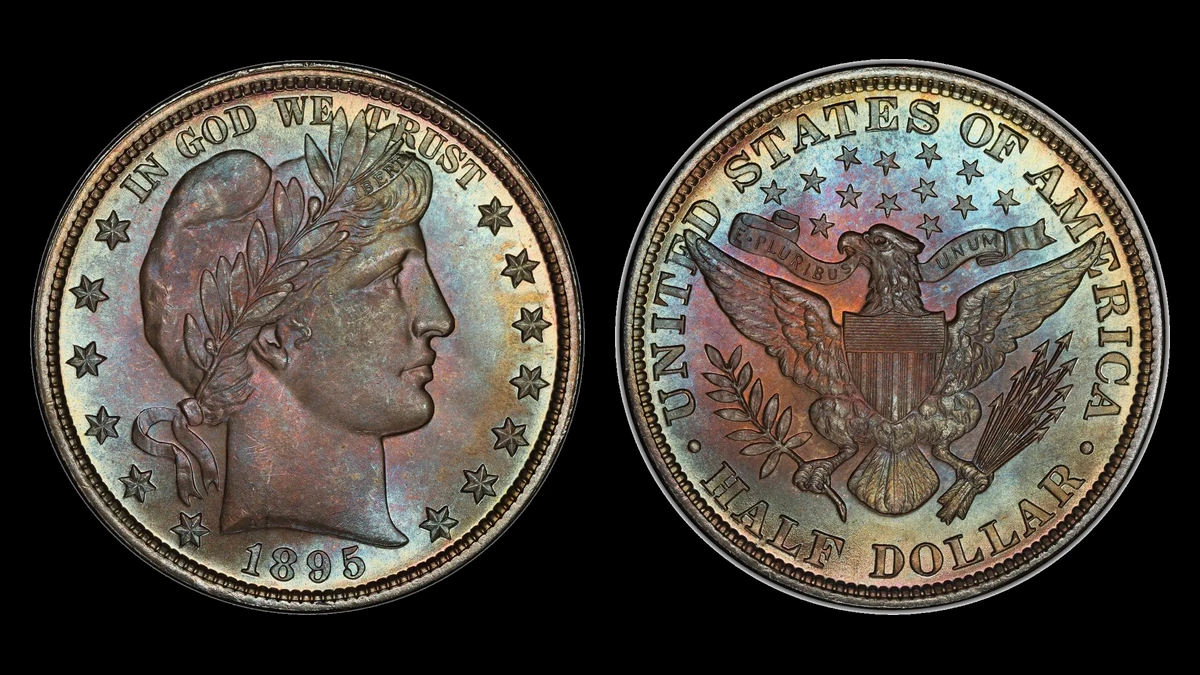
Some 1895 half dollar errors are visible from the outline, while others require a magnifier or a careful flip. The five categories here include both specifically described features and reports that still need an individual coin to confirm.
Estimated values range from $100–$35,000; the highest supplied listed auction result is $29,000 for an exceptional proof in January 2026. Check the whole coin first, then the ear, date, and mintmark.
| Observation | Check | Category | Estimated value |
|---|---|---|---|
| Blank margin beside missing design | Both complete faces | Reported off-center strike | $2,500–$8,500 |
| Eagle stays tilted after a controlled flip | Relative direction of the faces | Reported rotated dies | $150–$500 |
| Horizontal lines inside the ear | Liberty on an S coin | Die clash | $250–$600 |
| Extra stroke at the top of 1 | Date on a proof | Repunched date | $25,000–$35,000 |
| Another part of O or S | Reverse mintmark | Reported repunched mintmark | $100–$400 |
A regular unworn silver half has a reference weight of 12.50 grams and diameter of about 30.6 mm. Check the grooved edge as well when investigating an unusual outline or alignment.
1. 1895 Half Dollar Part of the Design Missing Beside Plain Silver: Reported Off-Center Strike Error
Two features belong together on an off-center coin: metal that stayed blank and design that fell beyond the blank’s edge. The displaced blank received the front and back impressions in that same position.
The supplied 1895 report identifies this broad category without a fixed mint, percentage, or certified specimen. Those details must come from the coin being examined.
How to Identify
Locate the complete date before estimating how far the strike moved. A readable 1895 is needed to connect a partly missing design with this year.
Follow the plain crescent around both faces and confirm that its metal is still present. A cut-away portion cannot serve as an unstruck margin.
If one face is centered, investigate die alignment instead. A wider coin with complete designs may be broadstruck, which involves failure of the surrounding collar to contain the metal.
At the border of the struck area, inspect for filing and later flattening. The transition should fit a misplaced strike rather than removal of a previously complete design.
What It’s Worth
Estimated range: $2,500–$8,500 for substantially off-center circulated Barber halves retaining the full 1895 date. Condition and the amount of visible displacement determine the useful comparison.
An 1894 graded NGC AU53 and struck forty percent off center sold for $7,800 in December 2022. Its neighboring date and lightly worn surfaces make it context for a strong example, not an 1895 sales record.
2. 1895 Half Dollar A Tilted Eagle After Flipping: Reported Rotated Dies Error
A rotation affects the direction of the two designs relative to each other. It can exist even when both designs sit neatly in the center of the coin.
If one steel die turns from its intended position, its design is stamped at that changed angle. The 1895 report specifies neither a measured angle nor a single mint.
How to Identify
Hold Liberty upright alongside a vertical guide, then turn the coin top to bottom about a horizontal axis. Avoid adding a sideways twist as the reverse comes into view.
The eagle should finish upright with normal alignment. Repeat the movement several times and check whether any tilt stays consistent.
A continuous video preserves this relationship more clearly than separately adjusted pictures. Two photos that have each been rotated upright cannot establish normal die alignment.
Inspect the edge for a seam or disturbance that might indicate an assembled coin. The turning test measures alignment; it does not by itself prove the coin is unaltered.
What It’s Worth
Estimated range: $150–$500 for a worn 1895 with substantial genuine rotation. A tiny deviation belongs outside a comparison based on a conspicuous tilt.
A 2000-P Kennedy half with seventy-five-degree rotation, graded PCGS MS61, sold for $79 in March 2025. That modern, unworn coin illustrates the category, while the Barber estimate also includes the older date’s underlying value.
3. 1895 Half Dollar Shield-Like Lines Inside Liberty’s Ear: Die Clash Error
The ear on an 1895-S is the specific area recorded by the Barber Coin Collectors’ Society. Short horizontal traces there are associated with shield lines from the reverse.
A collision between the two dies, with no blank separating them, could mark the front die with reverse details. Coins struck afterward could then carry the unexpected lines inside Liberty’s ear.
How to Identify
Magnify the ear and compare the spacing of its extra lines with the reverse shield. Their direction and arrangement should explain the connection between the designs.
Confirm the S mintmark before applying this particular description. A random line elsewhere on another Barber portrait is not the same documented feature.
Vary the lighting to separate actual surface detail from shadows. Normal ear contours or cuts from handling can look convincing in one photograph without matching the shield pattern.
What It’s Worth
Estimated range: $250–$600 for Fine-to-Very-Fine 1895-S coins with recognizable traces. This covers the complete circulated coin rather than an independently established clash premium.
Ordinary 1895-S auction comparisons include $264 for PCGS F12 in December 2025 and $427 for VF20 in July 2026. Neither was recorded as the ear-clash specimen.
4. 1895 Half Dollar A Small Remnant Above the 1: Proof Repunched Date Error
The date report is unusually specific about the coin and the digit: an extra stroke at the top of the 1 on a Philadelphia proof. Proofs were specially made collector coins, and this example was graded PCGS PR68 Cameo with CAC approval.
A previous placement of the date punch can leave a remnant when a later impression does not cover it completely. Here the report describes only the 1, so there is no basis to claim doubling on the other three digits.
How to Identify
Frame the entire 1 under magnification, including its stem, then study the upper stroke. This keeps the tiny remnant in proportion to the digit it is said to repeat.
Reflective proof fields make lighting important. Change the lamp angle and confirm that the raised fragment stays attached to the same spot rather than moving as glare.
The comparison also requires a Philadelphia proof with no O or S mintmark. A circulation coin with damage near its date cannot inherit the identity or value of this reported proof.
What It’s Worth
Estimated range: $25,000–$35,000 for similarly exceptional proofs. The Cameo designation describes contrast between frosted design and mirrored background, a major part of the coin’s appeal.
NumisBids lists $29,000 for Heritage lot 3106 in January 2026. That is the platform’s published result, used here without an additional fee adjustment.
The extra date stroke helps describe the specimen. The price chiefly concerns its exceptional proof quality and cannot be treated as a separate $29,000 reward for the small mark.
5. 1895 Half Dollar A Second Letter Shape Beside O or S: Reported Repunched Mintmark Error
Finish at the mintmark beneath the eagle, where part of an earlier O or S may survive beside the final letter. A repunched mintmark forms while the letter is being punched into the die, before that die stamps coins.
The general 1895 report does not name a fixed direction or a particular specimen. O and S refer to separate mints; the report does not describe an O struck over an S.
How to Identify
Include a little surrounding silver in the magnified view. This helps reveal whether an apparent extra curve belongs to the letter or to a scratch immediately beside it.
Try to fit the remnant to another impression of the same mintmark. General thickness and a low, flat shelf can arise without repunching.
Record the actual mint and visible overlap before choosing a reference. Because no precise direction is supplied, assigning one in advance would risk matching an imagined feature.
What It’s Worth
Estimated range: $100–$400 for genuinely repunched examples around Good through Fine. Their mint and remaining surfaces also contribute to the value.
For category context, an ANACS MS62 1942-D/D Walking Liberty half sold for $69 in March 2024. It is a much later, different-series coin and supplies no direct sale price for an 1895 Barber mintmark variety.
Conclusion
Whole-coin views establish displacement, a controlled flip tests rotation, and close views address the ear, 1, and mintmark. Keeping those tests separate avoids turning every unusual edge into the same kind of error.
The $100–$35,000 estimates cover very different grades and levels of evidence. In particular, the exceptional proof result cannot be applied to a worn half with a small extra stroke.