Rare 1874 Dime Errors (List & Pictures)
The mint letters can explain more of an old dime’s price than its most obvious flaw. A cracked-reverse 1874-CC brought $18,562.50 in October 2024, largely because the date and Carson City mint are scarce.
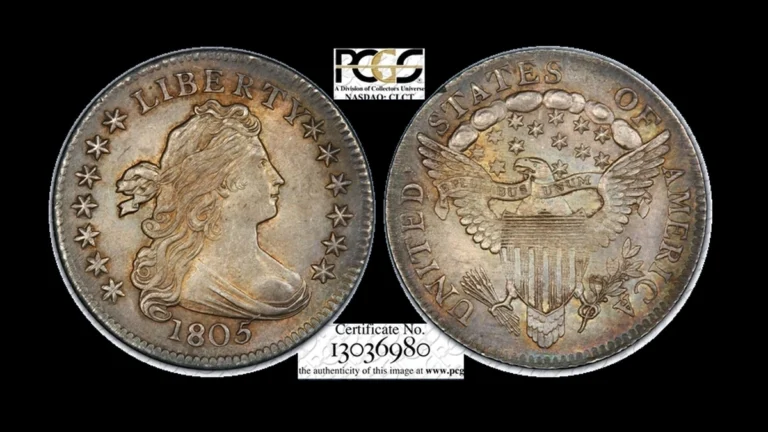
Whole-coin estimates for these 1874 dime errors cover $40–$45,000. Start around the date and arrows, then move to the wreath, surface lines, and rim.
| What you notice | First comparison |
|---|---|
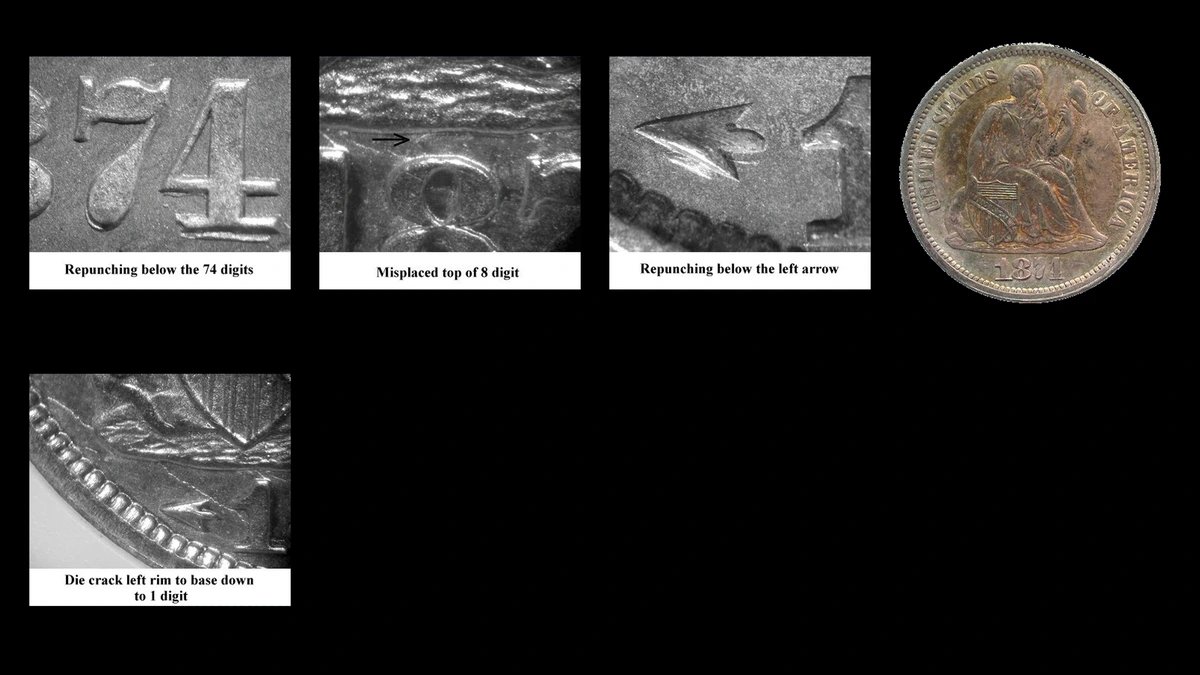
| Extra strokes close to 7 and 4 | Repunched date |
| A curved fragment above 8 | Misplaced date remnant |
| Two outlines on the left arrow | Repunched arrow |
| One or both arrows are faint | Matched weak-arrow variety, wear, or alteration |
| Extra wreath edges or stray shapes | Doubling appearance or die clash |
| Raised lines or a rim-connected patch | Die cracks or a cud |
1. 1874 Dime Extra Strokes Sit below 7 and 4: Repunched Date Error
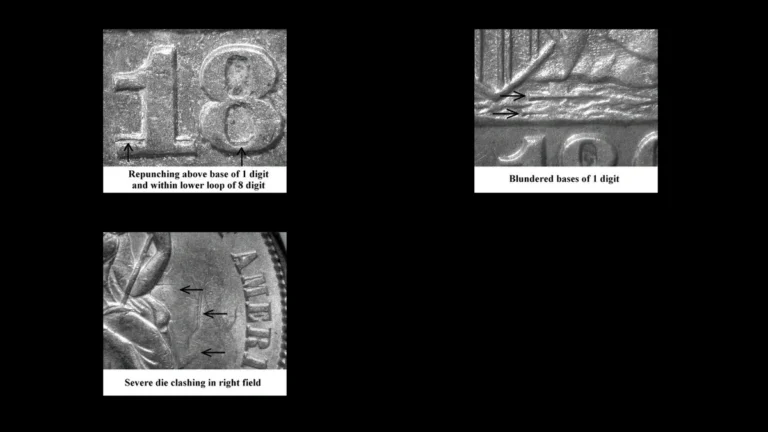
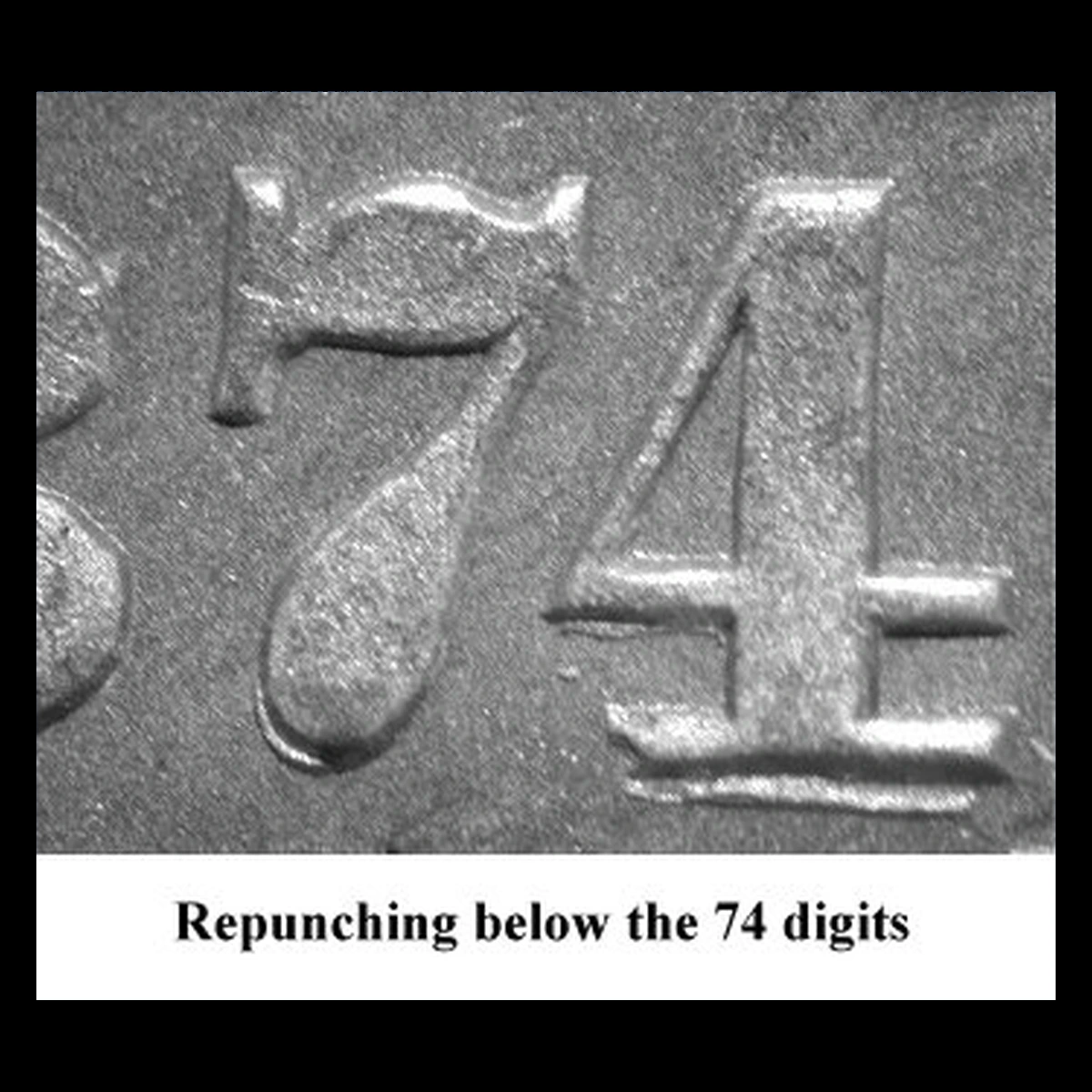
Early Philadelphia F-103 examples show remnants below 7 and 4, with another trace beneath the left crossbar of 4. An earlier date-punch impression remained in the die after the final date was placed.
The die repeated those traces on the coins it struck. Wear to the tool can make them weaker on later examples.
How to Identify
Check all three locations together: below 7, below 4, and beneath the left crossbar of 4. Rounded pieces of a numeral are more useful than a single low, flat shelf.
Other Philadelphia dies also show repunched digits, so this three-point pattern belongs specifically to the F-103 comparison. A separate Proof record describes a repunched 4.
Proofs were specially made for collectors. A shiny surface alone cannot establish one, because ordinary dies could also produce reflective backgrounds.
What It’s Worth
$50–$1,200 is the estimate for recognizable worn through lower-grade unworn circulation examples. A VF20 F-103 sold for $119.25 in October 2024.
Collectible lower-to-middle-grade Proofs have a separate estimated range of $500–$3,500. The $119.25 sale concerns an ordinary F-103, not the Proof with a repunched 4.
2. 1874 Dime A Curved Digit Fragment Appears above 8: Misplaced Date Error
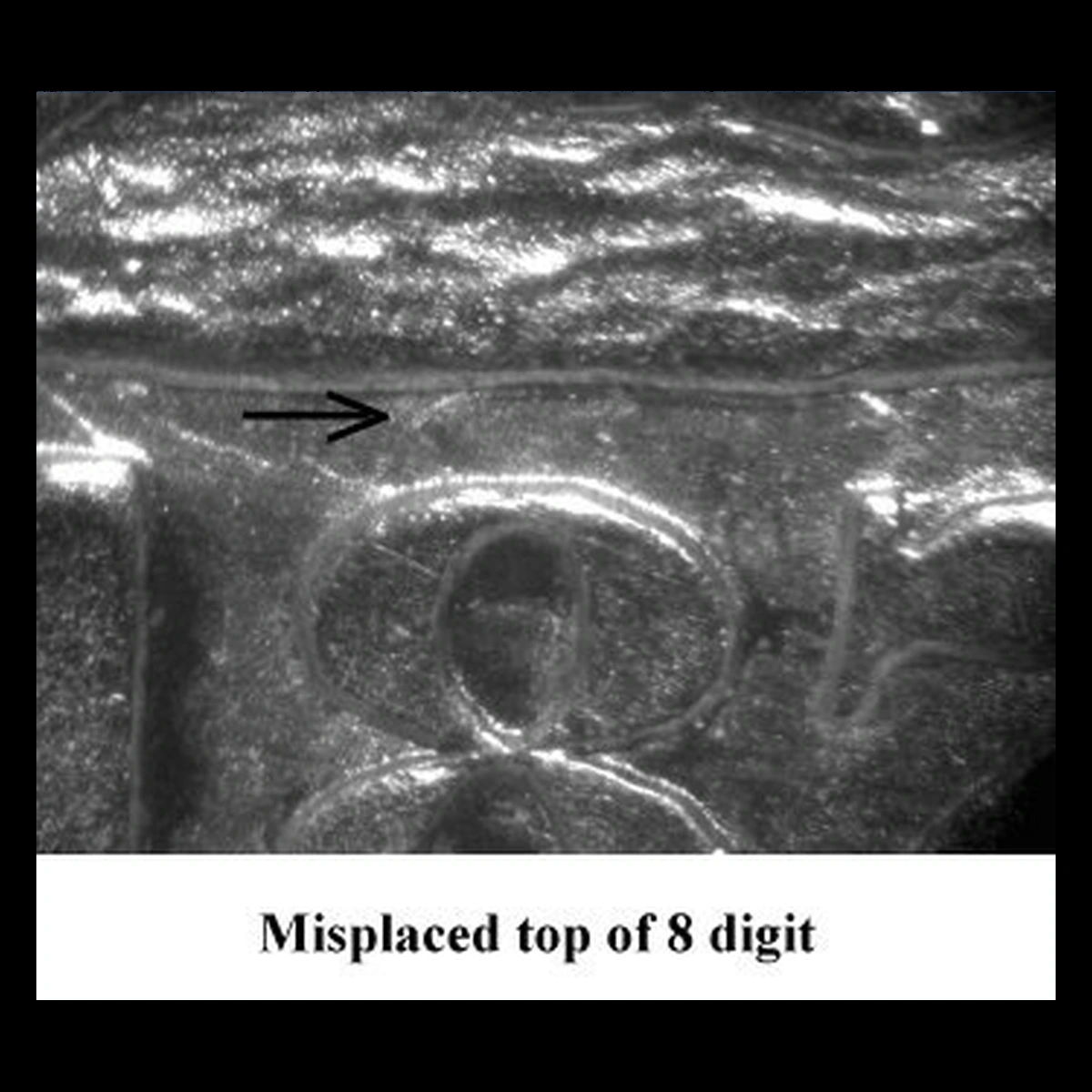
Between the regular 8 and Liberty’s base, an extra arc has been interpreted as the top of another 8. It sits away from the final numeral, which explains the misplaced-date name.
The reference also considers widely separated repunching as an explanation. These descriptions concern the same visible fragment rather than two errors to count on the coin.
How to Identify
Include the main 8, the space above it, and Liberty’s base in one close-up. Follow the curve to see whether it fits the reference’s upper-8 shape.
A later stage of this die also has cracks. Keep straight or angular crack branches separate from the rounded date remnant.
The Philadelphia coin should have arrows beside the date and no reverse mint letter. An isolated bright dot or a newly cut groove does not establish the extra numeral.
What It’s Worth
$50–$1,200 is the estimate for worn through lower-grade unworn examples with a clear matching arc. Much of that spread reflects the coin’s overall preservation.
No exact-example sale is supplied for this range. Calling the arc misplaced instead of widely repunched does not create a second premium.
3. 1874 Dime The Left Arrow Has a Second Upper Edge: Repunched Arrow Error
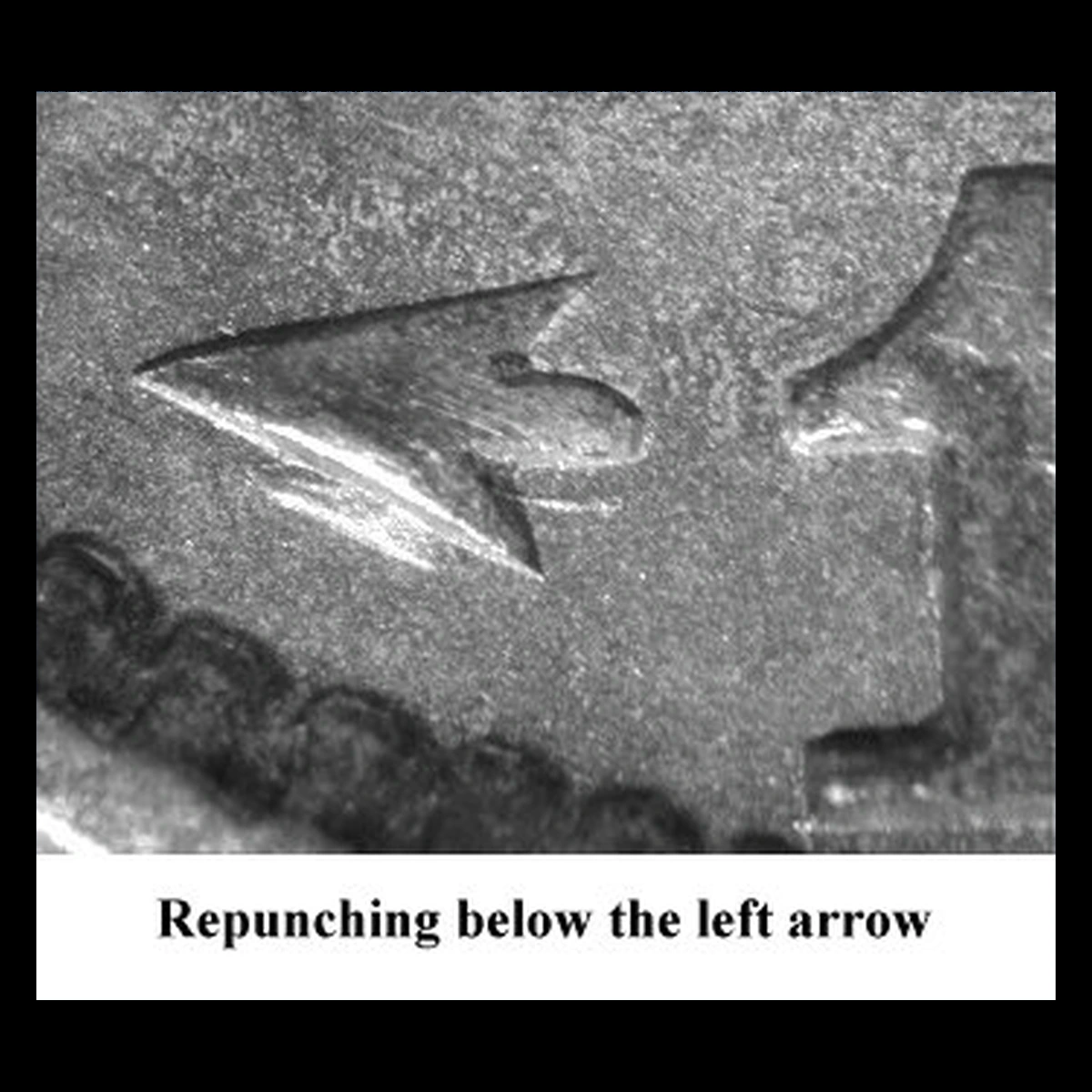
The illustrated San Francisco variety has another punch trace at the top of its left arrow. Its reverse carries a small, thin S, distinct from the micro S used for a different comparison.
The arrow was punched more than once during die preparation. Philadelphia also has a repunched-left-arrow report, but that coin needs its own matching outline.
How to Identify
Read the mintmark before choosing a close-up. For the San Francisco reference, match the small, thin S and then examine the upper edge of the left arrow.
An arrow that points upward is not automatically repunched. There must be a second formed outline at the documented location.
The illustrated AU55 coin has only slight wear, despite a weaker reverse design. Strike weakness and circulation wear are different, so compare the surfaces as well as the sharpness.
What It’s Worth
$100–$1,500 is the estimate for recognizable worn through lightly worn San Francisco examples. Comparable Philadelphia pieces have a separate $75–$900 estimate.
The AU55 coin with CAC quality approval serves as an identification reference, with no selling price quoted here. The ranges price the whole coin, not just its extra arrow line.
4. 1874 Dime Arrows Become Faint or Disappear: Missing Design Detail Error
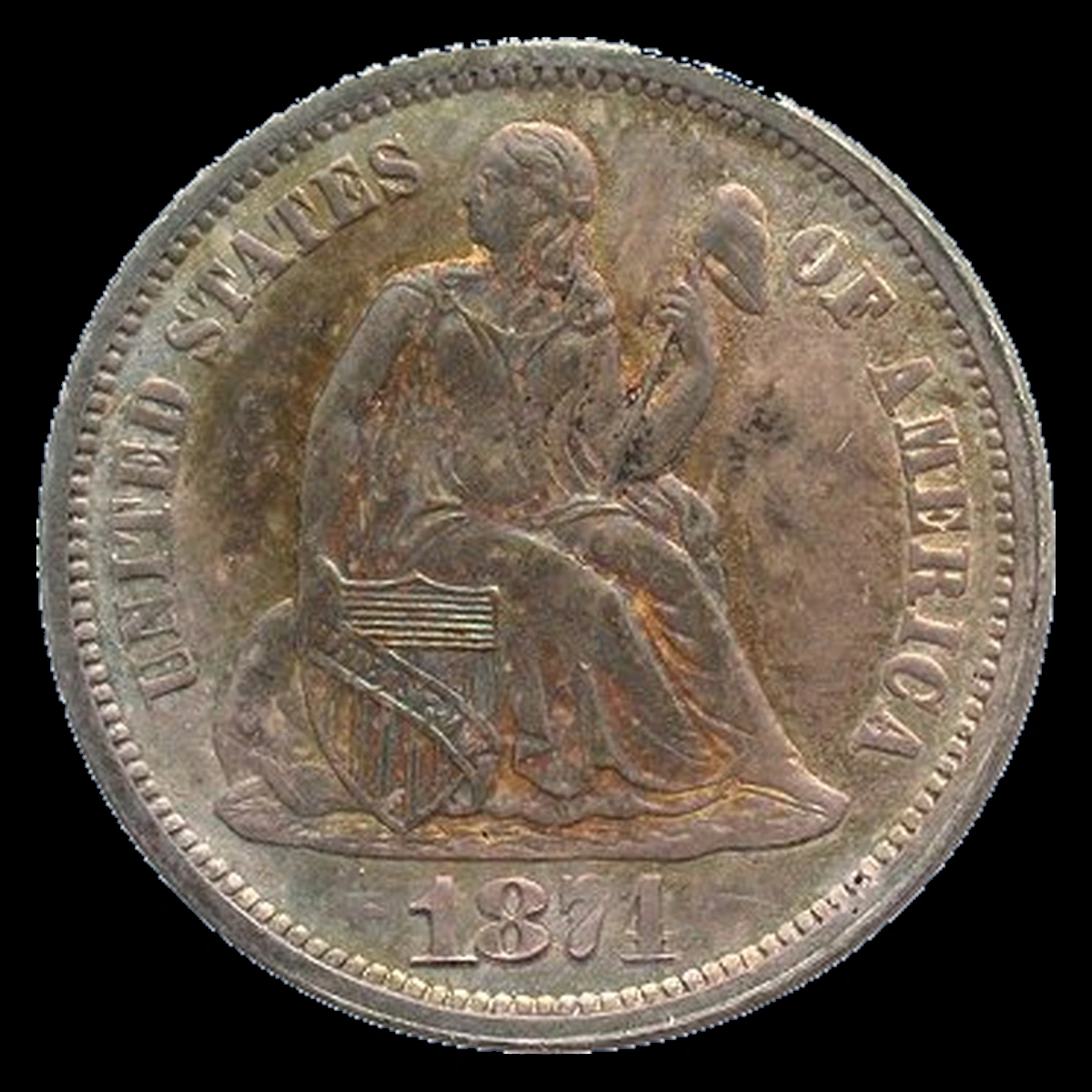
Philadelphia F-106 combines very faint arrows with repunched date digits. The reference proposes die polishing and another application of the date punch as part of its history, without settling that explanation completely.
A separate appearance has a full left arrow and a missing right arrow. It should not be grouped at the same rarity or price as the faint paired arrows of F-106.
How to Identify
Light both arrow positions from several directions and photograph the lower date remnants. Compare the combination with the F-106 reference.
Look for scraping or depressed metal where an arrow may have been removed after striking. Ordinary wear or glare can also make an arrow disappear in one photograph.
These remain dimes of the normal 2.50-gram standard, measuring about 17.9 millimeters and containing 90% silver. Missing-looking arrows do not by themselves create a different official coin type.
What It’s Worth
$3,000–$15,000 is the estimate for a convincing F-106 match in collectible worn through slightly worn condition. A private sale of an AU55-to-AU58 example was reported at $10,000 in January 2009.
That was a reported private transaction, not an auction result. The separate full-left, missing-right-arrow appearance has a lower $150–$1,500 estimate, with a reported $150 eBay sale in 2009.
The surviving date and arrow traces are essential to choosing between those comparisons. An empty-looking patch alone cannot support the scarcer variety’s price.
5. 1874 Dime Wreath Leaves Seem to Have Extra Edges: Reported Doubling Error
Philadelphia F-108 is described as having repeated wreath detail on the reverse. The supplied description records the appearance without establishing its cause.
A doubled die carries repeated design on the stamping tool itself. Movement during striking can instead leave a low, flat shelf beside the normal design.
How to Identify
Examine the wreath under light from opposite sides. Decide whether the second edge has rounded design detail or is simply a flattened border.
Keep the whole reverse available for comparison with F-108. Heavy sharpening of a small image can make an ordinary edge look more strongly doubled.
A bright surface or extra-looking leaf does not turn this regular arrows issue into a Proof. Record the visible contour before assigning a manufacturing cause.
What It’s Worth
$50–$900 is the estimate for recognizable Philadelphia examples in worn through lower unworn grades. This range does not assume a premium for a confirmed doubled die.
The different F-103 repunched-date variety’s $119.25 VF20 sale provides nearby minor-variety context. If the wreath only shows a flat shelf from striking movement, ordinary coins of matching condition are the better comparison.
6. 1874 Dime Pieces of the Opposite Design Show Through: Die Clash Error
Philadelphia F-104a has strong clash traces on both faces and a repeated outline on the left arrow. Those features can help match the same coin, but they formed in different ways.
The clash happened when the dies met without a blank between them and picked up parts of each other’s design. The repunched arrow was already a feature of die preparation.
How to Identify
Use the left-arrow outline to help choose the F-104a comparison. Then examine both faces for recognizable fragments of the opposite design.
The short reference description does not map every clash trace. Use the actual complete photographs rather than assigning an invented location to a stray line.
Scratches and polishing lines may cross the same areas without reproducing a design fragment. Keeping the full coin beside each close-up makes that distinction easier.
What It’s Worth
$75–$1,000 is the estimate for collectible worn through lower-grade unworn Philadelphia examples. No exact F-104a auction result is supplied.
Clear transferred shapes and attractive surfaces can make a coin more appealing. Its repunched arrow helps identify it, but does not add a second whole-coin price to the clash estimate.
7. 1874 Dime Thin Raised Routes Cross the Coin: Die Cracks Error
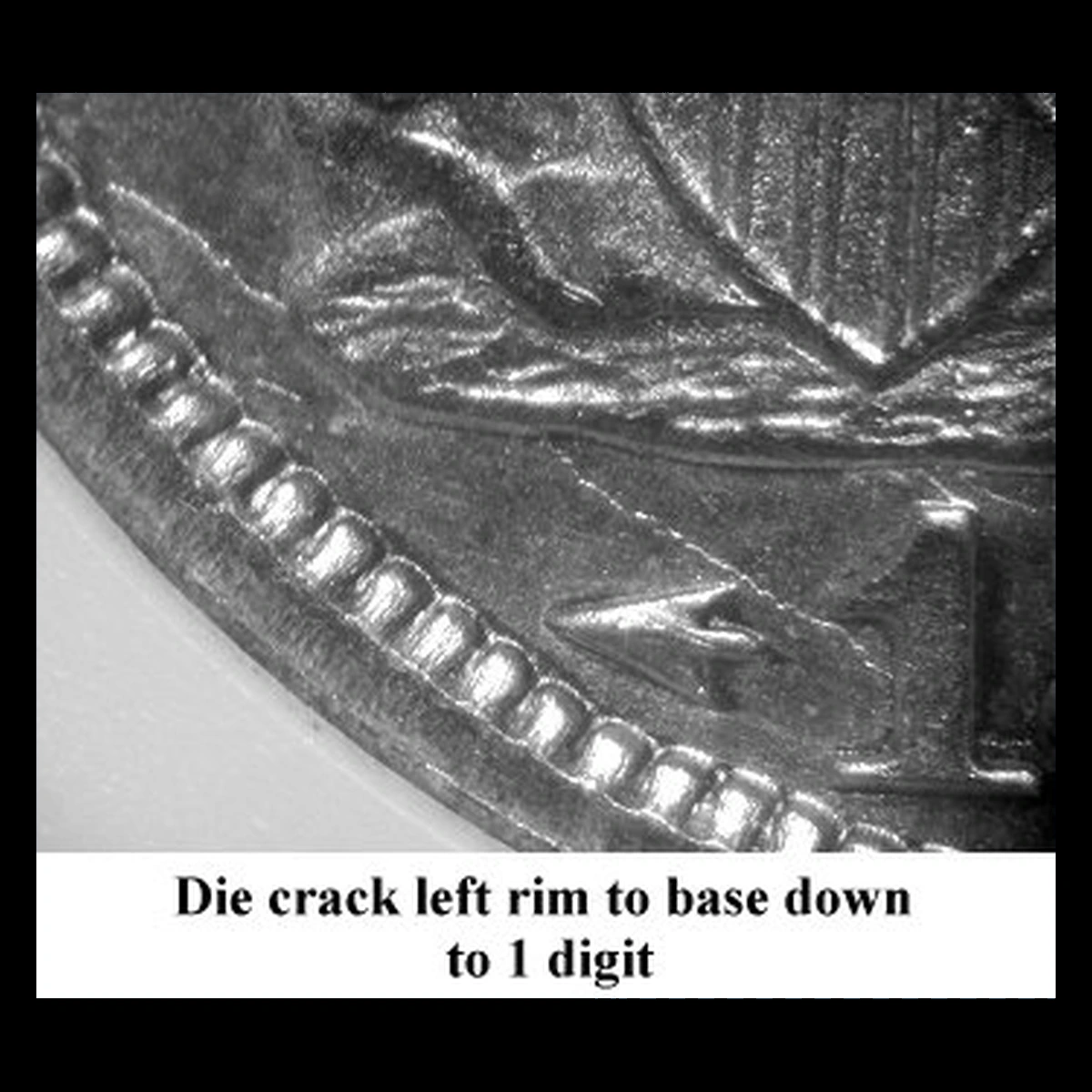
The Carson City reverse has a crack in the mint-letter area. The reference describes that reverse die as having served across 1871–1874, with the fracture present on the 1874 issue.
Philadelphia has different routes, including one from the left base along the bottoms of 874 to the right arrow. Another runs from the foot toward the final A in AMERICA.
How to Identify
Choose the correct mint’s pattern and follow the raised line across the full design. A crack in the die leaves a ridge on the coin, unlike a scratch cut into its surface.
For an expensive CC dime, compare the complete reverse and mint letters as well as the crack. A counterfeit can copy one familiar marker.
The reference notes wider edge grooves on Carson City coins than on Philadelphia pieces. That is supporting evidence, not a substitute for authenticating the entire coin.
What It’s Worth
$40–$900 is the estimate for collectible worn through lightly worn Philadelphia examples. The scarce Carson City date has a separate whole-coin range of about $10,000–$45,000 for heavily to moderately worn collectible coins.
A Carson City F12 sold for $18,562.50 in October 2024, as reported in the supplied GreatCollections results. F12 indicates heavy wear with recognizable design.
The high result mainly reflects the rare date and mint, rather than a measured crack premium. Surface problems also need separate consideration when comparing valuable CC coins.
8. 1874 Dime A Broad Raised Patch Meets the Rim: Reported Cud Error
A cud forms when a piece breaks from the edge of a die. Metal enters that empty area during striking and leaves a raised patch connected to the rim.
The older 1874 guide reports this category without an identified original example, mint, or clock position. A narrow crack or an isolated interior bump does not establish the larger break.
How to Identify
Photograph the patch with the adjacent rim, then inspect whether the metal joins naturally. A hit can push metal upward, and added metal may leave a seam.
The readable 1874 date, actual mint, and raised break must all belong to the same specimen. A cud on a Carson City dime from another year cannot demonstrate this report.
Check the remaining edge for filing or other alteration. The essential feature is the broad original raised area reaching the rim.
What It’s Worth
$100–$1,200 is the estimate for a genuine visible cud on a worn Philadelphia or San Francisco dime with collectible surfaces. No specific 1874 transaction is assigned to the general report.
Carson City needs a separate valuation because the ordinary rare coin can already exceed that range. Identify the mint before applying a guide intended for the more accessible issues.
Conclusion
The date and arrows offer several useful 1874 checks, but extra outlines and missing detail are different observations. Match the whole pattern before choosing a variety name.
On the reverse, distinguish a doubled-looking wreath from a clash or crack, and keep the mint in every comparison. A rare Carson City dime, a scarce faint-arrow variety, and an ordinary Philadelphia coin cannot share a price merely because each looks unusual.