Rare 1875 Dollar Errors (List & Pictures)
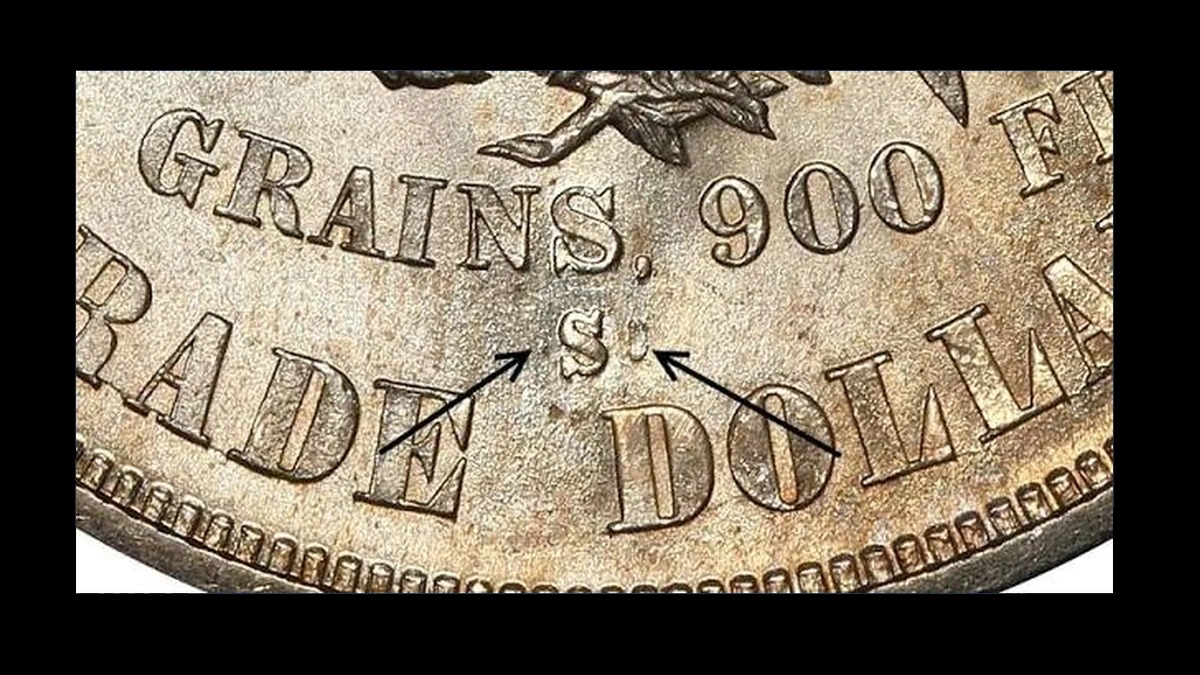
An 1875-S/CC Trade dollar has a recorded $57,500 sale in November 2005. The 1875 Trade dollar errors below span estimated whole-coin values of $300–$60,000.
Read the mint letters first, then inspect cracks, repeated lettering, surface impressions, and the edge while keeping later merchant stamps separate from minting errors.
| Feature | Category | Whole-coin range |
|---|---|---|
| Earlier CC beneath S or larger CC | Overmintmark or repunched mintmark | $500–$60,000 |
| Raised lines on the FS-502 discovery | Die cracks | $500–$30,000 |
| Repeated reverse letter edges | Reported doubled die | $500–$6,000 |
| Ghost design or woven texture | Clash or possible cloth strike-through | $300–$6,000 |
| Gradually changing edge step | Tilted partial collar | $600–$8,000 |
| Repeated original artwork | Possible multiple strike | $1,500–$25,000 |
1. 1875 Dollar Earlier mint letters beneath S or CC Error
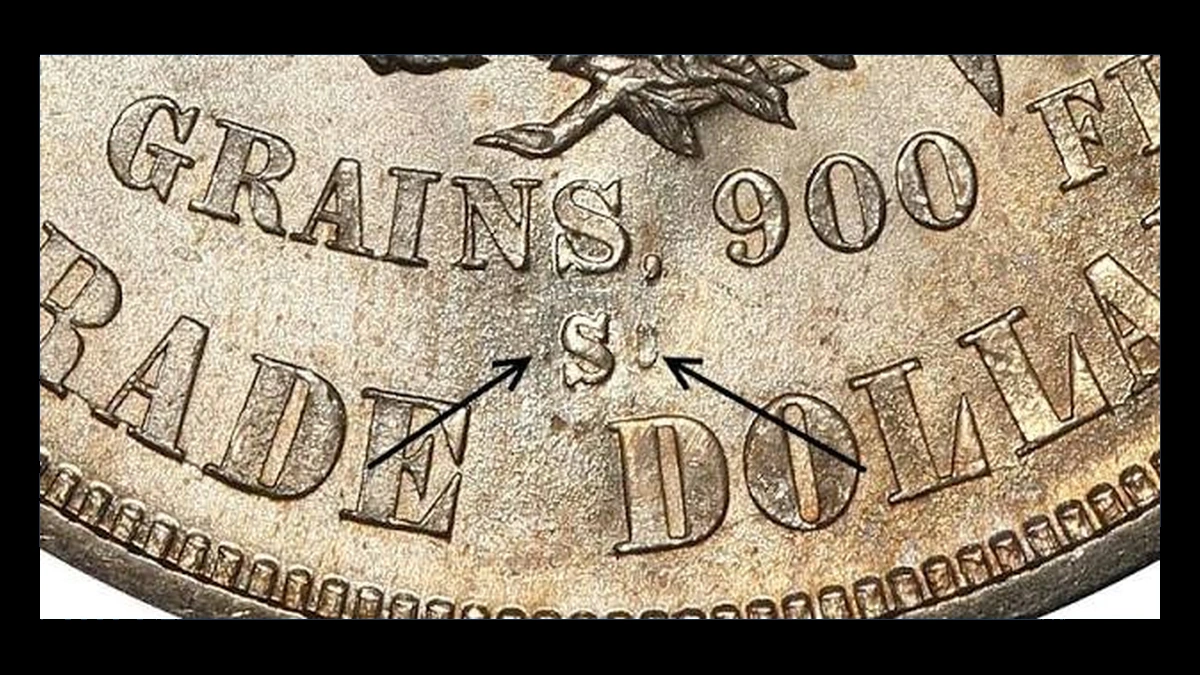
The mintmark sits below 420 GRAINS 900 FINE and above TRADE DOLLAR. On S/CC varieties, San Francisco used a die in which S replaced partly removed Carson City letters.
FS-501 also has a repunched S, while FS-502 does not share that feature. A separate Carson City variety has large CC over smaller CC remnants visible to the right.
How to Identify
Read the final main letters before looking for remnants. S/CC still has S as its main mintmark; CC over CC remains a Carson City mark.
Match the earlier C curves to the correct reference and distinguish them from nearby rust-related bumps. For FS-501, compare the repeated S as well, without requiring that same feature on FS-502.
On CC over CC, inspect the right sides of both larger letters for smaller earlier outlines. One bright edge or an altered mintmark cannot establish the complete pattern.
What It’s Worth
The combined estimated range is $500–$60,000, with S/CC examples around $500–$60,000 and identified CC-over-CC coins around $500–$5,000.
PCGS records an S/CC sale of $57,500 in November 2005. The FS-502 discovery separately brought $24,000 in January 2019.
These are whole-coin prices, including condition and exact variety. They are not fixed premiums for any small curve beside S.
2. 1875 Dollar Raised lines through TRADE and the lower front: die cracks Error
The FS-502 discovery has a reverse crack beginning left of TRADE and ending at the left side of A. A front crack runs from the lower-left rim through the waves and first star toward the second.
Silver entered splits in the dies during striking and formed raised ridges. Original rolled-metal streaks and small rust-related mintmark bumps have separate origins.
How to Identify
Follow each route using the named letters, waves, and stars as landmarks. Inspect the center of the line under low light to distinguish a ridge from a scratch with raised lips.
Compare the mintmark alongside the crack paths. A common dollar with one raised line does not automatically become the S/CC FS-502 discovery variety.
What It’s Worth
Matching S/CC examples with these features have an estimated whole-coin range of $500–$30,000.
The NGC MS65 FS-502 discovery sold for $24,000 in January 2019. This is the same discovery cited above, with its cracks and overmintmark included in one sale.
3. 1875 Dollar Extra edges below weight and denomination text: possible doubled reverse Error
Heritage described a possible doubled reverse on an 1875-S NGC MS64 coin with a Type II reverse. Repetition points downward at 420 GRAINS, 900 FINE, and TRADE DOLLAR, while S remains single.
A true doubled die would transfer repeated detail already present in the tool. Flat shelves created by movement during striking need to be excluded before accepting that interpretation.
How to Identify
Compare the lower edges across all three inscriptions with a normal Type II reverse. A consistent pattern provides better evidence than one thick character.
Use changing light to judge the shape and height of the extra contours. An additional outline on S would require another explanation because the reported mintmark is not doubled.
What It’s Worth
An authenticated doubled-reverse example has a conditional estimated range of $500–$6,000.
The supplied MS64 description provides a condition and appearance reference without a realized price. Its three affected inscriptions do not represent three separate premiums.
4. 1875 Dollar A fragment of opposing artwork: die clash Error
A faint eagle-side shape near Liberty may suggest a clash if its form and position agree with the opposite design. Dies meeting without a blank can mark one another and transfer those traces to later coins.
An unfamiliar line alone is insufficient on a Trade dollar. Scratches, normal details, and merchant stamps may all look unexpected under magnification.
How to Identify
Compare photographs of both faces and identify the specific opposing feature proposed as the source. Adjust a reference image for comparison while leaving the candidate image unchanged.
Check for a cut, punched depression, or displaced metal from later damage. A genuine clash should explain several connected details rather than merely resemble a random line.
What It’s Worth
An authenticated clash has a conditional whole-coin estimate of $300–$3,000.
No specific completed sale is supplied for an 1875 clash specimen. Mint, surface condition, and the clarity of the transferred design remain part of the estimate.
5. 1875 Dollar A woven patch in the silver: reported cloth strike-through Error
In 2016, an owner described an 1875-S coin as appearing to have been struck through burlap. Cloth between the die and blank could leave a woven impression, but the report is not a certified material identification.
How to Identify
Photograph the repeating texture and its transition into adjacent letters or artwork. An original obstruction should affect how the design formed in that area.
Corrosion, scratches, or later squeezing can create textured patches for other reasons. Check both faces and the edge without cleaning or pressing the coin.
What It’s Worth
An authenticated cloth-struck example has a conditional estimated range of $500–$6,000.
No recorded sale is supplied for the owner’s candidate. The estimate applies only after the original striking cause is established.
6. 1875 Dollar A wide step that narrows around the rim: tilted partial collar Error
The 1875-CC PCGS VF30 example has a double-wide front rim near 6:30 that narrows and disappears near 1 o’clock. Its reverse rim is uneven too.
The tilted blank met the collar unevenly, leaving different parts of the edge restrained to different degrees. A slight off-center shift toward 1 o’clock accompanies the same event.
How to Identify
Start with a side view near 6:30 and follow the changing step toward 1 o’clock. Compare the reverse edge so both faces support one tilted strike.
Inspect for later filing, crushing, or added metal. Keep the date, CC, and Type II reverse in the photo record for the documented specimen.
What It’s Worth
Comparable authenticated partial-collar Trade dollars have an estimated range of $600–$8,000.
The PCGS VF30 example sold for $960 in September 2019. The step, slight displacement, circulation wear, and Carson City identity all belong to that single whole-coin comparison.
7. 1875 Dollar Repeated original designs: disputed multiple-strike report Error
An owner reported an 1875-S coin with possible second and third strikes. The interpretation was disputed, and merchant stamps complicate the surface.
These later trade stamps are called chopmarks. They are not additional impressions from the original coin-making dies.
How to Identify
Trace recognizable dollar letters, portrait edges, or eagle details into a consistent second design position. Set chopmarks aside when deciding which remnants could belong to another mint strike.
Several matching points should explain one shift or turn. Unrelated deep stamps and dents cannot establish a second portrait.
A normal Trade dollar weighs 27.22 grams and measures 38.1 millimeters across. Measurements can flag problems but do not prove a sequence of multiple strikes.
What It’s Worth
A genuine authenticated multiple-struck 1875 Trade dollar has a conditional estimated range of $1,500–$25,000.
This is not a sale price for the disputed owner example. Its chopmarks and overall condition require separate consideration even if a mint-made repeat strike is eventually established.
Conclusion
An 1875 Trade dollar can preserve earlier mint letters, damage to a die, or a striking accident at the edge. Later merchant stamps add another layer of history but must remain separate from mint-made impressions.
Match the entire variety and condition before using the high S/CC results. For disputed cloth or multiple-strike reports, keep the interpretation conditional until the actual surface supports the proposed sequence.