Rare 1855 Dollar Errors (List & Pictures)
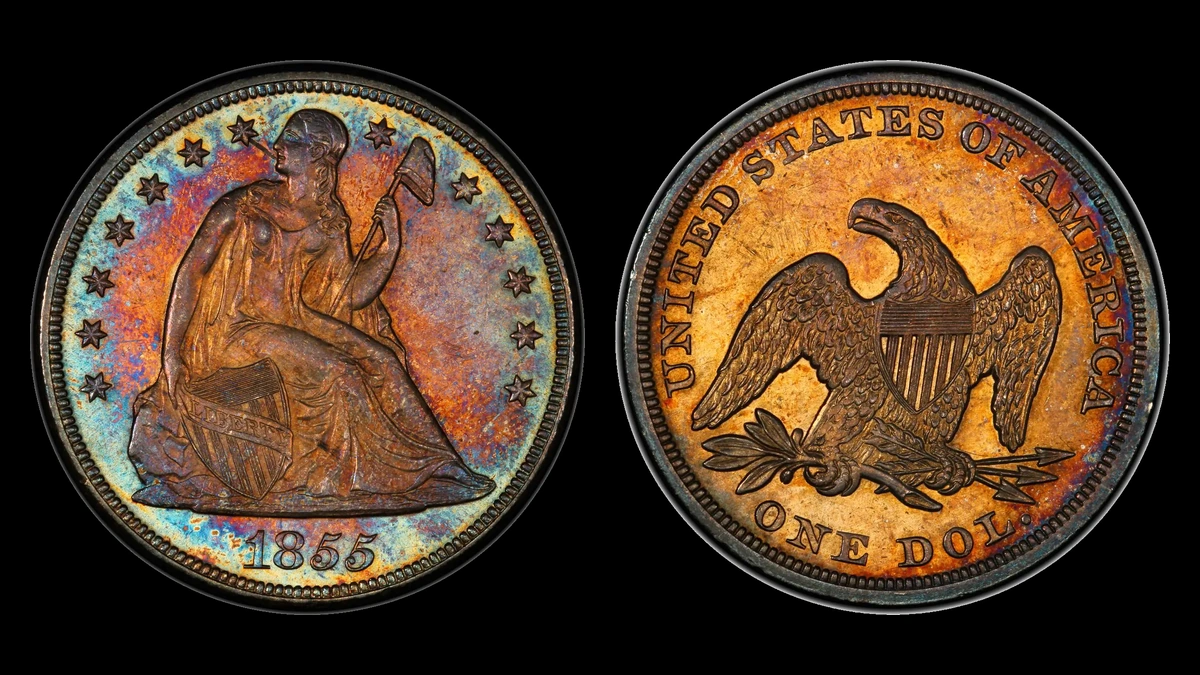
The word ONE provides a precise starting point for the documented feature in this 1855 Liberty Seated dollar error guide. A matching coin with light wear and earlier improper cleaning sold for $7,320 in July 2026.
Estimated whole-coin values span $1,000–$20,000 across different conditions. Trace the line between N and E toward the lower border, then check its height and the surrounding surface before choosing a comparison.
1855 Dollar A ridge descends from ONE toward the border: reverse die crack Error
A thin raised line begins in the space between N and E in ONE and slopes downward to the small border beads below E. Its path identifies a crack in the reverse die rather than an opening through the dollar.
During striking, silver entered the split in the steel tool and formed a raised copy. A scratch cut into the finished coin would have a different surface structure.
The documented ordinary dollar belongs to OC-1, a catalog designation for the pair of dies used together. That same pair had earlier produced specially prepared Proofs before this crack developed.
The feature therefore helps identify a later state of the tool. It does not imply that the coin itself changed from a Proof into an ordinary strike.
How to Identify
Set the eagle upright and keep the entire word ONE in view. Find the gap between N and E, then follow the suspected ridge toward the beads beneath E.
A line somewhere near the denomination is not enough. The angled route and its relationship with both letters and border need to match the documented feature.
Illuminate it from opposite sides under magnification. A die crack leaves a ridge, while a scratch has a recessed channel and may push metal upward only along its margins.
Include the surrounding untouched silver in photographs so the line’s height can be judged in context. Do not rub or polish the area to make it brighter.
Earlier Proofs preceded this crack in the shared die pair, but absence of the line alone does not prove Proof manufacture. Wear or weak visibility can also make small features difficult to assess.
The useful attribution combines the correct date and dollar design with the specific reverse route. A single enlarged dark streak cannot establish that full relationship.
What It’s Worth
$1,000–$20,000 is the supplied estimate for identified ordinary examples from worn through desirable unworn condition. The scarcity and preservation of the dollar account for much of the range.
The NGC AU Details OC-1 example at Heritage sold for $7,320 in July 2026. It retained About Uncirculated detail but carried an improper-cleaning designation.
Keep that condition problem attached to the price rather than shortening the description to an uncomplicated AU coin. The crack identifies a tool state; it does not cancel cleaning or create a fixed surcharge.
A smoother, more original example needs a different condition comparison, as does a heavily worn one. Both may show the line without sharing the auction specimen’s overall value.
Conclusion
Follow the raised line from the N–E space to the beads below E, keeping the whole word and border visible. Its route and height distinguish the documented die feature from a coincidental scratch.
The $7,320 result belongs to a scarce dollar with light wear and acknowledged cleaning. Use the full condition description when comparing another example, and do not let the presence or absence of one crack decide its manufacture type alone.