Rare 1899 Dollar Errors (List & Pictures)
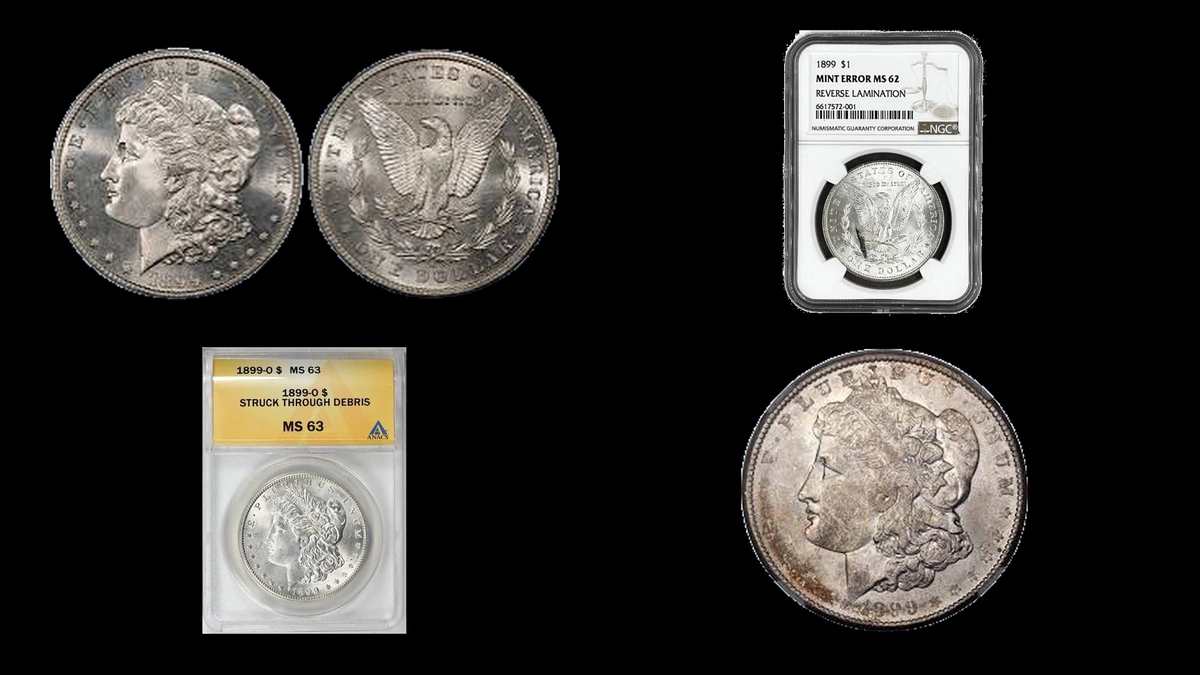
An 1899-O Micro O dollar graded PCGS MS66 brought $73,437.50 in June 2015. Estimated whole-coin values for the 1899 Morgan dollar errors and major varieties below span $75–$75,000.
Begin beneath the wreath and at the date, then examine the surface, the relationship between the two faces, and the coin’s outline.
| Clue | Category | Whole-coin range |
|---|---|---|
| Small O or a projection on S | Micro O or Spiked S | $75–$75,000 |
| Repeated final 9 or reverse detail | Repunched date or doubled die | $100–$15,000 |
| Peeling metal or embedded wood | Lamination or retained strike-through | $75–$1,500 |
| Extensively shallow design | Possible weak strike | $200–$2,000 |
| Tilted reverse after a controlled flip | Rotated die | $75–$1,000 |
| Expanded or displaced design | Broadstrike or off-center strike | $1,500–$10,000 |
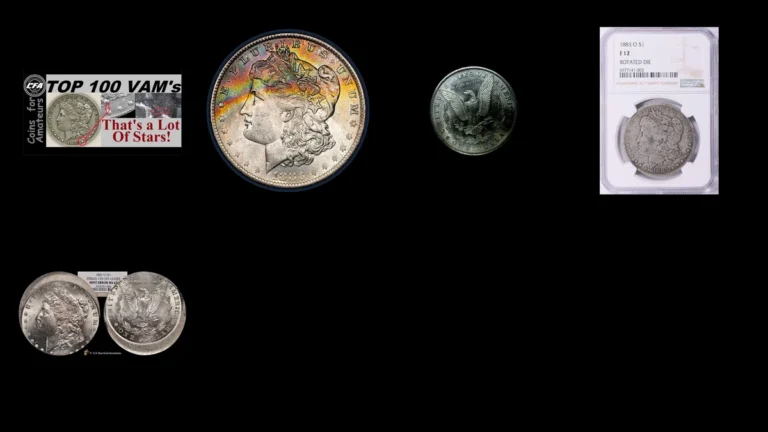
1. 1899 Dollar An unusually small New Orleans letter: Micro O Error
The small O beneath the wreath is the starting clue for several genuine 1899-O varieties. VAM-4, 5, 6, 31, and 32 belong to this broad Micro O group, with other details distinguishing their die combinations.
VAM numbers identify particular tools and their features, not a grade or price. VAM-5 also involves wing lines, so the small letter alone cannot determine every catalog number.
How to Identify
Compare the complete O with a normal 1899-O mintmark at equal magnification. A worn larger letter may look thin or incomplete without actually being the small variety.
Match the front and back to the claimed VAM reference, including its additional markers. Genuine 1899 Micro O varieties should not be rejected by applying counterfeit conclusions associated with certain other dates.
The whole coin still needs examination for an altered mintmark or copied design. Mintmark size is one part of authentication.
What It’s Worth
Estimated whole-coin values span $75–$75,000, from worn coins to exceptional unworn survivors.
PCGS records an MS66 result of $73,437.50 in June 2015. A VAM-31 AU53 example sold for $288 in May 2024, while a separate MS64+ brought $20,400 that September.
Those prices concern different coins and condition levels. The headline result is not a typical price for a circulated small O.
2. 1899 Dollar A projection attached to S: Spiked S Error
The reported 1899-S VAM-4 has a small projection from the mintmark beneath the wreath’s bow. Its Spiked S nickname describes the appearance without proving that the letter was punched twice.
How to Identify
Inspect how the projection joins the complete S under more than one lighting direction. Dirt beside a letter can appear attached in a single photograph.
Compare a normal S of similar wear, then an authenticated VAM-4 image. The supplied description does not specify a direction for the spike, so use the actual reference rather than guessing its position.
What It’s Worth
A correctly identified Spiked S has an estimated range of $100–$1,500 across worn through modest unworn grades.
No individual sale is supplied for this feature. High-grade 1899-S coins can exceed ordinary ranges through condition alone, so their entire price should not be attributed to the projection.
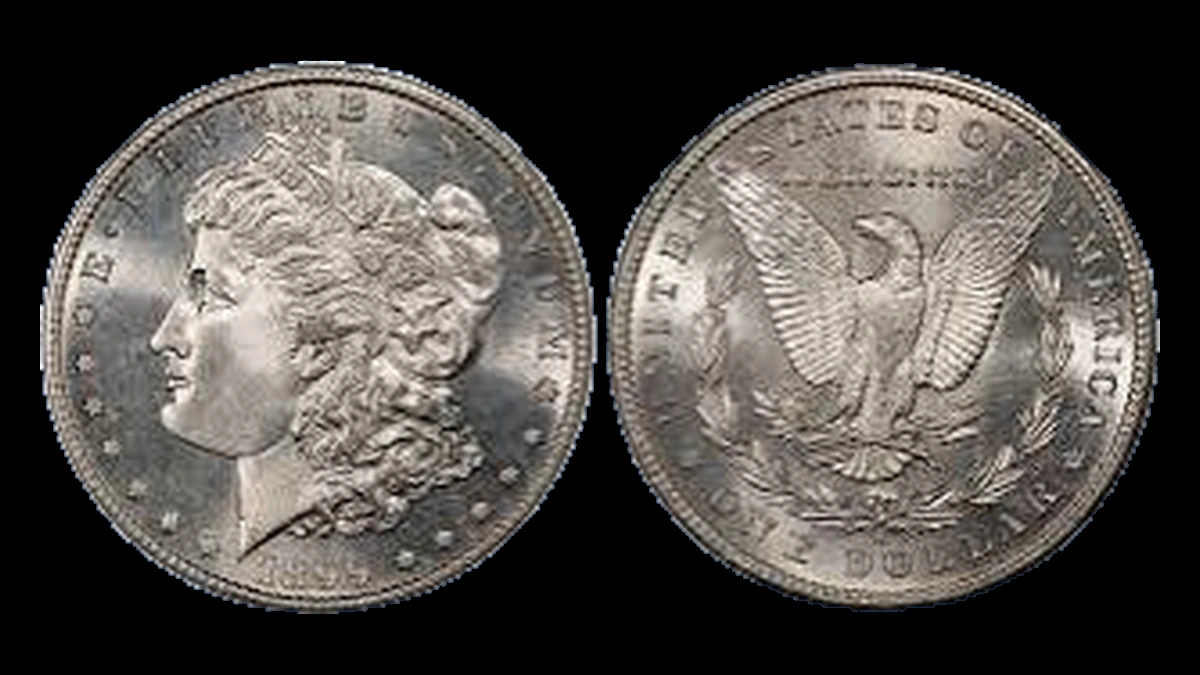
3. 1899 Dollar Extra outlines above and below the last 9: repunched date Error
San Francisco VAM-7 preserves repeated contours around the final 9. A worker applied the date punch more than once to the die, leaving traces at slightly different positions.
Although sometimes called a doubled date, this is specifically repunching of the date. It differs from doubling introduced during transfer of the larger die design.
How to Identify
Confirm S, then inspect both the top and bottom of the final 9. The two locations should agree with a documented VAM-7 close-up.
Move the light to separate raised contours from reflections or scratches. A flat shelf along the date or a worn bump beside one digit cannot establish the full pattern.
What It’s Worth
Estimated whole-coin values range from $100–$15,000, with preservation responsible for much of the spread.
PCGS records an MS67 VAM-7 at $14,400 in November 2017. That exceptional grade is central to the comparison, rather than the small repeated digit being worth that amount independently.
4. 1899 Dollar Repeated reverse contours: doubled die Error
New Orleans VAM-26 is reported with reverse doubling. Its die already carried the repeated detail, so a coin did not need a second strike to display the extra contours.
How to Identify
Use an authenticated VAM-26 image to establish which reverse details to inspect. The supplied account does not provide a reliable letter-by-letter diagnostic list.
Compare several neighboring features at equal magnification. Distinct raised contours differ from a flat ledge shaved beside a letter by movement during striking.
What It’s Worth
An authenticated 1899-O doubled-reverse variety has an estimated whole-coin range of $100–$1,000 across ordinary worn and unworn grades.
No individual auction result is supplied for VAM-26 here. Apply a variety premium only after the complete pattern matches.
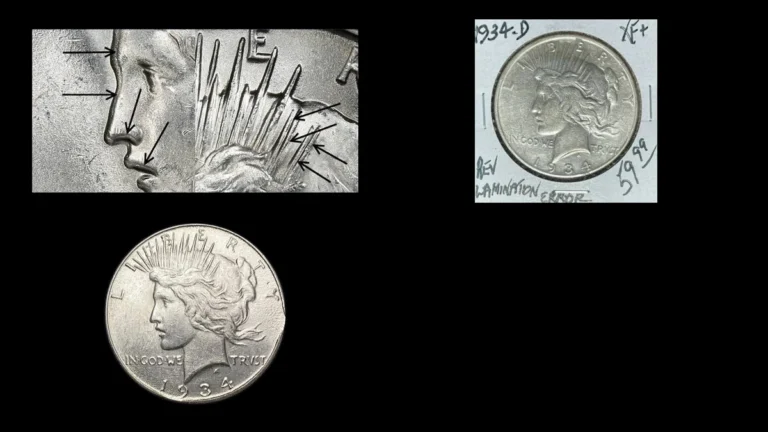
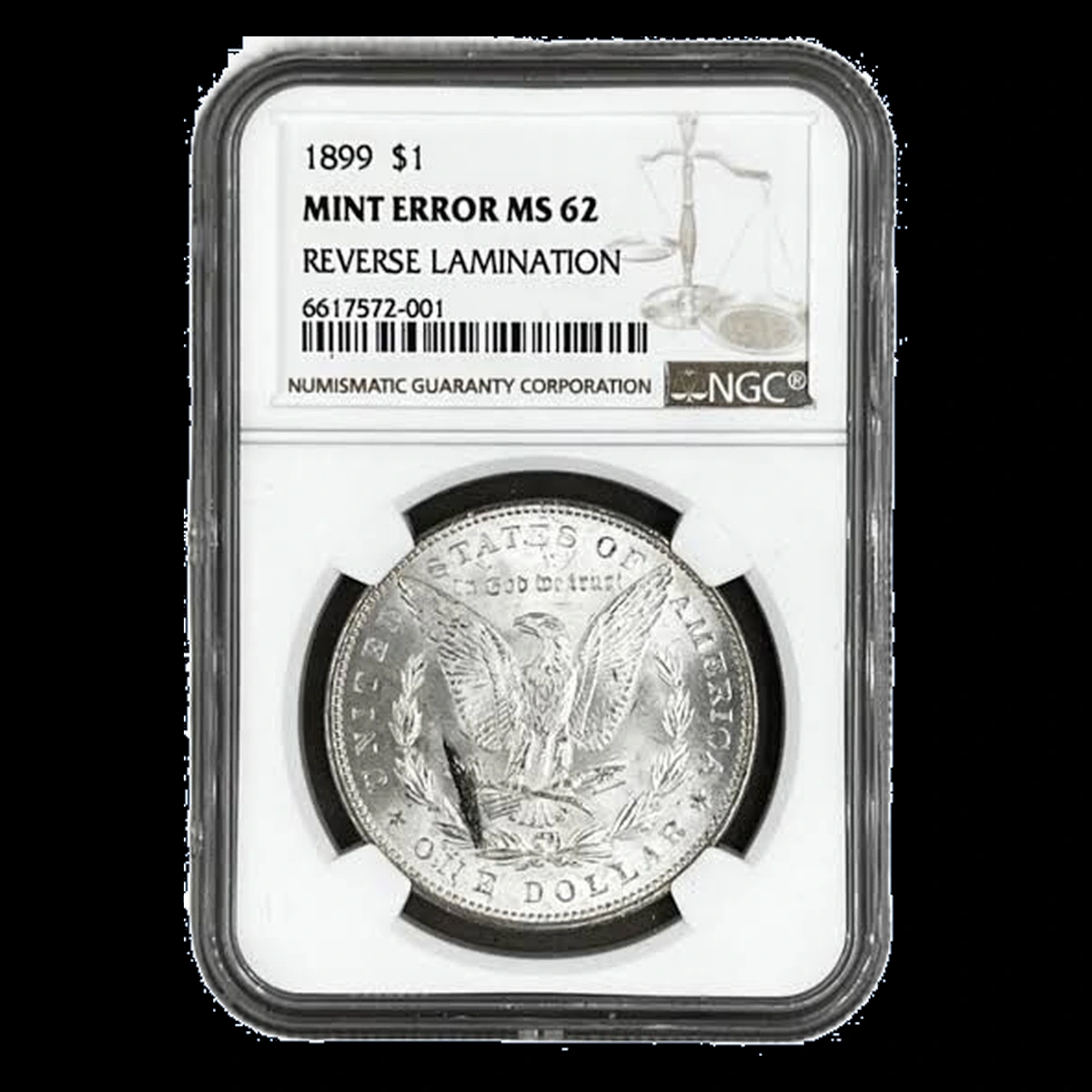
5. 1899 Dollar A loose flap or shallow missing strip: lamination Error
Lamination occurs when metal near the surface of the blank splits or peels. An 1899 MS64 example is reported without a firmly established mint, alongside a separate New Orleans discussion.
Neither report establishes a fracture through the entire coin. The feature concerns a surface layer within the silver alloy.
How to Identify
Photograph where the loose metal joins the coin and any original design remaining on it. Leave the flap in place.
A layered boundary supports separation, while a gouge may show tool cuts and displaced lips. Corrosion can roughen the surface without producing the same structure.
A normal Morgan dollar weighs 26.73 grams and measures 38.1 millimeters across. Small laminations may not remove enough metal for weight alone to be useful.
What It’s Worth
Authenticated 1899 laminations have an estimated whole-coin range of $75–$1,000. Mint, flaw size, and condition all matter.
A different-year 1923 Peace dollar with front lamination sold for $84 in March 2024. It is a general silver-dollar comparison rather than an 1899 Morgan sale.
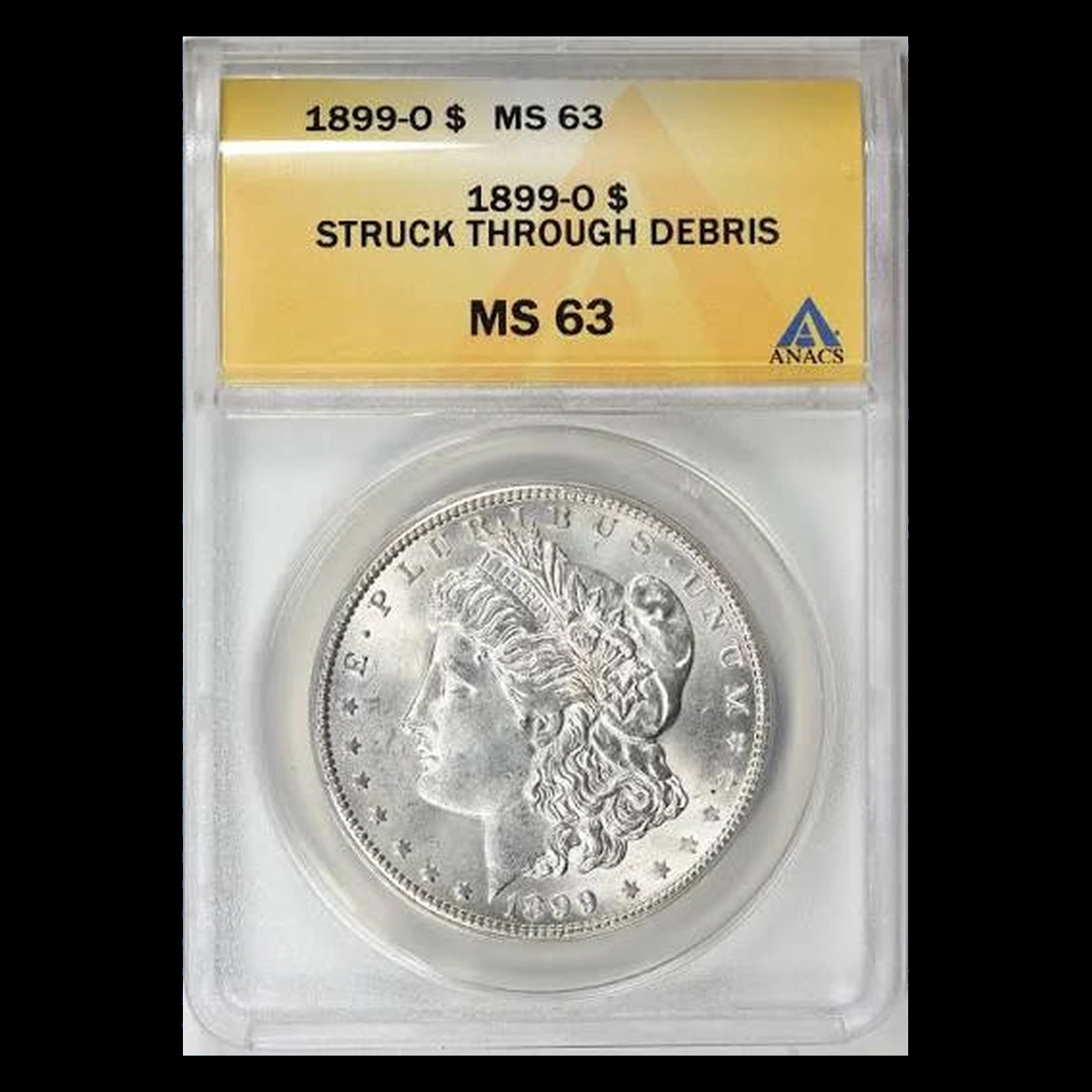
6. 1899 Dollar Wood remaining in a reverse impression: retained strike-through Error
A recorded 1899-O PCGS MS62 dollar retains part of a piece of wood on the reverse. The obstruction lay between the blank and die, receiving pressure that impressed its shape into the silver.
Both the depression and some of the material survive. Loose wood placed on a finished coin does not create the same relationship to the strike.
How to Identify
Leave the material undisturbed and inspect how the struck silver meets it. Brown color alone cannot distinguish wood from dirt, toning, or corrosion.
Compare multiple angled views with the recorded example. No clock position is established in the supplied description, so the embedded boundary is more useful than an assumed location.
What It’s Worth
Comparable genuine retained-wood examples have an estimated range of $250–$1,500.
The PCGS MS62 coin sold at Heritage for $504 on October 10, 2022. MS62 indicates an unworn coin with noticeable marks.
If the wood has been removed, value the remaining impression on its own evidence. It no longer has the intact retained-object display of the sold specimen.
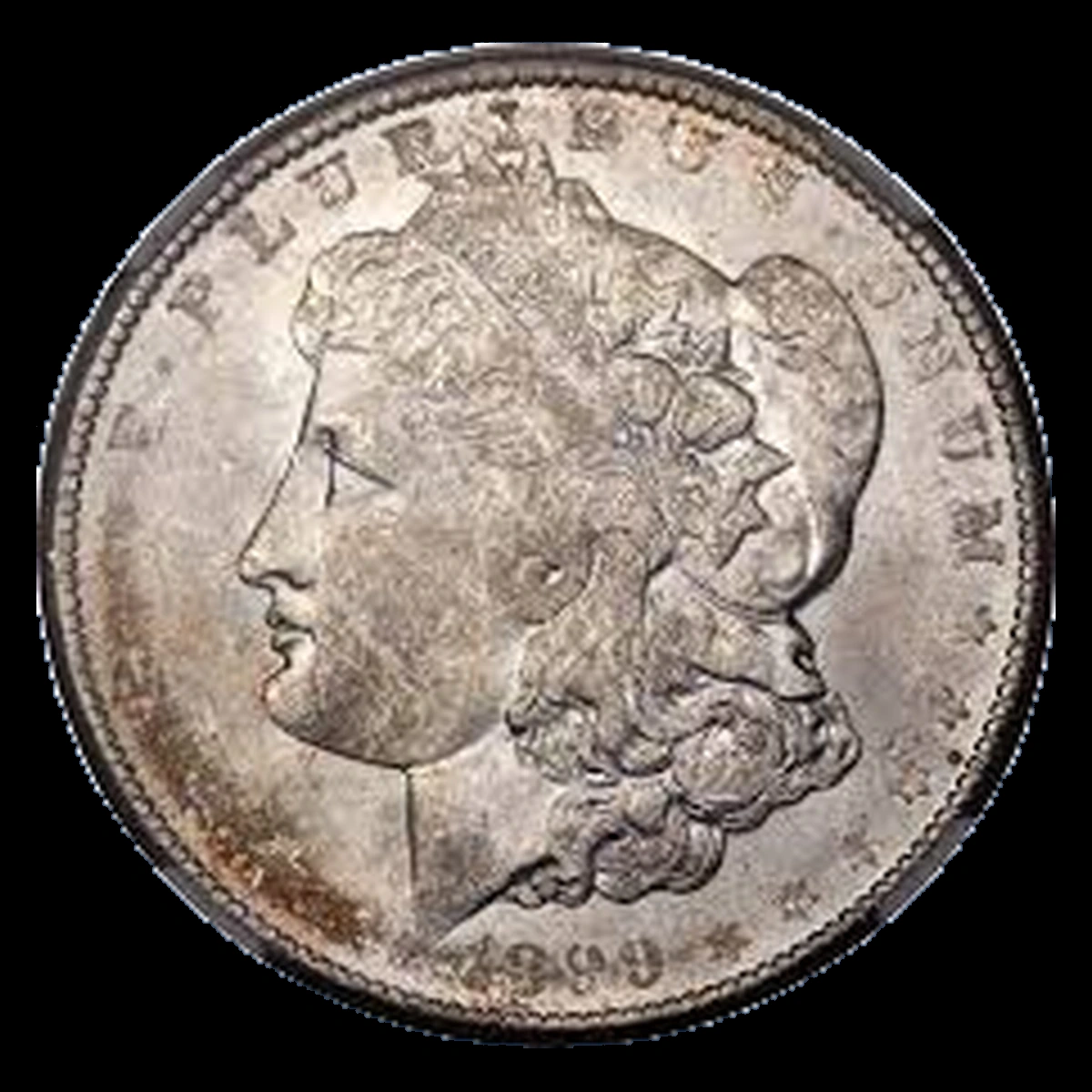
7. 1899 Dollar Broadly shallow detail with original texture: possible weak strike Error
Insufficient pressure or an unsuitable space between dies can leave much of the design shallow. A die-adjustment explanation suggests the press was being set up, but weak detail alone cannot establish that history.
The supplied 1899 report fixes neither a mint nor a certified specimen. It remains a possible striking failure requiring surface evidence.
How to Identify
Compare weak areas with protected detail and exposed high points. Circulation wear usually smooths the high points, while a weak strike may preserve original texture beneath shallow design.
Ordinary New Orleans Morgans can have soft central detail, so use a normal same-mint comparison. Polishing and corrosion can also erase design, and normal weight does not prove press adjustment.
What It’s Worth
The conditional whole-coin estimate is $200–$2,000 for a substantial authenticated weak strike.
This range does not apply to ordinary soft centers or later surface damage. No specific sale of a verified 1899 die-adjustment example is supplied.
8. 1899 Dollar A tilted eagle after a top-to-bottom flip: rotated die Error
On a normal dollar, holding Liberty upright and flipping the coin top to bottom brings the eagle upright. A die mounted at an incorrect angle changes that relationship.
Rotated reverses are recorded for 1899-O, without one angle specified for all examples.
How to Identify
Align Liberty with a vertical guide and turn the coin around a horizontal axis without a sideways wrist movement. Repeat the same flip several times to check that the eagle’s tilt recurs.
For a holdered coin, turn the entire holder. Consistent photographs can be used to measure the angle; a crooked auction image or a side-to-side flip cannot establish rotation.
What It’s Worth
A genuine 1899-O rotated-die dollar has an estimated whole-coin range of $75–$1,000.
No particular realized price is supplied. A small rotation may add little, while a pronounced repeatable angle provides a clearer display.
9. 1899 Dollar Expanded metal outside a complete design: broadstrike Error
A reported New Orleans broadstrike spread without the normal restraint of the collar. That ring ordinarily controls the width and forms the edge grooves.
The enlarged outline can be uneven while the full design remains present. Partial collar is different: part of the edge was still confined.
How to Identify
Compare the loose coin’s width in several directions with the normal standard above, or use side views through its holder. Check for outward spread and the absence of normal collar restraint.
A step between grooved and expanded bands suggests partial collar instead. Flattened artwork and unnatural crushing may reveal a finished coin widened by later pressure.
What It’s Worth
An authenticated 1899-O broadstrike has an estimated whole-coin range of $1,500–$8,000.
A different-design 1921 Peace dollar broadstrike graded NGC AU58 sold for $7,762.50 in January 2009. That is not an auction record for the reported 1899 coin.
10. 1899 Dollar A high design and lower blank crescent: cataloged off-center strike Error
The recorded 1899-O PCGS XF45 dollar has its front design shifted toward 12 o’clock and its date close to the edge. Heritage describes it as 5% off center while noting that the full design remains visible.
That description also makes an uncentered-broadstrike comparison useful. The 2024 and 2025 listings concern the same coin, not two separate discoveries.
How to Identify
Compare the high design, narrow lower crescent, edge, and O mintmark with the actual auction photographs. Dark toning can hide the strike boundary in an unevenly lit image.
Preserve the holder and auction attribution when discussing this specimen’s result. At the same time, full design visibility alone does not prove an off-center mechanism on another coin.
Examine both faces and the edge before distinguishing a displaced strike from an uncentered broadstrike. An undated example cannot acquire an 1899 identity merely from a similar shape.
What It’s Worth
The estimated whole-coin range for genuine 1899 off-center dollars is $2,000–$10,000.
This PCGS XF45 example sold for $3,360 on August 31, 2025. Its clear date and mintmark support that specific comparison despite its circulation wear.
Conclusion
A small mintmark, repeated digit, embedded object, and expanded outline each tell a different story on an 1899 Morgan dollar. Start with a precise observation and match the correct mint and variety.
Condition accounts for much of the largest price differences, especially among Micro O coins. Keep recurring auction appearances tied to the same specimen and preserve loose metal or retained material while documenting the feature.