Rare 1904 Half Dollar Errors (List & Pictures)
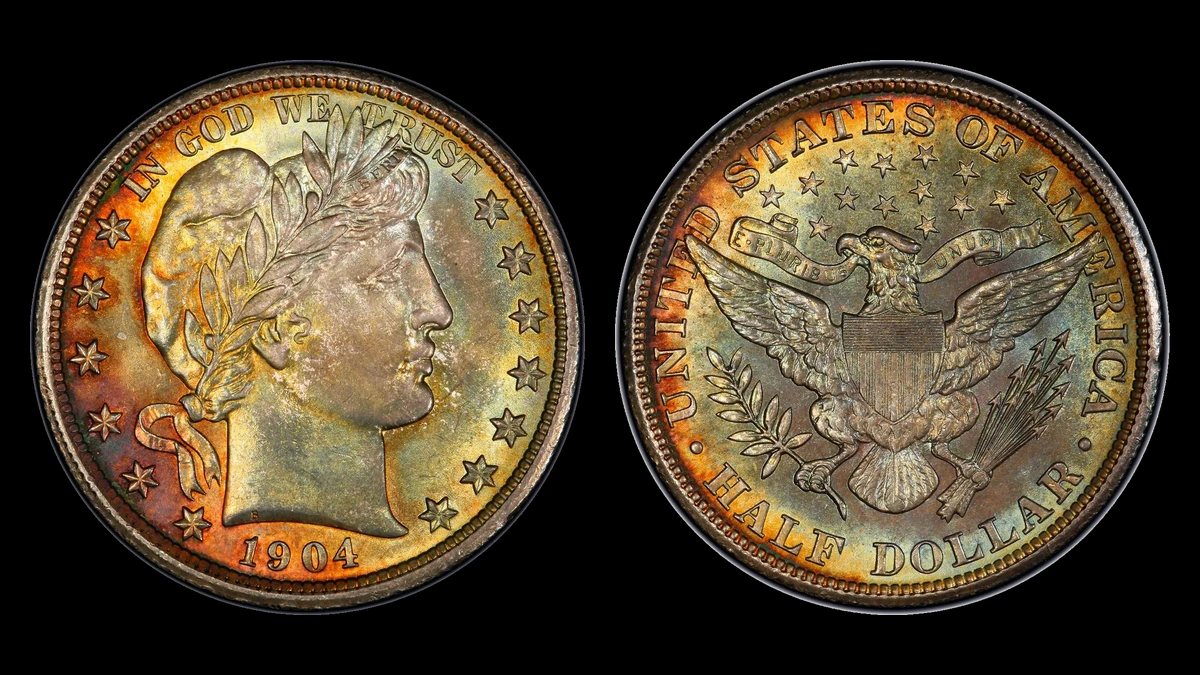
A broad missing portion of the design and two tiny portrait lines lead to very different 1904 half dollar errors. The estimated $150–$138,000 span combines circulated off-center coins with an exceptional San Francisco rarity.
The upper figure is the Duckor 1904-S’s documented $138,000 sale in 2010, driven by its remarkable MS67 preservation. Begin with the coin’s outline, then use the portrait checks below to understand the fine cracks on that specimen.
Establish Which Coin You Have
On the back, O means New Orleans and S means San Francisco; an intact mintmark area with no letter identifies Philadelphia. If that part of the design never reached an off-center coin, the missing letter cannot identify its mint.
A normal half dollar of this date weighs 12.50 grams when unworn and measures about 30.6 mm across. Its edge has narrow grooves, though a faulty strike can affect the outline and edge.
1904 Half Dollar Design Missing Beside Blank Metal: Off-Center Strike Error
An unstruck crescent should draw your attention before a missing letter does. On an off-center half, the blank metal sits beside a design that extends beyond the available space.
The border between blank metal and stamped design marks how far the coin lay beneath the dies. These steel stamping tools caught only part of the misplaced blank when they came together.
A 1904 half dollar guide reports the error for Philadelphia, New Orleans, and San Francisco. It does not identify a certified example from every mint, so those reported categories still require coin-by-coin confirmation.
How to Identify
Photograph both sides without cropping out the rim. An off-center strike should show displaced designs on both faces, while movement of only one die can leave the opposite design centered.
See how much of 1904 remains readable and inspect whatever survives of the mintmark area. The direction of the shift determines which identifying details are lost.
Look closely where the design meets the blank crescent. Filing, cut edges, or crushed metal can expose a later alteration instead of a genuine unstruck area.
Small missing details within an otherwise complete design are a different problem. They do not establish that the whole blank was misplaced during striking.
What It’s Worth
Estimated range: $150–$1,000 for circulated examples with a readable date. The year guide describes values from $150 to more than $1,000, with the amount of displacement and condition influencing the result.
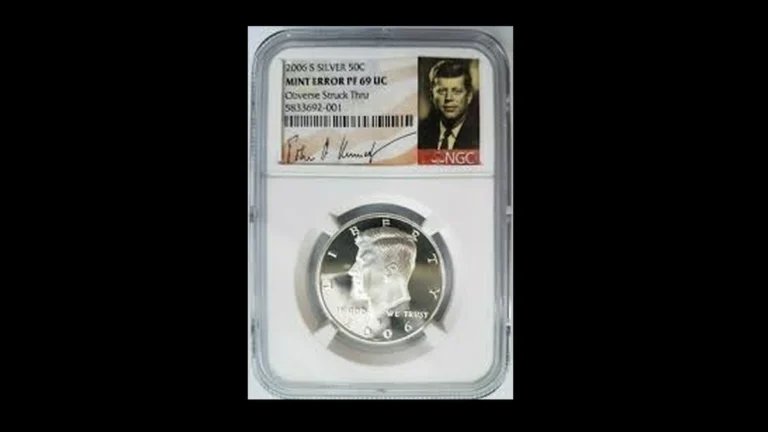
A 1976 Kennedy half struck fifteen percent off center sold for $480 at Heritage in December 2025. Its NGC MS64 grade denotes an unworn coin, so it differs from the circulated Barber examples covered by the estimate.
The comparison demonstrates a market price for the same general striking fault. It is not a recorded 1904 sale, and the two coins also differ in design and metal.
1904 Half Dollar Fine Raised Lines on the Portrait: Obverse Die Cracks Error
The Duckor 1904-S carries a thin ridge across the sloping bottom of Liberty’s bust. A second, fainter line lies on her cap.
Cracks opened in the front die and filled with silver when it struck the coin. “Obverse” means the front, and the resulting raised lines do not mean the half dollar itself split.
Heritage also described roller lines from preparing the metal before striking. Those preparation marks are separate from the two cracks, and the back was described without corresponding cracks.
How to Identify
After confirming the S below the eagle’s tail, return to the portrait. Trace the sloping base of the bust under magnification, then examine the cap with the light shifted to reveal the weaker line.
Compare the two locations together with the Duckor coin’s photograph. Finding an unrelated ridge elsewhere on a 1904-S does not identify the same die state.
A scratch lies below the surface and may have a bright pushed-up edge. Judge the full shape under changing light rather than taking one bright line as proof of a crack.
What It’s Worth
Estimated range: $90,000–$138,000 for an exceptional MS67 coin comparable to the Duckor specimen. MS67 indicates superb preservation without circulation wear.
The PCGS MS67 CAC Duckor coin sold for $138,000 at Heritage in August 2010. PCGS records its later sale at $91,062.50 in August 2015.
These are two prices for the same outstanding San Francisco coin. Its scarce issue and preservation explain the price level; matching a small crack on a worn piece would not justify the same valuation.
Conclusion
A blank crescent calls for an examination of both designs, while the Duckor crack comparison calls for close inspection of the lower bust and cap. Each feature needs its own evidence.
The broad $150–$138,000 span combines very different coins. Keep ordinary circulated off-center estimates separate from the exceptional MS67 San Francisco specimen, whose condition and rarity account for its major auction prices.