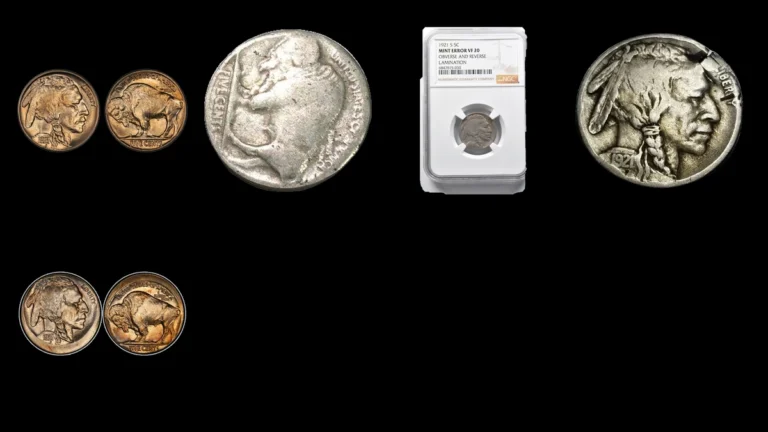
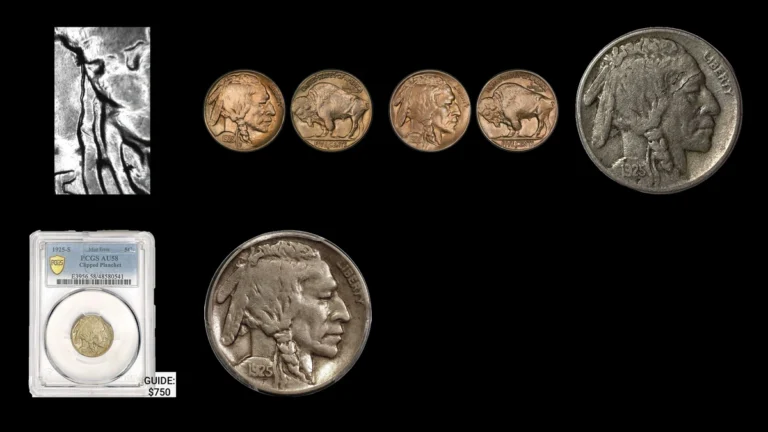
Rare 1917 Nickel Errors (List & Pictures)
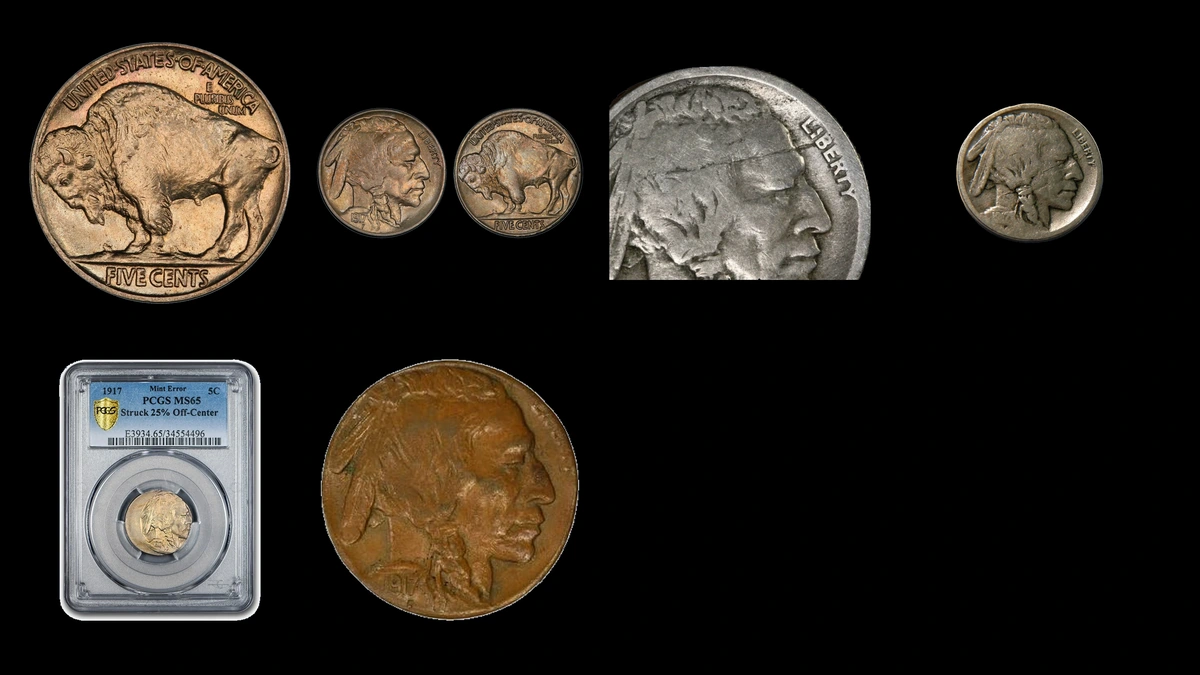
Small reverse lettering can matter more than a dramatic change in shape: a 1917 doubled-reverse nickel sold for $11,500. Its extra raised strokes were already present in the die.
Estimated whole-coin values for 1917 nickel errors span $10–$15,000. Begin with the lettering and missing design details, then distinguish raised breaks, separating metal, displaced strikes, and a design struck on the wrong blank.
| Clue | Likely category | Estimated range |
|---|---|---|
| Separated reverse letter strokes | Doubled die reverse | $100–$15,000 |
| Small feather or part of a leg absent | Polished-die variety | $40–$6,000 |
| Raised line or rim patch | Die crack or cud | $10–$400 |
| Peeling layer or matching split pieces | Lamination or split after striking | $10–$2,500 |
| Blank crescent beside missing design | Off-center strike | $400–$3,500 |
| Design crowded onto copper-colored metal | Cent-planchet strike | $1,500–$6,000 |
1. 1917 Nickel Reverse Letters Have Distinct Extra Strokes: Doubled Die Reverse Error
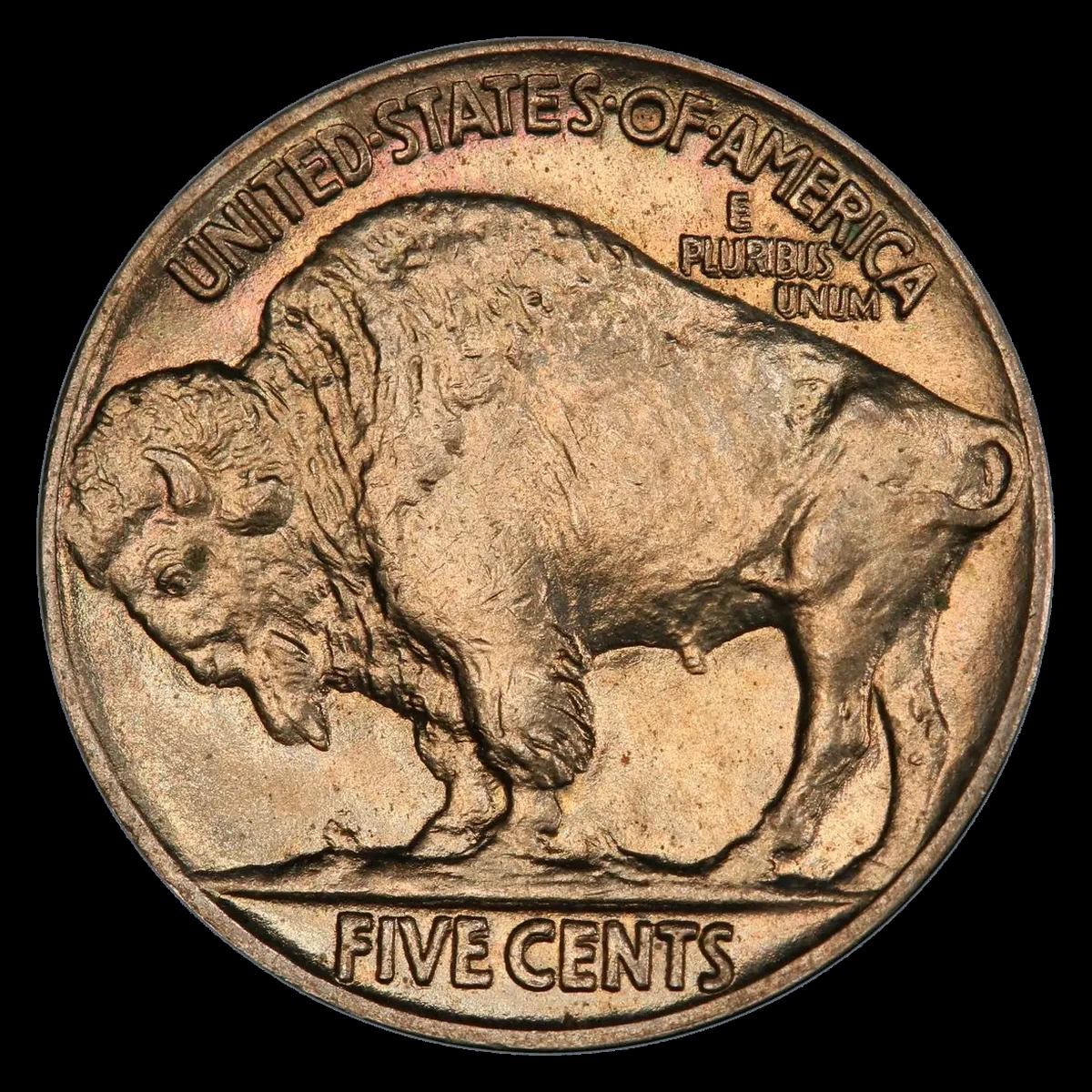
Start with E PLURIBUS UNUM above the buffalo and look for separated raised outlines. Philadelphia varieties FS-801 and FS-802 record doubling introduced while the dies were being prepared.
How to Identify
Match the entire group of affected letters to photographs of the specific variety. An isolated thick stroke, a bright reflection, or a flat shelf is weaker evidence than repeated rounded separation in the correct locations.
These Philadelphia coins have no letter below FIVE CENTS. The FS numbers describe distinct die varieties, not separate strikes delivered to the same coin.
What It’s Worth
$100–$15,000 is an estimated range across varieties and grades. A well-preserved, clearly attributed coin belongs in a different price comparison from a worn piece with faint doubling.
An FS-801 graded MS64 sold for $11,500 at Bowers & Merena on June 17, 2010, according to PCGS. That named-variety result is not a general price for doubled-looking lettering.
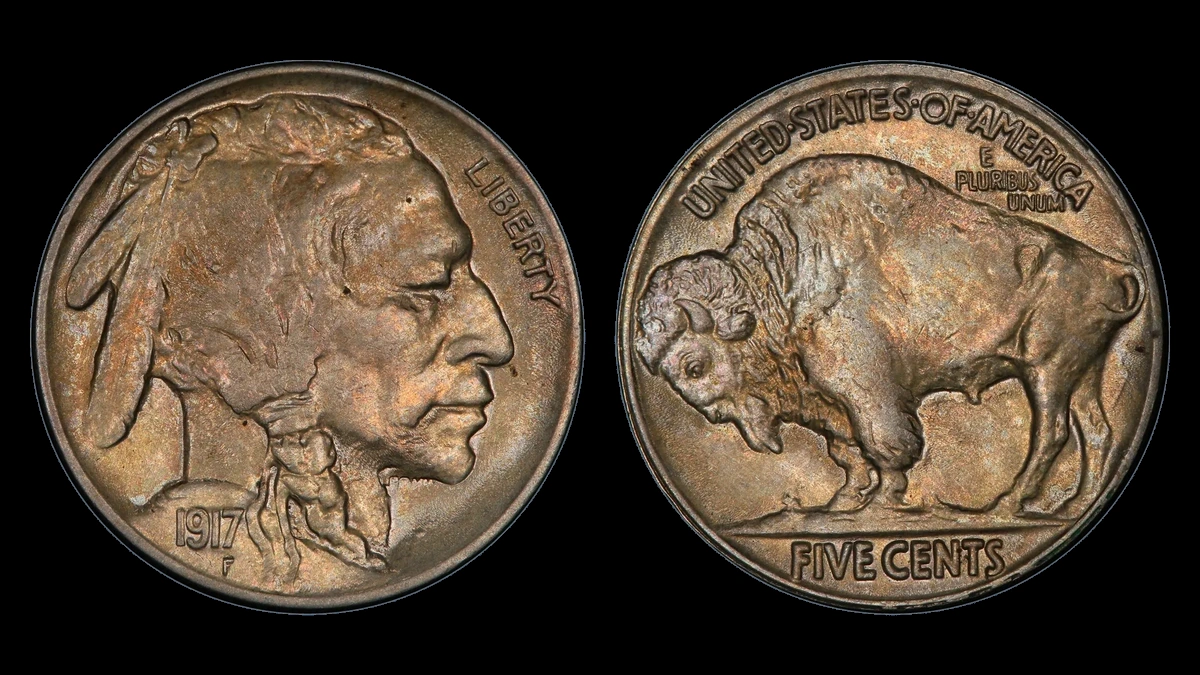
2. 1917 Nickel A Feather or Part of a Front Leg Is Missing: Polished-Die Varieties Error
Heavy polishing can erase shallow details from a working die while leaving stronger nearby features intact. Two Feathers varieties concern the small feather behind the portrait’s neck, while the 1917-D Three-and-a-Half Legs variety concerns the buffalo.
How to Identify
Read the mint below FIVE CENTS before selecting an attributed comparison: Two Feathers examples are reported for Philadelphia, Denver, and San Francisco. Examine the small inner feather beside the neck rather than anything near the buffalo’s tail.
A slight feather remnant can survive, so the diagnosis depends on the matching shape and neighboring detail. Uniform wear across the portrait or scraping at the feather does not reproduce a polished-die pattern.
For the Denver leg variety, follow the affected front leg through the middle toward the hoof and compare it with a confirmed 1917-D. The later 1937-D variety has different diagnostics, and the missing feather and partial leg need not occur together.
What It’s Worth
$40–$6,000 is a broad estimate covering different mints, varieties, and levels of preservation. Two Feathers coins with heavy wear should not inherit the value of a sharp scarce leg variety.
A 1917-D Three-and-a-Half Legs nickel graded MS63 brought $2,640 at Heritage in August 2019. An AU58 example of that same variety sold for $1,410 in February 2017.
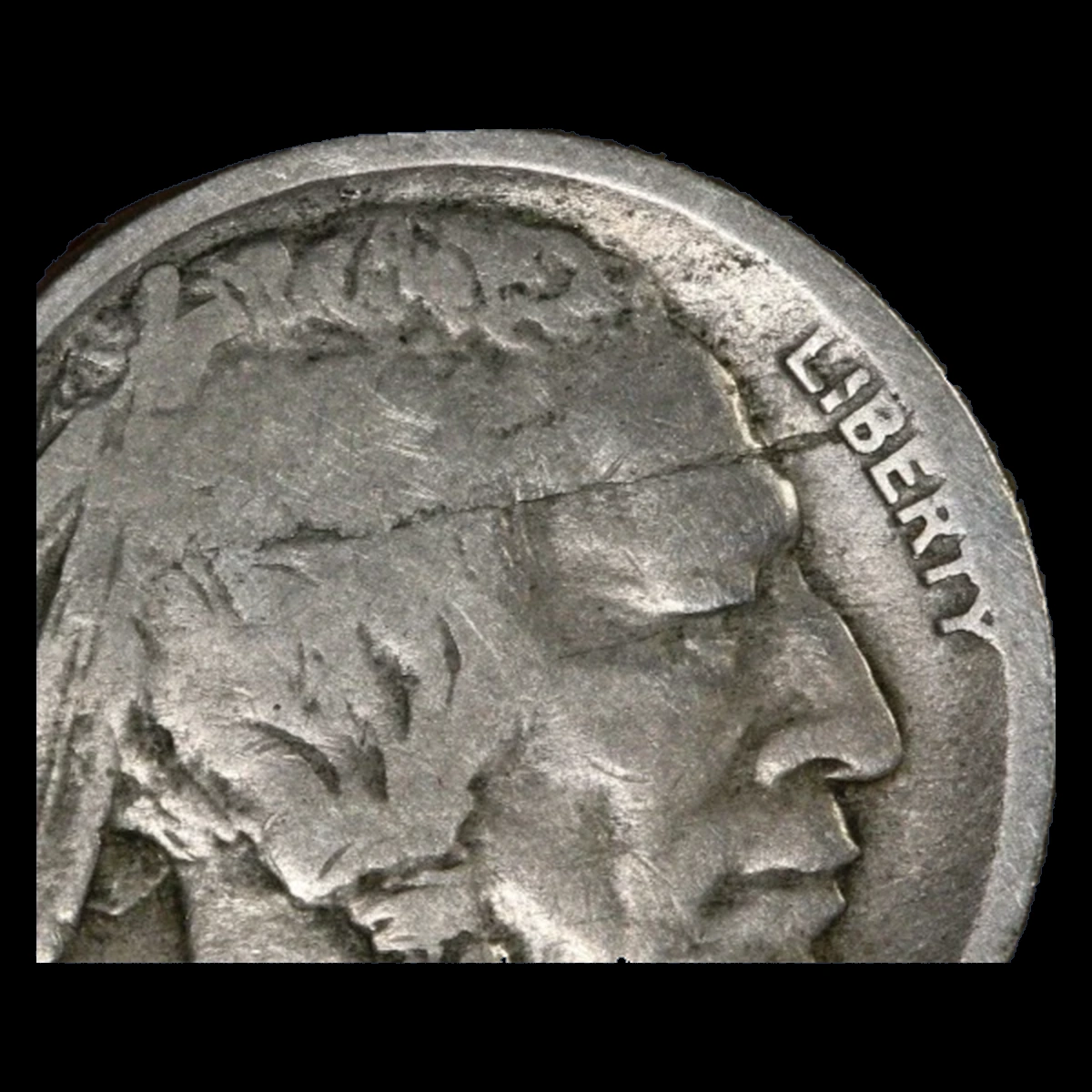
3. 1917 Nickel Raised Metal Forms a Line or Rim Platform: Die Crack or Reported Cud Error
A raised line above the portrait can come from metal entering a crack in the die. A larger patch connected to the rim can be a cud, formed where part of the die’s edge broke away.
How to Identify
Examine the center of a line under low light to distinguish a ridge from a cut with raised edges. For a larger patch, check its continuity with the coin and look for an impact along the nearby rim.
A worn 1917-S collector specimen has a reported platform-like area beneath the date. That particular feature remains unconfirmed and needs examination for damage or counterfeit characteristics before it is accepted as a mint-made cud.
What It’s Worth
$10–$100 is an estimate for modest genuine cracks, with a clear authenticated rim break potentially reaching $400. Mint, wear, and the size of the feature affect these whole-coin estimates.
No completed sale or authentication is supplied for the reported 1917-S platform. Merely touching the rim does not entitle that piece to the cud estimate.
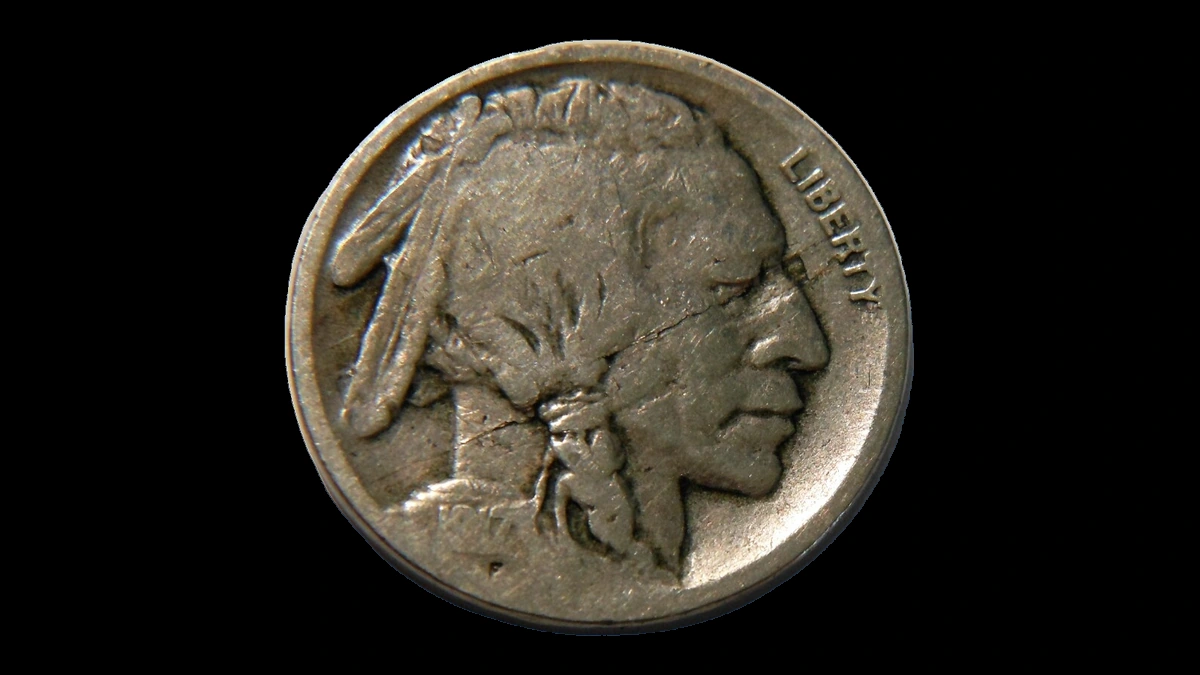
4. 1917 Nickel Surface Metal Peels or the Coin Separates into Two Pieces: Lamination and Split Pair Error
A weakness inside the alloy can leave a thin surface flap or extend through the coin’s full diameter. In a split after striking, one separated piece can retain the portrait and the other the buffalo.
How to Identify
Leave attached flakes in place and examine their layer boundaries. On separated pieces, rough complementary inner surfaces and matching outlines support a genuine pair more than two merely similar thin disks do.
Compare without pressing the pieces together, and look for saw marks or smooth machining that would suggest alteration. The recorded 1917 pair consists of two NGC MS64 pieces from one original coin.
A normal Buffalo nickel weighs about 5 grams, measures 21.2 millimeters, and has a plain edge. A pair’s combined weight can be compared with that standard, allowing for lost material; the same measurements help assess the remaining errors below.
What It’s Worth
$10–$2,500 is an estimated range from small worn laminations through attractive matching split pairs. An isolated piece should not automatically receive the price of both partners.
NGC reports that the 1917 MS64 pair realized $1,260 at Heritage in June 2023, including the buyer’s fee. That was the total for both pieces of one original nickel.
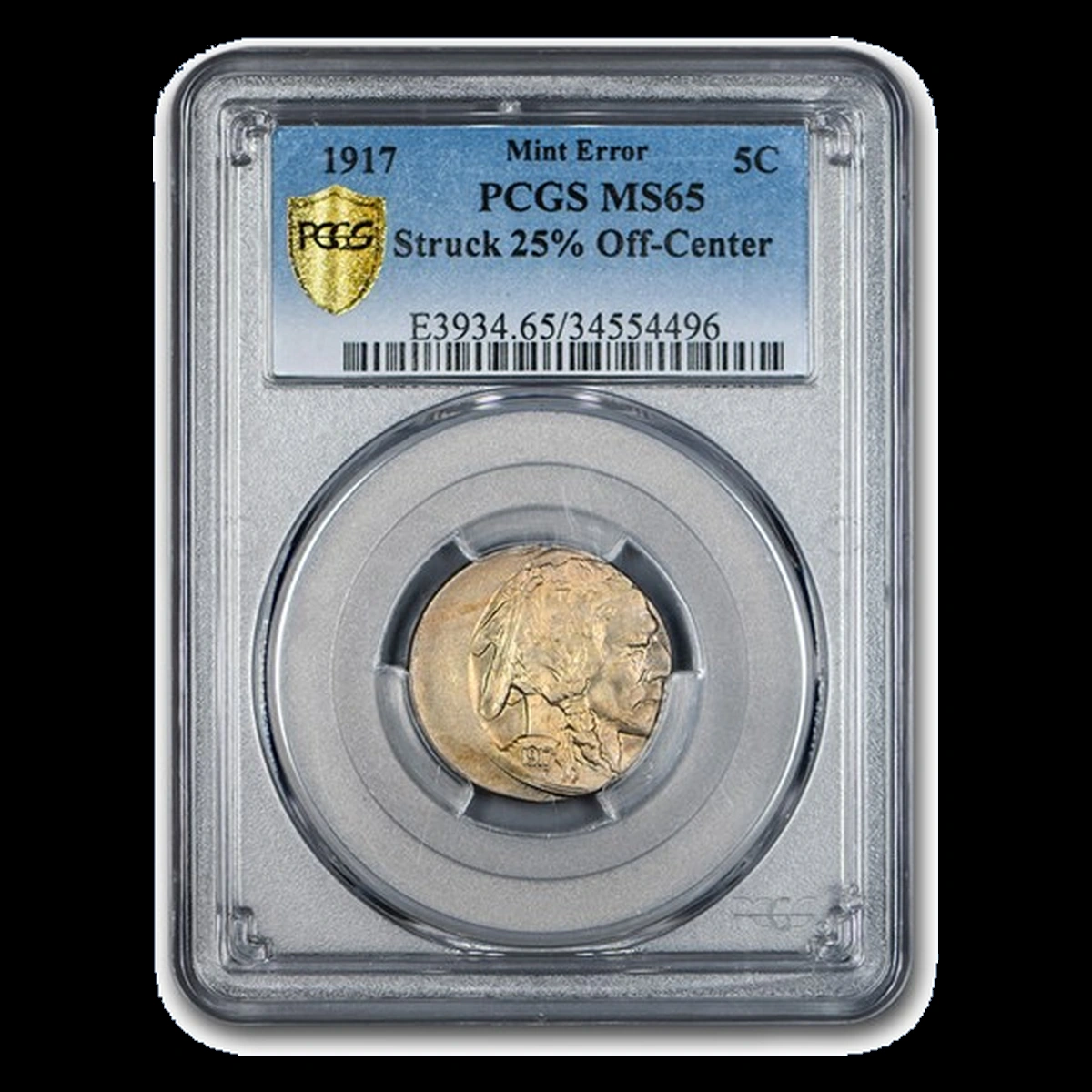
5. 1917 Nickel The Design Ends beside an Unstruck Crescent: Off-Center Strike Error
A blank that enters the striking area in the wrong position can retain an untouched crescent while losing part of the design beyond its edge. Recorded 1917 examples include roughly 25%, 40%, and 45% offsets.
How to Identify
Read the surviving date and inspect both faces where the design meets the unstruck metal. The displaced details should explain the same original strike, without grinding marks or later cuts creating the blank-looking area.
Check whether the mint-mark area actually survives. A missing area beneath FIVE CENTS leaves the mint unidentified; it does not prove Philadelphia.
What It’s Worth
$400–$3,500 is an estimated range for clearly dated 1917 off-center nickels. Wear, scratches, and the surviving date matter along with the amount of displacement.
A 1921 example struck 45% off-center sold for $2,300 in NGC MS63 in September 2009, with its mint unidentified. That is a different-year comparison, not a completed sale of the supplied 1917 collector examples.
6. 1917 Nickel The Buffalo Design Crowds a Smaller Brown Disk: Cent-Planchet Strike Error
The nickel dies can strike a blank intended for a cent if the wrong disk reaches the press. A recorded 1917 example is graded PCGS MS64 Brown, with some outer design lost beyond the smaller copper-rich blank.
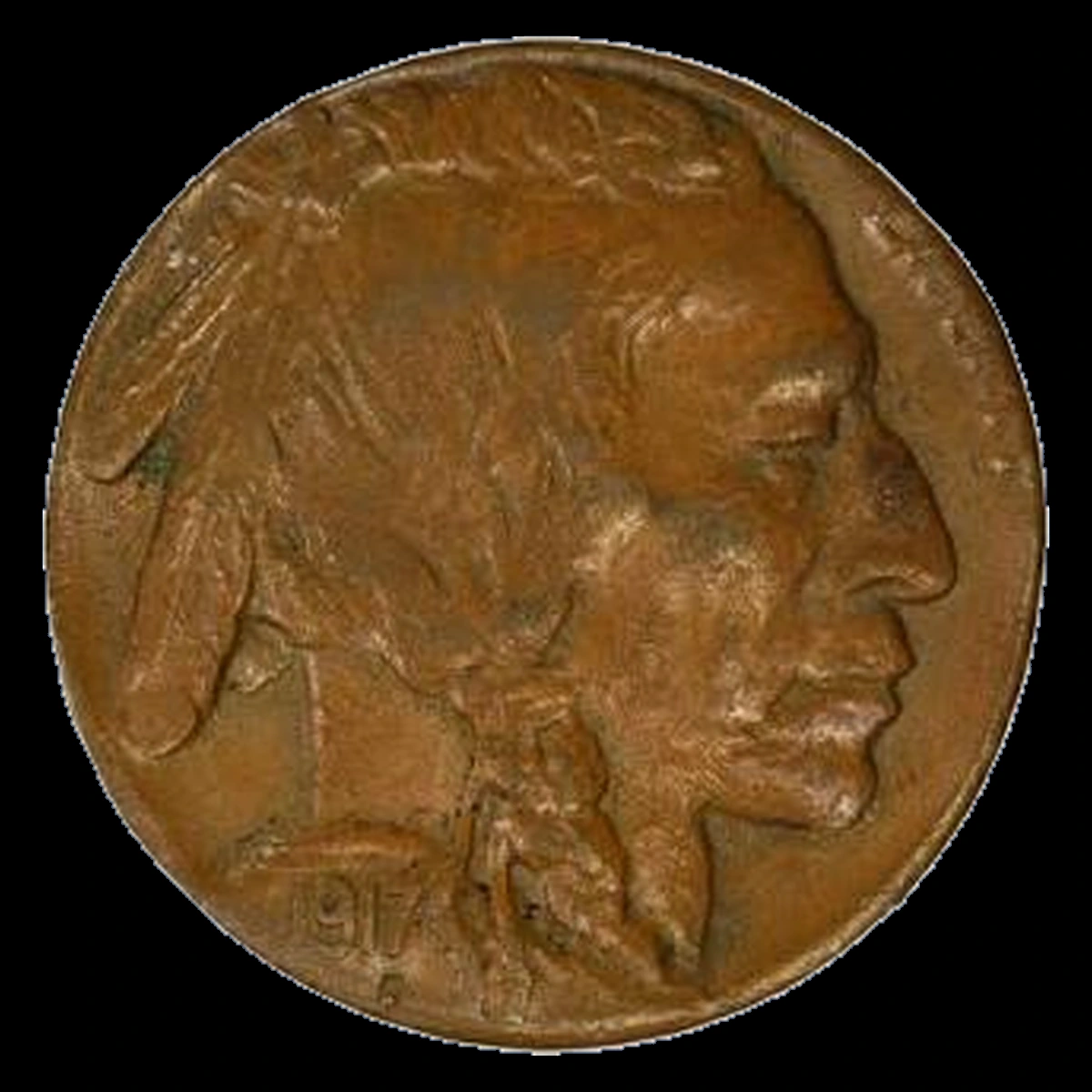
How to Identify
A contemporary cent blank normally weighed 3.11 grams and measured 19 millimeters before striking. Its dimensions can change under pressure, so combine measurements with the naturally incomplete nickel design and a nondestructive composition check.
Inspect the edge for cutting, grinding, or plating that could imitate the color or size. The supplied record does not establish the mint merely from a missing visible letter.
What It’s Worth
$1,500–$6,000 is an estimated range for an authenticated 1917 cent-planchet error. The recorded MS64 Brown coin is unworn, but the supplied material does not assign it a completed sale price.
A 1936 Buffalo nickel on a cent blank brought $3,290 in AU55 at Heritage in June 2017. That separate-year sale provides context while readable detail and surface quality remain individual pricing factors.
Conclusion
Several valuable 1917 nickel varieties need precise comparisons of small features, especially reverse lettering, the inner feather, and the buffalo’s front leg. Larger shape changes still require both faces and the edge to tell a consistent story.
Keep the reported San Francisco rim platform conditional, and preserve thin flakes or split pieces without manipulating them. When a strike omits the mint-mark area, record the missing information instead of assuming Philadelphia.