Rare 1957 Half Dollar Errors (List & Pictures)
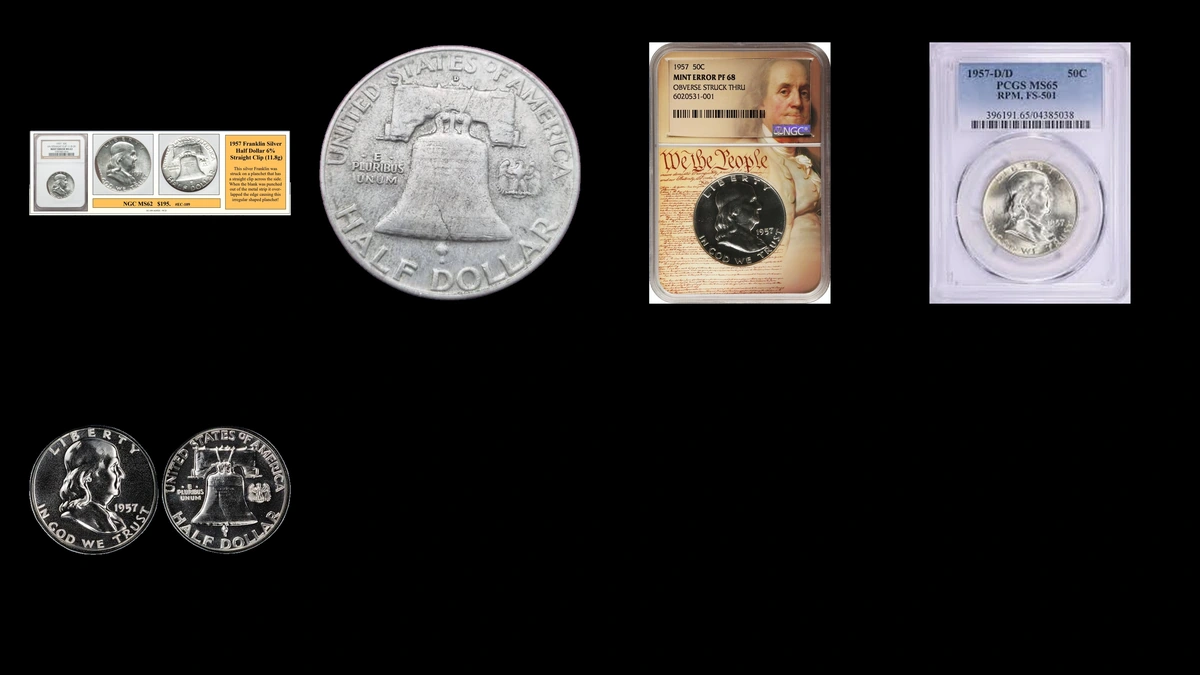
Wrong blanks create some of the most visible 1957 half dollar errors: a documented quarter-blank strike sold for $1,145.63 in 2013. A different-year nickel-blank half, dated 1962-D, brought $4,312.50 in 2009.
The supplied estimates range from $40 to $7,500 across the categories below. Begin with size and outline, then inspect the surface, Franklin’s mouth, and the bell-side lettering and mintmark.
| Clue | Error or variety | Estimated range |
|---|---|---|
| Much lighter and smaller | Wrong planchet | $1,200–$7,500 |
| A gap in the rim | Clipped planchet | $75–$400 |
| Blank crescent with shifted design | Off-center strike | $150–$1,500 |
| Separating front layer | Lamination | $50–$300 |
| Depressed or weak patch | Strike-through | $75–$750 |
| Raised “tooth” at upper lip | Bugs Bunny clash report | $40–$200 |
| Extra curve beside D | Repunched mintmark | $40–$150 |
| Repeated reverse-letter outlines | Proof tripled die reverse | $250–$2,500 |
A normal 1957 Franklin half weighs 12.50 grams, measures about 30.6 millimeters, and has a grooved edge. Identify the mint and finish too: Denver coins have a D above the bell, while Philadelphia made both ordinary strikes and specially manufactured proofs without a mintmark.
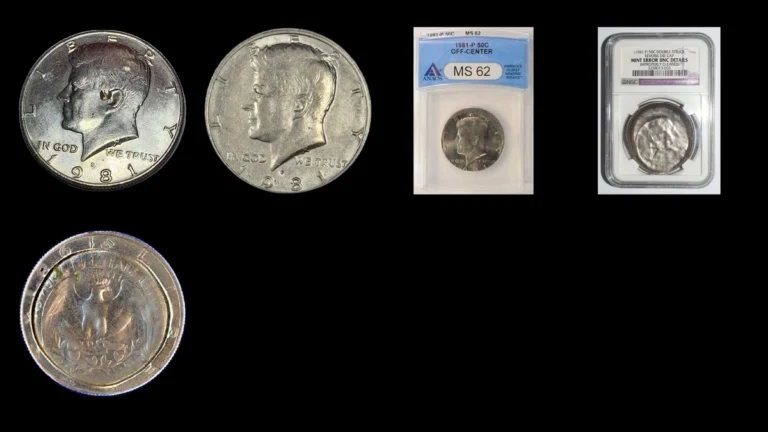
1. 1957 Half Dollar A small coin with half-dollar designs: Wrong planchet Error
Two recorded 1957 errors used blanks intended for smaller denominations: a five-gram nickel blank and a silver quarter blank. The nickel example was not struck over a finished Jefferson nickel.
The quarter-blank coin retains Franklin, the bell, date, eagle, and the area above the bell despite losing much outer lettering. The surviving mintmark area supports its Philadelphia identity.
How to Identify
Weigh the coin and compare its metal with the proposed blank: a nickel blank is five grams and a silver quarter blank begins at 6.25 grams. Either is far lighter than a normal half, while striking can spread the smaller blank beyond its original diameter.
Inspect the perimeter for filing and compare the incomplete design with the natural outline. Metal-composition testing can help distinguish the copper-nickel blank from silver alloy.
The nickel example, graded NGC MS65 Full Bell Lines, also has a fine horizontal strike-through approaching Franklin’s eye. Record that line separately from the wrong-blank evidence.
What It’s Worth
Comparable quarter-blank strikes are estimated at $1,200–$4,000, with attractive nickel-blank examples around $3,000–$7,500. The PCGS MS63 silver-quarter example sold for $1,145.63 at Heritage in January 2013.
A 1962-D nickel-blank half graded NGC MS67 brought $4,312.50 in January 2009. That is a historical comparison from another year, and the eye-area strike-through on the 1957 nickel example remains part of one whole coin’s value.
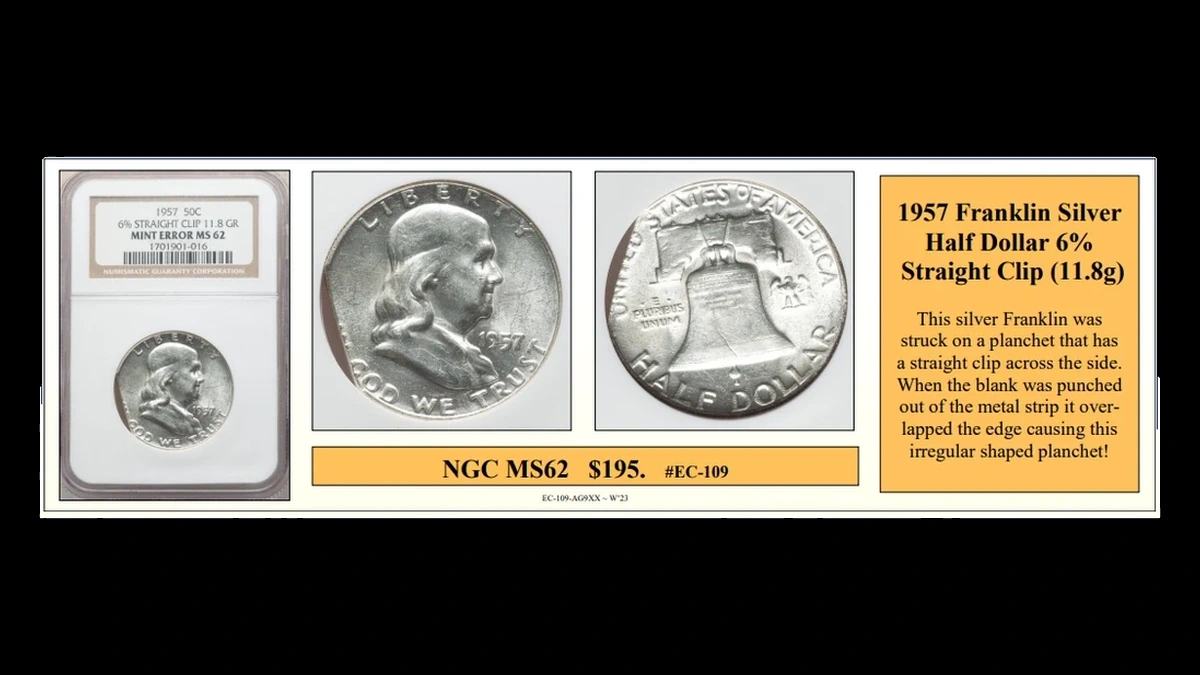
2. 1957 Half Dollar A missing arc near the lower-left rim: Clipped planchet Error
The cataloged Philadelphia clip removes roughly 10% of the blank near eight o’clock. The incomplete blank received its design after the gap had formed.
How to Identify
Examine the ends of the gap for rim and design shaped around missing metal during striking. Saw marks, sharp burrs, or filing indicate a later cut instead.
A weak opposite rim can support a genuine clip, although its visibility varies. Weight should be reduced by the absent metal.
The guide also mentions an AU58 clip, meaning a coin with very slight wear. The evidence does not establish that it is the same specimen as the 10% clip, so do not transfer that grade or location to every reported example.
What It’s Worth
Genuine clips are estimated around $75–$400, depending on size, visibility, and condition. A small gap on a worn half needs a different comparison from a prominent clip on attractive surfaces.
A 1962-D with a 4% clip, graded PCGS MS61, sold for $84 in March 2011. The 1957 catalog description supplies no sale price, and a larger percentage does not justify multiplying the smaller coin’s result.
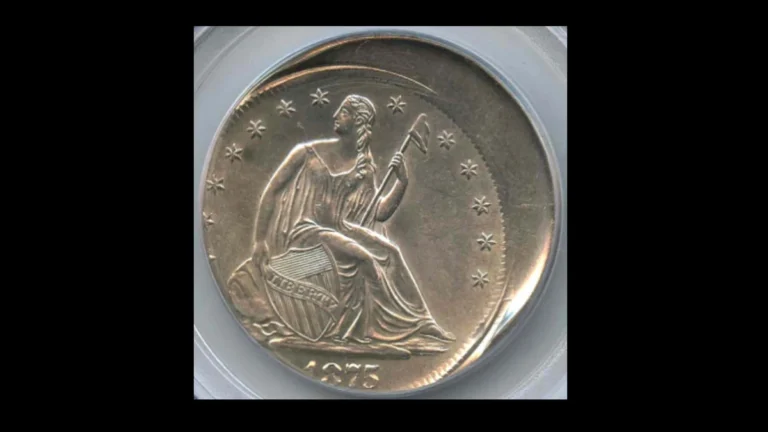
3. 1957 Half Dollar An unstruck crescent beside missing lettering: Off-center strike Error
With an off-center strike, a normal half-dollar blank sits partly outside the dies. The design shifts relative to the outline, leaving some original surface unstruck.
How to Identify
Check both faces for corresponding displacement and plain metal. An uneven border on only one side may result from a misaligned die rather than an off-center blank.
A wrong-size blank can also lose outer lettering, but its much lower weight and overall size provide a different explanation. Look for original strike boundaries rather than surfaces where grinding removed detail later.
The supplied 1957 reports identify no graded specimen with a particular mint, direction, or percentage of offset. Those details require an actual coin, not a general price guide.
What It’s Worth
Modest offsets with readable dates are estimated at $150–$500, while stronger, attractive examples are estimated at $500–$1,500. No specific 1957 auction result accompanies these ranges.
The quarter-blank sale above is not an off-center price comparison. Similar missing letters can arise from different errors with different markets.
4. 1957 Half Dollar A thin layer separating on the front: Lamination Error
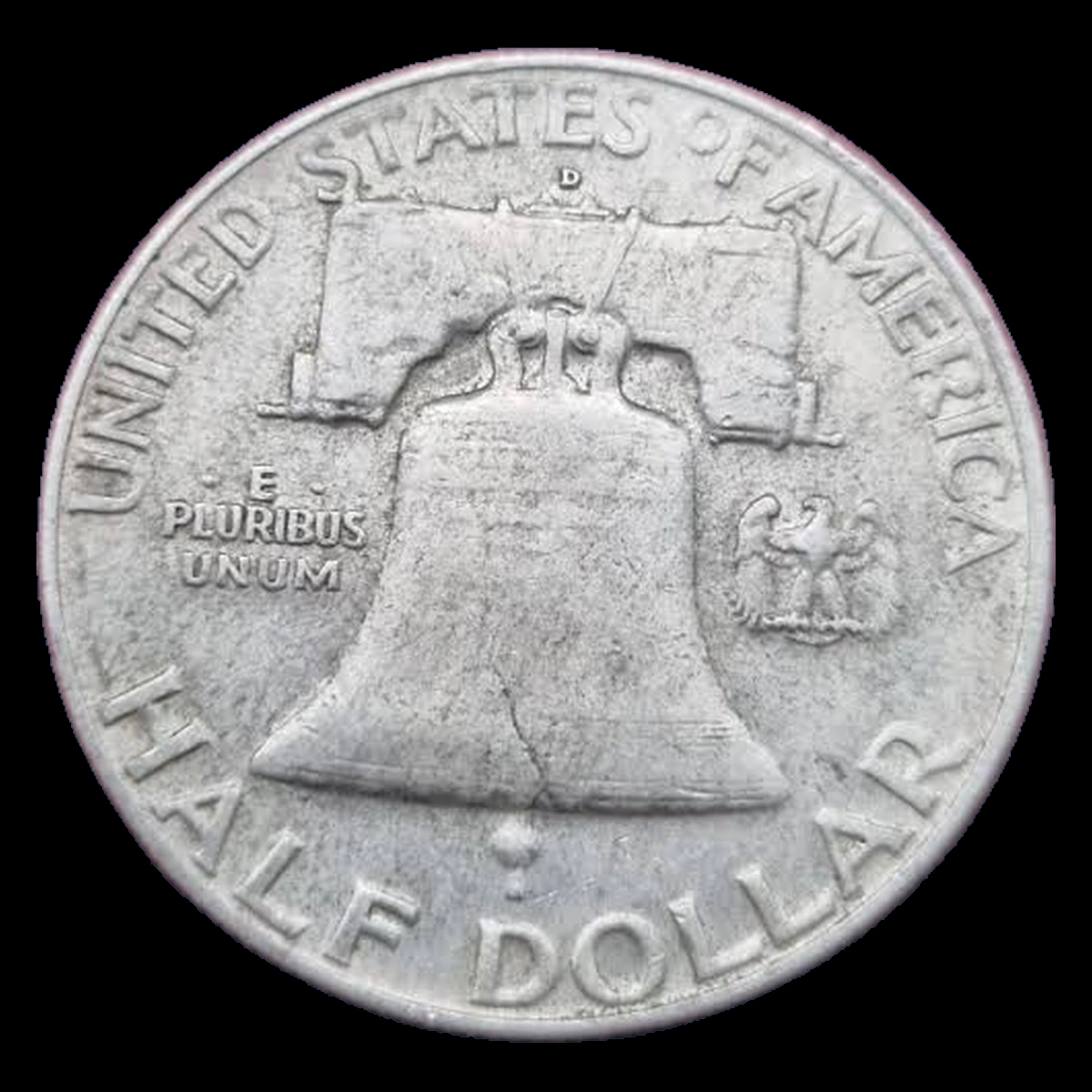
A weakness inside the silver alloy can allow a surface layer to peel or detach. A Philadelphia example graded NGC MS63 has a recorded obverse lamination, while a separate Denver report places a flaw near the date.
How to Identify
Follow the boundary between intact metal and the separated layer. A flap or natural separation plane differs from a scrape cutting through finished detail or scattered pits from corrosion.
Leave attached metal untouched, since pulling it changes both the defect and its evidence. An attached flap may retain nearly the full original weight.
Use the actual Philadelphia photograph to locate its flaw. The Denver date-area description belongs to another coin and must not be assigned to the MS63.
What It’s Worth
Modest laminations are estimated around $50–$300 across circulated and attractive unworn examples. The Philadelphia NGC MS63 sold for $74.49 including the buyer’s fee in January 2021.
The separate Denver example had a reported $79.99 asking price. A larger patch is not automatically worth more, because loss of attractive surface can also reduce demand.
5. 1957 Half Dollar A depression or weak area interrupting the design: Strike-through Error
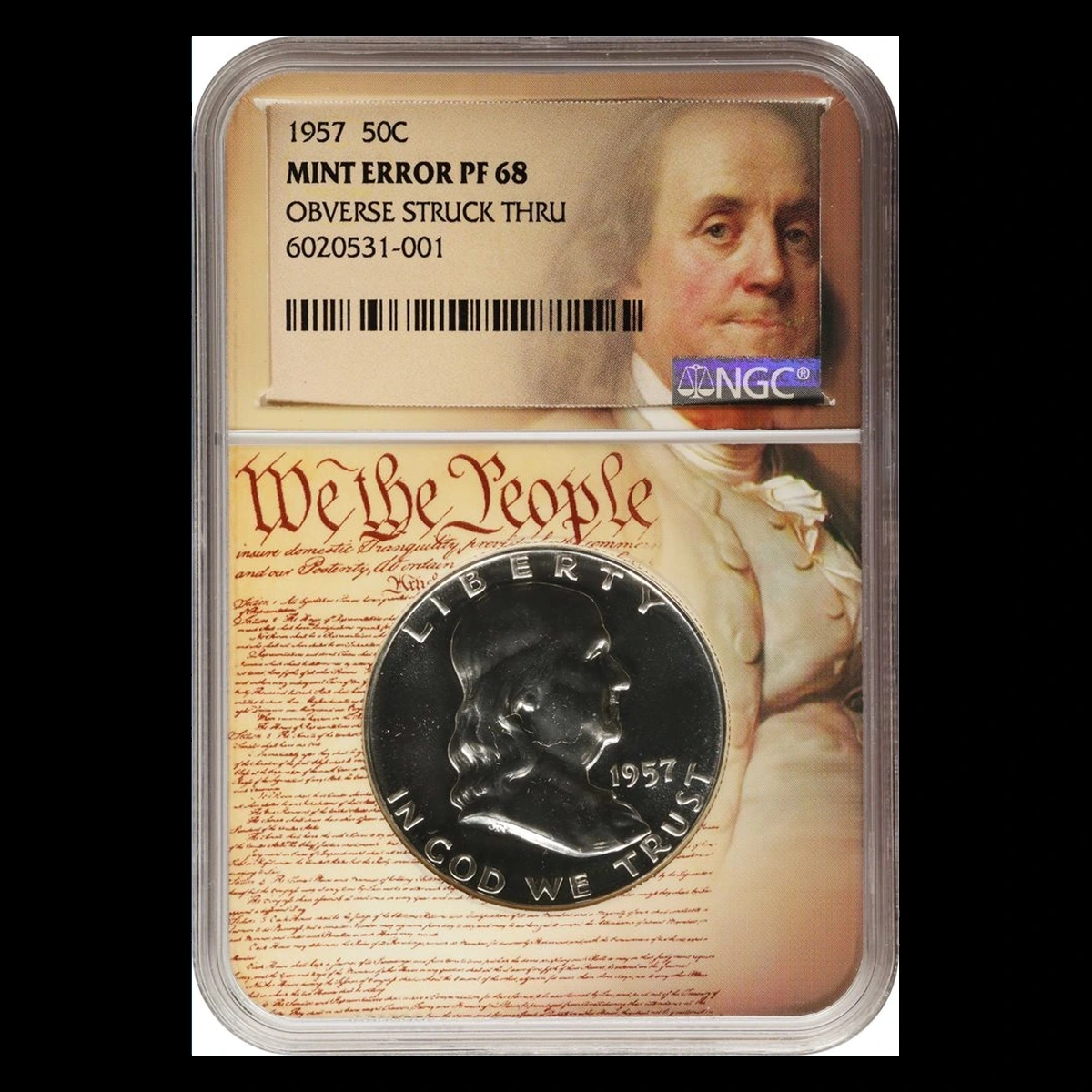
Material between die and blank can prevent normal contact, leaving a depression or an area of incomplete detail. Three Philadelphia records concern separate coins: an ordinary NGC MS64 with a reverse error, a PF67 proof with an obverse error, and a PF68 proof with a reverse error.
How to Identify
Establish which face and finish the record describes before comparing the defect. The PF67 listing concerns the front of a proof, not the separate MS64 coin’s reverse.
Look for an interruption formed as surrounding detail was struck. Later scratches often cut across completed design and can displace metal along their edges.
The listing titles do not identify the obstructing material. A wire, grease, or other object should not be named without evidence supporting that particular cause.
What It’s Worth
Visible errors on ordinary unworn coins are estimated at $75–$250, versus $150–$750 for attractive proofs. The guide’s $300–$550 estimate for a PF68 reverse example falls within the proof range.
These are estimates rather than recorded results for the three specimens. Proof surfaces, preservation, and the affected area’s visibility help determine an appropriate comparison.
6. 1957 Half Dollar A raised tooth-like mark at the upper lip: Reported Bugs Bunny clash Error
The Bugs Bunny nickname refers to a projection at Franklin’s upper lip. A 1957 guide reports this clash feature on Denver halves, where contact between empty dies could leave an opposite-design trace that transferred to later coins.
How to Identify
Confirm the date and D, then examine how the raised projection joins the mouth. Compare it with a suitably identified clash example rather than accepting the nickname as proof.
A nick can push up metal beside a cut, and dirt can resemble a tooth in a close-up. Change the light to distinguish these possibilities without scraping the surface.
What It’s Worth
A convincingly matched 1957-D mouth clash is estimated at $40–$200 in circulated through ordinary uncirculated condition. The year guide supplies the report and modest valuation context.
Different-year 1956 Bugs Bunny halves graded NGC MS64 appeared in 2026 sold listings at $48.52 and $68. Exceptional grades or strong bell lines may add value to a 1957-D beyond the clash alone.
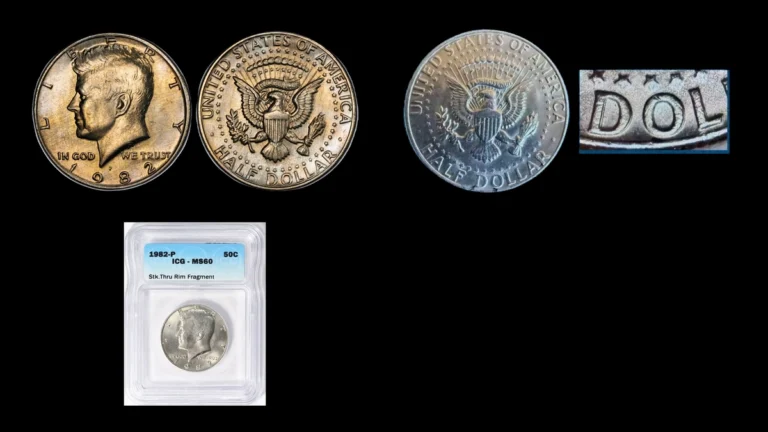
7. 1957 Half Dollar Another D outline above the bell: Repunched mintmark Error
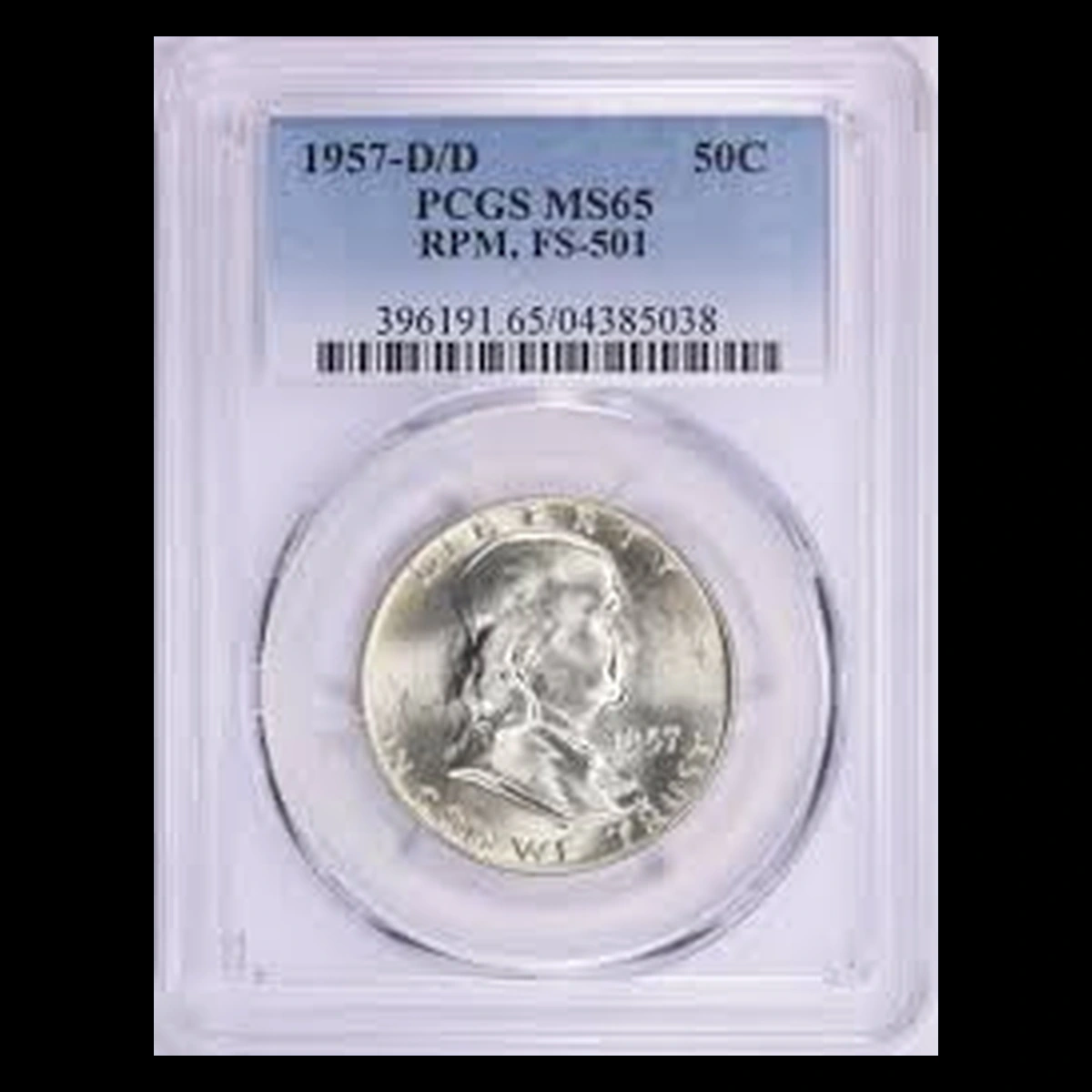
A rotated fragment beside the Denver D can preserve an earlier mintmark impression. The letter was punched into the die separately, allowing a shifted second entry to leave part of the first visible.
How to Identify
Follow the D’s straight and curved edges and compare the additional outline with a clear D/D reference. Roughness, a flat shelf, or reflected light does not necessarily represent a second letter.
A dealer’s example is graded ICG MS62 Full Bell Lines. Full Bell Lines describes well-defined fine lines near the bell’s bottom, a feature separate from the repunched mintmark.
What It’s Worth
Identified examples are estimated at $40–$150 from circulated through ordinary unworn grades. M. Barr Coins offered the ICG MS62 Full Bell Lines coin at $79.95 or best offer.
That is an asking price, not a completed sale. Bell-line quality, color, and overall surfaces can contribute to the total independently of the extra D.
8. 1957 Half Dollar Closely repeated lettering around the bell: Proof tripled die reverse Error
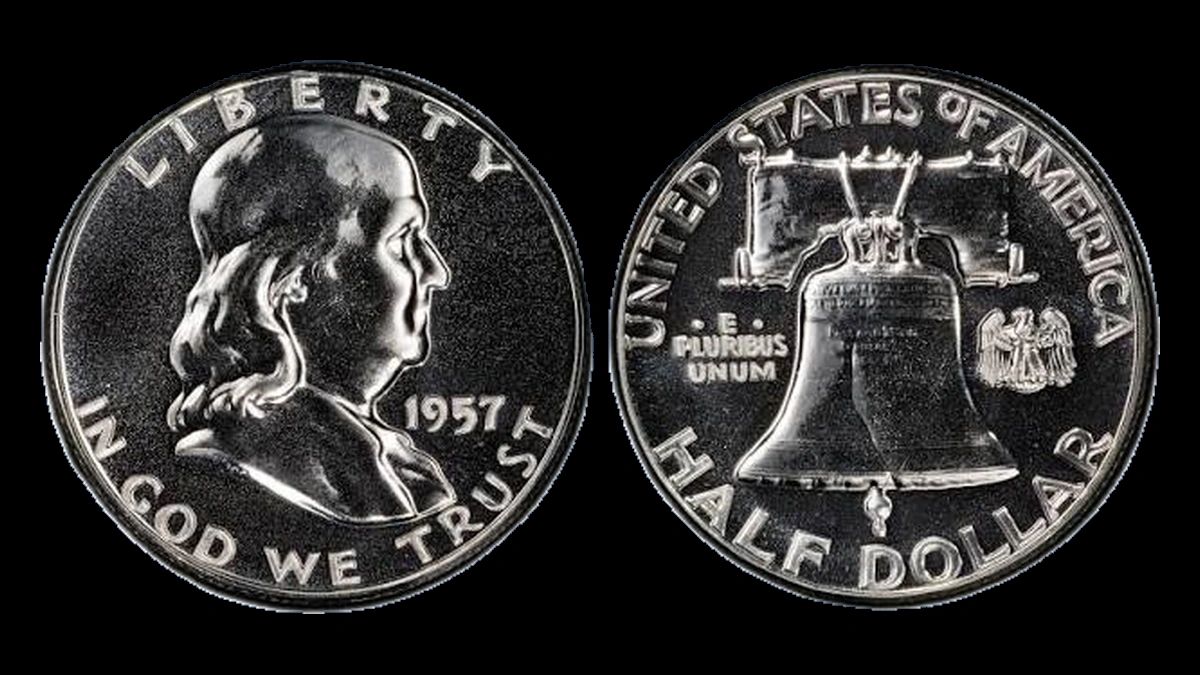
On the recognized Philadelphia proof variety, extra contours appear in reverse lettering because of the way the die was prepared. They do not mean that the finished coin received three separate strikes.
How to Identify
Inspect UNITED STATES OF AMERICA and HALF DOLLAR for a consistent pattern of repeated contours across neighboring letters. Compare with the recognized 1957 tripled reverse, rather than counting unrelated lines in several areas.
Proof reflections can imitate extra edges, so view the letters from more than one lighting angle. A flat ledge or generally soft lettering does not establish tripling.
Confirm the Philadelphia proof identity and absence of a mintmark. Thick lettering on a Denver ordinary strike does not make it this variety.
What It’s Worth
Standard proofs are estimated at $250–$1,100, with especially attractive Cameo or Deep Cameo examples around $1,000–$2,500. Those contrast labels describe frosted designs against reflective backgrounds.
The guide quotes about $300 for PF65 and $995 for PF68, with a reported PF68 Deep Cameo offer of $1,995. These grade-based figures are not completed-sale records, and contrast and original surfaces contribute to the total.
Conclusion
A 1957 half’s size, metal, mint, and finish establish the starting point for interpreting an unusual detail. A small blank, a missing piece, and a displaced strike can all remove lettering for different reasons.
Keep the separate proof, ordinary-strike, Philadelphia, and Denver records attached to their own specimens. That prevents transferring a grade, flaw location, or sale price to a coin that merely looks similar.