Rare 1966 Dime Errors (List & Pictures)
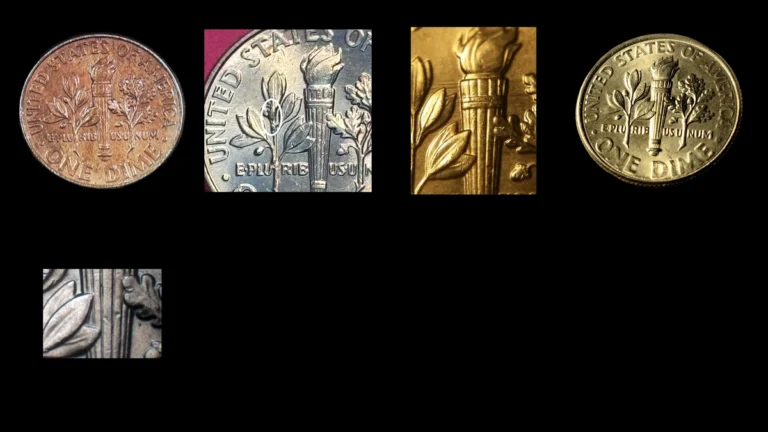
A tiny raised shape resembling a 5 makes one 1966 collector dime especially recognizable. PCGS records a $1,500 October 2023 eBay result for that Special Mint Set variety.
This list of 1966 dime errors also covers unusual blanks and displaced strikes, with estimated values of $5–$20,000. The highest range is conditional on authentication of the reported silver-blank candidate; begin with the visible feature before choosing a price comparison.
1. 1966 Dime A Small Raised 5 on Roosevelt’s Cheek — SMS FS-401 Error
The recognized FS-401 variety has a raised 5-shaped mark below the eye, above and behind the mouth. It belongs to Special Mint Set coins, usually called SMS coins.
The mark is not a five-cent denomination stamped on a dime. Its origin has received different explanations, so identification rests on its actual shape and position.
How to Identify
Compare the curve and lower stroke with the PCGS FS-401 images. Angled light should show a raised feature rather than a scratch cut into the cheek.
Confirm the SMS identity and inspect for tooling around the mark. Both ordinary and SMS 1966 dimes normally lack mintmarks, so an empty mintmark area does not identify the collector issue.
What It’s Worth
$100–$1,500 is an estimate for matched examples. PCGS records an SP67 coin at $1,500 on eBay in October 2023.
SP67 describes a well-preserved special collector strike. Haze, marks, and the clarity of the cheek feature affect the comparison.
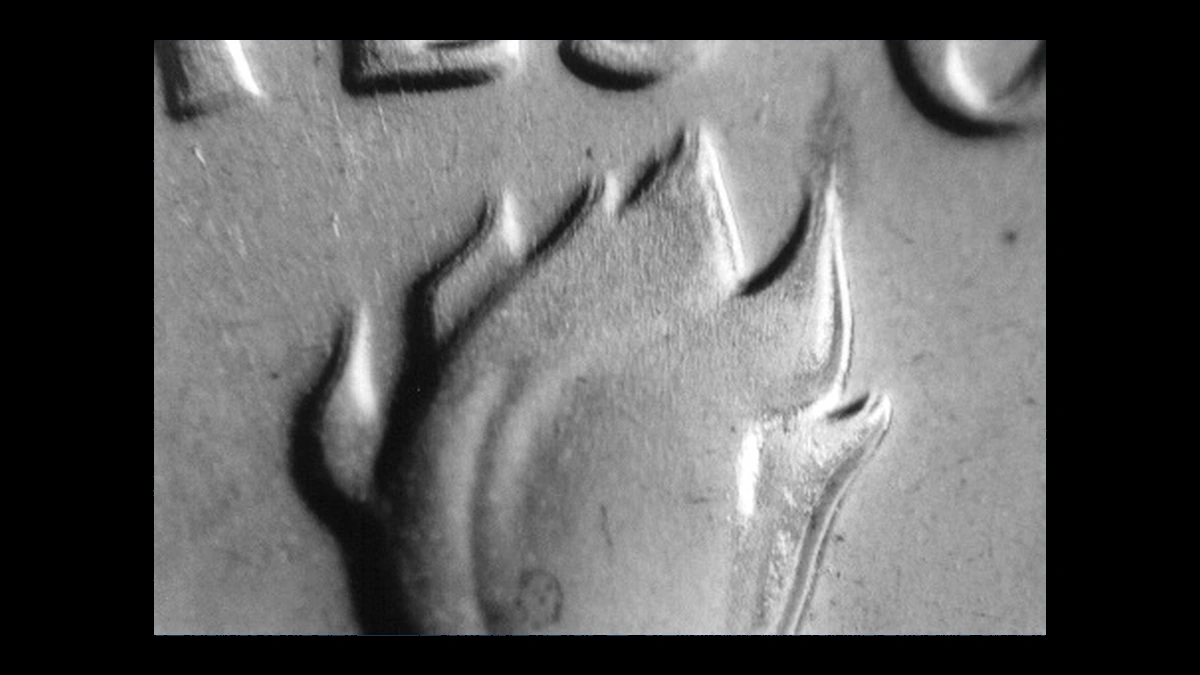
2. 1966 Dime Extra Outlines in Letters or Flame Tips — Doubled Die Error
Reported front doubling appears around the date and lettering, without a settled catalog number in the supplied year lists. SMS reverse varieties have more specific patterns.
One reverse pattern shows slight separation in letters and repeated flame tips. Another has thicker letters, upper leaves, and flame details.
How to Identify
Choose the face and finish before comparing the illustrated reverse patterns. Several matching features are more useful than one wide letter.
A doubled die repeats details already in the tool. Flat, lowered shelves caused during the strike are a different kind of doubling.
What It’s Worth
$20–$500 is an estimated range for identified examples. Clear SMS patterns with attractive surfaces generally provide stronger comparisons than minor worn features.
3. 1966 Dime Faint Traces of the Opposite Design — SMS Die Clash Error
Two dies can mark each other if they meet without a blank between them. Later coins may copy those marks as faint traces of the opposite design.
A public discussion reports marks near the brow, nose, and chin of a 1966 SMS dime, with additional reverse traces near the branches. Those reported lines still need a match to the opposing design.
How to Identify
Compare photographs of both faces, reversing one image as needed to understand how the tools faced each other. Several correctly placed matching shapes provide better evidence than a single scratch.
A clash is not another whole coin pressed into the dime. Polishing lines and random marks should not be assigned a design identity unless their shapes and positions agree.
What It’s Worth
$25–$250 is an estimated range for a properly identified SMS clash. It compares collector dimes with clear opposing-design traces rather than supplying a sale price for the discussed coin.
4. 1966 Dime A Raised Patch or Fine Ridge — Die Break Error
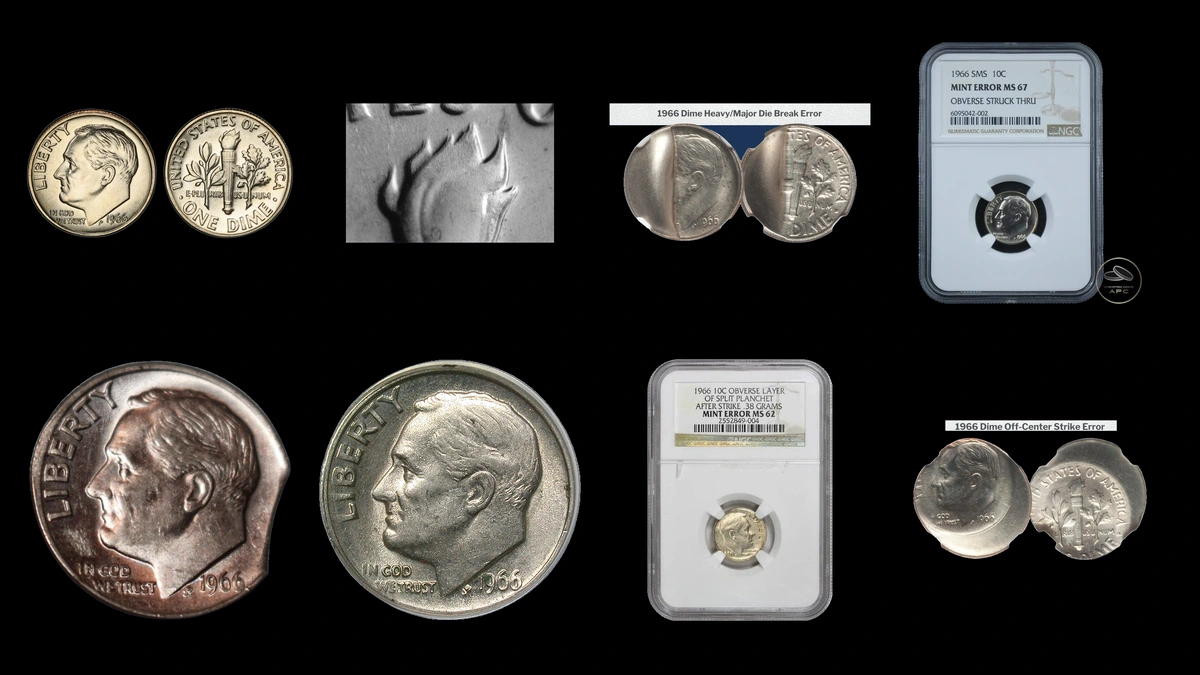
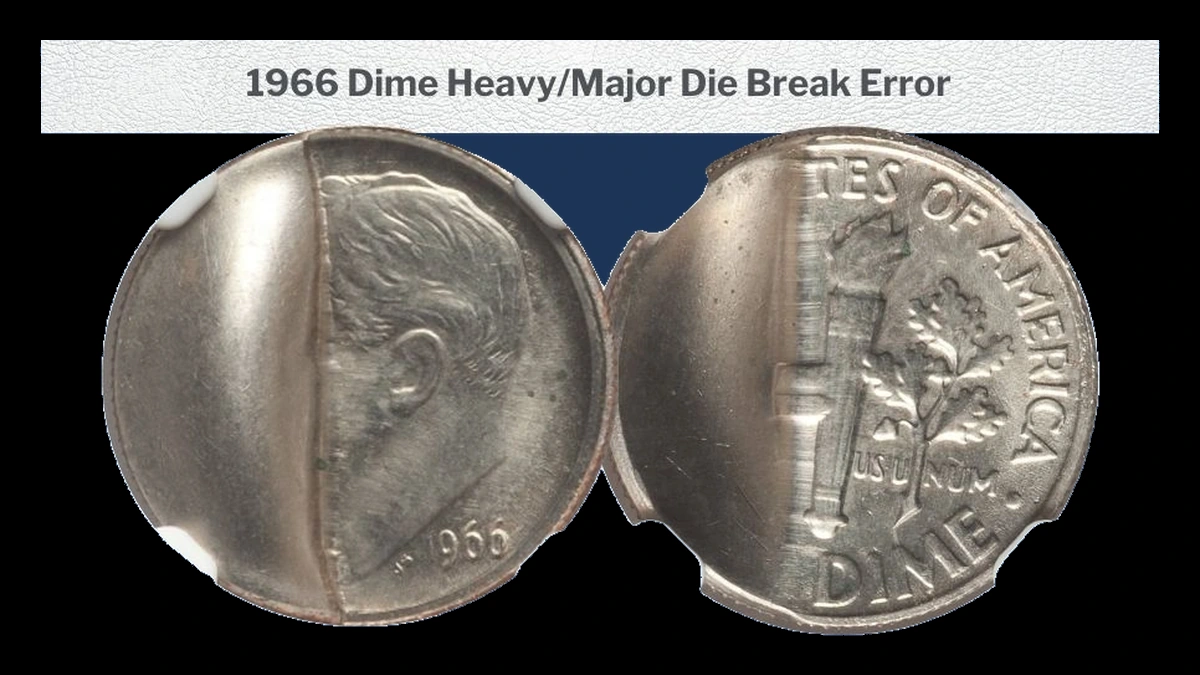
Metal can rise into a crack or missing part of the striking tool. A large raised patch joined to the rim is called a cud.
Cataloged 1966 shapes include left-edge, upper-right, and lower-right breaks, plus a smaller rim-only form. A separate auction records an NGC MS66 dime with a major front break.
How to Identify
Match the full boundary with the 1966 break catalog. Different positions describe different damaged dies.
A cud should connect naturally to the rim and replace design. For a fine crack, confirm that the line is raised and lacks the cut beside it that a scratch can leave.
What It’s Worth
$5–$650 spans small cracks and substantial breaks. Minor ridges generally fit $5–$50, with stronger cuds around $40–$650.
The NGC MS66 major-break specimen sold for $384 in July 2021. That result belongs to one coin, not every listed break.
5. 1966 Dime A Weak Patch beside Clear Detail — Struck Through Error
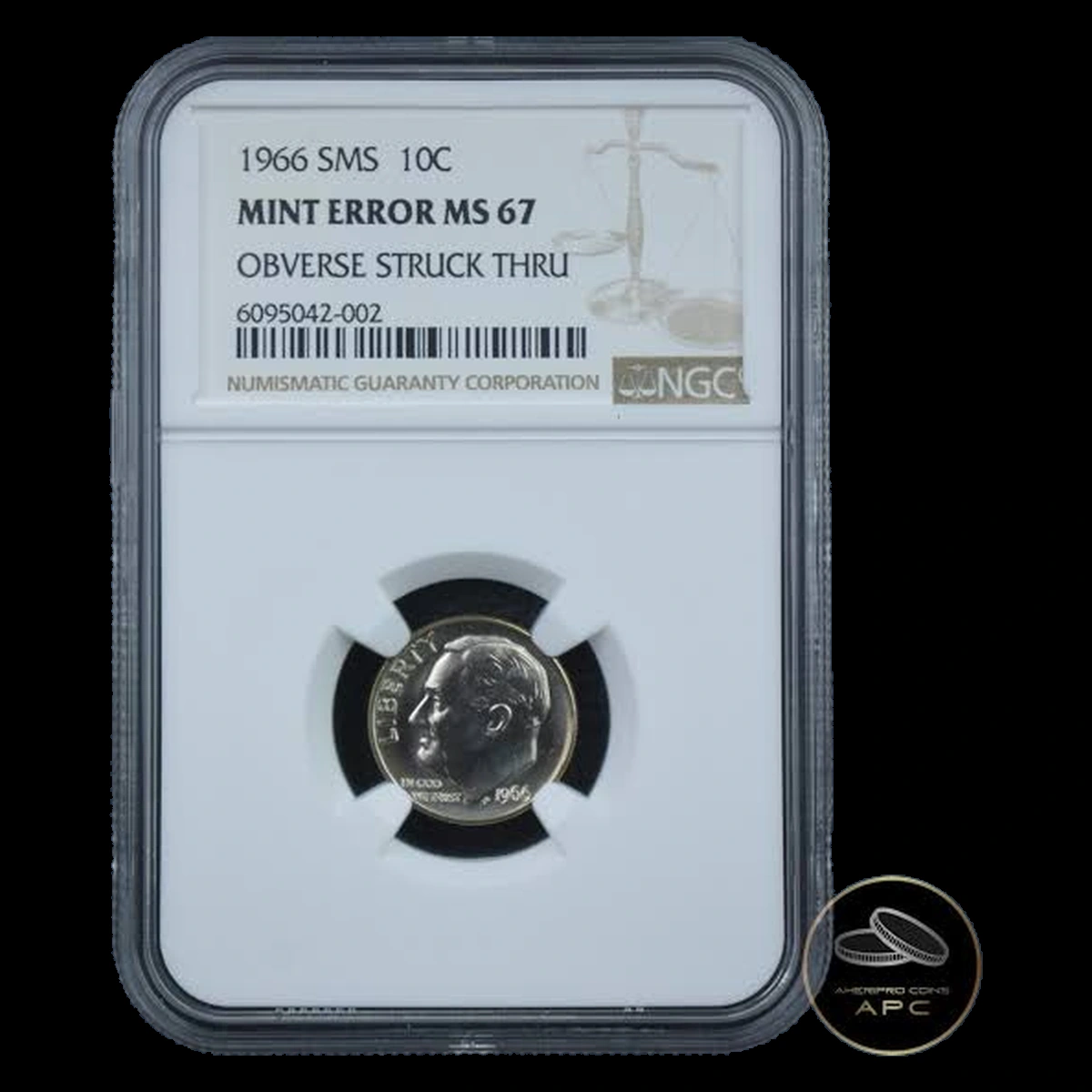
Grease or another substance can block part of the die and stop detail from forming. Harder material between the blank and tool can leave a more distinct hollow.
A seller reports a grease-struck 1966 dime, and general guides list other strike-throughs without identifying the material. No particular word or object is established by those broad reports.
How to Identify
Compare the affected area with nearby protected letters and with the opposite face. A local interruption surrounded by sharp design differs from wear across the high points.
Inspect the boundary for scraping or later pressure. Do not call an unidentified impression wire, wood, or cloth without a matching shape or texture.
What It’s Worth
$5–$150 covers estimated values for this group. Small grease-filled details generally fit $5–$40, while clearer material impressions can fall around $20–$150.
6. 1966 Dime A Curve Is Cut but the Metal Remains — Incomplete Punch Error
A blank-cutting punch can start an overlapping cut without fully separating the metal. The finished coin then retains a curved trace with metal still present inside it.
A 1966 example from the Fred Weinberg collection was graded PCGS AU58. Its slight wear does not change the distinction between an unfinished cut and a missing clip.
How to Identify
Follow the curve and its meeting points with the edge under side lighting. Look for an original punch trace rather than a line carved through finished detail.
A complete 1966 clad dime normally weighs 2.268 grams and measures about 17.91 mm across. Retaining the outlined metal can leave an incomplete-punch coin near normal weight.
What It’s Worth
$75–$350 is an estimate for comparable identifiable examples. The PCGS AU58 specimen sold for $139 in July 2022.
A clear original curve makes the unfinished cutting step easier to recognize.
7. 1966 Dime Part of the Outline Is Gone — Clipped Blank Error
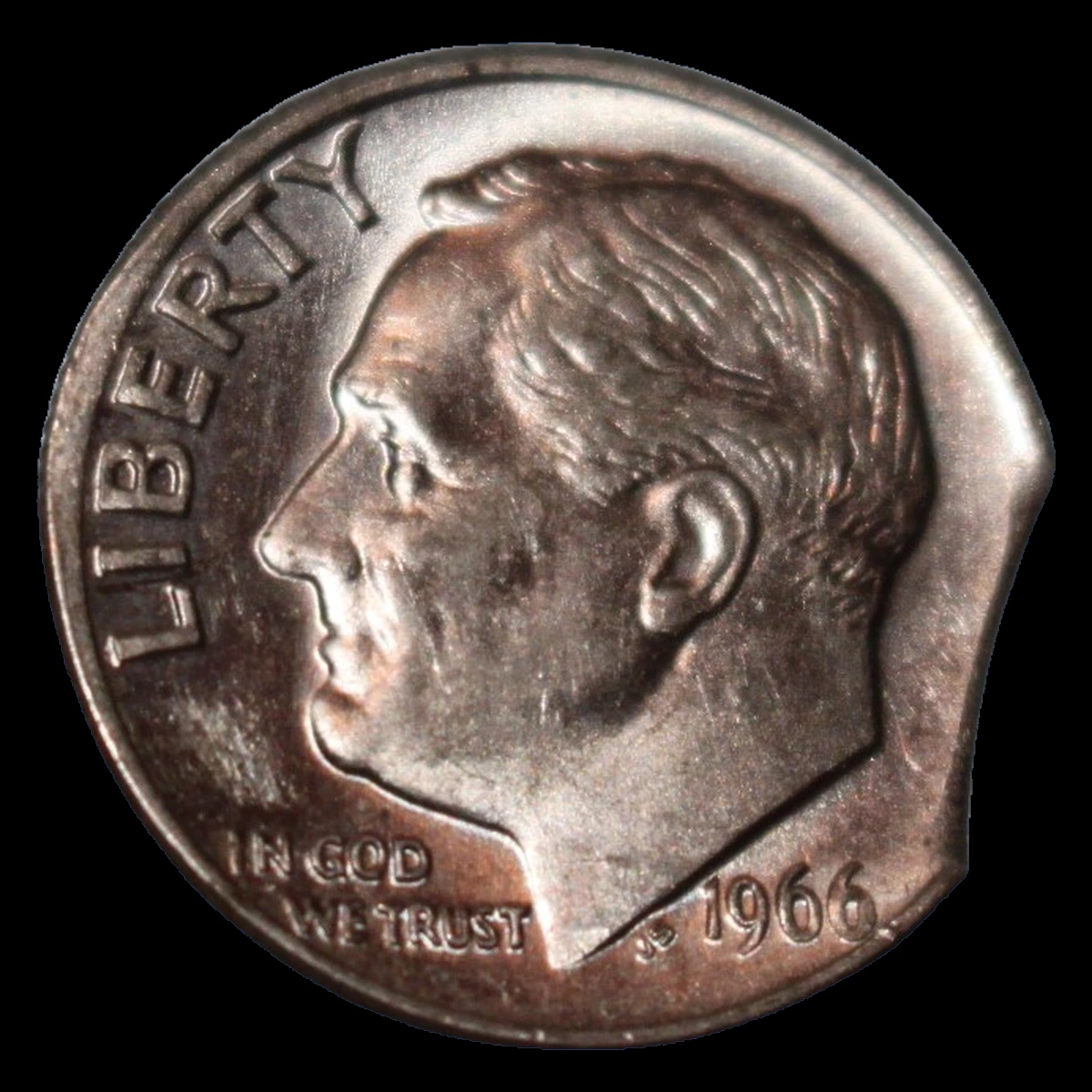
Ordinary 1966 records include curved, straight, and double clips, plus a reported lens-shaped remaining blank. An SMS NGC MS67 example has a curved gap near one o’clock.
The shapes begin in blank preparation before the design is struck. The SMS collector finish and its gap location belong to that particular example.
How to Identify
Inspect both ends of each gap for natural transitions between the missing boundary and the struck design. Multiple clips require separate checks of every opening.
Watch for saw grooves or fresh burrs. A low weight shows metal is missing but does not establish when it disappeared.
What It’s Worth
$15–$500 spans the reported clip groups. Ordinary clips generally fit $15–$200, distinct multiple or lens-shaped examples $75–$500, and identified SMS clips $100–$500.
A 2021 group containing an MS61 straight-clipped 1966 dime sold for $35 with two other coins. That total cannot be assigned to the dime alone.
8. 1966 Dime A Flap Lifts from a Small Area — Local Lamination Error
A local flaw or weak bond can let a thin piece separate while most of the surface stays intact. The flap may remain attached or fall away and leave a shallow rough area.
The 1966 reports do not specify one fixed location. Keep this small separation distinct from a whole missing face or a large hinged split.
How to Identify
Follow the layer to the point where it rejoins the coin without moving it. Original design near that boundary can help distinguish a natural split from a gouge.
A cut that piles up metal or slices through finished lettering has a different explanation. A brown patch alone does not show that a layer peeled away.
What It’s Worth
$15–$200 is an estimated range for genuine local peeling. An attached strip can explain the feature clearly, but a larger flaw that destroys the date need not be more desirable.
9. 1966 Dime An Edge Split with a Surviving Hinge — Clamshell Error
A clamshell opens along a layer within the blank while staying joined at one end. It is more than a small flake, but has not become two fully detached pieces.
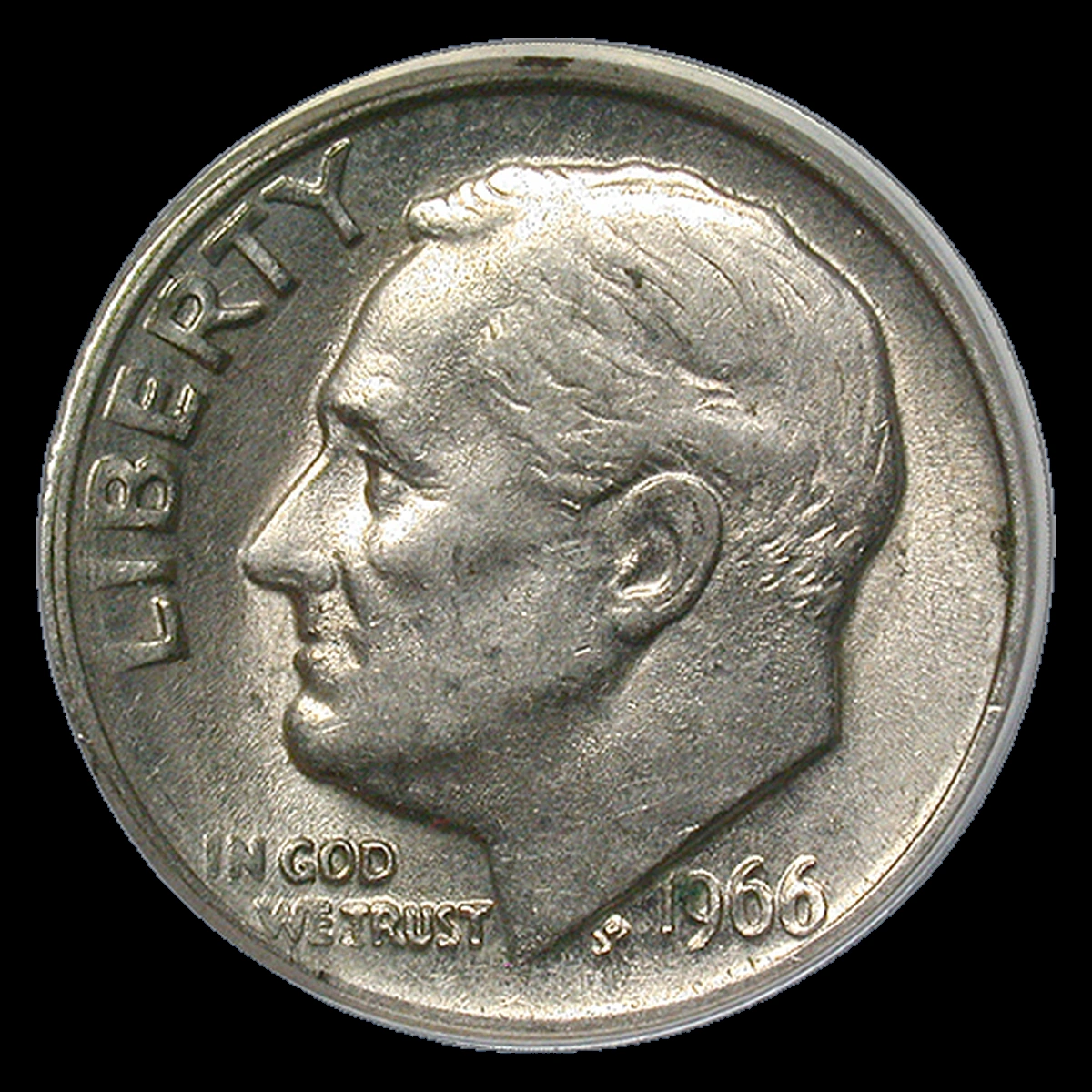
A dealer-listed 1966 example was graded ANACS AU50. It is separate from the loose 0.38-gram front layer described below.
How to Identify
Use side lighting to follow the opening toward its connection. Never insert a blade or bend the sides apart.
Check for fresh pry marks or artificial bending. When all the metal remains attached, the weight can still be near the complete dime standard.
What It’s Worth
$50–$350 is an estimated range for comparable clamshell errors. The ANACS AU50 coin carried a $65 asking price at Northeast Numismatics.
That was an offer to sell, not a completed transaction. Preserving the attached connection helps retain the feature’s value.
10. 1966 Dime A Whole Front Layer Is Missing or Detached — Clad Separation Error
One NGC MS62 dime body lost its front layer after striking and weighs 1.8 grams. A separate NGC MS63 coin was already missing that layer when struck and weighs 1.9 grams.
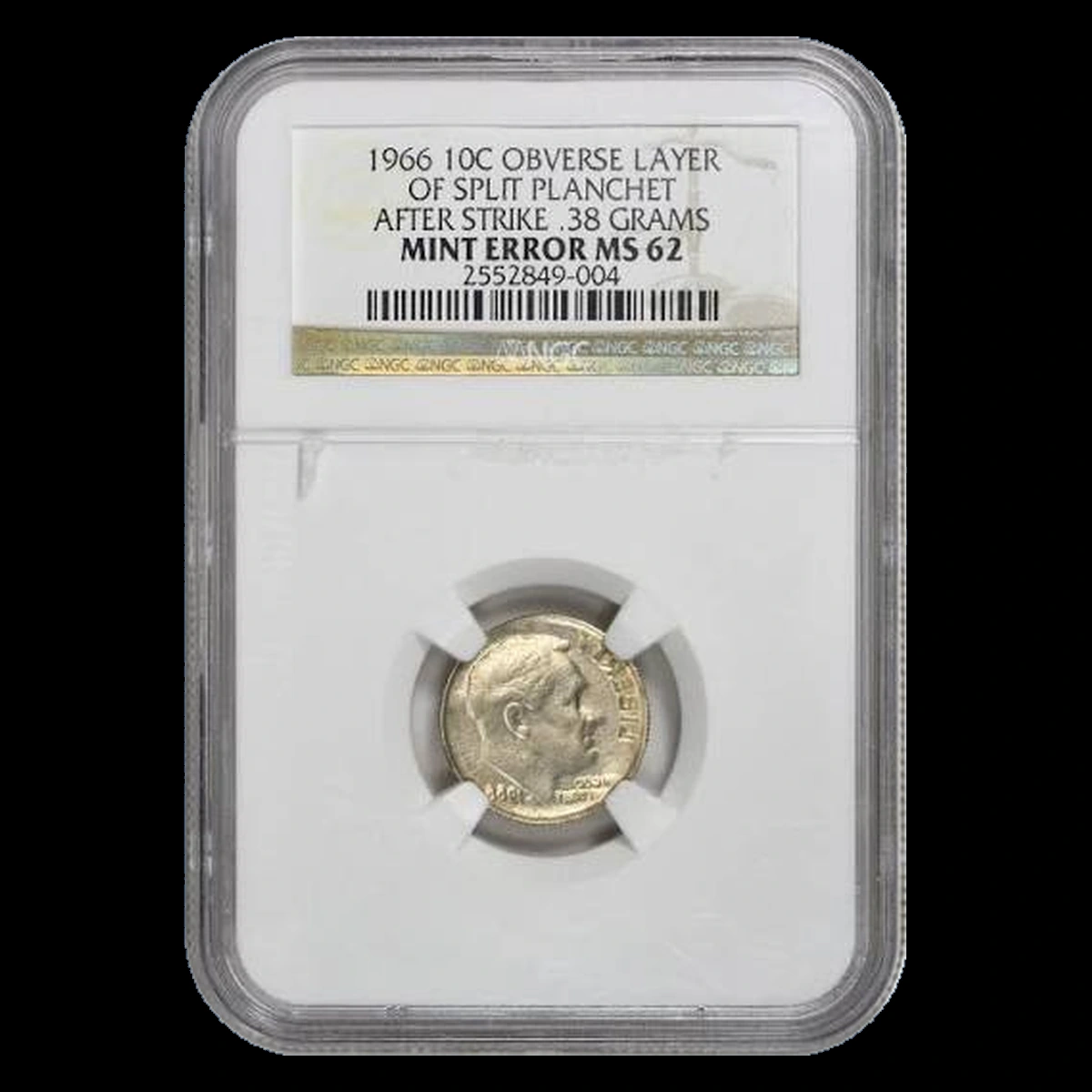
A third NGC MS62 record describes the detached front layer itself, weighing only 0.38 gram. These records do not establish any matching pair.
How to Identify
Decide whether the object is a copper-centered body or a very thin pale outer layer. The outside of a detached front layer carries Roosevelt and the date, while its opposite face is the internal separation surface.
Metal exposed before striking can receive design directly. Separation afterward exposes an interior surface, so the two events should not be described as identical.
What It’s Worth
$50–$600 spans missing-layer bodies and detached pieces. Comparable bodies are estimated at $50–$400, with the 1.8-gram coin selling for $79 in December 2020 and the 1.9-gram coin for $51.75 in March 2004.
An identified detached front layer is estimated at $75–$600. The 0.38-gram piece is one object, not a complete matched pair.
11. 1966 Dime Nearly Normal Size but Extra Weight — Rolled-Thick Blank Error
Metal strip rolled too thick can produce an overweight blank. The design may look fairly ordinary even though the dime contains more metal than intended.
A PCGS AU58 1966 example weighs 3 grams, and another 3-gram piece is reported in MS64. Those descriptions do not identify a foreign or wrong-denomination blank.
How to Identify
Compare the actual weight and thickness at several edge points with a normal dime. A thick rim at one spot is different from consistently thicker stock.
Inspect for solder, joined pieces, or added coating that could increase weight later. The recorded thick-stock identity should explain the original surfaces as well as the scale reading.
What It’s Worth
$30–$450 is the estimated range for identified rolled-thick examples. The PCGS AU58 3-gram coin sold for $30 in January 2014.
12. 1966 Dime A Complete Design inside an Expanded Border — Broadstrike Error
A blank can spread sideways when the collar ring fails to restrain it. The result is a broadstrike, sometimes with weak or missing edge grooves.
The documented 1966 example was cataloged NGC MS65. Its enlarged outline is different from a thin rim on an otherwise normal worn dime.
How to Identify
Follow all the outer lettering on both faces and confirm that it stays on the coin. Then compare the expanded border with the usual diameter.
Check for crushed letters or hammer marks that could explain later widening. Original spreading and incomplete collar contact should support the same strike.
What It’s Worth
$25–$200 is an estimate for comparable broadstrikes. A year guide links the NGC MS65 specimen to a reported $42 sale in 2011.
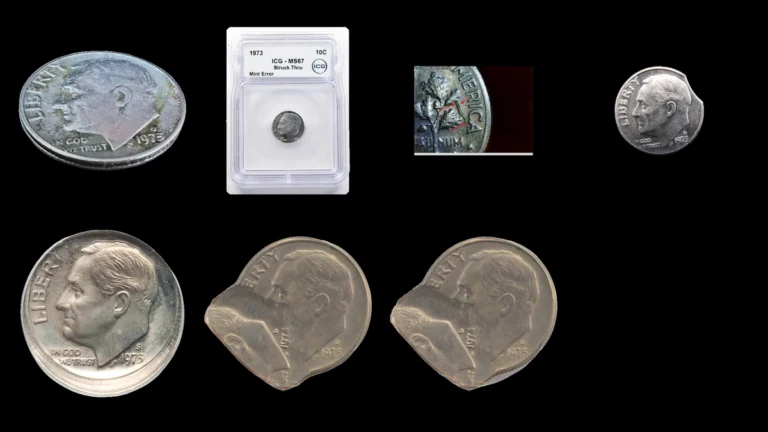
13. 1966 Dime A Plain Crescent beside a Shifted Design — Off-Center Strike Error
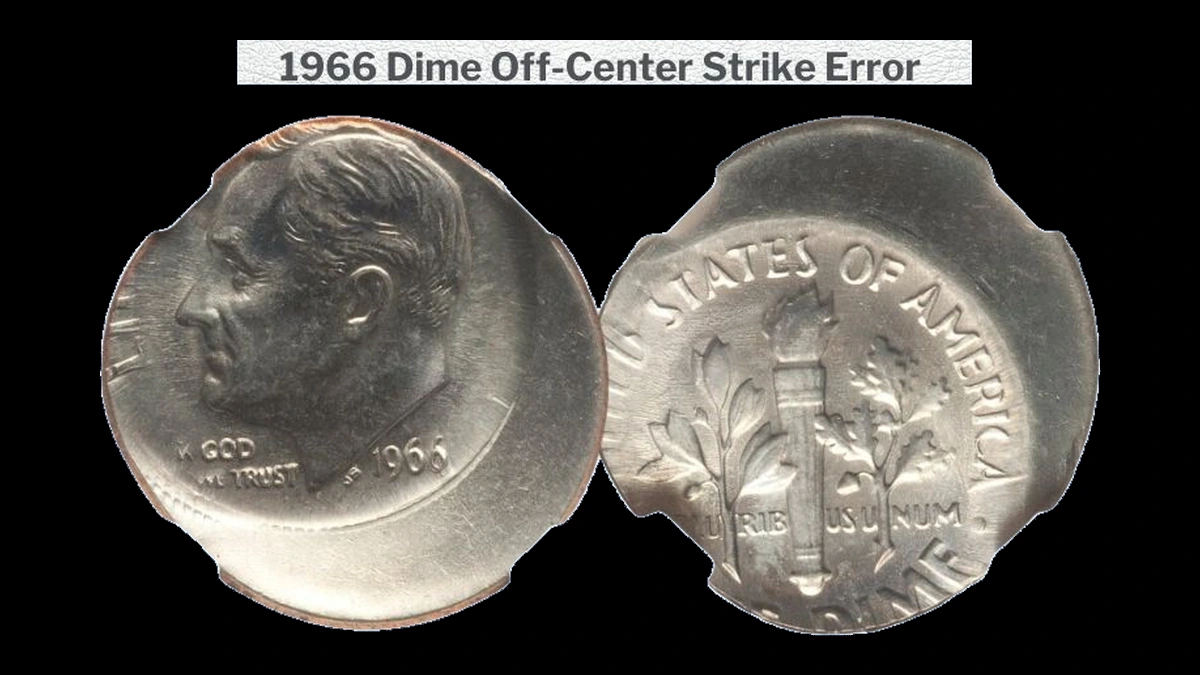
Recorded 1966 examples include a 35% off-center NGC MS64 dime, a separate 25% MS65 coin, and a 50% MS63 coin. Each reflects its own blank position in the press.
The unused crescent remains metal, while design runs off the opposite edge. A shift on only one face may instead come from a misaligned die.
How to Identify
Read the surviving date and compare both faces for matching displacement. Keep the grade and percentage with the correct specimen.
Inspect the original surface at the transition between struck and untouched metal. A scraped or ground area should not be mistaken for the unstruck crescent.
What It’s Worth
$35–$300 is an estimated range for dated examples. A year guide reports $104 for the separate 50% specimen in 2020.
More displacement does not guarantee a higher price if the date becomes unreadable or the surfaces are damaged.
14. 1966 Dime Design Softened by a Covering Coin — Struck through a Die Cap Error
A coin stuck against a die can cover it during later strikes. Another blank struck through that metal receives a softened image.
A 1966 receiver appears in an auction as PCGS AU58. The receiver is not the stuck cap itself and does not need tall cup-like walls.
How to Identify
Compare the softened face with the other face, which may have received a more direct strike. Study the broad interference pattern rather than judging one weak letter.
Separate the cataloged coin’s slight wear from its original soft design. Polishing or general weak striking needs to be considered before attributing a face to cap interference.
What It’s Worth
$60–$400 is an estimated range for identified cap-struck receivers with readable dates. The comparison concerns the receiving coin, not the cap that covered the die.
15. 1966 Dime Another Design at the Edge — Repeated Strike Error
A PCGS MS63 1966 dime has a second strike 80% off center. Another recorded coin first broadstruck, then received a second blow 90% off center with its front blocked during that later strike.
The second coin also has scratches. Its blocked face, broad outline, and condition problem should not be transferred to the PCGS specimen.
How to Identify
Trace the first design before following the smaller later impression across it. Look for raised details that overlap or flatten the earlier strike.
On the 90% combination, compare the expanded first-strike outline with the later blocked front area. Scratches cross finished metal and do not establish extra blows.
What It’s Worth
$150–$750 is an estimated range for clear repeated strikes. A year guide reports $360 in 2022 for the PCGS MS63 coin with the 80% second strike.
The scratched 90% combination needs its own condition comparison.
16. 1966 Dime A White Edge and Possible Silver Metal — Silver-Blank Candidate Error
Ordinary 1966 dimes use copper-nickel layers around copper. A genuine piece on an earlier 90% silver blank would be an unusual leftover-metal error.
The supplied 1966 report describes a candidate rather than a certified specimen. A white edge, plating, or an altered date can mislead a first inspection.
How to Identify
Examine all four date digits and their surrounding surface before testing the metal. Compare the ordinary 2.268-gram clad standard with the earlier 2.50-gram silver standard.
Professional composition testing must confirm the silver alloy without scratching the coin. Both a genuine 1966 date and the correct original blank are needed.
What It’s Worth
$5,000–$20,000 is the conditional estimate for a confirmed 1966 dime on a 90% silver blank. It compares authenticated 1965 silver-blank errors rather than a sale of an established 1966 specimen.
A 1965 NGC MS62 example sold for $14,400 in January 2023, while an AU53 example brought $9,150 in January 2026. Metal identity, date authenticity, and preservation would guide the comparison.
Conclusion
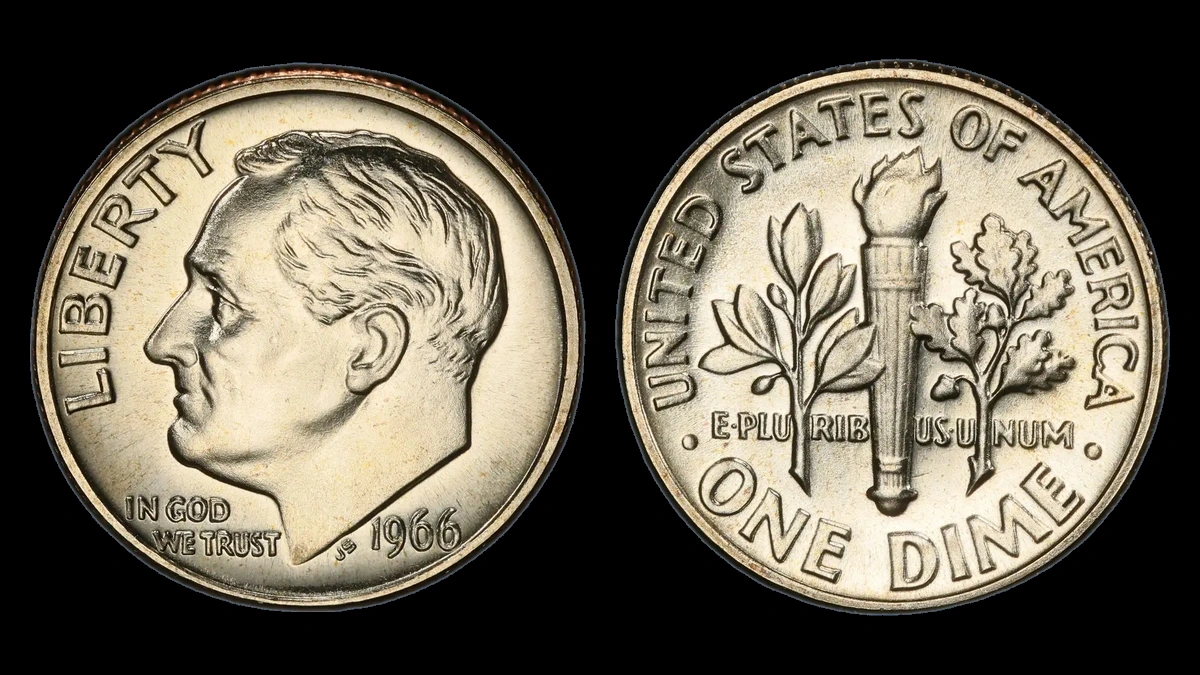
No mintmark is normal on a 1966 dime, and it does not distinguish an SMS coin from an ordinary issue. Match the actual design feature and finish before applying a collector-variety name.
For unusual metal, identify which part of the coin remains and record its own weight. A local flap, attached clamshell, detached layer, and thick blank tell four different stories even when their surfaces first look alike.