Rare 1985 Half Dollar Errors (List & Pictures)
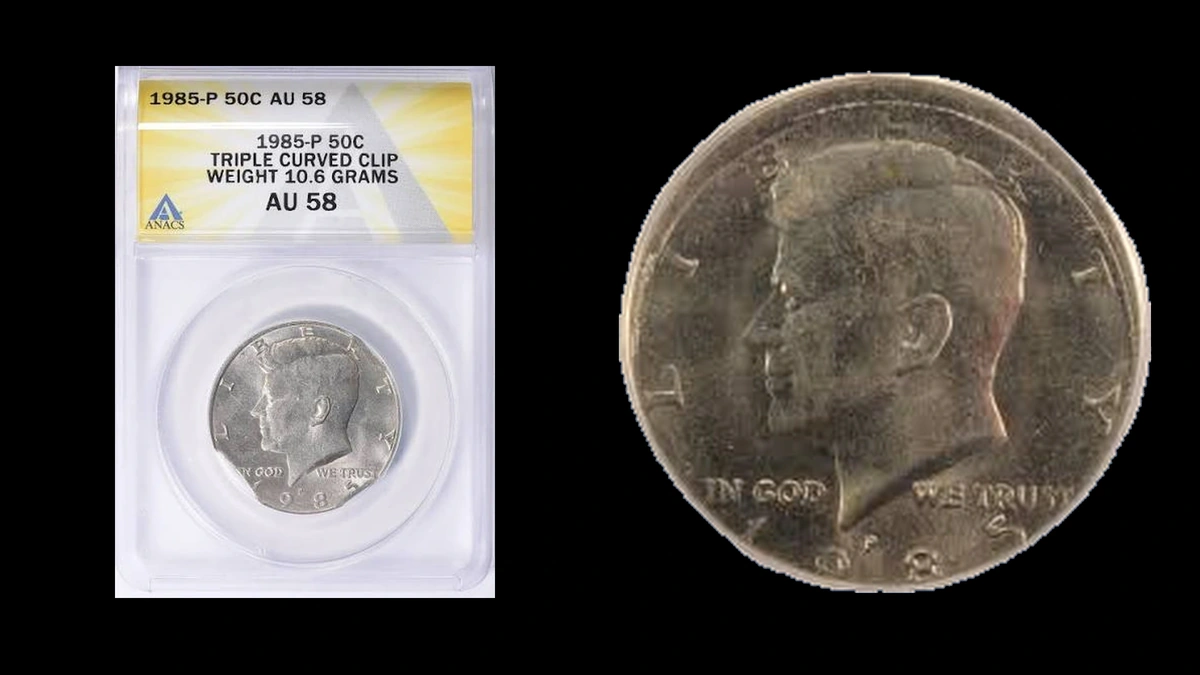
A multiple-struck, broadstruck 1983-P half dollar sold for $552 in June 2024. It provides a different-year comparison for a documented 1985 double strike with an additional indent.
Estimated 1985 half dollar errors values span $5–$1,500. Begin with missing edge pieces and displaced designs before moving to smaller raised marks.
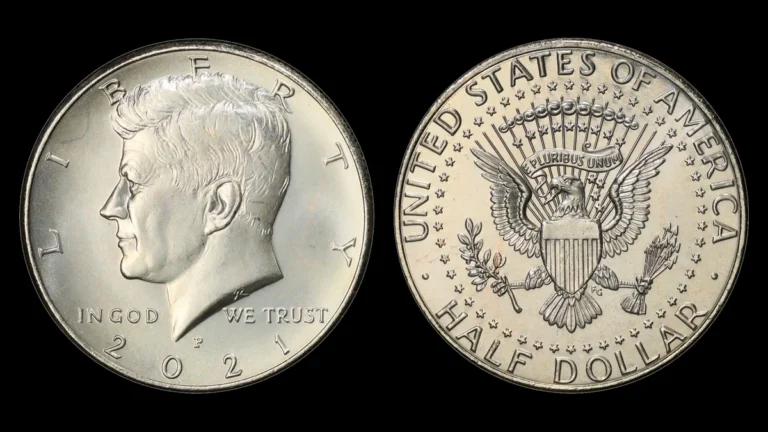
An intact ordinary half weighs 11.34 grams and measures approximately 30.61 millimeters, with a reeded edge. Weight and full views of both faces help document the physical features.
| Clue | Category | Estimated whole-coin value |
|---|---|---|
| Three curved missing pieces | Clipped planchet | $30–$350 |
| Two impressions and a hollow | Double strike with indent | $300–$1,500 |
| Single shifted design | Off-center strike | $75–$650 |
| Spread metal around complete design | Broadstrike | $80–$500 |
| Small raised tool mark | Die gouge | $5–$75 |
| Raised line or patch | Die crack or break | $10–$400 |
| Repeated small contours | Doubled die varieties | $20–$300 by face |
1. 1985 Half Dollar Three Curved Gaps Interrupt the Outline: Clipped Planchet Error
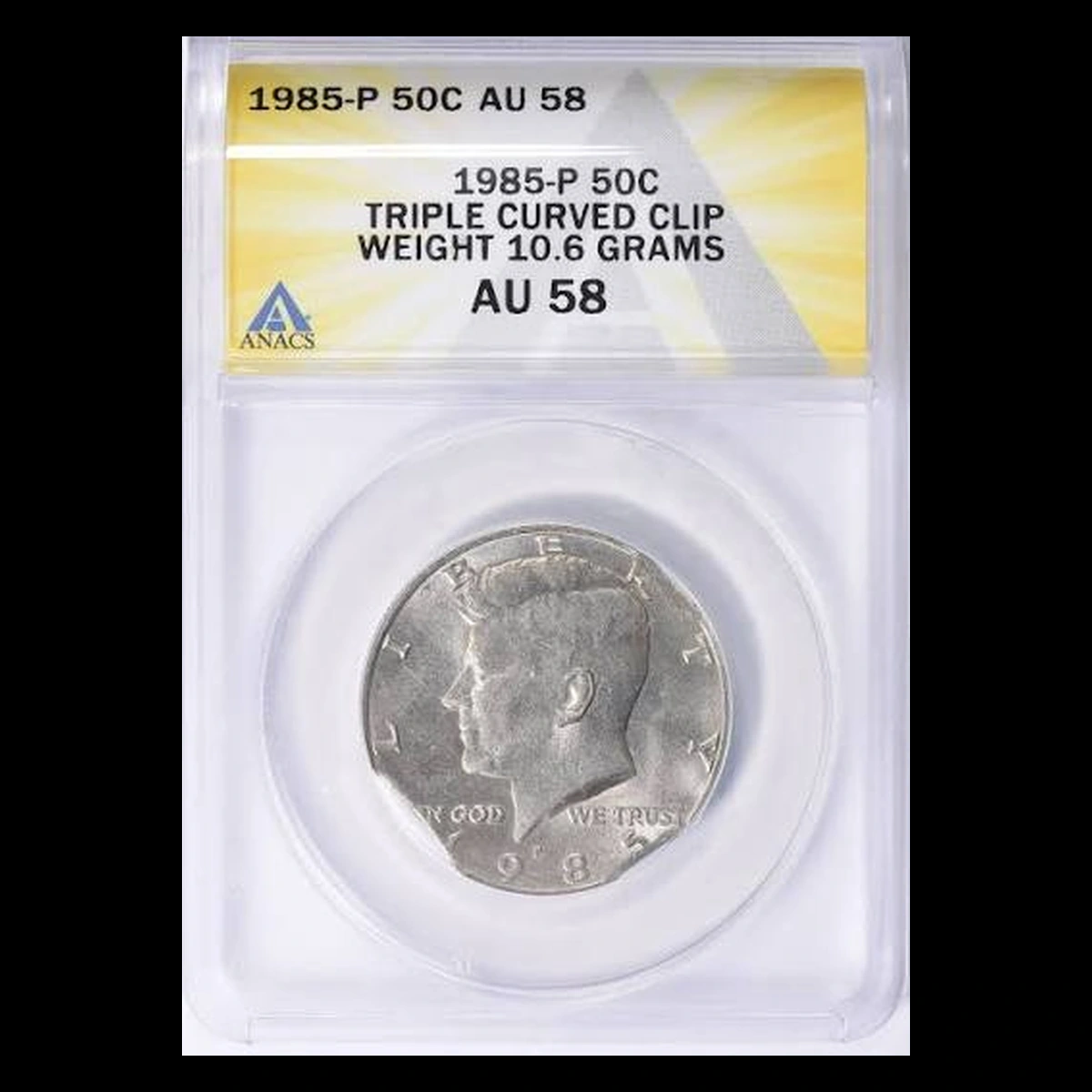
The documented 1985-P has three curved clips, weighs 10.6 grams, and is graded ANACS AU58. That grade indicates slight wear.
The missing sections originated while the blank was made, before the dies stamped the design. Multiple gaps remain one broad kind of blank-making error, but each gap needs its own inspection.
How to Identify
Compare the recorded specimen’s 10.6 grams with the intact standard, then inspect each curve and its two endpoints. The original rim should have formed around the missing metal.
Look for file tracks, cut faces, and burrs in the exposed edges. One convincing curve cannot authenticate a different section cut away later.
Possible opposite-rim weakness can support the diagnosis, though it may be faint. Preserve a whole-coin image showing all three gaps and the P alongside the closeups.
What It’s Worth
Simple through multiple clips have an estimated $30–$350 range. The size and clarity of the missing sections matter together with condition.
A 1993-D curved clip graded ANACS MS64 sold for $34.74 including the buyer’s fee in August 2025. That single-clip comparison supplies no realized price for the documented 1985-P triple clip.
2. 1985 Half Dollar A Later Image Overlaps the First beside an Indent: Double Strike Combination Error
The described 1985 PCGS MS62 received a second strike 70 percent off center and also has a partial indent. MS62 indicates an unworn coin with noticeable marks.
Its first image remains under or beside the later impression. The supplied description does not fix the indent’s side or clock position, and the mintmark must be checked on the complete coin.
How to Identify
Trace several surviving design pieces and determine how one impression moved relative to the other. A doubled-looking rim or one flat letter shelf is insufficient.
Examine the indent separately from ordinary unstruck metal. A smooth indentation differs from a recessed mirror-image design left by contact with another struck coin.
Check the edge and any spreading for consistency with the strike sequence and for later manipulation. Do not borrow the indent’s position from a different specimen.
What It’s Worth
The combination has an estimated $300–$1,500 value. Clear overlap and an understandable indent can increase visual appeal.
The Stack’s Bowers catalog describes the 1985 coin, but no realized price from that listing is supplied. The multiple-struck and broadened 1983-P NGC MS63 sold for $552 in June 2024, a whole-coin comparison that cannot be divided into separate premiums.
3. 1985 Half Dollar One Design Is Shifted beside Blank Metal: Off-Center Strike Error
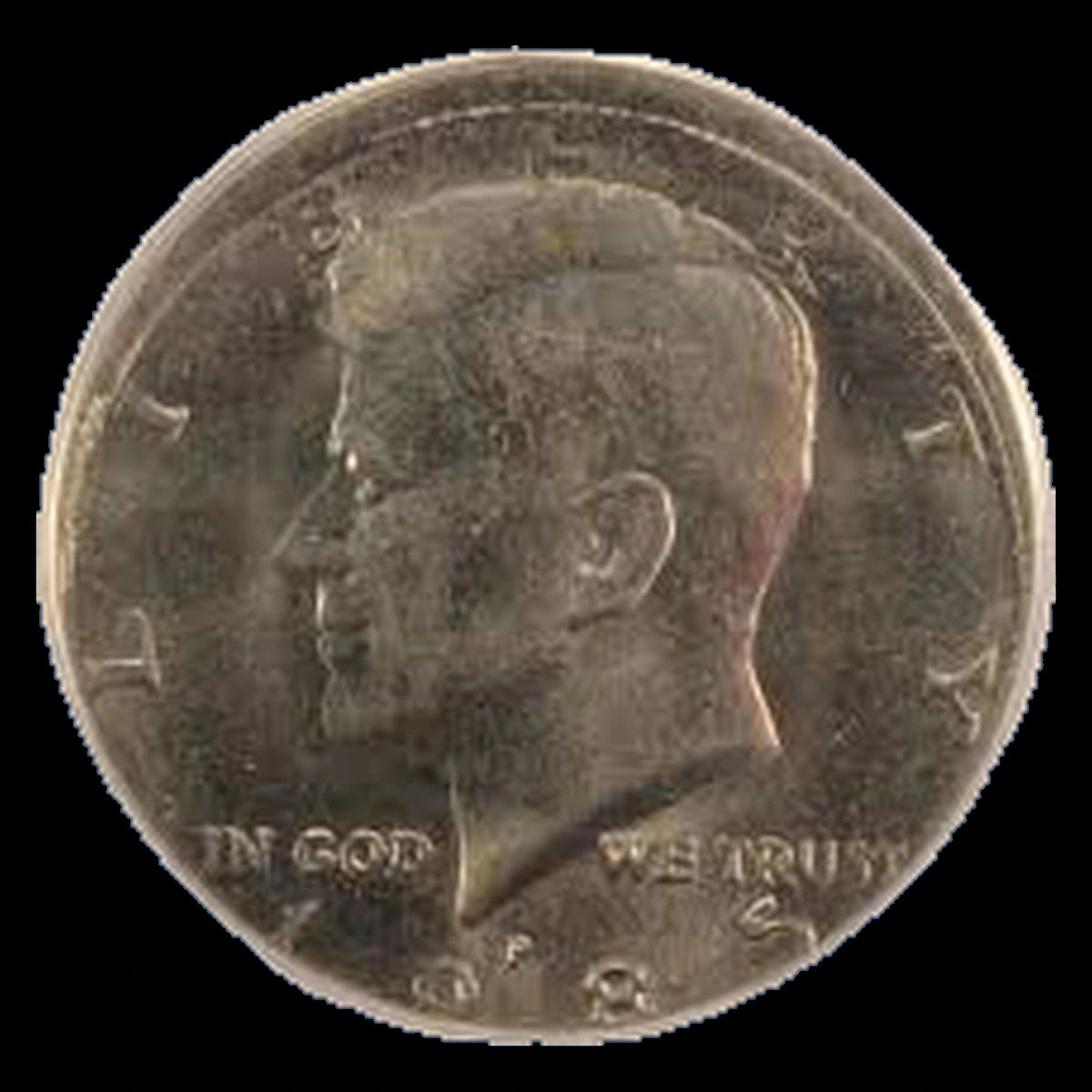
A listed 1985-P graded NGC MS64 establishes a specific same-year off-center example. Its blank sat partly outside the dies, so only the overlapping metal received the image.
The listing supplies no displacement percentage or direction. Those details belong to the actual specimen rather than the broad category name.
How to Identify
Compare the complete coin in the NGC MS64 listing, retaining the date and P in view. A crop of the plain area loses information needed for identification.
Follow where the design meets unstruck metal on both faces. Missing outer details should fit the same displacement rather than a misaligned die affecting only one side.
Inspect the edge and smooth areas for original surfaces instead of filing or cutting. Record the outline before assigning any percentage.
What It’s Worth
Genuine examples with readable dates are estimated at $75–$650. Attractive displacement and remaining surfaces affect the price as well as the amount of shift.
No public realized price is used for the listed 1985-P. A ten-percent-off-center 1990-P graded NGC MS66 sold for $198 in September 2025, providing a different-year comparison with its own measurements.
4. 1985 Half Dollar A Complete Picture Sits inside Wider Metal: Reported Broadstrike Error
A broadstrike spreads outward because the collar does not hold the blank to normal width. The collar is the surrounding ring that normally controls diameter and forms edge grooves.
The full design remains present despite the wider outline. The supplied 1985 report establishes no particular graded broadstrike specimen.
How to Identify
Measure several widths, then follow the outer lettering on both faces to confirm that the intended design fits. An unevenly positioned but complete image can still be compatible with a broadstrike.
Check for natural spread metal and an edge formed without normal restraint. Later hammering tends to crush already struck detail, while grinding leaves altered surfaces.
A smooth edge alone cannot prove the error because wear or alteration can remove grooves. Weight should remain compatible with a complete blank and any circulation loss.
What It’s Worth
The estimated range is $80–$500 for confirmed examples. Spread, surviving detail, and preservation guide the comparison.
A plain 1990-P ANACS MS61 sold for $192 in March 2025. A different 1983-P NGC MS65 had a $175 dealer asking price, which is an offer rather than a completed sale.
5. 1985 Half Dollar A Small Raised Shape Marks the Surface: Reported Die Gouge Error
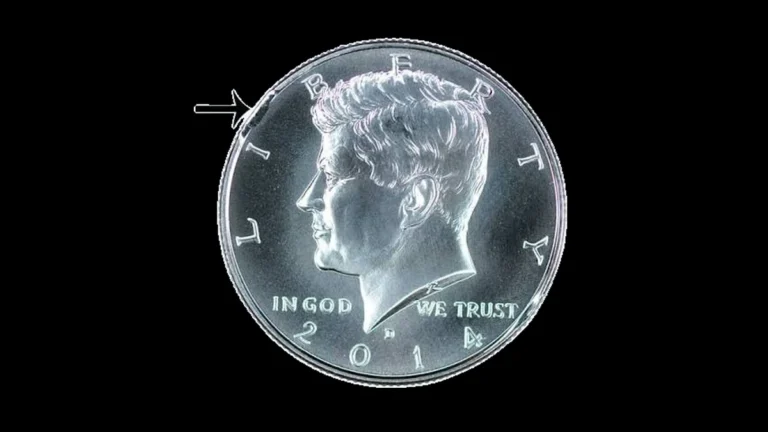
A gouge in a die can produce the opposite of a trench on the coin. Metal enters the recessed damage in the steel tool and emerges as a raised feature.
The 1985 report places this kind of mark near the rim without establishing a mint or exact position. A raised shape therefore needs direct examination rather than a presumed location.
How to Identify
Change the light and determine whether the feature is solid raised relief or a lip beside an incuse scratch. Follow its entire boundary.
Inspect nearby edge grooves and the rim for an impact that could have displaced metal. Added material may also have a seam or different texture.
A matching mark on another coin can help show that it originated in a shared die. Similarity should include shape and position, not merely the presence of a bump.
What It’s Worth
A small clear die gouge has an estimated $5–$75 value. Subtle marks generally attract less interest than an obvious feature crossing recognizable detail.
A larger reverse die break on a 1976-D NGC MS65 sold for $256 in June 2026. That more severe tool failure is not a direct price for a minor raised gouge.
6. 1985 Half Dollar A Ridge or Broad Patch Replaces Detail: Die Cracks and Breaks Error
A crack in a die leaves a fine raised line; loss of a larger piece can leave a broader raised patch. In both cases, coin metal fills an unwanted opening during striking.
The supplied 1985 reports include cracks and internal breaks without establishing a specific photographed rim cud. A cud requires the broken die area to reach the rim.
How to Identify
Classify the feature as a ridge, an interior patch, or a patch connected to the rim. This keeps distinct forms of die damage from being given the same name.
Inspect for solder, crushed edge grooves, and displaced rim metal. A blob resting on the coin or a dent with a raised lip is not automatically a mint-made break.
Look at the design replaced by a broad patch and compare its boundary with the surrounding strike. A precise route must come from the coin, since none is established here.
What It’s Worth
Small cracks through substantial confirmed breaks are estimated at $10–$400. A barely visible line belongs to a different comparison class from a prominent patch.
The 1976-D NGC MS65 reverse-break sale of $256 in June 2026 provides larger-break context. It establishes neither a 1985 cud sale nor the location of a 1985 break.
7. 1985 Half Dollar Small Design Elements Have Repeated Contours: Doubled Die Varieties Error
Both obverse and reverse doubling are reported for 1985-P, without a numbered variety or exact diagnostic letter, star, or feather. The two reports do not establish both sides on the same coin.
A doubled die already contains repeated detail before striking and can reproduce that pattern across multiple coins. It does not require the individual coin to receive another blow.
How to Identify
Inspect one face at a time for rounded repetition or split letter ends, then compare the shape and direction with a reliable variety image. Change the light to exclude reflections.
A flat shelf that reduces the main letter’s shape may result from movement during striking. One heavy-looking element cannot establish a doubled die.
Keep full-face photographs with closeups and seek a consistent pattern on independently identified coins. Normal size and weight do not prove this kind of variety.
What It’s Worth
Confirmed 1985-P varieties have provisional estimates of $20–$250 for obverse doubling and $25–$300 for reverse doubling. Attribution, visible separation, and condition must support the premium.
A 1974-D obverse doubled die graded ANACS MS64 sold for $49 in May 2026. A 1965 Special Mint Set reverse doubled die graded MS66 brought $408 in March 2024, but its special finish and 40-percent-silver construction differ from ordinary 1985-P coins.
Conclusion
The documented triple clip, Philadelphia off-center strike, and double strike with an indent provide distinct starting points for a 1985 inspection. Their measurements and descriptions belong to those individual examples.
For smaller marks, identify raised original metal before assigning a die-error name. Keep broader reports provisional until a candidate has a reliable match, and use whole-coin prices that account for both the feature and the surrounding condition.