Rare 1996 Quarter Errors (List & Pictures)
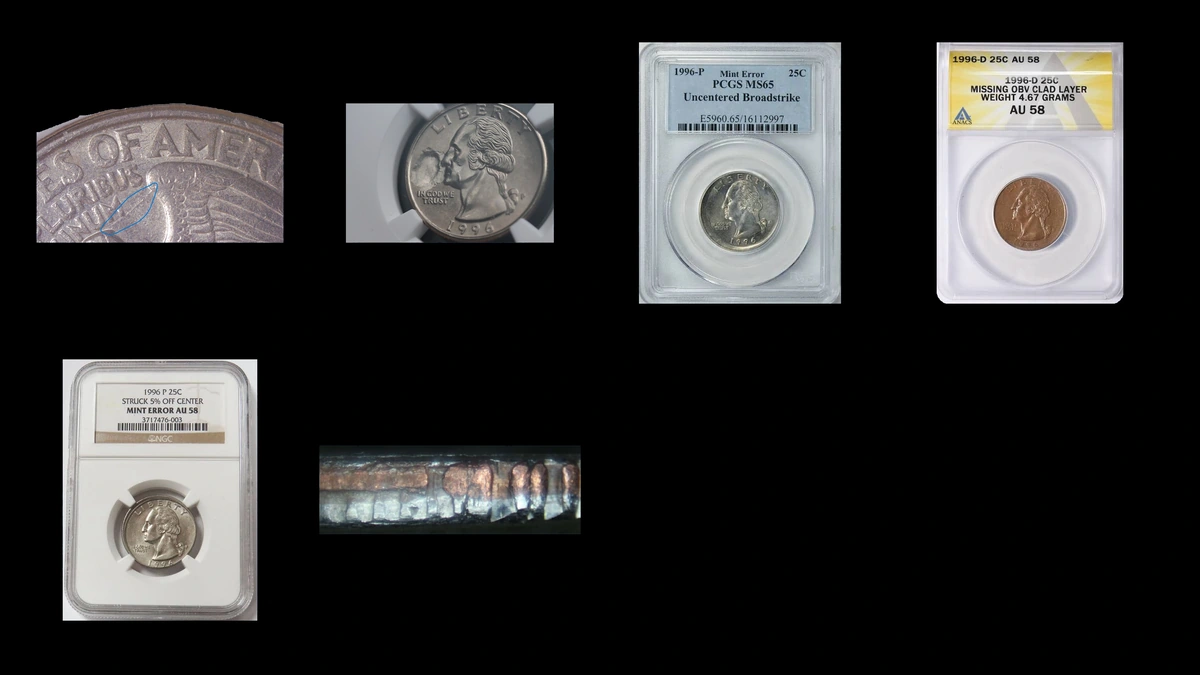
A Philadelphia quarter struck on a nickel blank sold for $600 in January 2023. Estimated values across 1996 quarter errors range from $5–$1,500, including subtle raised lines and complicated collar-related shapes.
This guide explains the identifying features and keeps individual weights, strike percentages, and auction records attached to the right coins.
| Category | Estimated value |
|---|---|
| Die crack | $5–$75 |
| Grease-filled detail | $10–$150 |
| Reported doubled ear | $20–$150 |
| Broadstrike | $30–$250 |
| Strike through a late die cap | $50–$250 |
| Clip | $40–$400 |
| Missing reverse layer | $75–$400 |
| One-sided off-center combination | $60–$450 |
| Ordinary off-center strike | $50–$500 |
| Multiple strikes | $100–$700 |
| Nickel blank | $150–$1,200 |
| Collar shimmy combination | $250–$1,500 |
1. 1996 Quarter Die Cracks Error
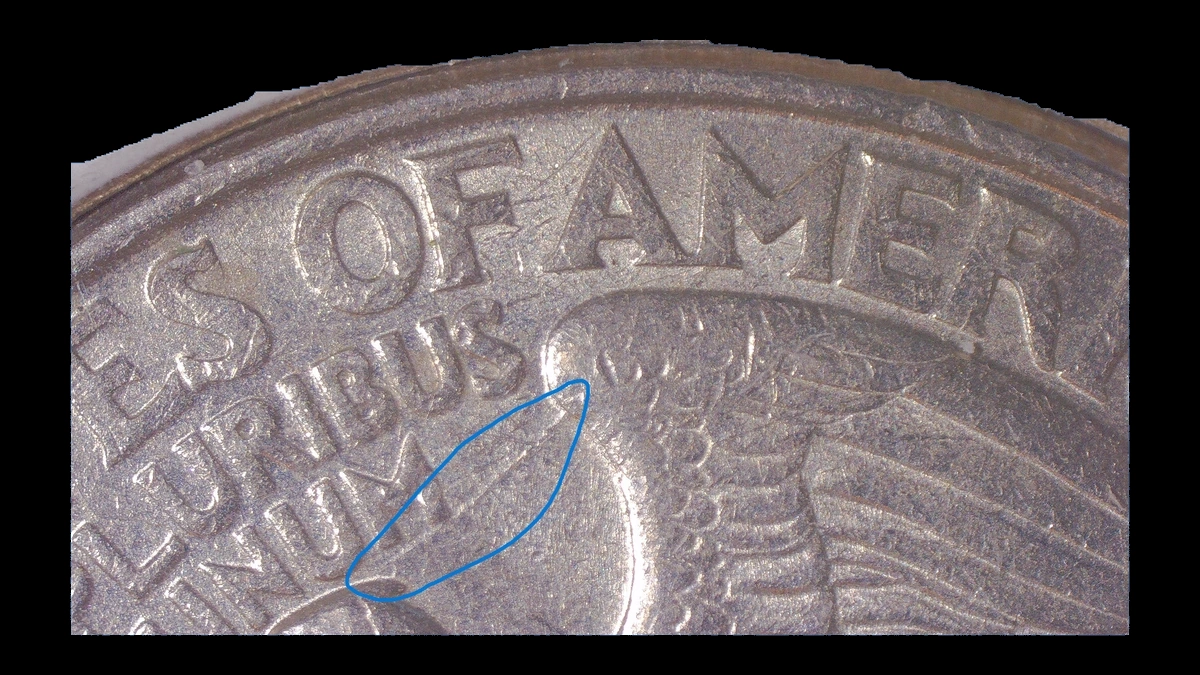
A Philadelphia crack is reported for this year, while a separate illustration shows a reverse line from the eagle’s wing toward UNITED. The illustrated specimen’s mint is not established.
A crack in the die accepts metal during striking and leaves a raised ridge. Its exact path belongs to the particular tool involved.
How to Identify
Follow the line under side lighting and inspect for a scratch trench beside any raised lip. Compare the illustrated wing-area line near E and D in UNITED without assigning its location to every Philadelphia example.
Read the mintmark from the actual coin. A continuous raised ridge supports the cause, but a similar position alone does not establish the mint or specimen.
What It’s Worth
Recognizable cracks have estimated values of $5–$75. A clear line on original surfaces is easier to compare than one obscured by wear, scratches, or corrosion.
2. 1996 Quarter Grease-Filled Details Error
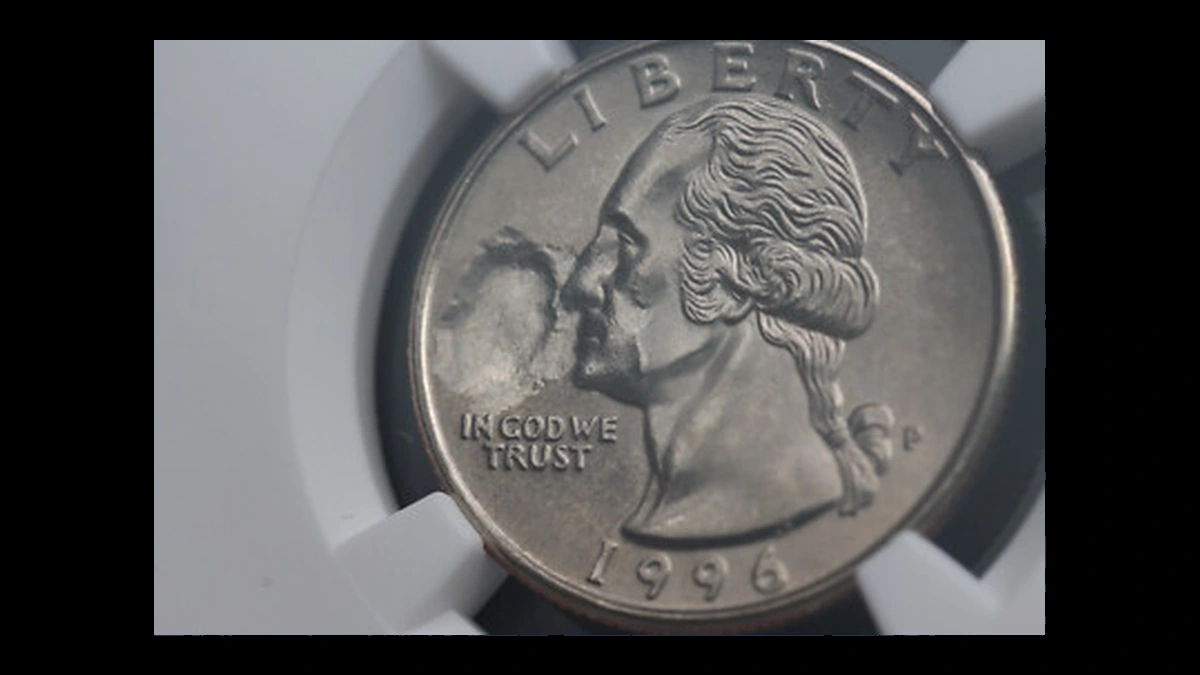
Localized missing letters or eagle detail can result when grease and debris block recesses in a die. The surrounding design may still form normally.
The reported category does not establish one mint or exact affected area. It also does not identify a cloth or wire impression.
How to Identify
Compare the weak patch with nearby strong detail and with the portrait’s wear. General flattening can explain missing letters without a blocked die.
Look for scraping where a letter seems absent. A broad uniformly weak design may require a weak-strike explanation instead of a localized grease attribution.
What It’s Worth
Small filled areas have estimated values of $10–$50, while more obvious missing detail may fall around $50–$150. The contrast with sharp nearby design matters more than simply counting weak letters.
3. 1996 Quarter Reported Doubled Ear Error
The illustrated 1996 report places an extra outline at the upper rear of Washington’s ear. It does not establish a mint or recognized variety number.
A doubled die would carry that repeated shape in the stamping tool itself. The reported location should not be replaced with another year’s better-known ear feature.
How to Identify
Enlarge the upper rear of the ear, rather than beginning below the earlobe. Compare the full extra outline under different lighting directions.
A flat shelf or shifting reflection does not establish rounded repeated design. Keep the year and mintmark visible in a wider photograph while evaluating the close-up.
What It’s Worth
An established doubled-ear example has an estimated range of $20–$150. This remains conditional on correct identification of the feature.
Clear separation on an undamaged surface provides a better comparison than an indistinct line hidden among contact marks.
4. 1996 Quarter Broadstrikes Error
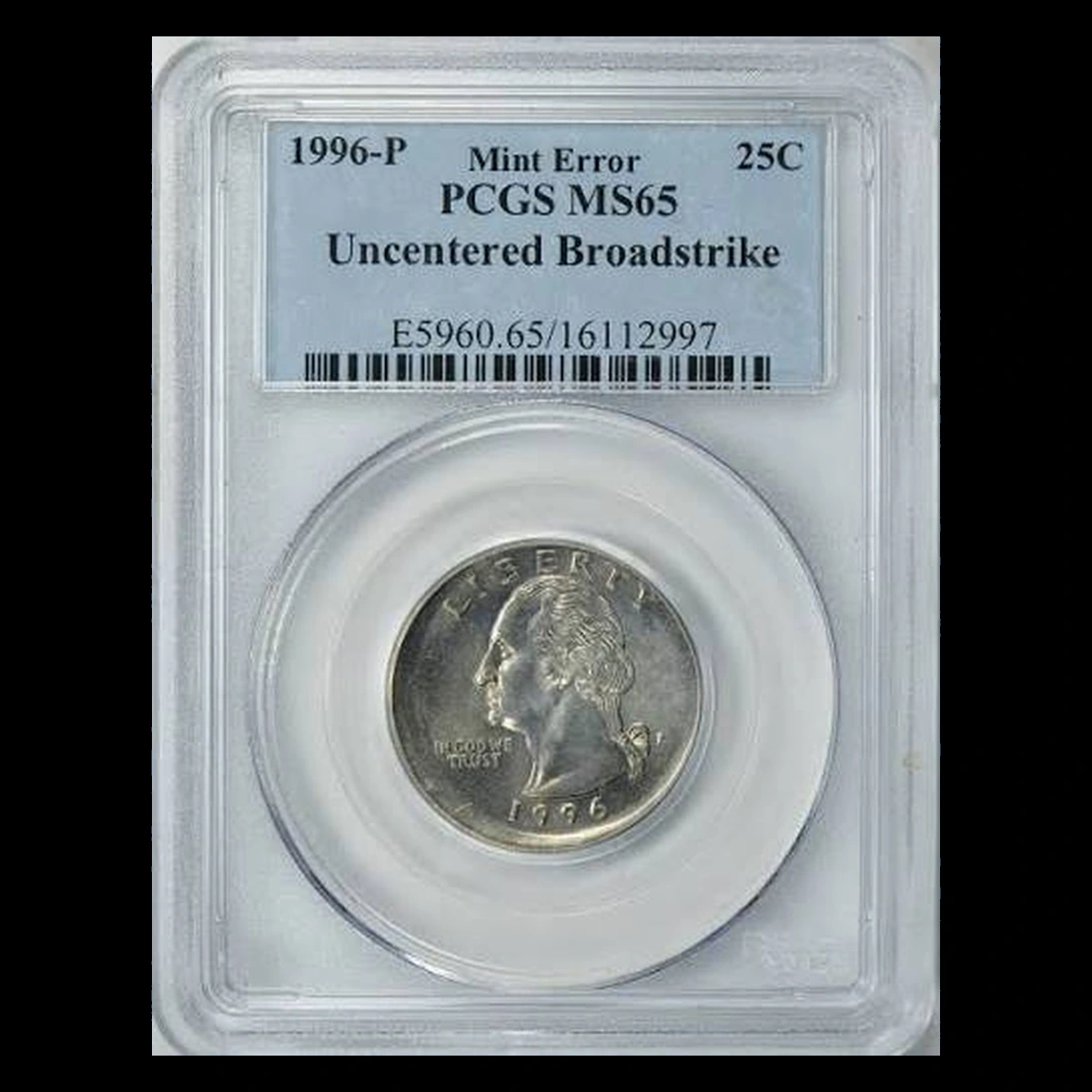
Philadelphia broadstrikes include an example on a Type I blank, meaning its rim had not been raised before striking. A separate Denver coin retains a narrow band of edge grooves next to the front.
The metal expanded without normal collar restraint. The Denver contact band shows that a limited trace of grooves can survive on an otherwise expanded edge.
How to Identify
Check for a complete design inside the spread border and examine the edge formation. A normal quarter measures about 24.3 millimeters across and weighs 5.67 grams, but increased width alone cannot prove a broadstrike.
On the Denver example, locate the narrow grooved strip beside the front face. Later flattening can enlarge a coin while crushing details instead of preserving original struck flow.
What It’s Worth
Readable broadstrikes have estimated values of $30–$250. Expansion, intact lettering, and preservation affect the comparison.
The narrow Denver groove band belongs to the same error coin. Normal die orientation is not an additional error to price separately.
5. 1996 Quarter Strike Through a Late Die Cap Error
The reported Philadelphia ANACS MS61 quarter received an impression through a late-stage die cap. A coin stuck to a die can thin under repeated pressure and transmit a blurred design to later blanks.
This quarter is the receiving coin, not the cap itself. The supplied description does not establish which face was affected.
How to Identify
Use the clearer face to establish identity and condition, then inspect the softened face for traces transmitted through the barrier. Grinding or sanding may erase design but leaves different surface evidence.
The receiver need not have the high walls of a cup-shaped cap. Look for a coherent blocked impression rather than assuming that any smooth face qualifies.
What It’s Worth
Comparable late-cap strikes have estimated values of $50–$250. An auction index lists the Philadelphia MS61 example at $59 in 2010.
MS61 indicates no circulation wear but noticeable marks. Readable ghost detail and a preserved clearer face help explain the error.
6. 1996 Quarter Clipped Blanks Error
The Denver NGC MS66 example has a forty-five-percent clip and weighs 3.16 grams. A different Denver quarter has two curved clips.
The gap existed before striking because the blank was incomplete. The percentage and weight of the first coin do not describe the double-clip specimen.
How to Identify
Examine each exposed boundary for original formation beside the gap. Filing, sawing, or fresh shearing through finished detail suggests later removal.
Possible weakness opposite a curved clip can support the check. For two gaps, inspect both independently and preserve the full outline in photographs.
What It’s Worth
Genuine clips have an estimated range of $40–$400. The forty-five-percent MS66 example sold for $79 in July 2021.
Its large missing area did not produce an exceptional price. A second gap likewise does not automatically double the value.
7. 1996 Quarter Missing Reverse Clad Layer Error
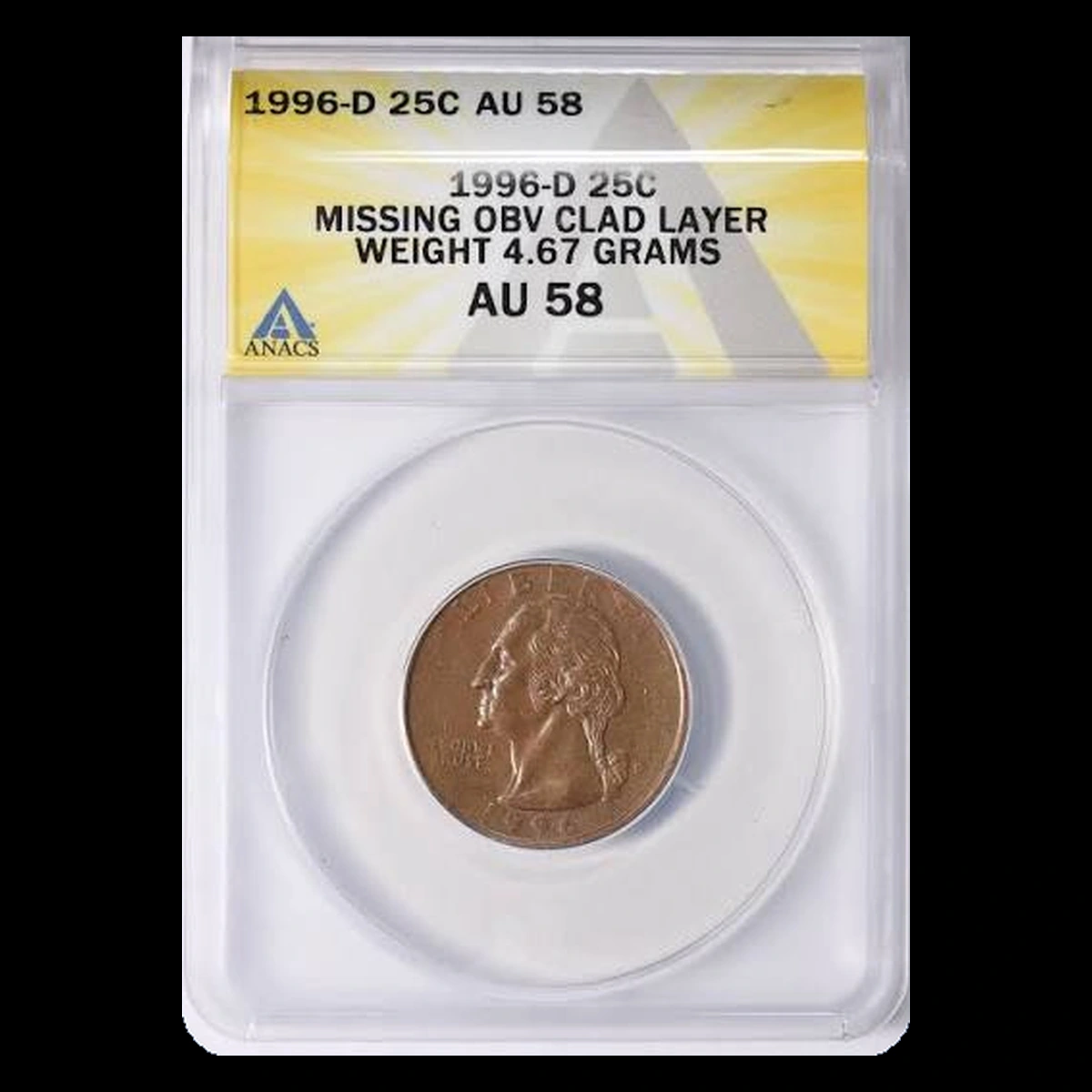
The recorded Denver NGC MS63 quarter weighs 4.7 grams and lacks its reverse outer layer. Its eagle side exposes copper while the front retains its pale covering.
This is a change in the coin’s layered construction. Staining over intact metal can imitate the color without removing the sheet.
How to Identify
Compare the copper reverse, pale front, and edge structure together. Original design should remain on the exposed copper without the abrasion or etching expected from later removal.
The recorded weight belongs to this particular coin. Do not polish the surface to test its color or use weight loss alone to name the missing face.
What It’s Worth
Similar authenticated coins have estimated values of $75–$400. The 4.7-gram Denver MS63 example sold for $79 in January 2015.
Clean exposed metal and readable design are more useful comparisons than a bright but damaged surface.
8. 1996 Quarter Off-Center Strike with a Blank Reverse Error
The Philadelphia NGC MS65 example is described as eighty percent off center with a blank reverse. Only a small part of the front received the normal design.
The one-sided, or uniface, appearance is an additional blocked-contact feature. A severe off-center strike does not inevitably leave its reverse blank.
How to Identify
Locate the small struck front area and inspect the corresponding reverse region. An ordinary off-center strike would normally show some opposing design where the blank met both tools.
Check the blank reverse for sanding lines, a dished surface, or erased design remnants. Photographs must show both faces and the edge to explain the combination.
What It’s Worth
Comparable one-sided combinations have estimated values of $60–$450. An auction index reports $60 in 2020 for the Philadelphia MS65 specimen.
The result illustrates why a large displacement percentage alone cannot establish a high price.
9. 1996 Quarter Off-Center Strikes Error
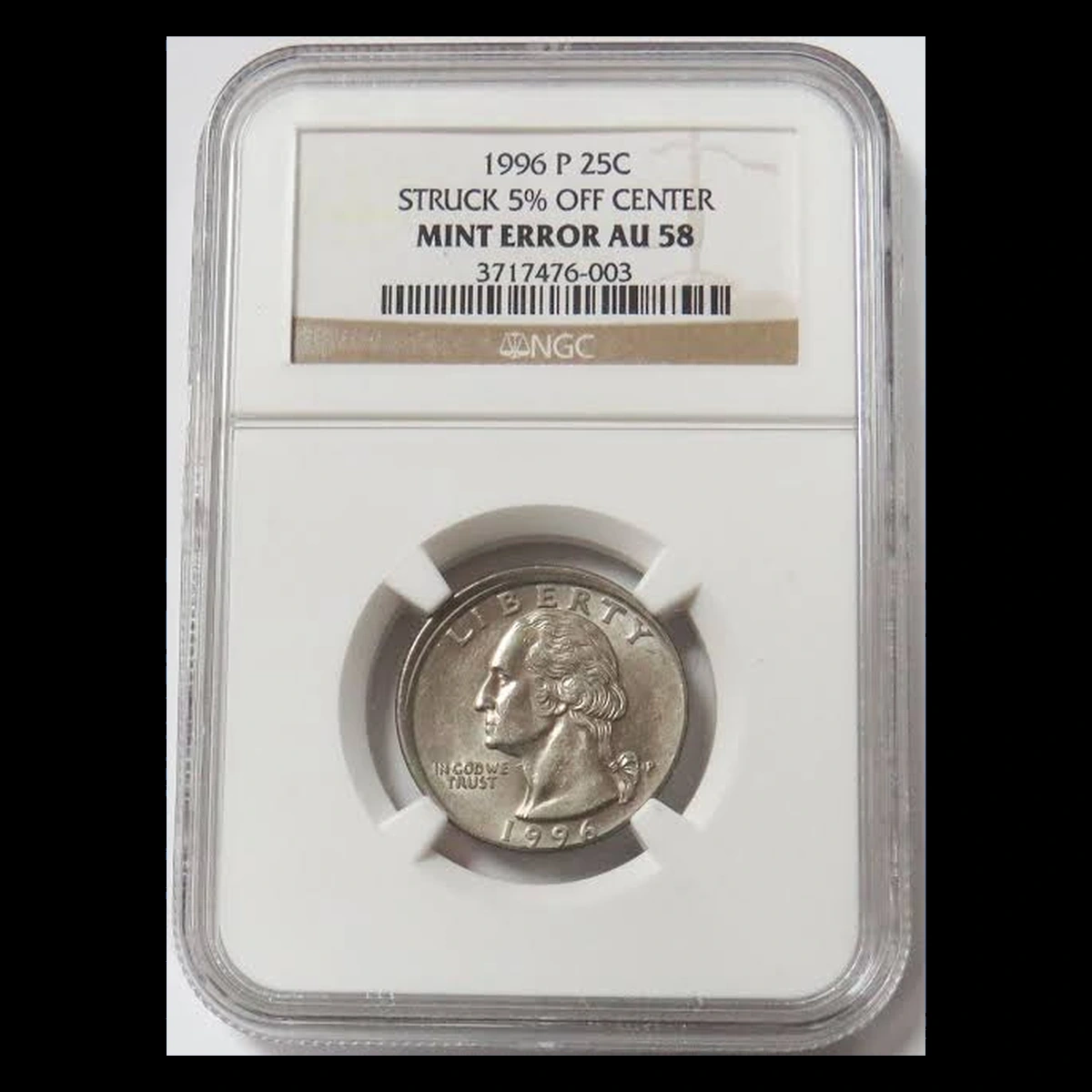
A Philadelphia PCGS MS64 example is described as twenty-five percent off center. The design missed part of the blank while an untouched crescent remained elsewhere.
The crescent is present metal, unlike the empty gap of a clip. Other displacement amounts belong to the same general mechanism.
How to Identify
Compare how both images fit the disc and inspect the transition into unstruck metal. If the reverse remains centered while only the front moves, investigate a shifted die.
Read the surviving date and P directly, and look for grinding across the blank boundary. Do not supply missing identity from another auction coin.
What It’s Worth
Comparable off-center quarters have estimated values of $50–$500. The twenty-five-percent Philadelphia MS64 example is listed at $126 in December 2020.
A larger blank crescent can be less appealing if it loses the date or accompanies heavy damage. Evaluate the complete coin rather than the percentage alone.
10. 1996 Quarter Multiple Strikes Error
Philadelphia records include second strikes eighty-five and ninety-six percent off center. Those figures describe the later blow, not the amount missing from the first design.
A separate Philadelphia example combines multiple strikes with a broadstrike. Its general description does not establish an exact strike count or direction.
How to Identify
Inspect the extreme edge for connected fragments of another impression. A highly displaced second strike may leave only a small group of repeated letters or image details.
For the broadstruck combination, compare the expanded outline with the overlapping design groups. A random distorted line does not necessarily mark an additional blow.
What It’s Worth
Clear attractive multiple strikes have an estimated range of $100–$700, with less desirable examples sometimes below it. Listings place the eighty-five-percent second-strike MS60 coin at $264 in 2022 and the ninety-six-percent AU58 coin at $61 in 2022.
The separate broadstruck multiple-strike MS65 example is listed at $348 in May 2021. Its added expansion should be valued as part of the whole coin.
11. 1996 Quarter Strike on a Nickel Blank Error
Both mints have recorded nickel-blank quarters. A Philadelphia NGC MS62 specimen weighs 4.9 grams, while a Denver Type I blank example is listed at 5 grams.
Type I refers to a blank without its prepared raised rim. Neither piece requires an earlier Jefferson image because the host was an unused blank.
How to Identify
A nickel blank normally starts near 5 grams and 21.21 millimeters across, with uniform alloy rather than a quarter’s copper-centered layers. The quarter strike may expand its outline.
Compare the original edge with the outer design that the smaller blank could not hold. Grinding a quarter smaller may remove letters but leaves a different edge and metal structure.
What It’s Worth
Identified nickel-blank examples have estimated values of $150–$1,200. A Philadelphia PCGS MS63 coin sold for $600 in January 2023.
The separate NGC MS62 Philadelphia coin weighing 4.9 grams brought $204 in April 2020. Its measurement and result should not be assigned to the MS63 coin or Denver example.
12. 1996 Quarter Collar Shimmy Combination Error
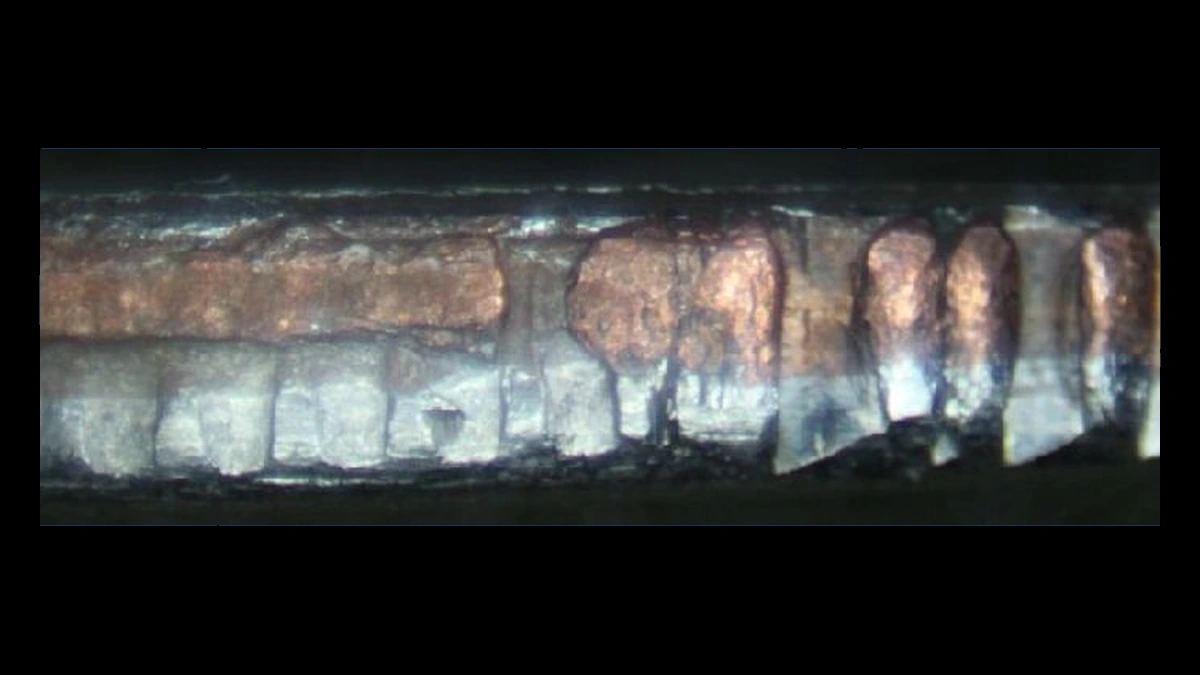
The Philadelphia example has crowded or sideways-displaced edge grooves, a strongly cupped unstruck crescent, and a misplaced front design. Collar shimmy describes back-and-forth collar movement while the coin remained held between the dies.
The affected grooves run roughly from six to nine-thirty on the illustrated coin. This differs from simply expanding outward without normal collar restraint.
How to Identify
Compare the bunched grooves with the undisturbed edge in the Error-Ref example. Inspect the cupped unstruck area and front displacement toward about six-thirty as related parts of the same strike.
Later squeezing can also damage grooves, often leaving crushing or tool marks. The complete set of original striking features must support the mechanism.
What It’s Worth
An established collar-shimmy combination of this kind has an estimated range of $250–$1,500. No sale within that range is supplied for the illustrated specimen.
Clear edge views are essential to explain it. Adding separate full prices for its cupping, displacement, and edge disturbance would overstate the value of one combined error.
Conclusion
A convincing 1996 error identification begins with the feature itself, whether that is a fixed ear outline, original missing layer, or disturbed edge grooves. Photographs should preserve the date, mintmark, and surrounding design needed to interpret it.
Keep combination errors together and individual auction records separate. Large clips and extreme displaced strikes can still sell modestly, while a small feature requires a secure match before a variety premium becomes meaningful.