Rare 2002 Dollar Errors (List & Pictures)
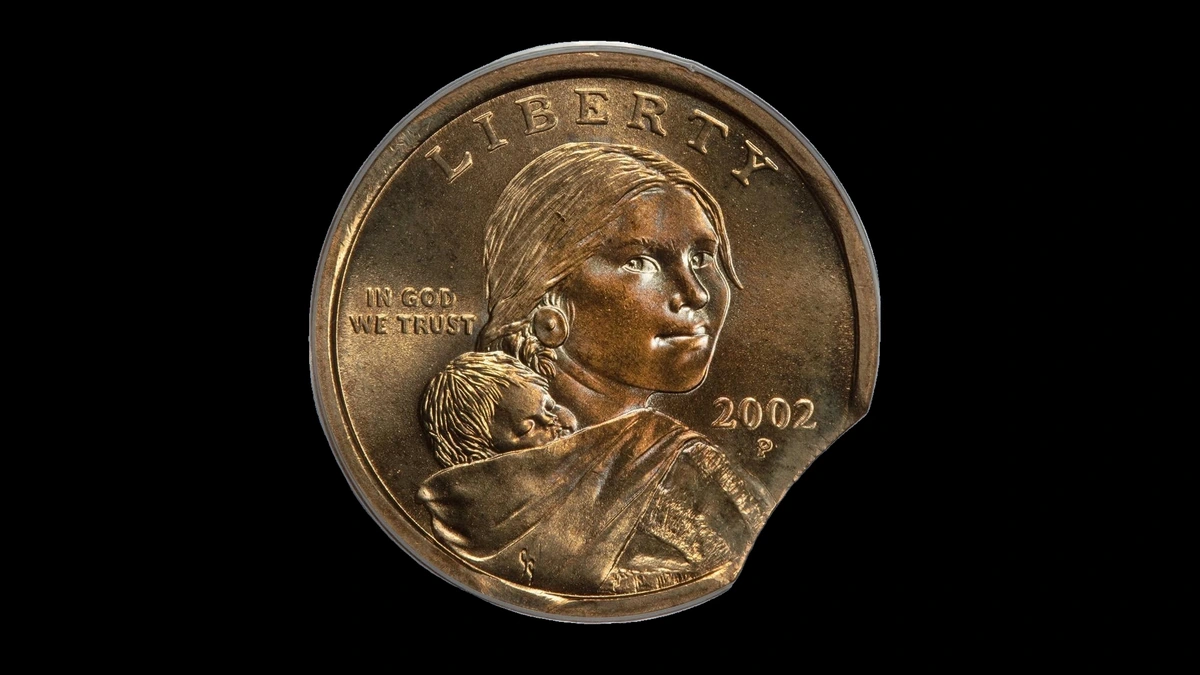
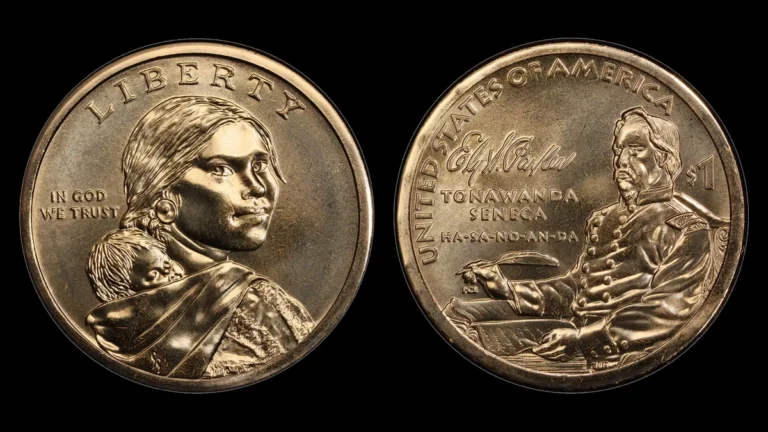
A complete-looking dollar can still be on the wrong blank: the 5.6-gram Denver example among these 2002 Sacagawea dollar errors retained narrow rims despite being struck on quarter metal. It sold for $8,050 in January 2009, the highest completed result supplied here.
Whole-coin estimates run from $15 to $12,000. Inspect the surface details first, then examine peeling layers, missing edges, displacement, and metal identity.
| Observation | Possible error | Estimated value |
|---|---|---|
| Raised line or repeated outline | Die crack or doubled die | $15–$500 |
| Interrupted design | Struck through | $20–$600 |
| Peeling or hinged layer | Lamination or clamshell separation | $15–$3,000 |
| Several gaps | Multiple clips | $50–$1,500 |
| Blank arc beside displaced design | Off-center strike | $100–$2,000 |
| Light-gray, unusually light body | Quarter-planchet strike | $4,000–$12,000 |
1. 2002 Dollar A fine ridge crosses a face: die crack Error
A crack in the steel die becomes a raised line when metal fills it during striking. Denver reports place such lines across Sacagawea’s cheek or jaw.
A separate San Francisco Proof graded PCGS PR69 Deep Cameo has two reverse cracks, described as roughly three-eighths and five-sixteenths of an inch long. Its reflective collector finish is different from an ordinary Denver strike.
How to Identify
Read the mint letter below the date, then select the appropriate face to compare. Denver cheek or jaw lines should not be transferred to the San Francisco eagle side.
Use angled light to establish whether the line rises from the surface. A scratch may push up metal at its sides, so examine the center for an incuse channel.
The supplied Proof lengths do not establish the lines’ starting points or routes. Follow each actual ridge with the surrounding eagle design visible.
What It’s Worth
$15–$400 is the estimated range for these cracked-die dollars. Finish, preservation, and the strength of the feature matter together.
The PR69 Deep Cameo Proof is a nearly flawless collector coin, while a worn Denver example offers a different comparison. Two cracks on one Proof do not produce two independent prices to add.
2. 2002 Dollar Letters or feathers have extra outlines: doubled die Error
One strike can produce repeated details if the die already contains a doubled image. That differs from a finished coin moving and receiving a second blow.
Reported front inspection areas include LIBERTY, the date, and IN GOD WE TRUST. Reverse reports involve feathers and surrounding lettering, without establishing one shared pattern across all mints.
How to Identify
Compare several neighboring features before concentrating on a single bright edge. Rounded extra outlines or small splits at letter joins offer stronger evidence than general thickness.
On the reverse, examine the eagle alongside E PLURIBUS UNUM and UNITED STATES OF AMERICA. Match the actual face, mint, and finish to an attributed variety.
Change the light to eliminate reflections, and check whether a photograph itself is blurred. Flat shelves produced during striking do not establish the same die variety.
What It’s Worth
$20–$500 is the supplied estimate for correctly identified doubled-design varieties. It is not tied to a particular certified auction result in this material.
Clearly separated details and an exact variety match are needed before considering the upper end. A thick-looking letter on a worn coin provides much weaker evidence.
3. 2002 Dollar Part of the picture never formed: struck through Error
A foreign object or soft obstruction can keep the die from reaching part of a blank. It leaves interrupted design and sometimes an impression of the material itself.
A 2002-D graded NGC MS67 has a documented reverse strike-through. Separate reports of weak front letters do not identify the substance responsible.
How to Identify
Trace intact feathers or lettering into the affected patch and inspect its interior texture. The boundary should help explain which design was blocked.
Dragged metal, repeated scratches, and crushed completed detail may indicate damage afterward. Weak front lettering also needs comparison with ordinary wear on the rest of the coin.
Do not call a smooth patch grease or a narrow mark wire without supporting evidence. The MS67 grade describes the Denver coin’s preservation, not the obstruction’s size or identity.
What It’s Worth
$20–$600 is the estimated range for authenticated examples from modest weakness to more visible impressions. A distinct shape or texture generally makes the error easier to demonstrate.
No sale amount accompanies the Denver MS67 description. Its unworn condition does not establish the same price for every struck-through dollar.
4. 2002 Dollar A layer peels or opens like a hinge: lamination and clamshell separation Error
Metal can separate while remaining attached to the coin. A localized peel is called lamination; a large hinged opening can resemble a clamshell.
The Denver front lamination graded NGC MS67 is separate from the San Francisco NGC Proof-64 Cameo clamshell. On the Proof, an outer layer splits along the edge from 6 to 12 o’clock.
How to Identify
Follow the actual opening and the remaining connection without pulling the layers apart. A simple color boundary on a layered dollar does not demonstrate separation.
The Denver front peel needs its own examination of design continuing across the loose metal. Its exact location is not supplied and should not borrow the Proof’s edge positions.
Tool marks inside an opening or a flap bent back afterward can reveal interference. Preserve the attached layer because breaking it off changes both evidence and appearance.
What It’s Worth
$15–$300 is the estimate for ordinary laminations, while an authenticated Proof clamshell has a separate $600–$3,000 range. The Denver MS67 front lamination sold for $15 in September 2002.
Fred Weinberg’s list in Mint Error News offered the San Francisco Proof clamshell for $1,850. That figure is an asking price rather than an auction result.
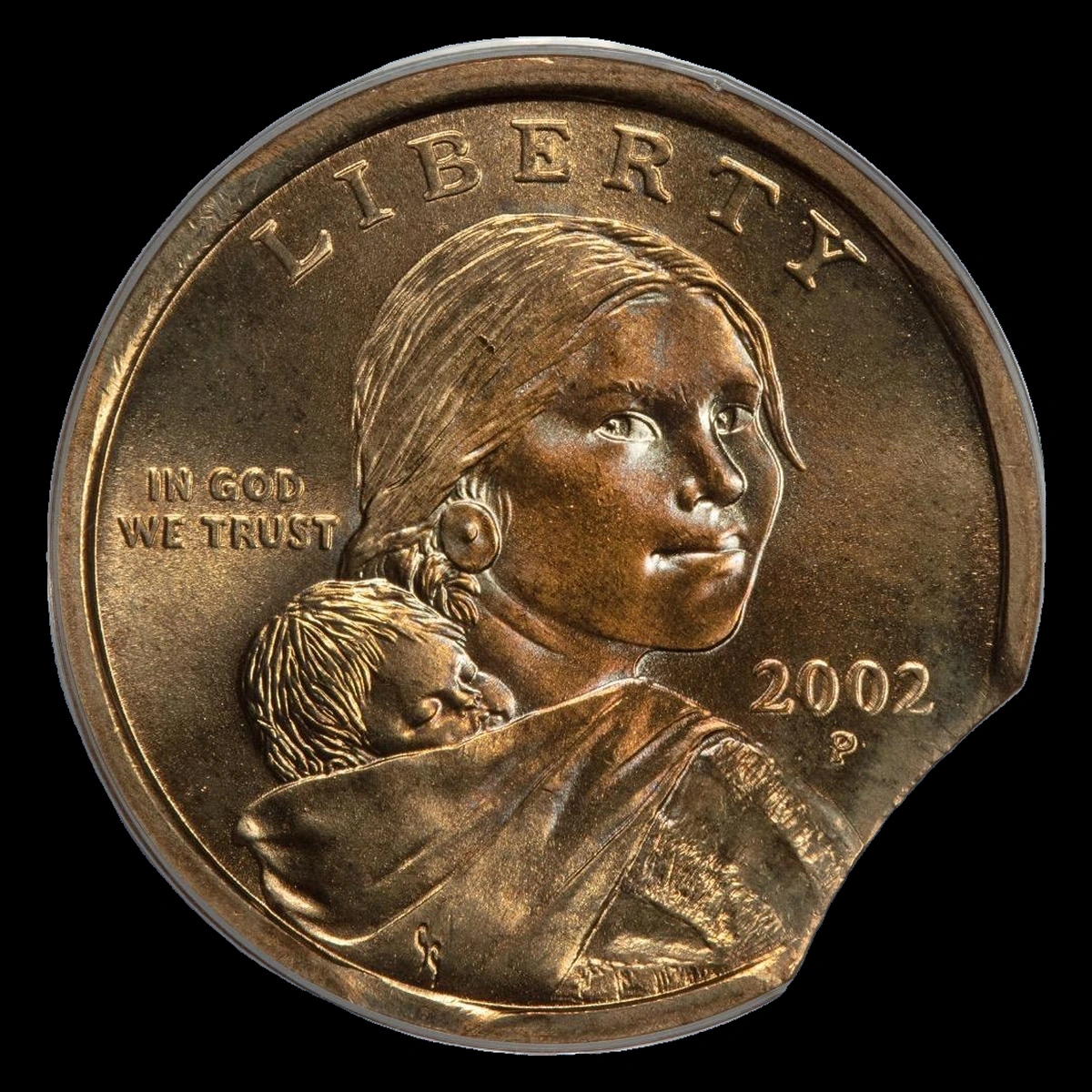
5. 2002 Dollar Several sections are missing from the outline: multiple clips Error
A PCGS MS64 Philadelphia dollar is cataloged with 5% triple clips. Its three gaps belong to one incomplete blank that received the dollar design afterward.
An owner separately reported a San Francisco Proof with two clips in its original set. Packaging supports its history but does not by itself authenticate the gaps.
How to Identify
Map every missing section on a full-coin photograph, then inspect each boundary. The rim and adjacent design should show a consistent relationship with metal that was absent before striking.
File strokes or sharp burrs may expose later cutting. Opposite-rim weakness can support a clip diagnosis but should not be its only basis.
Inspect a Proof through its packaging without forcing the set open. The Philadelphia 5% designation describes its reported triple clips and should not be assigned to the owner’s separate double clip.
What It’s Worth
$50–$600 is the estimate for ordinary Philadelphia multiple clips, with a conditional $150–$1,500 range for an authenticated San Francisco Proof double clip. No confirmed transaction accompanies the owner’s Proof report.
The total missing metal and condition matter more than simply counting gaps. Three tiny clips do not automatically cost three times as much as one clip.
6. 2002 Dollar An unstruck arc remains beside missing design: off-center strike Error
A misplaced blank can receive incomplete designs on both faces, leaving a plain arc on the opposite side. The supplied year guide reports this category without identifying an individual mint, direction, or percentage.
A single-face shift can instead result from a misaligned die. The full relationship between both faces is needed to distinguish them.
How to Identify
Keep the date and unstruck area in the same view. Across from the plain arc, some intended artwork or lettering should run beyond the available metal.
Compare the reverse in a consistent orientation for corresponding displacement. A complete design inside a wide border is insufficient evidence of an off-center strike.
Examine the blank region for grinding or scraping that could have removed a normal design. Originally unstruck metal needs to explain the lost outer picture without signs of alteration.
What It’s Worth
$100–$2,000 is the estimated range for an authenticated single off-center strike. Clear displacement and a surviving date make a stronger comparison.
No completed sale for an individually described 2002 example is supplied. A lost date, second strike, or wrong blank would require additional identification and a different valuation.
7. 2002 Dollar A light-gray dollar weighs too little: quarter-planchet strike Error
The documented Denver error was struck on an unused quarter blank and weighs 5.6 grams. Its metal is light gray instead of the usual golden dollar color.
Despite the smaller blank, the NGC MS66 coin is well centered with narrow rims around both faces. Missing outer letters are not required for this particular error.
How to Identify
Compare color under neutral light, then use recorded measurements or weigh a loose candidate. A normal Sacagawea dollar is about 8.1 grams, while a normal quarter blank begins around 5.67 grams.
The documented 5.6 grams is the specimen’s reported measurement. Striking can change a smaller blank’s diameter, so inspect the body and rims rather than demanding an unchanged quarter outline.
Read the D below the date and have the metal checked for an added coating. An unused quarter blank need not carry edge grooves, and it should not retain Washington’s design.
An underlying quarter picture would indicate a different sequence involving an already struck host coin. Here, weight, composition, and original surfaces support the blank identity.
What It’s Worth
$4,000–$12,000 is the estimate for comparable authenticated Denver quarter-blank dollars. The NGC MS66 example realized $8,050 at Heritage in January 2009.
Its readable identity, strong preservation, and original surfaces contribute to that comparison. A coating that makes a normal dollar silvery does not create the same error.
Conclusion
Use the mint letter and finish to keep the ordinary Denver and Philadelphia examples separate from San Francisco Proofs. The same broad error can look very different across those coins.
Protect loose metal, inspect every claimed clip, and compare actual measurements when the blank is in question. A plain edge is normal for this year, while the documented quarter-blank error depends on its metal and weight rather than edge lettering.