Rare 1888 Dollar Errors (List & Pictures)
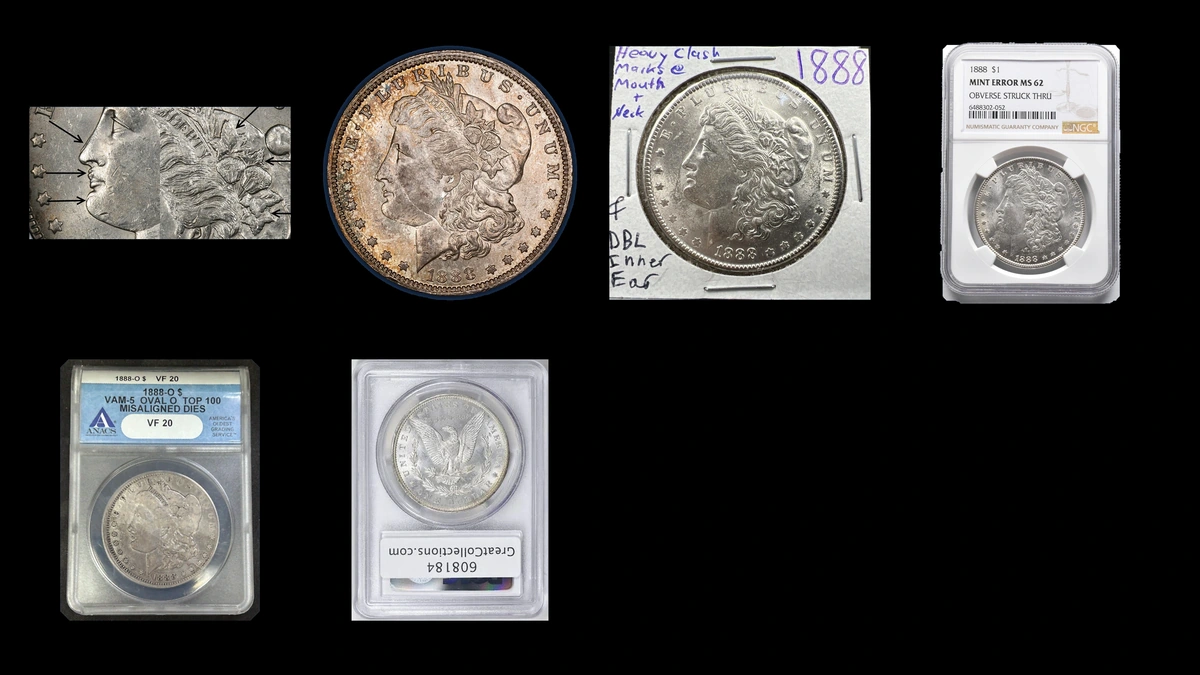
A scarce unworn Hot Lips example sold for $19,200 in July 2022, but a genuine peeling-metal example brought only $53. The estimated span for 1888 Morgan dollar errors is $50–$25,000.
Use the portrait to distinguish doubling from raised breaks, then inspect the eagle, alignment, and edge. The O below the back wreath identifies New Orleans, S means San Francisco, and Philadelphia dollars normally have no mintmark.
1. 1888 Dollar Extra Outlines Around the Mouth: Doubled Dies Error
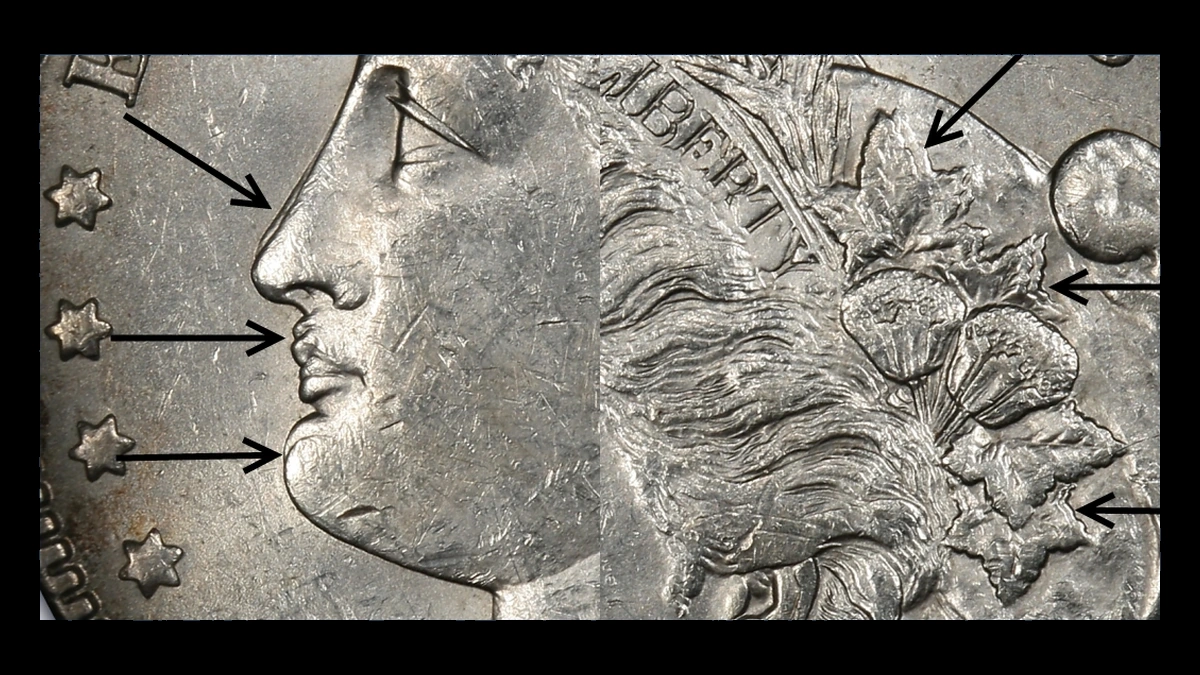
Hot Lips is the name collectors give to strong repeated profile details on an 1888-O. The extra outlines extend beyond the mouth to the nose and chin because the die itself received a doubled design during preparation.
Other varieties affect different places: New Orleans arrows, Philadelphia ear or eyelid details, and Philadelphia reverse feathers, arrows, or wreath. These are separate comparisons, not additional features required on Hot Lips.
How to Identify
Find the mintmark before selecting a close-up for comparison. On Hot Lips, follow several raised profile outlines instead of deciding from one unusually thick lip.
A doubled arrow or ear needs its own variety photograph. Flat ledges from movement during striking and unrelated raised die gouges should not be confused with rounded duplicate design details.
What It’s Worth
$50–$20,000 is the estimated range across these varieties. A worn Hot Lips graded XF40 sold for $229 in February 2023.
An MS61 Hot Lips brought $19,200 in July 2022, as recorded by PCGS. Its unworn condition makes it much scarcer than an ordinary unworn 1888-O, and that price does not transfer to Philadelphia doubling.
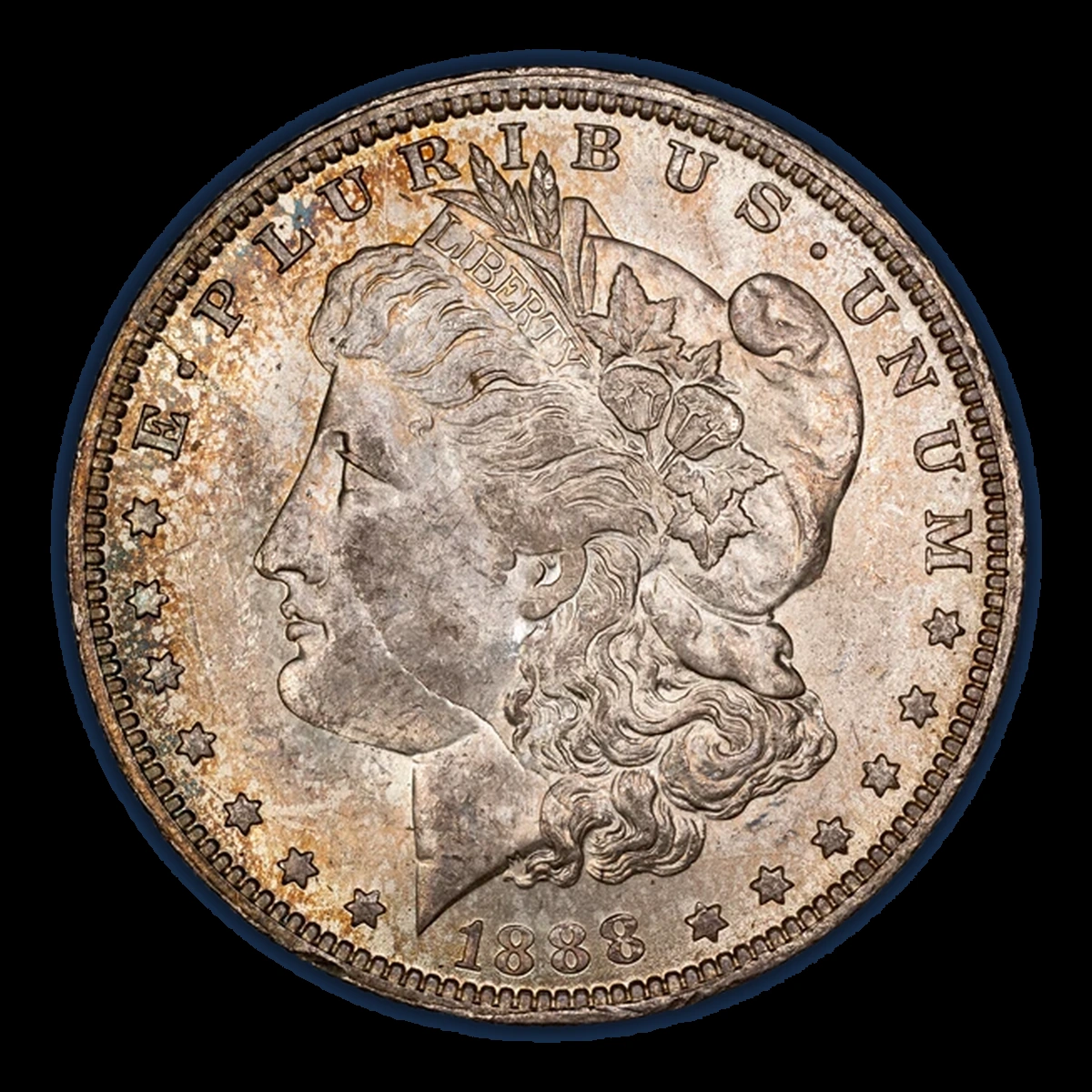
2. 1888 Dollar A Raised Line Across Liberty: Scarface and Other Die Damage Error
A scratch removes or pushes aside coin metal; Scarface reproduces a split in the stamping tool. Its raised path starts near the dot between E and PLURIBUS, crosses the nose, and continues toward the lower hair curls on an 1888-O.
Separate die damage includes a New Orleans break across the R in PLURIBUS and reported San Francisco gouges near the eagle, arrows, and feathers. A gouge cut into a die and a crack through it can both produce raised marks, despite their different origins.
How to Identify
Trace the facial line from its starting point and check how far it developed. An early short crack is a different stage from the conspicuous full Scarface break.
Use angled light to confirm relief above the surface. For the S-mint gouges, compare the collection of reverse marks with an attributed example rather than using a single bump as proof.
What It’s Worth
$50–$25,000 is a broad estimate spanning minor die damage and strong Scarface pieces. A Scarface graded MS64 sold for $18,800 in August 2015.
The extent of the scar is essential to that comparison. The R break, San Francisco gouges, and faint early cracks do not share the same market merely because each came from a damaged die.
3. 1888 Dollar A Thin Sheet Lifting from the Surface: Lamination Error
Peeling on an 1888 dollar exposes a weakness within its silver-copper alloy. An internal seam can open into a thin flap or leave a rough patch where a piece has detached.
A documented 1888-O has front lamination and an NGC MS62 grade. Morgan dollars are not modern layered coins, so this is not the loss of a separately applied outer coating.
How to Identify
Study the edge of the opening for a thin layer and any surviving struck detail. A deep scoop with tool tracks suggests later removal instead.
Photograph an attached flap without lifting it. The normal unworn weight is 26.73 g, but a tiny missing flake may not produce a noticeable difference on an ordinary scale.
What It’s Worth
$50–$750 is the estimated range for these laminations. The NGC MS62 New Orleans coin sold for $53 in March 2024.
MS62 means unworn with noticeable surface marks. More conspicuous peeling can attract greater interest, while cleaning or a disturbed flap can reduce it.
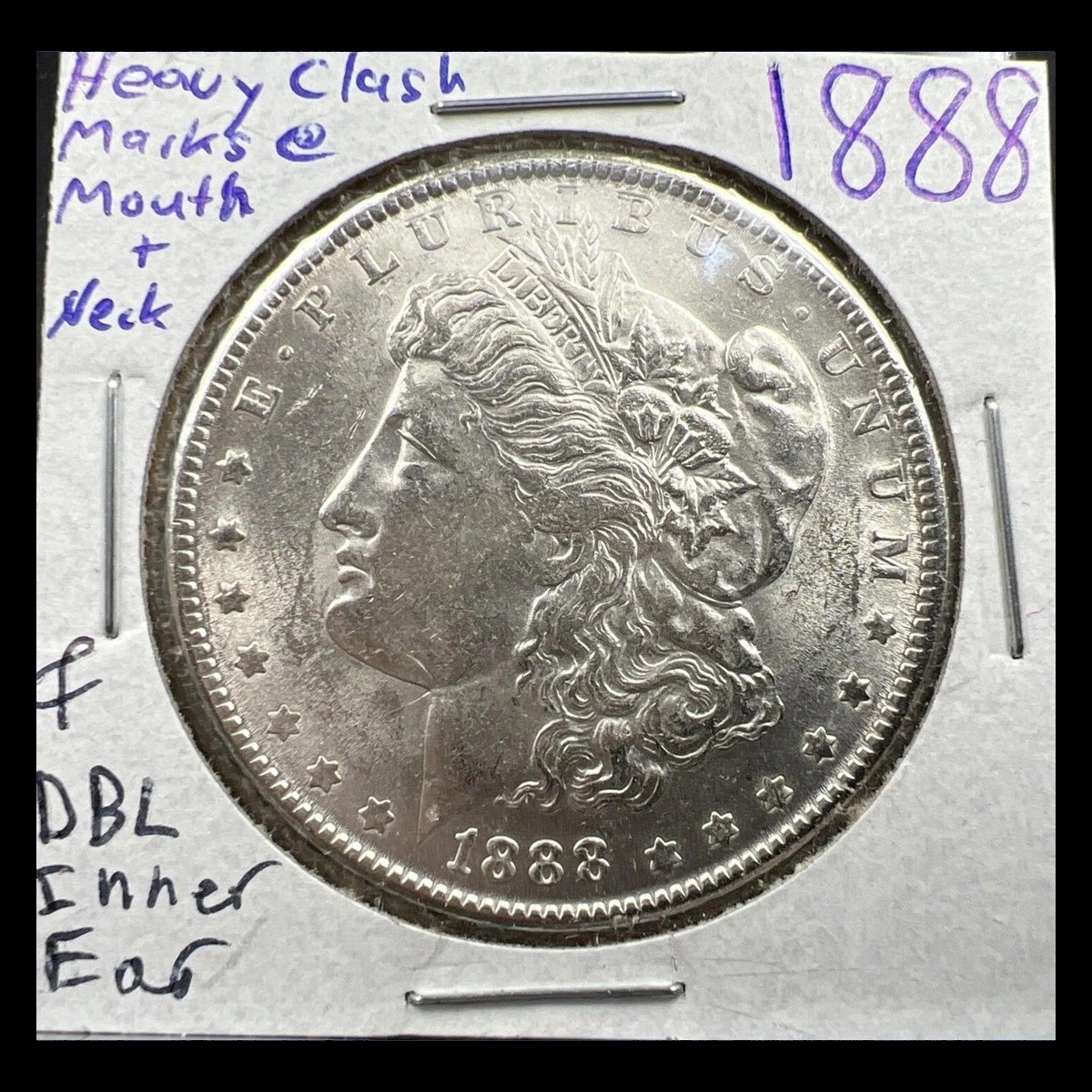
4. 1888 Dollar An Extra E Beside the Bow: Die Clash Error
On a documented 1888-O, a transferred E appears to the left of the ribbon bow beneath the eagle. Its source is LIBERTY on the opposite die.
The two tools collided without a blank between them, leaving transferred detail that later appeared on coins. Separate reports mention marks beneath the eagle’s beak; those should not be assumed to accompany this E.
How to Identify
Locate the bow, then compare the E-shaped mark immediately to its left with a confirmed clash image. A handful of intersecting scratches is not enough to establish the transferred letter.
For a mark under the beak, select a photograph showing that particular clash. The location and recognizable opposite-face shape must agree.
What It’s Worth
$75–$3,500 is an estimated range from modest clashes to stronger, attractive examples. The documented MS63 clashed-E dollar sold for $207 at Heritage in November 2004.
That same coin also has a front die break and a reverse strike-through. The $207 result values the complete coin once, with all three features.
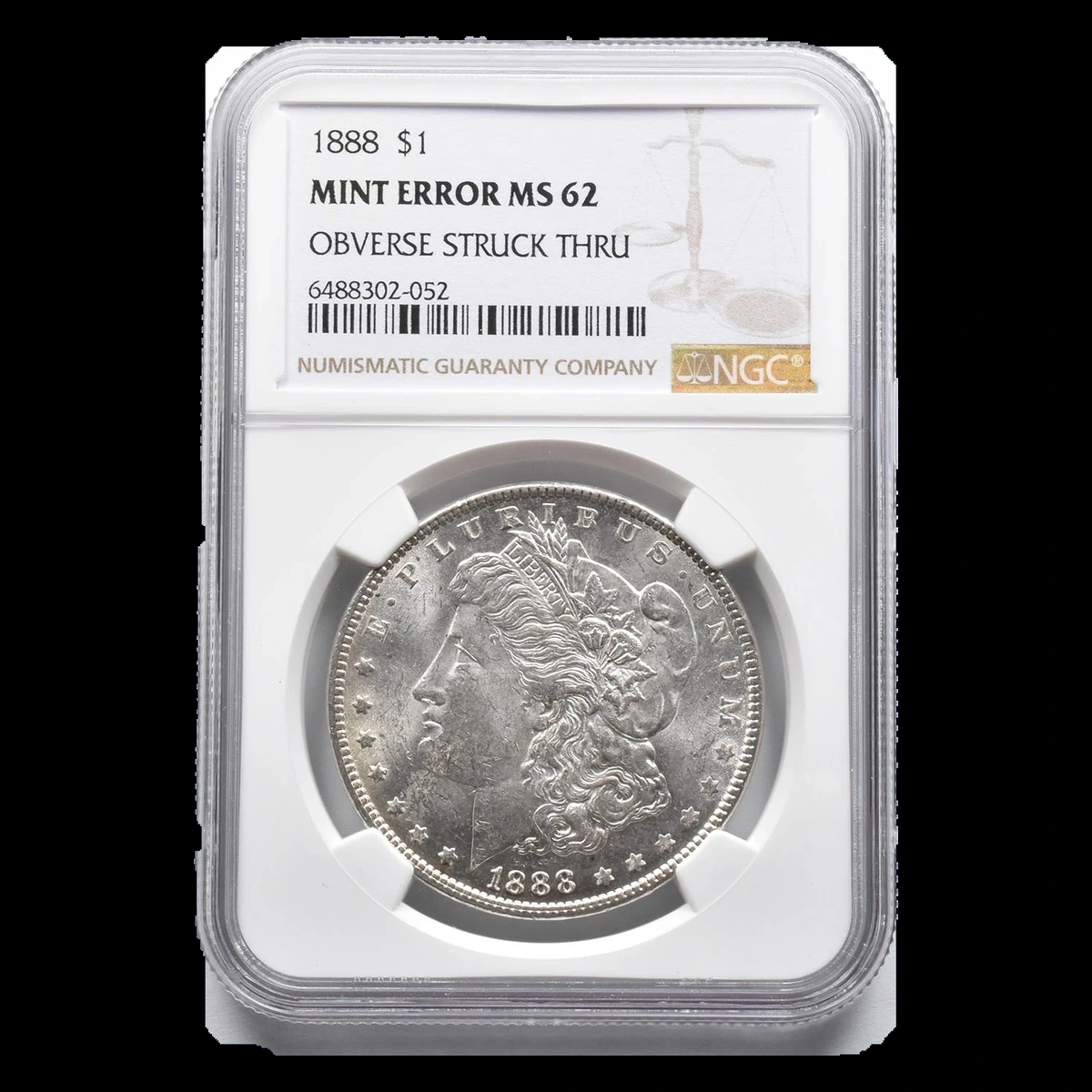
5. 1888 Dollar Nearly Missing RU in TRUST: Strike-Through Error
The R and U in TRUST are unusually faint on the New Orleans dollar discussed above. Something between the blank and die blocked those letters during striking, although the auction description does not identify the material.
Philadelphia strike-throughs also appear in the supplied reports. Their exact impressions need to be examined individually, since the RU location belongs to the documented O-mint example.
How to Identify
Compare RU with the adjacent lettering and inspect the affected surface under angled light. A localized obstruction can suppress detail while leaving the surrounding design intact.
Later abrasion usually leaves scraped surfaces and can reduce nearby high points. Do not call the obstruction cloth, grease, or wire without a shape that supports that identification.
What It’s Worth
$75–$3,000 is the estimated range for ordinary clear strike-throughs. The RU example is the same $207 coin sold in November 2004, not a second auction comparison.
A larger identifiable object impression or better preservation could support a different price. The reported Philadelphia coins need comparisons appropriate to their own features.
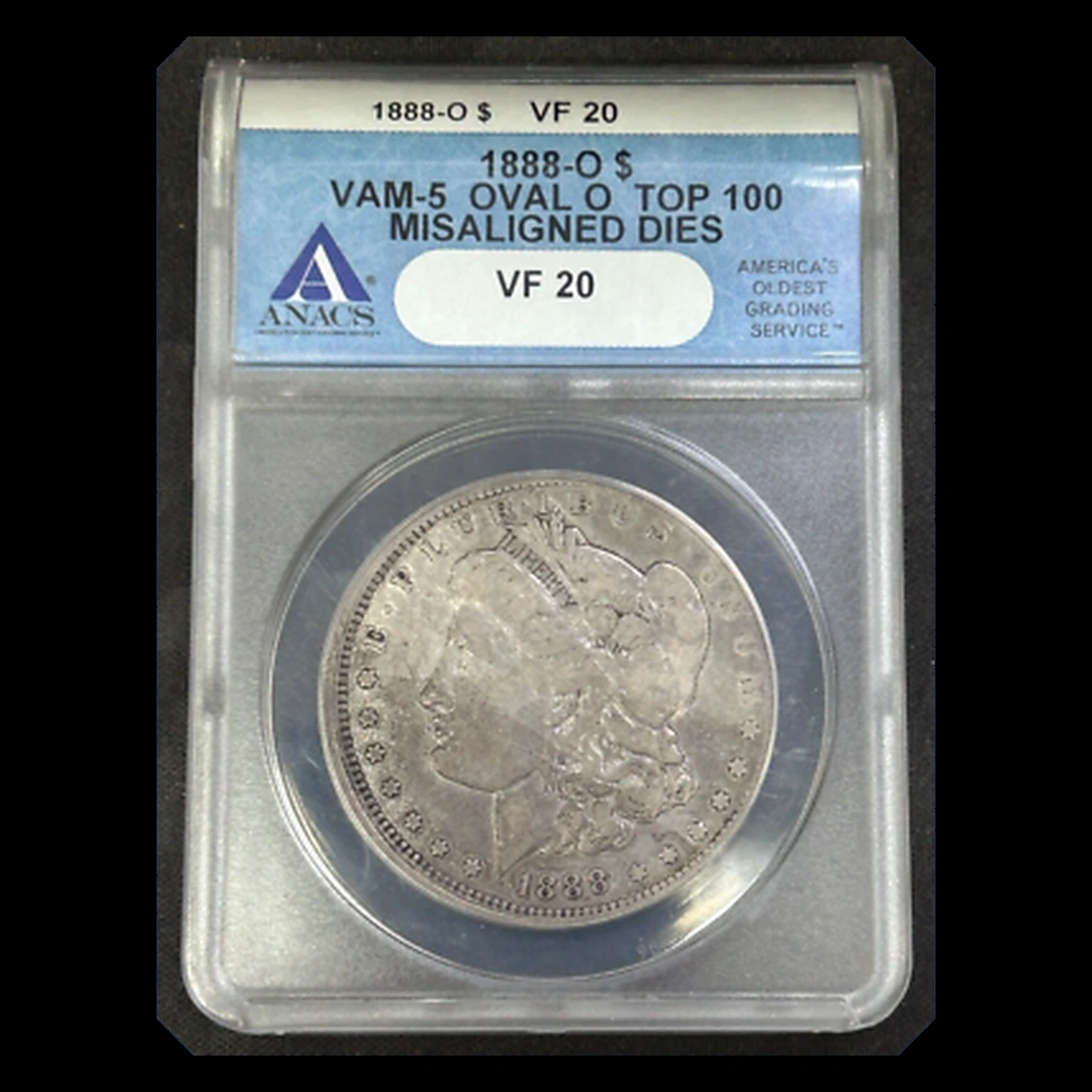
6. 1888 Dollar A Narrow Border on Just One Face: Misaligned Front Die Error
An uneven front border deserves a comparison with the back before being called an off-center strike. A front die that shifts sideways can displace its design while the other face remains better centered.
An 1888-O was cataloged with this error and an XF Details grade for improper cleaning. The cleaning affected its later condition; it did not move the design.
How to Identify
Photograph both faces straight on with the complete rims visible. Compare the narrowest front border with the back to establish whether the displacement is largely confined to one die.
Inspect the rim for filing or crushed metal that could distort its apparent width. A blank struck off center usually shows related displacement on both faces.
What It’s Worth
$100–$1,500 is an estimated range for these errors. The cleaned XF Details New Orleans coin sold for $276 in February 2012.
That result concerns a worn dollar with a separate surface problem. A more obvious shift or original, better preserved surfaces can change the comparison.
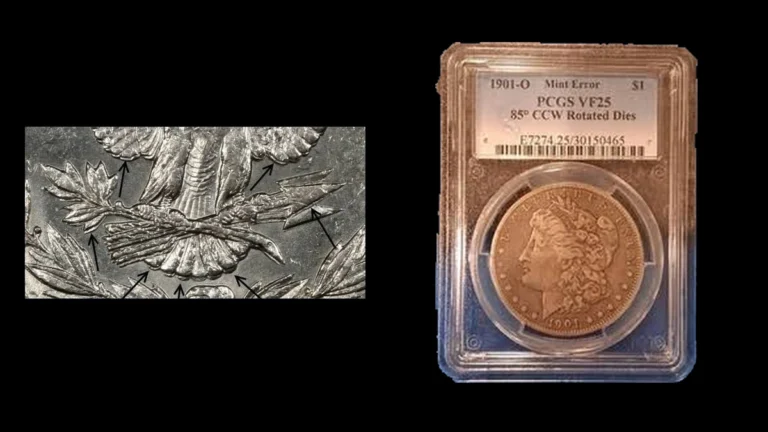
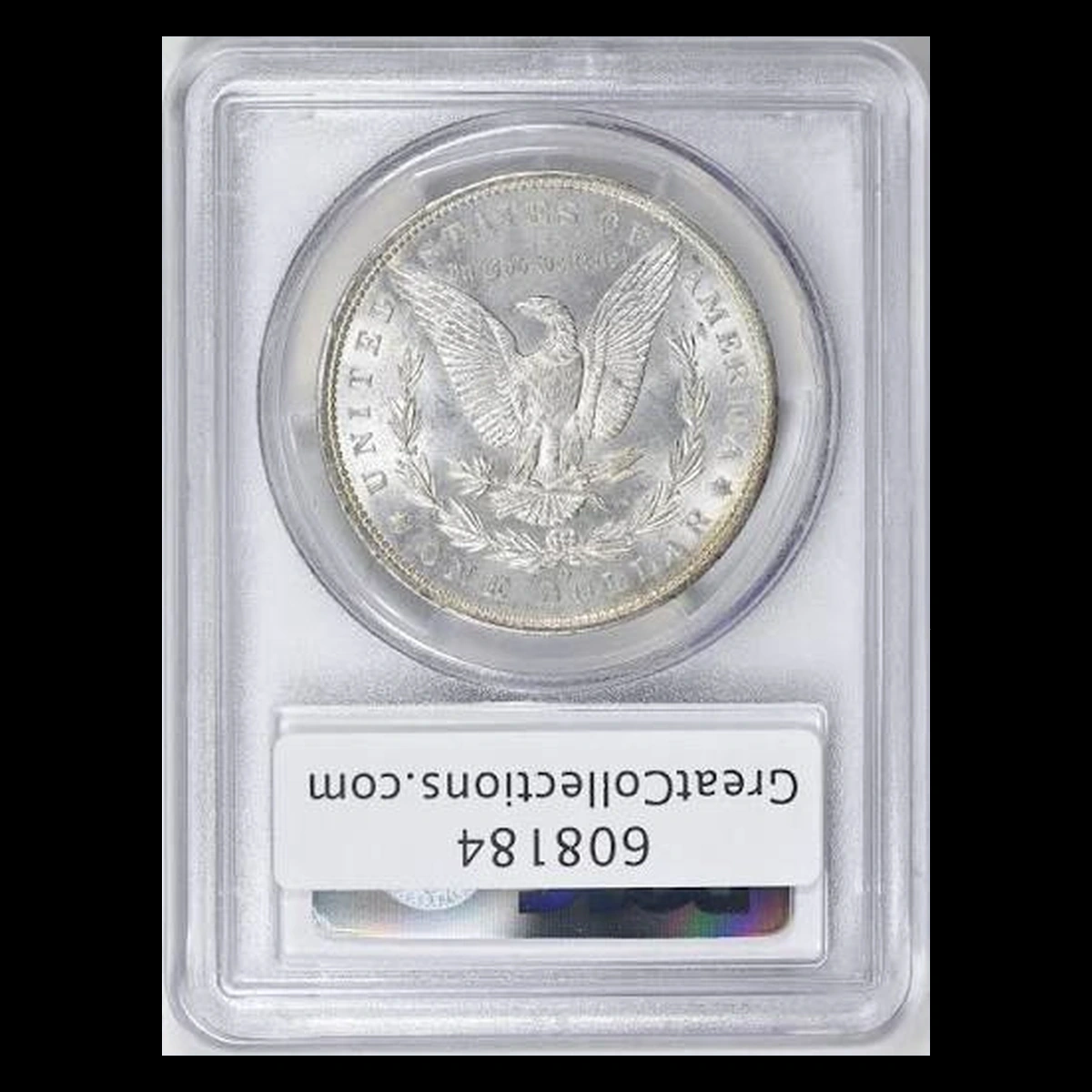
7. 1888 Dollar The Eagle Turns Sideways: Rotated Reverse Die Error
The designs can be centered yet face the wrong direction relative to one another. A documented 1888-O has its reverse rotated 80 degrees counterclockwise because the die was out of its intended orientation.
How to Identify
Hold Liberty upright and flip the coin top to bottom without twisting your grip. The eagle should normally finish upright; repeat the motion to check an apparent tilt.
A controlled video or a flip of the entire sealed holder preserves the relationship between the faces. Two independently rotated photographs cannot prove the angle, and 80 degrees applies only to the documented specimen.
What It’s Worth
$300–$5,000 is an estimated range for substantial rotations. The PCGS MS63 example with the 80-degree counterclockwise reverse sold for $1,092.50 in June 2010.
Its unworn condition and pronounced rotation provide the context. A slight tilt should not be priced as an equally dramatic error.
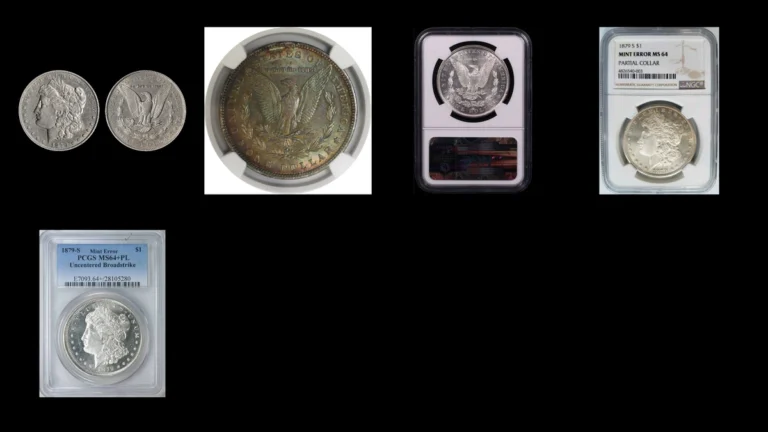
8. 1888 Dollar A Step Along the Grooved Edge: Partial Collar Error
The collar is the ring that restrains the blank and forms its edge grooves during striking. If only part of the blank sits within that ring, the unrestricted portion can spread into a wider band beside the grooves.
An NGC MS61 Philadelphia dollar and a separate ANACS MS63 tilted example are documented. A tilt can make the height of the resulting step change around the edge.
How to Identify
Examine the edge from several directions to follow the junction between the grooved portion and expanded metal. Isolated dents or ground-down areas do not form the same continuous struck relationship.
A normal Morgan dollar measures 38.1 mm across, useful when gently comparing a loose coin’s width. Keep the two documented examples separate; one specimen’s tilt and edge position do not describe the other.
What It’s Worth
$150–$2,000 is the estimated range for a visible partial-collar error. The Philadelphia NGC MS61 example sold for $180 in November 2020.
The MS63 tilted coin appeared in a three-coin group lot. Its individual price cannot be extracted by treating the group’s total as the value of that one dollar.
9. 1888 Dollar A Curved Section Missing from the Blank: Clip Error
A curved gap can originate when the blank-cutting punch overlaps an earlier opening in the metal sheet. The incomplete blank then receives the coin design.
A 2010 advertisement offered an 1888 curved clip graded NGC MS61. The listing does not establish its mint, gap percentage, or position.
How to Identify
Check the curve for an original blank edge and natural design flow toward the missing section. Saw teeth and fresh filing marks point to later alteration.
The opposite rim may be weak, though this sign is not equally visible on all clips. Weight below the normal 26.73 g can support missing blank metal, but a small clip may change the reading only slightly.
Include the mintmark area in the photographs. If it is absent or obscured, leave the mint uncertain rather than automatically assigning Philadelphia.
What It’s Worth
$150–$2,500 is the estimated range for genuine examples. The advertisement asked $275 for the MS61 coin; this was a seller’s asking price, not a completed auction sale.
Conclusion
An 1888 Morgan dollar’s nickname is only the beginning of an identification. Hot Lips requires the correct doubled profile, Scarface depends on the developed break, and an edge error often needs photographs that a front view cannot provide.
Match the mint, condition, and actual defect before applying the $50–$25,000 estimates. Where several features share one documented coin, use its sale as one whole-coin comparison.