Rare 2004 Dollar Errors (List & Pictures)
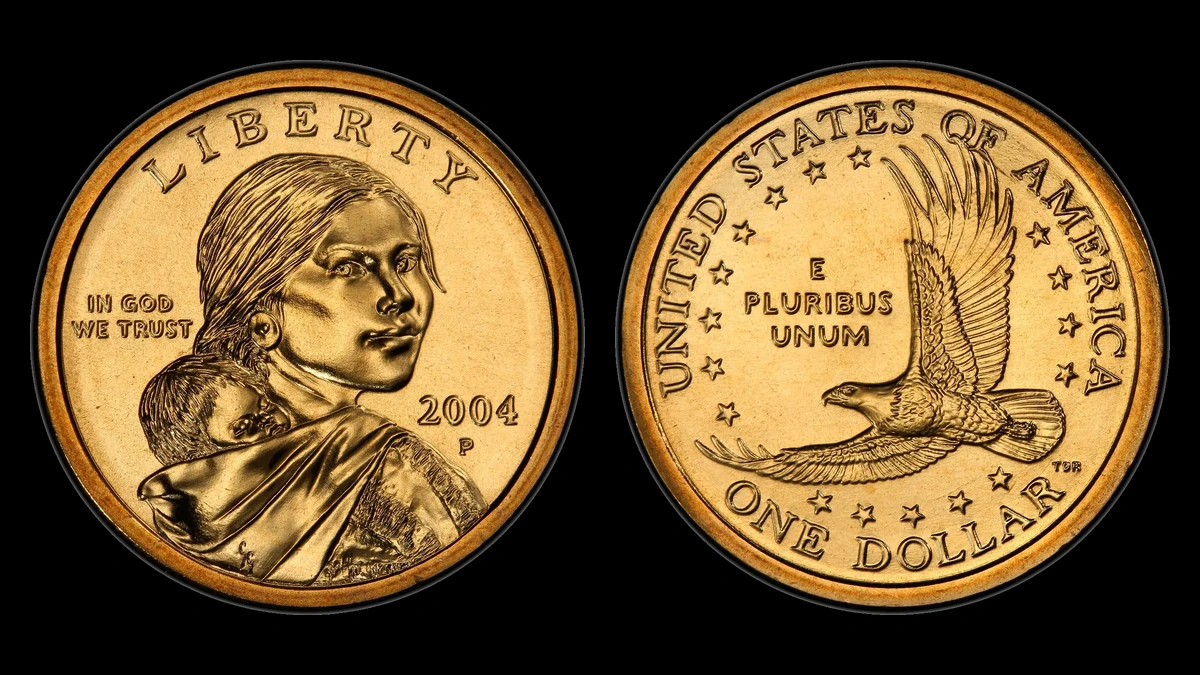
A plain edge is normal on a 2004 Sacagawea dollar, so missing edge letters are not an error to hunt for. Better clues include a raised line by LIBERTY, peeling metal, or a design that missed part of the blank.
2004 dollar errors have estimated values of $5–$4,000. For major-strike context, a different-year 2000-P dollar struck 50% off-center brought $3,120 in April 2021.
Check the surface first, then the outline and the alignment of the two faces.
1. 2004 Dollar A Raised Tail by LIBERTY: Die Crack or Chip Error
On a reported 2004-S Proof, a line extends from the lower-left base of the L in LIBERTY. It formed when metal entered a crack in the die that stamped the coin.
A Proof is a specially made collector coin, often with mirror-like backgrounds. Small solid lumps from broken die pieces are also reported for 2004, but they do not share one fixed location.
How to Identify
Find the S below the date before matching the specific Proof crack. Follow the line outward from the L under light from the side.
A solid raised ridge differs from a scratch that cuts into the surface. For a separate chip, check that the lump is coin metal rather than dirt stuck beside a letter.
What It’s Worth
$5–$250 covers this group. Small ordinary chips can fit $5–$50, while a clear S Proof crack may fall around $50–$250.
The length and visibility of the flaw matter, as does the preservation of the Proof surface.
2. 2004 Dollar A Patch Interrupting the Eagle: Strike-Through Error
Foreign material can block part of a die from reaching the blank. The result may be an impression or a missing patch of design, known as a strike-through.
A 2004-S dollar listed by GreatCollections was graded NGC Proof 69 Ultra Cameo with a reverse strike-through. That grade describes excellent preservation and strong contrast, not the material that caused the mark.
How to Identify
Examine where the unusual patch meets the eagle-side design. Normal detail may stop or fade at the boundary without the torn metal associated with a scrape.
Change the light angle to separate a reflection from a real depression. The documented listing does not identify cloth, grease, or another specific obstruction, so avoid guessing from shape alone.
What It’s Worth
$10–$1,500 is the estimated span. Ordinary examples may fit $10–$300; a clear S Proof strike-through can fall around $100–$1,500.
The supplied Proof listing has no stated sale result. A bold interruption on an otherwise sharp surface is generally easier to appreciate than slight weakness in a few details.
3. 2004 Dollar Metal Lifting from the Face: Lamination or Layer Separation Error
A lifting flap or shallow irregular opening can point to weakness in the coin’s metal. A split within the metal is often called lamination.
Sacagawea dollars also have golden alloy layers bonded to a copper center. The 2004 report does not establish whether a particular defect lies within a layer or between bonded layers.
How to Identify
Study the place where a flap still joins the coin. Actual separating metal should connect with the surface, rather than sit on it like peeling paint or residue.
Look for design detail on the flap and nearby metal. Do not bend it back to investigate; its original position can help explain when the separation happened.
A rough patch with corrosion or tool marks needs a different explanation. A normal weight does not rule out a small attached flake.
What It’s Worth
$25–$500 is a guide for genuine separating metal. Larger original defects with an attached piece can display the error more clearly than a tiny empty pit.
This estimate does not give every surface peel the value of a dollar missing an entire outer layer.
4. 2004 Dollar An Unexpected Surface Color: Improper Annealing Error
Annealing means heating blanks to soften them before striking. A problem during that step can change the surface color.
The 2004 year guide reports this type without identifying a separate certified specimen. Brown or dark color alone cannot show that the change happened at the mint.
How to Identify
Use neutral light and compare both faces with the edge. Warm lighting can make a normal golden dollar look unusually red.
At the edge of a colored patch, check for deposits, peeling coating, or corrosion. Later chemicals and heat can produce color changes that resemble the reported error.
Keep the coin uncleaned for examination. Rubbing away a small test spot changes the very surface being evaluated.
What It’s Worth
$30–$400 is the estimated range for an authenticated 2004 annealing error. It assumes the color comes from manufacture rather than later damage.
A 2009-P Native American dollar with improper annealing sold for $61 in November 2011. That later date and reverse design provide a comparison, not a 2004 sale record.
5. 2004 Dollar A Missing Part of the Outline: Clipped Blank Error
A blank that was cut incompletely can become a dollar with a piece missing from its outline. Collectors call this a clip even though the finished coin was not clipped afterward.
The 2004 report names neither a particular mint nor a definite curved or straight shape. Those details must come from the coin being examined.
How to Identify
Check the rim and design beside the gap. They may have formed weakly near the already missing metal, while a later cut can slice through complete struck details.
Look inside the gap for fresh cuts, filing, or pushed metal. Weakness on the opposite rim can support a clip, though it is not equally clear on every example.
A normal dollar weighs about 8.10 grams. A lighter weight supports missing metal but cannot distinguish an original clip from a coin cut after striking.
What It’s Worth
$50–$1,000 is the estimate for a confirmed 2004 clip. The size and shape of the gap, remaining date, and surface condition help determine the price.
A tiny notch should not automatically receive the estimate for a large, obvious incomplete blank.
6. 2004 Dollar Complete Designs on a Wider Coin: Broadstrike Error
The collar is a ring that holds a blank’s sides during striking. Without that restraint, the metal can spread outward into a broadstrike.
A 2004-P broadstrike is reported without a separately identified certified example. Its normal smooth edge means that a lack of edge lettering proves nothing here.
How to Identify
Compare the coin with the normal diameter of about 26.5 millimeters. The extra width should come with naturally spread metal and complete intended designs on both faces.
Inspect the outer letters for crushing or flattening caused after the coin left the mint. Width alone does not separate a broadstrike from a dollar squeezed by tools.
What It’s Worth
$150–$2,500 is an estimated range for a genuine 2004-P broadstrike. Greater expansion can add appeal when the design remains readable and the surfaces are original.
A historical dealer list asked $1,650 for a 2007 Washington dollar with broad expansion, repeated strikes, and missing edge lettering. That was an asking price for a different, combined-error coin, not a simple 2004 broadstrike sale.
7. 2004 Dollar A Blank Crescent beside Cut-Off Designs: Off-Center Strike Error
If a blank sits too far to one side, part of it misses the dies. Both faces can show incomplete designs beside a smooth, unstruck crescent.
The supplied report concerns 2004-P dollars but gives no fixed displacement percentage or separately certified example. Each candidate therefore needs its own clear date and mint evidence.
How to Identify
Find the date and P, then compare the portrait and eagle with the same blank crescent. Both designs should reflect the misplaced blank.
A shifted front above a centered back suggests a different problem with die position. Grinding or flattening the design after striking can also imitate empty space, but usually disturbs the surface.
What It’s Worth
$100–$4,000 is the guide for a confirmed 2004-P off-center dollar. A major shift that leaves the date readable generally has greater appeal than a slight shift.
An NGC MS66 2000-P Sacagawea dollar struck 50% off-center brought $3,120 in April 2021. The earlier date, unworn grade, and large displacement are all part of that comparison.
8. 2004 Dollar The Eagle Stays Tilted after a Flip: Rotated Dies Error
The eagle should stand upright after an upright front is turned over from top to bottom. A substantial repeatable tilt can show that the two dies were not aligned normally.
Rotation is reported for 2004 without one established mint or angle. The direction in which you turn the coin matters when checking it.
How to Identify
Hold the front upright against a vertical reference and flip it top to bottom without twisting. Repeat the movement to see whether the eagle returns to the same tilted position.
Record the two faces without straightening each photograph separately. A coin tilted inside its holder or a sideways flip can create a misleading impression.
What It’s Worth
$50–$1,000 is the estimate for a substantial confirmed rotation. A large tilt or inversion is usually more noticeable than a small alignment difference.
Compare ordinary strikes with ordinary strikes and Proofs with Proofs. The viewing angle of a photograph adds no error value.
Conclusion
The S Proof crack and documented reverse strike-through offer specific starting points for a 2004 search. Broader reports, such as annealing and off-center strikes, need an actual coin that fits the claimed cause.
Keep the mintmark, finish, and affected area together in your notes. A sharp close-up plus both complete faces is more useful than a dramatic description, especially when later damage can create a similar appearance.