Rare 1974 Dollar Errors (List & Pictures)
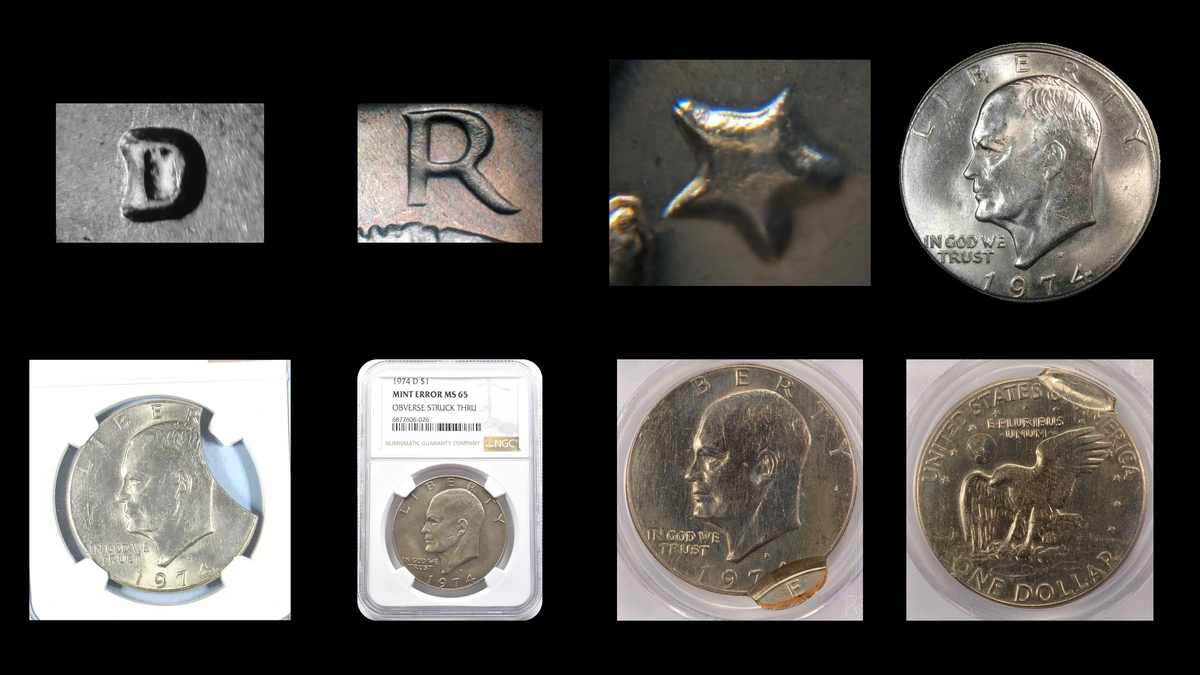
A dollar design over a finished dime brought $14,100 in January 2014. Estimated values for the 1974 Eisenhower dollar errors below span $2–$25,000, with common inherited doubling far below major wrong-coin strikes.
Begin with the mintmark and lettering, then inspect the outline, metal layers, and any overlapping designs.
| Clue | Category | Guide range |
|---|---|---|
| Unusual S or repeated D | Doubled punch or repunched mintmark | $10–$300 |
| Changed R or repeated design | Peg Leg or doubled die | $2–$500 |
| Shifted face or missing edge | Misalignment, clip, or off-center strike | $10–$3,000 |
| Copper reverse | Missing outer layer | $250–$1,500 |
| Depression or backward design | Struck through or brockage | $15–$2,500 |
| Additional strike | Double strike | $300–$3,000 |
| Wrong metal or earlier coin artwork | Wrong planchet or dollar over dime | $1,000–$25,000 |
1. 1974 Dollar A bulge and split on S: doubled mintmark punch Error
The left outside edge of the S’s upper loop can show a raised bulge, while the upper-right tip appears split. The Ike Group describes this as a doubled mintmark punch with several stages of appearance.
The punch was the small tool used to place S into a die. Several dies could inherit its shape, unlike a mintmark punched twice into one die.
How to Identify
Compare the bulge and split together with a documented stage. Early and stronger appearances need not look equally distinct.
The feature is reported on silver collector strikes and silver or copper-nickel Proofs. It does not establish the metal or finish by itself.
What It’s Worth
Estimated whole-coin values are $10–$200 for identifiable examples. Much of that value can belong to the coin’s metal, finish, and condition.
No individual sale is supplied for this punch form. Its presence should not be treated as an automatic surcharge above the ordinary silver or Proof value.
2. 1974 Dollar An earlier D outline: reported RPM-002 Error
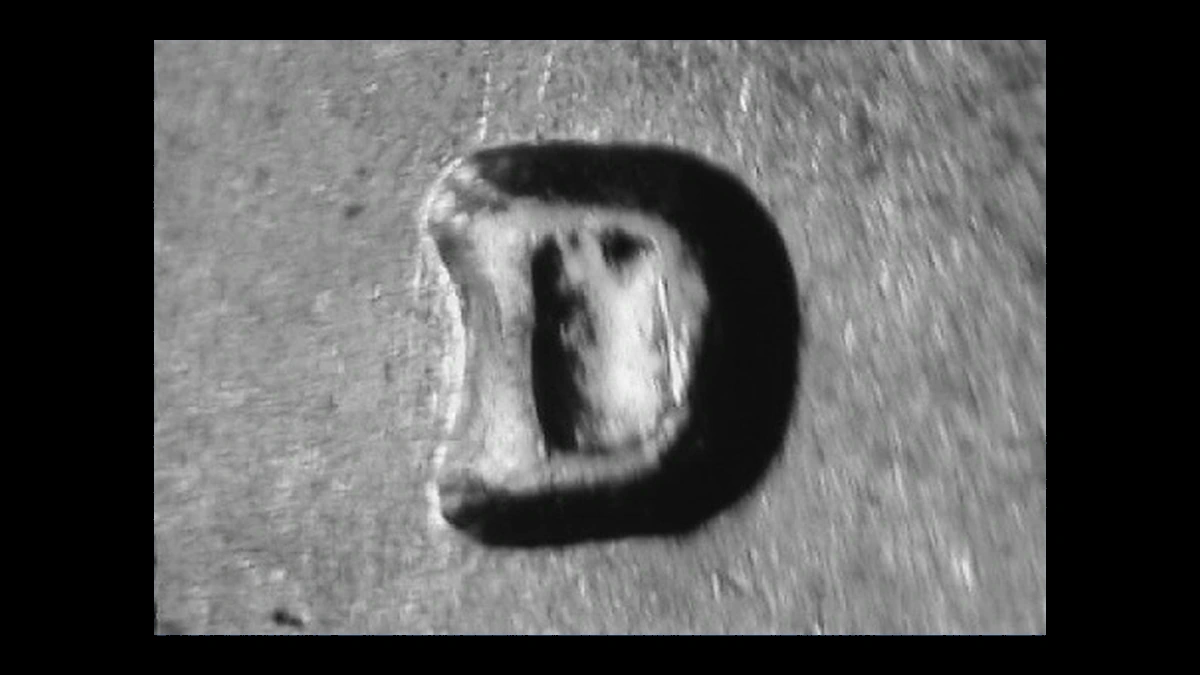
A collector display identifies a 1974-D/D dollar as RPM-002. A repunched mintmark results when another application of the letter punch leaves traces of its earlier position.
How to Identify
Examine the full D beneath Eisenhower’s neck and compare it with a reliable RPM-002 image. The supplied description does not establish a precise direction for the extra outline.
Normal thickness, a nearby hit, or a flat shelf from movement during striking can resemble repetition. A numerical grade does not independently verify the displayed variety label.
What It’s Worth
A confirmed example matching the reported pattern has an estimated range of $20–$300. Clear separation on an undisturbed surface supports a better comparison.
This range is not a reported sale of the collector-displayed specimen.
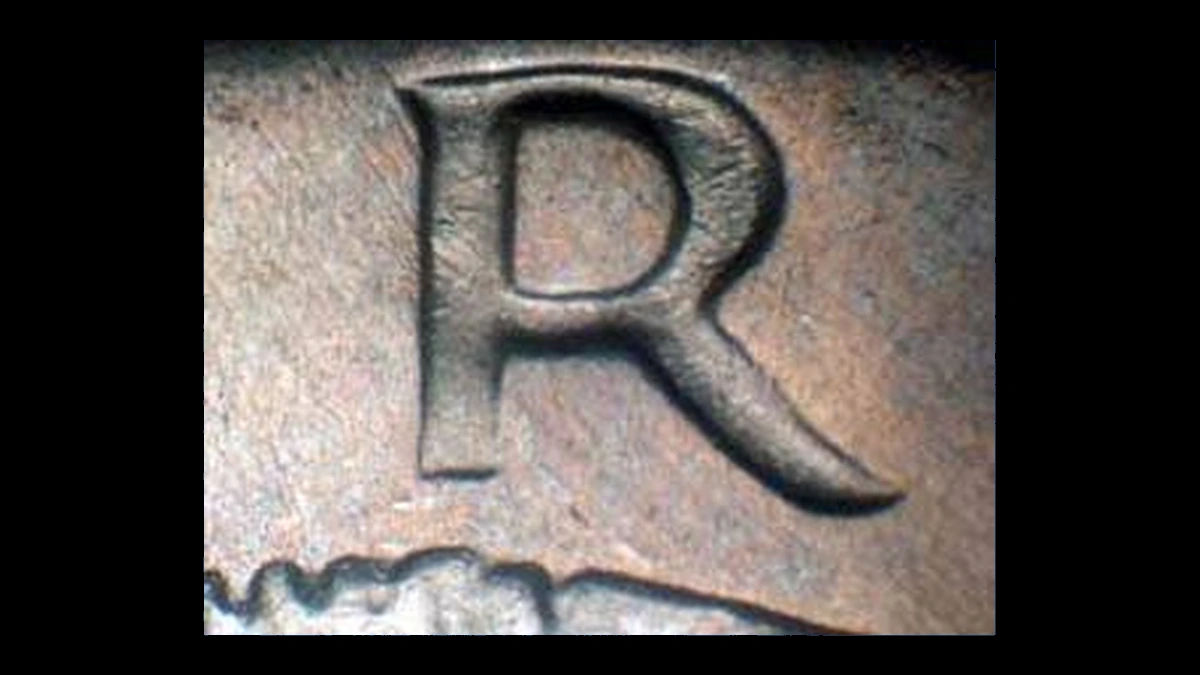
3. 1974 Dollar A plain or rounded foot on R: Peg Leg varieties Error
The small projecting feet at the base of LIBERTY’s R can weaken through die polishing. Denver’s Peg Leg variety is cataloged as FS-401, with separate reported forms on Philadelphia ordinary strikes and San Francisco silver collector strikes.
A San Francisco Proof form called Eskimo Boot has a rounded lower-left corner. A remaining small pointed foot indicates a less complete appearance.
How to Identify
Select the reference for the correct mint and finish before inspecting R. Compare both feet and nearby letters to distinguish the tool’s shape from general wear.
On the Proof form, check the entire lower-left corner rather than one rounded spot. Do not polish the letter to expose its outline.
What It’s Worth
Estimated whole-coin values span $5–$400 across the reported forms. Metal, finish, condition, and an exact variety match matter.
No completed sale is supplied for a specific Peg Leg specimen. A weak R on a worn coin may add little to its usual value.
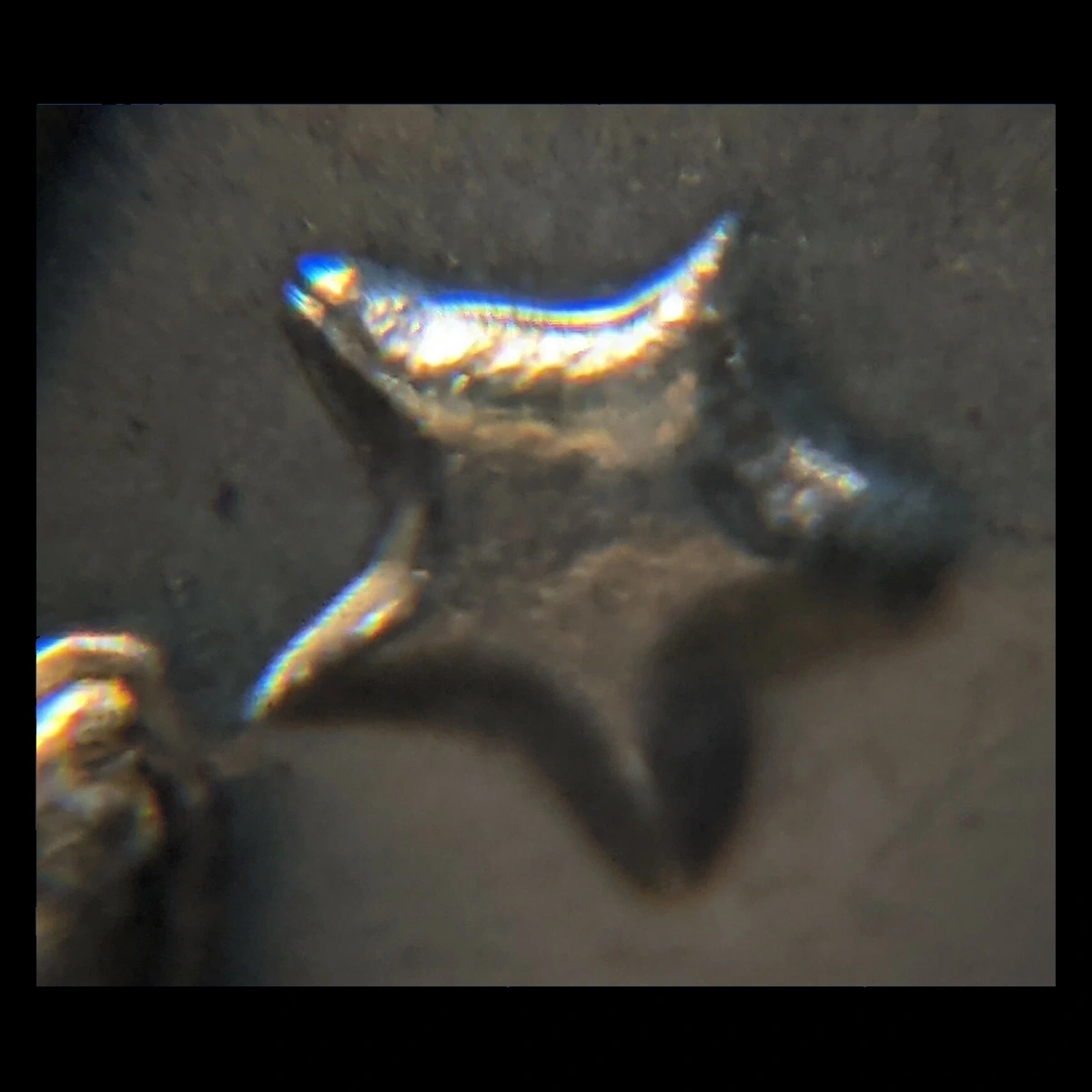
4. 1974 Dollar Repeated lettering and other details: doubled dies Error
Some repeated design features occur on individual working dies, while others were inherited from earlier tools used to make many dies. Widely shared doubling can be visible without being scarce.
Philadelphia, Denver, and San Francisco patterns affect different letters and design areas. They should not be merged into a single checklist for every 1974 dollar.
How to Identify
Philadelphia WDDO-001 affects LIBERTY and has a small raised marker inside the ear. Denver WDDO-001 involves IN, TR in TRUST, and the lower ends of LIB.
Denver WDDO-002 affects the motto, with supporting die lines near the dot to the right of UNUM’s M. San Francisco WDDO-001 is a silver Proof, while the separate Proof WDDO-002 report does not establish its alloy.
Shared patterns include motto doubling, reverse words and Moon details, and a broader silver collector-strike reverse pattern. A copper-nickel Proof form also affects the crossbar of 4.
Match several raised details within the same listed pattern. A flat shelf or an isolated extra edge is not enough to identify a scarce doubled die.
What It’s Worth
The combined estimate is $2–$500, including normal issue value. Common inherited doubling may leave a coin around $2–$100, while identified individual-die varieties may fall around $20–$500.
No individual auction result supplied here prices each named pattern. Sharp doubling can still be common if many dies inherited it.
5. 1974 Dollar The front sits closer to one rim: misaligned die Error
A reported 1974-D NGC MS64 dollar has a shifted front design. One die moved sideways relative to its partner, changing the border spacing mainly on that face.
How to Identify
Photograph both faces squarely with their full rims visible. Compare opposite margins around LIBERTY and the date, then around the eagle and reverse lettering.
A local rim dent does not shift the whole portrait and its words. Displacement affecting both faces with missing artwork calls for an off-center-strike comparison instead.
What It’s Worth
A clear front misalignment has an estimated range of $10–$150. Very small shifts may add little.
The supplied MS64 record establishes the reported grade but gives no realized sale price.
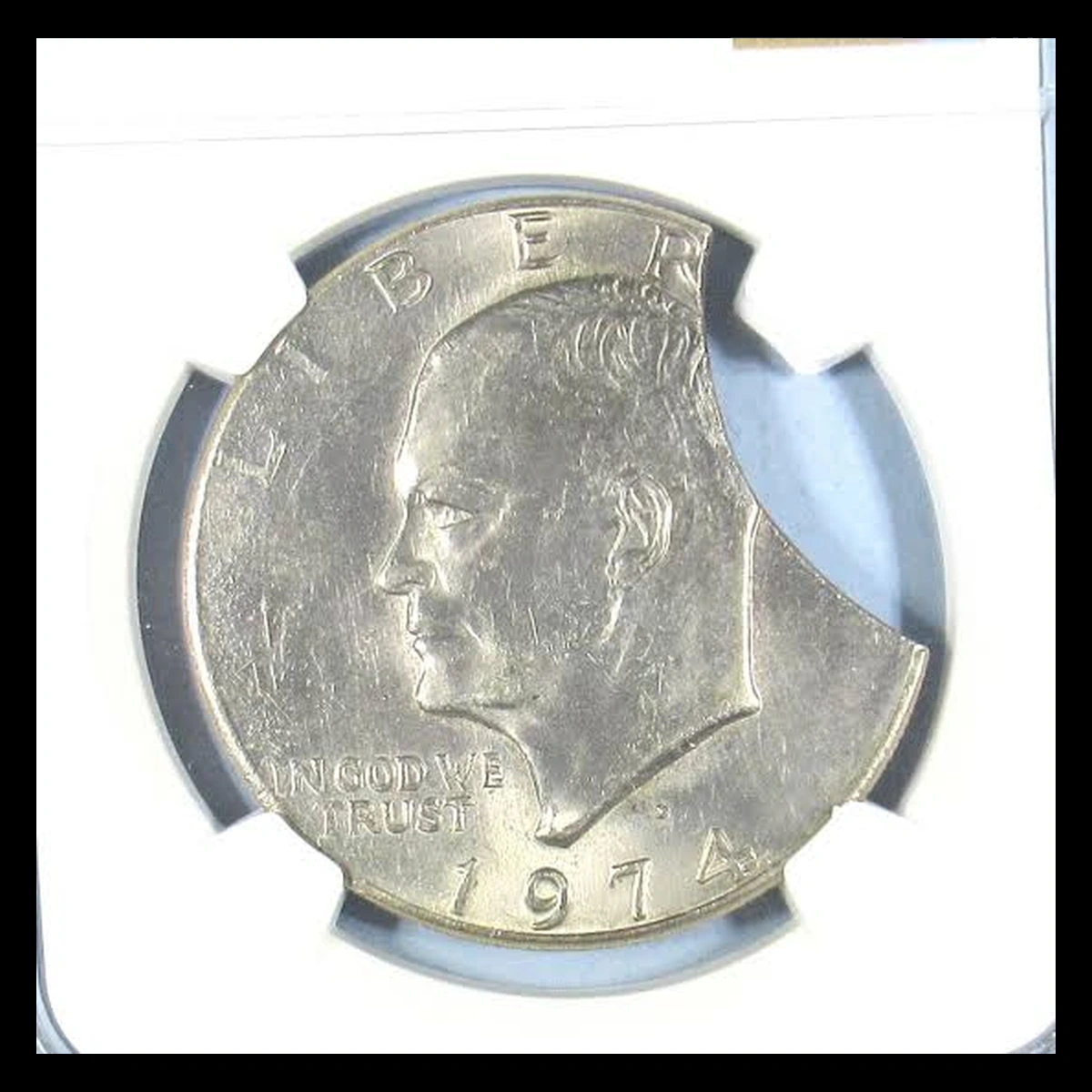
6. 1974 Dollar Curved gaps or overlapping missing sections: clipped blank Error
Denver examples include a curved clip, an 11% end-of-strip gap, and a 13% triple clip. Another Denver specimen has four clips arranged in two overlapping groups, while Philadelphia has a recorded 2% clip.
These blanks lacked metal before the design was struck. The percentage describes the named whole example, not a separate amount for every gap.
How to Identify
Count curved boundaries rather than large open spaces, especially where clips overlap. Follow how the original rim and lettering approach each gap.
Fresh burrs, saw lines, and filing suggest later cutting. A normal copper-nickel dollar weighs 22.68 grams and measures 38.1 millimeters across; reduced weight supports missing metal but cannot establish when it was removed.
What It’s Worth
Authenticated clips have an estimated range of $30–$750. Shape, condition, and intact edge evidence guide the comparison.
A Denver 13% triple clip graded PCGS MS65 sold for $384 in March 2023. That is one coin’s price and one combined missing-metal percentage.
7. 1974 Dollar An exposed copper reverse: missing outer layer Error
A Denver dollar’s reverse can appear copper-colored when a pale outer layer is absent. One NGC MS64 example weighs 18.3 grams, compared with the normal 22.68-gram copper-nickel dollar.
Another Denver report specifically describes layer loss before striking. That timing should not be assumed for every missing-layer example.
How to Identify
Compare the copper reverse, remaining front layer, and edge boundary together. A coating can alter color without accounting for substantial missing metal.
Inspect the eagle and letters for natural struck texture versus filing or scraping. Weigh a loose coin only; a holder’s weight is not part of the specimen.
What It’s Worth
A clear authenticated missing-layer dollar has an estimated range of $250–$1,500.
The 18.3-gram NGC MS64 example sold for $493.50 in January 2015. Its result does not automatically price a small local peel or a chemically browned coin.
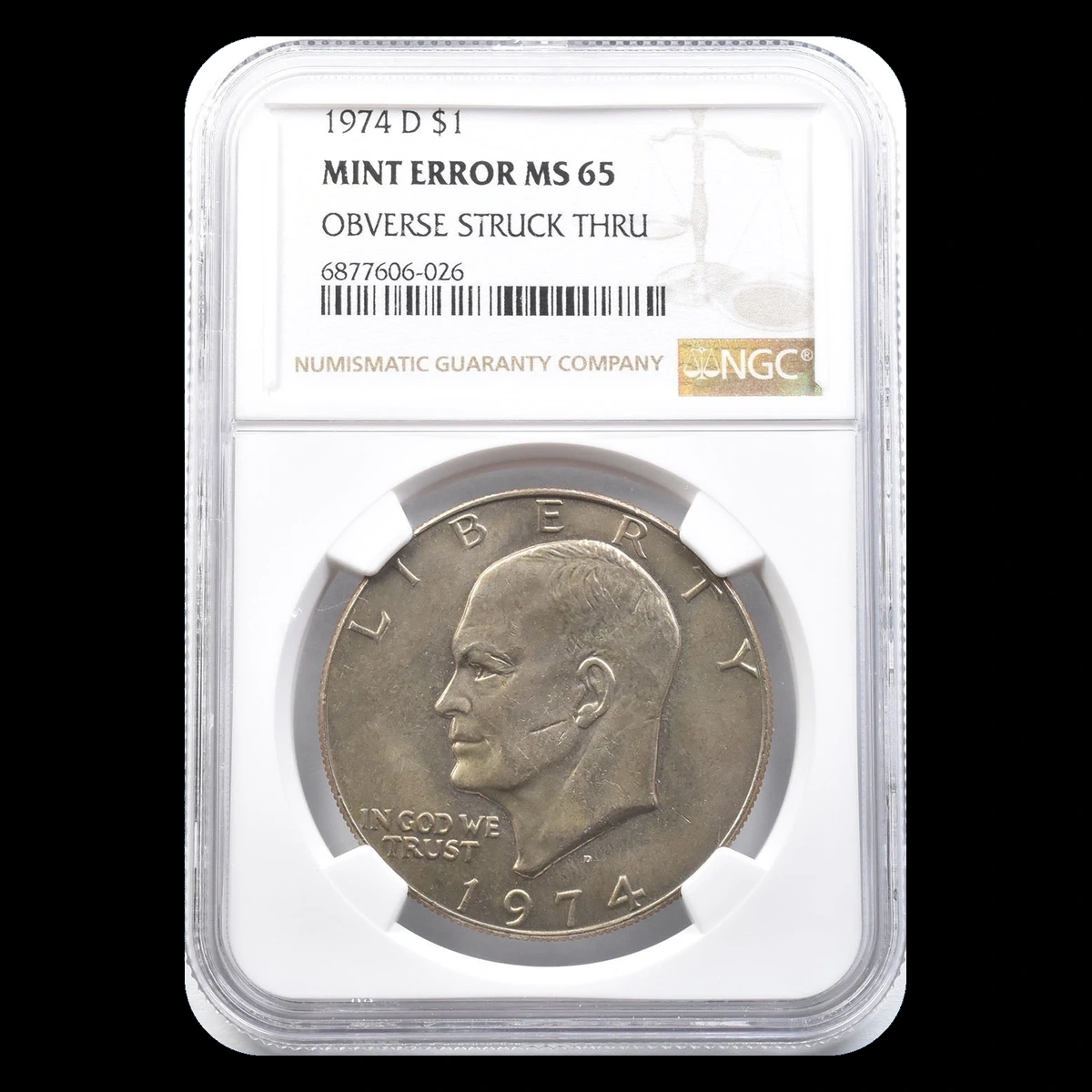
8. 1974 Dollar A depression with surviving letters: struck through material Error
A silver 1974-S collector strike graded PCGS MS67 has an impression near the upper edge, extending roughly from 10 to 12:30. BE remains visible inside the affected area together with impressed edge grooves.
The broader category also includes weak detail from grease obstructing the die. A solid object and grease leave different evidence, even though both interfere with the strike.
How to Identify
On the silver example, start at BE in LIBERTY and follow the depression and its groove pattern toward the rim. This is a collector strike, not a Proof.
For a grease candidate, compare selected weak detail with nearby protected design and overall wear. A later gouge may cut through the finished surface and push metal up beside it.
What It’s Worth
The combined guide range is $15–$2,500, with minor grease-related weakness around $15–$150 and substantial shaped impressions around $200–$2,500.
No realized price is supplied for the PCGS MS67 silver example. Its ordinary silver content and preservation are included in the whole-coin estimate.
9. 1974 Dollar A backward front design and stepped edge: brockage with partial collar Error
A brockage is a recessed mirror-image design transferred by another struck coin under pressure. A recorded 1974-D NGC MS63 dollar combines a front brockage with a partial-collar edge.
The collar caught only part of the blank, allowing another part to spread. Its edge and face preserve different features of the same coin.
How to Identify
Identify readable backward detail that sinks into the front surface, then inspect the edge step from the side. Compare the restrained band with the area that expanded.
A coin squeezed against another later can also acquire a backward impression. The original surface and collar structure must support a mint-made event.
What It’s Worth
Comparable authenticated combinations have an estimated range of $150–$2,000.
The NGC MS63 coin sold for $276 in December 2009, as recorded in the PCGS auction entry. That is the complete coin’s value, not two separate error prices to add together.
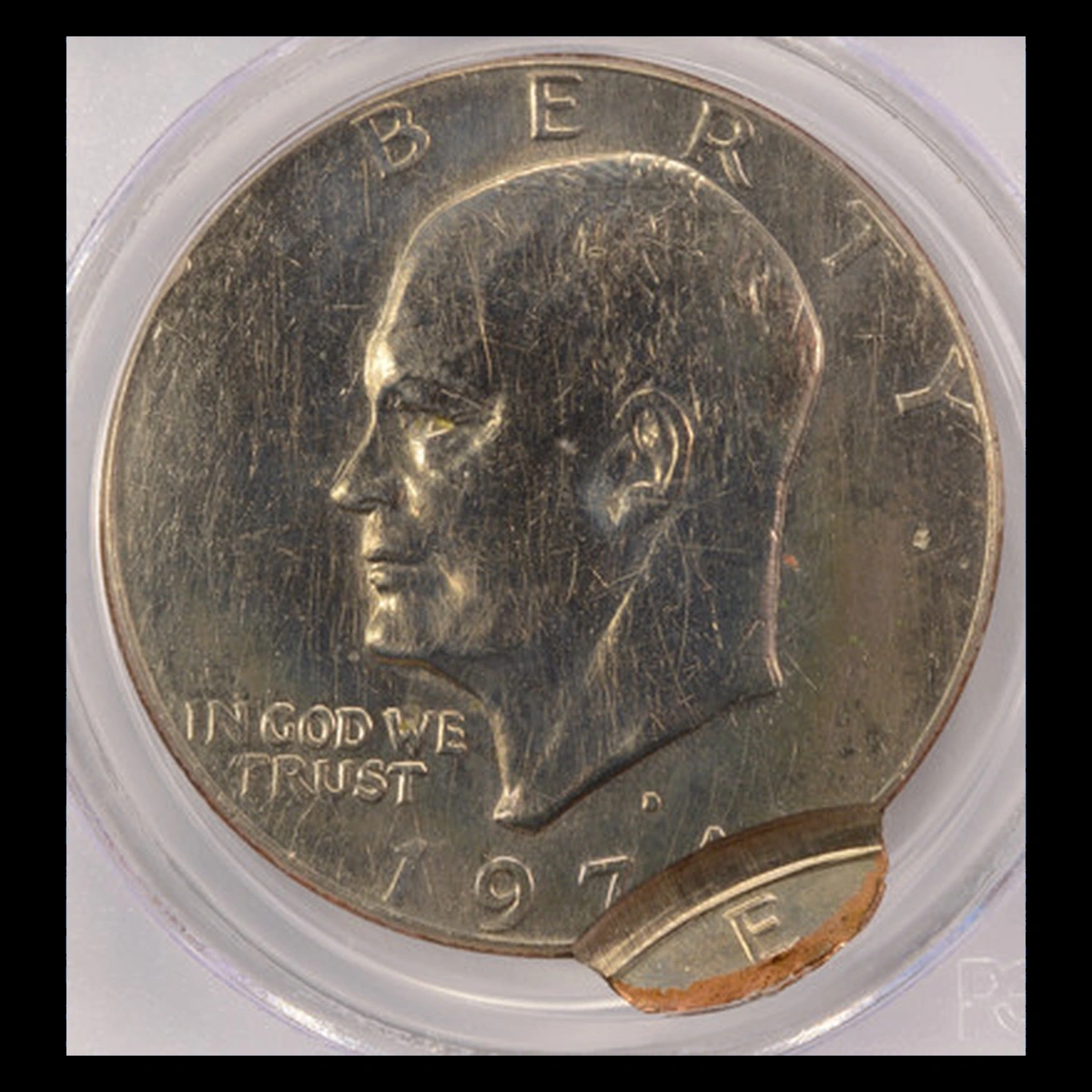
10. 1974 Dollar An unstruck crescent beside the design: off-center strike Error
A Denver NGC MS66 example is described as 10% off center. The blank was misplaced, so the portrait and eagle designs landed incompletely on the available metal.
How to Identify
Compare both faces for displacement that agrees with the same blank position. Record the surviving date and D directly, without assigning a mintmark that fell outside the strike.
Inspect the unstruck crescent for a natural boundary with the design. Grinding or an added metal extension cannot reproduce the complete evidence of an original misplaced strike.
What It’s Worth
Estimated values range from $150–$3,000 for authenticated off-center Eisenhower dollars.
A different-year 1978 NGC MS66 dollar struck 30% off center sold for $1,680 in March 2023. Its displacement is not the 10% recorded for the 1974-D example.
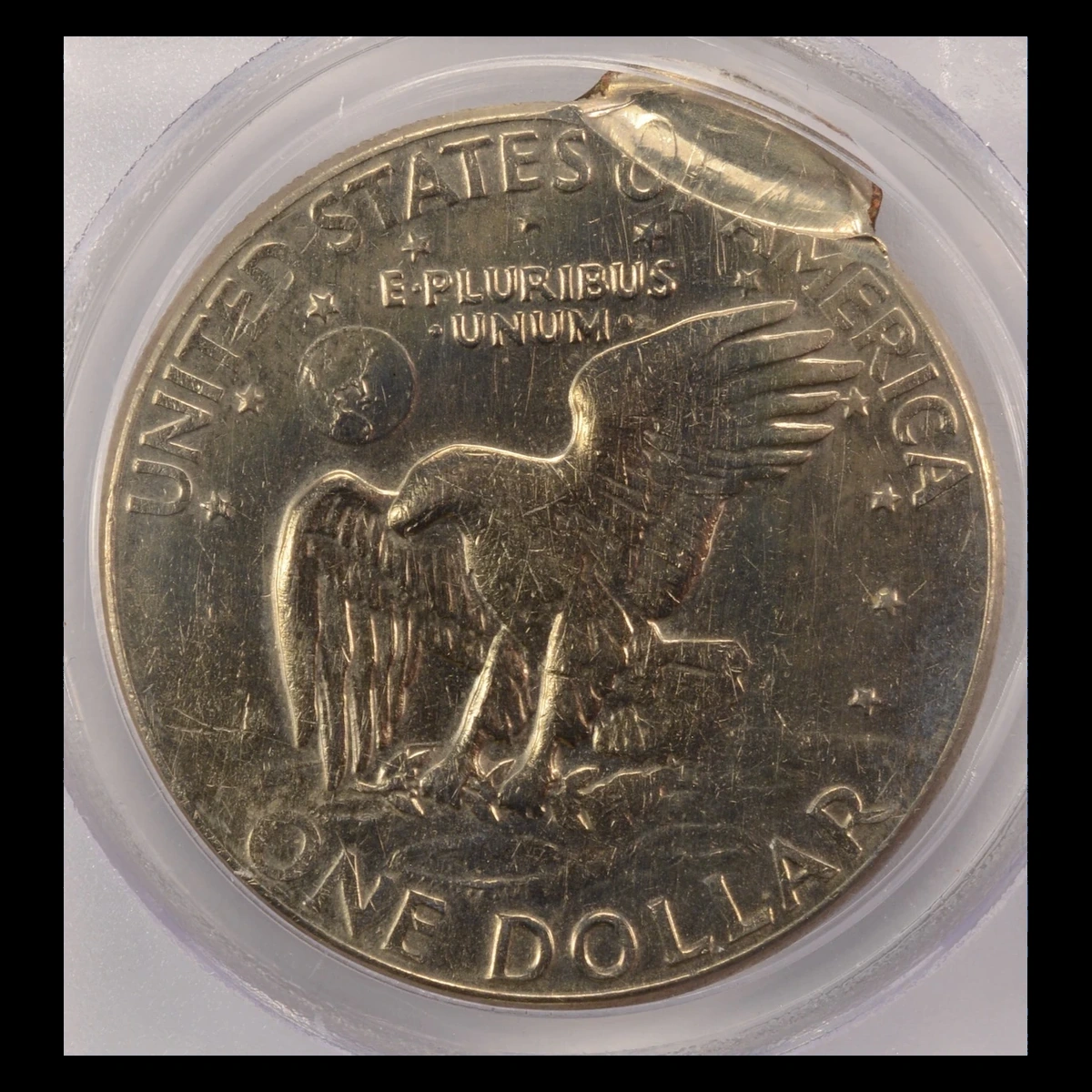
11. 1974 Dollar A small second impression near the edge: double strike Error
A PCGS AU53 dollar received a second strike 90% off center, with its reverse blocked during that blow. A separate 96% off-center second-strike type, illustrated by a CACG MS64 coin, has fresh impressions on both faces.
How to Identify
Find recognizable dollar detail in the small second patch and inspect the corresponding reverse area. The 90% example lacks a matching new reverse design because that face was blocked.
The 96% type requires evidence of the additional strike on both sides. A flattened rim or clip without new struck artwork is a different appearance.
What It’s Worth
Authenticated examples have an estimated range of $300–$3,000. The clarity of the small second impression and surface condition matter.
A dealer asked $500 for the 90% PCGS AU53 coin and $550 for the 96% CACG MS64 example. These were asking prices, and the dealer also noted cleaning lines on the AU53 coin.
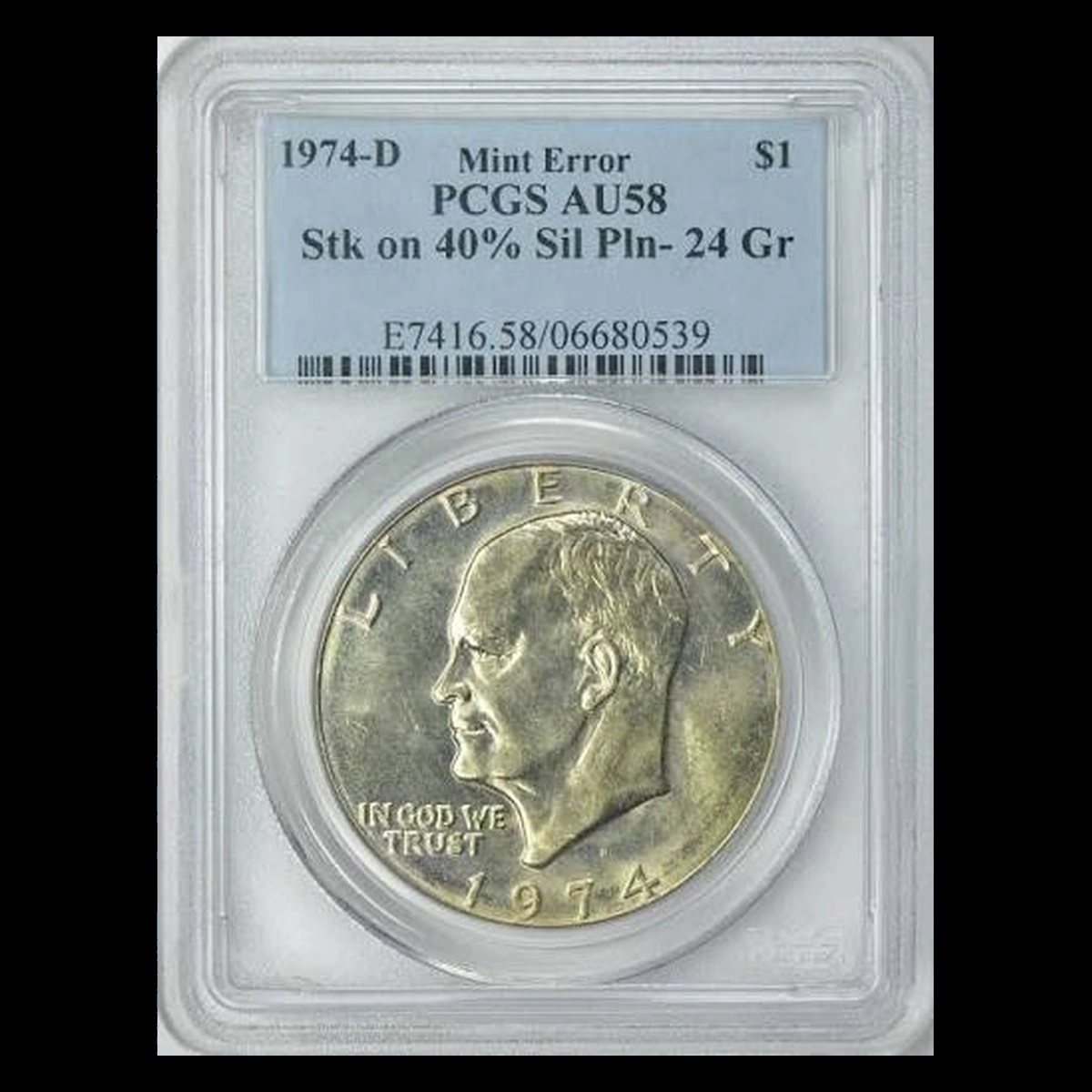
12. 1974 Dollar Wrong metal or a smaller foreign blank: wrong planchet Error
A Denver dollar on a 40% silver blank uses the wrong material for that issue; an S silver collector dollar is normal. A PCGS MS63 example documents the Denver silver error.
Another Denver dollar used a Philippine one-piso blank and was graded PCGS MS64. Its smaller starting disc could not hold the full dollar design.
How to Identify
Confirm a genuine D before investigating the silver claim and obtain a nondestructive composition test. About 24.6 grams is the normal silver-dollar standard, not a measured weight supplied for the MS63 specimen.
For the Philippine-blank type, compare the cropped design, actual weight, and original edge. Later trimming can reduce a dollar’s size without proving use of another country’s blank.
What It’s Worth
The combined estimate is $1,000–$20,000, with authenticated Denver silver blanks around $6,000–$20,000 and Philippine blanks around $1,000–$5,000.
A separate Philippine-piso-blank coin graded NGC MS65 sold for $1,260 in March 2023 and has a recorded weight of 14.5 grams. It is distinct from the PCGS MS64 example.
13. 1974 Dollar Roosevelt within Eisenhower’s neck: dollar over dime Error
The small Roosevelt portrait survives because this piece was a finished dime before the dollar strike. Most of Eisenhower’s face missed the tiny disc, although his chin and ear remain.
The NGC MS65 coin has a sharp dollar D and the upper halves of all four dollar date digits. The dime’s D is faint, its 197 is clear, and its final digit is weak.
How to Identify
Locate Roosevelt’s raised portrait inside Eisenhower’s neck, then follow the separate remnants of each design. A backward dent from later squeezing is not the same as surviving earlier raised artwork.
Keep the dime’s weak final date digit distinct from the dollar’s partial date. The normal dime weight of about 2.27 grams is a comparison standard, not a recorded measurement for this specimen.
What It’s Worth
A similarly clear authenticated dollar-over-dime error has an estimated range of $10,000–$25,000.
This coin sold for $14,100 at Heritage in January 2014. The result prices the complete double-denomination coin, not a dollar struck on an unused dime blank.
Conclusion
On a 1974 Eisenhower dollar, the mintmark and finish establish what should be normal before an unusual feature is evaluated. Silver can be ordinary on an S issue and a major wrong-blank clue on a Denver coin.
Use exact pattern matches for small letter varieties and both-face evidence for displaced or repeated strikes. Keep each measurement, asking price, and auction result attached to its own specimen.