Rare 2006 Half Dollar Errors (List & Pictures)
Size, surface depth, and finish help separate the 2006 half dollar errors in this guide. Their estimated values span $15–$2,500.
An ordinary 2006-D graded MS68 sold for $2,585 in 2017, illustrating a condition record rather than an error price. Begin with the coin’s size and outline, then compare front detail, sunken marks, and lifting layers.
| Observation | Main check | Feature | Estimated value |
|---|---|---|---|
| Half design crowded onto small metal | Weight, edge, and diameter | Reported wrong planchet | $500–$2,500 |
| Blank crescent beside displaced design | Both faces | Off-center strike | $15–$350 |
| Missing edge section | Gap and opposite rim | Clipped planchet | $25–$200 |
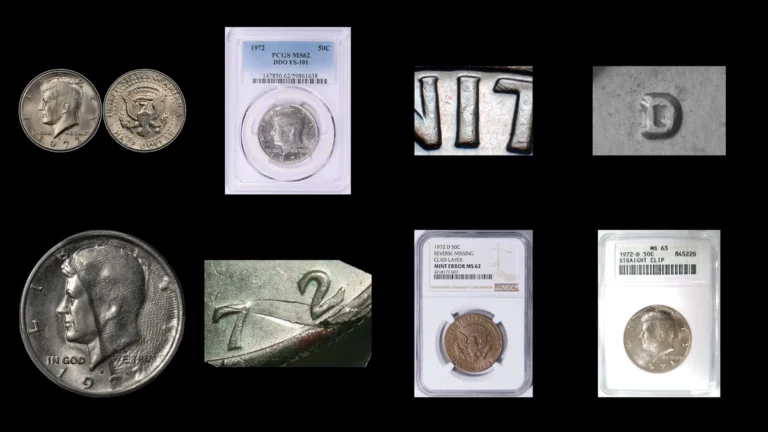
| Repeated raised outlines | LIBERTY, motto, eye | Doubled die obverse | $25–$250 |
| Sunken object-shaped track | Affected design area | Struck through | $30–$300 |
| A lifted or missing surface layer | Satin-finish metal | Clad separation | $45–$250 |
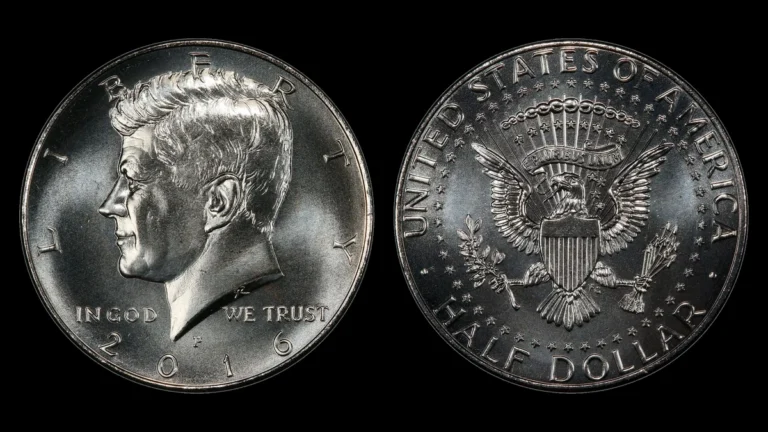
Regular clad halves weigh 11.34 grams and measure about 30.61 mm; silver proofs weigh 12.50 grams. Satin collector-set surfaces have a normal soft matte appearance, while proofs are specially made collector coins, so finish must be matched before diagnosing an error.
1. 2006 Half Dollar The Design Does Not Fit the Small Blank: Wrong-Planchet Report Error
The year guide reports half-dollar designs struck on quarter blanks. A blank meant for a smaller denomination lacks enough surface for the full Kennedy design, even when placed in the half-dollar press.
A small diameter alone does not establish the report. A cut-down finished half can also lose its outer design, and the report does not assign one mint to every candidate.
How to Identify
Weigh the coin before relying on its appearance. A clad quarter blank starts near 5.67 grams, about half the normal clad half-dollar weight.
Record the diameter in several directions; striking may spread the blank beyond a quarter’s usual 24.30 mm. The remaining Kennedy design should fit naturally on the available metal.
Inspect the edge for machining, filing, or a newly cut circumference. Weight, composition, original edge, and missing outer design need to support the same explanation.
What It’s Worth
Estimated range: $500–$2,500 for an authenticated quarter-blank strike, based on modern Kennedy guide comparisons. No recorded 2006 auction result is supplied.
A readable date and confirmed blank identity are central to applying the estimate. Authorized silver proofs have their own normal metal and should not receive a wrong-metal premium merely for differing from clad.
2. 2006 Half Dollar The Full Blank Received Only Part of the Design: Off-Center Strike Error
Philadelphia and Denver reports describe a misplaced half-dollar blank that kept an untouched crescent. The opposite part of the intended design fell beyond the edge.
No single offset percentage is established for every reported example. The date and mint must remain readable on the actual coin being evaluated.
How to Identify
Compare the portrait and eagle with the same blank margin. Their displacement should fit the position of the whole blank rather than one face alone having an uneven rim.
Examine the plain metal for grinding or later cutting. Removing an existing design leaves different evidence from an area that never received one.
The clad weight may remain near 11.34 grams because displacement normally removes no silver-colored alloy. Record the changed outline and surviving edge grooves as additional evidence.
What It’s Worth
Estimated range: $15–$350 from small shifts to conspicuous dated examples. The 2006 guide places modest errors in the low tens and stronger examples around $100–$300.
Those are estimates by appearance, not results for a named auction specimen. Damage or lost identifying digits can weaken an otherwise dramatic coin’s appeal.
3. 2006 Half Dollar A Gap in the Metal Itself: Clipped Planchet Error
The 2006-P clip report concerns an incomplete planchet, the blank prepared for striking. The design formed around a section of metal that was already absent.
The report specifies neither one gap shape nor one finish. Those details must be read from the candidate rather than supplied from another example.
How to Identify
Follow the rim into both ends of the gap. Fresh saw marks or a sharply filed wall suggest removal after the coin was made.
Inspect the opposite rim for weakness, commonly called the Blakesley effect. Small clips may not show it clearly, so it is supporting evidence rather than a single pass-or-fail test.
Look for metal loss consistent with the gap and for natural struck detail at its boundary. Identify regular versus satin finish separately; a satin surface is not itself a flaw.
What It’s Worth
Estimated range: $25–$200 for an authenticated 2006-P clip. Small, unobtrusive defects generally fit nearer the lower end.
A 1993-D ANACS MS64 curved clip totaled $34.74 with fees in August 2025. It is a different-year comparison, with better visibility and undamaged surfaces supporting stronger estimates for other examples.
4. 2006 Half Dollar Extra Outlines in the Front Detail: Doubled Die Obverse Error
The 2006-P guide names LIBERTY, the motto, and the eye area as places to inspect. Its report does not require equally strong repetition at all three locations.
A doubled die contains repeated detail before striking, so the coin copies the abnormal design in one impression. Die movement during striking can instead leave flat ledges.
How to Identify
Choose a normal 2006-P with the same finish and compare the named areas at equal size. Move the lamp while keeping the coin still to separate fixed metal detail from changing glare.
Examine the shape where an extra outline joins the main stroke. Rounded duplication differs from a low shelf that merely widens or flattens an edge.
Regular and satin examples require matching variety references. A dull surface alone cannot establish satin production or make another finish’s diagnostic apply.
What It’s Worth
Estimated range: $25–$250 for minor through more obvious authenticated doubling. The guide describes roughly $25–$75 for minor forms and above $200 for stronger examples.
These are guide figures without a specific auction transaction. Extreme enlargement of flat mechanical ledges does not establish the genuine doubled-die feature needed for the estimate.
5. 2006 Half Dollar A Sunken Track Across the Surface: Struck Through Error
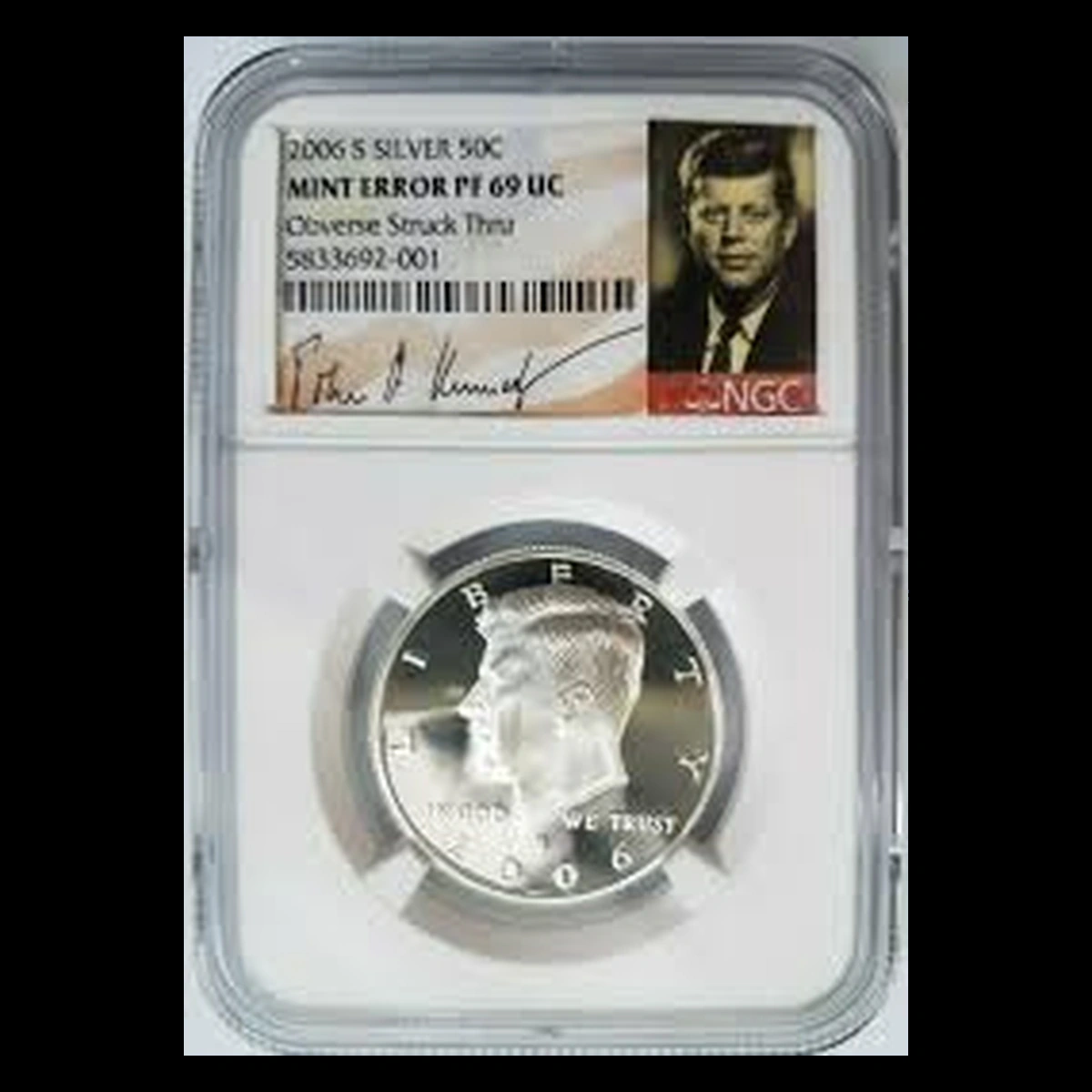
A collector’s 2006-P shows a depression described as cord-like or possibly made by insulated wire. The discussion does not establish the material itself.
An object between die and blank can block contact and leave its outline during the strike. A separate guide report concerns S-mint proofs, which need their own finish comparison.
How to Identify
Trace the entire depression, especially where it crosses design. Locally blocked detail differs from a scratch cutting through letters already formed.
Look for displaced metal along the groove and vary the light to confirm its depth. A dark line in one photo may only be a reflection.
Use the reported P example for its own appearance, and matching proof images for an S candidate. A shared category does not prove the same object caused both.
What It’s Worth
Estimated range: $30–$300 for modest through clearly visible authenticated strike-throughs. The guide places small proof interruptions around $30–$80 and stronger ones above $150.
The collector’s groove supplies no transaction price. Length, original surface condition, and a secure mint-made explanation matter more than guessing exactly what the object was made of.
6. 2006 Half Dollar A Layer Lifting From Satin Surfaces: Clad Separation Error
Reports for 2006-P and 2006-D collector-set halves describe a flap or peeling patch in the bonded metal. A local failure between the clad layers can let an outer portion lift or detach.
A small attached flap is different in severity from an entirely missing outer layer. Normal satin texture or a change of color alone proves neither.
How to Identify
View the boundary from a shallow angle for physical depth or attached metal. Toning can change color while leaving the surface intact.
Do not pry at the flap. Existing scratches or lifting-tool marks can indicate that someone disturbed the surface after minting.
Inspect how the layers meet at the edge and confirm satin production from reliable set history or a holder. A silver proof is a different issue and should not be judged as a defective clad satin coin.
What It’s Worth
Estimated whole-coin range: $45–$250 for authenticated satin examples with local separation. It combines a modest normal-coin allowance with the guide’s roughly $40–$120 premium for smaller defects and higher allowance for prominent peeling.
The range does not add the price of an exceptional top-grade collector coin. Original layer boundaries, rather than the diameter of a colored patch, support the defect’s identification.
Conclusion
Measure a small coin, trace an incomplete outline, and inspect the depth of surface marks before choosing an error name. A depression, lifted sheet, and repeated raised contour describe different manufacturing events.
The $15–$2,500 estimates apply after the mint, finish, and actual abnormal feature are identified. Normal satin texture and authorized silver proof composition should remain separate from error claims.