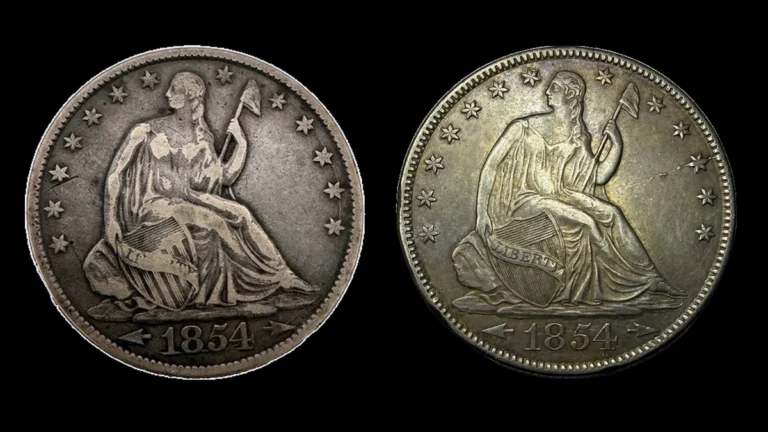
Rare 1855 Half Dollar Errors (List & Pictures)
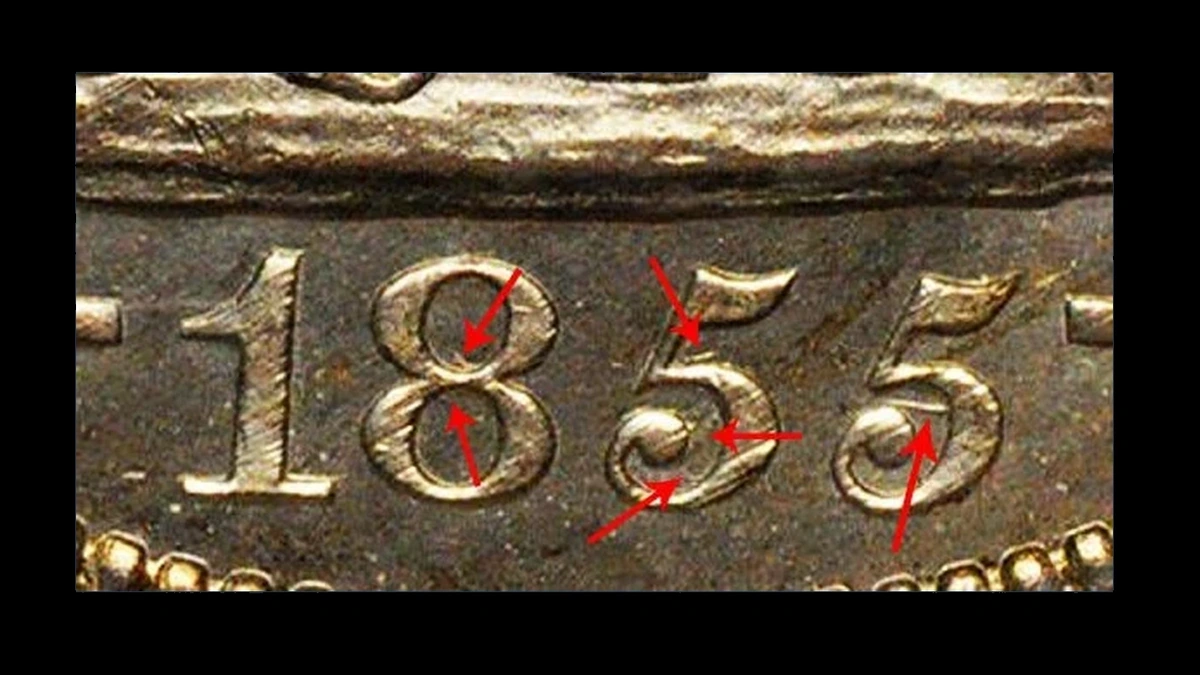
Two unusual marks can belong to one coin—and one sale price. A finely preserved 1855/54 half dollar with a small struck-through mark brought $17,825 in August 2011.
This guide to 1855 half dollar errors covers that date variety, its chest-area mark, and raised cracks on New Orleans coins. Estimated comparisons span $200–$18,000 across the different grades below.
Follow the date, portrait, and reverse lettering to keep the three features separate.
| Location | What to look for | Estimated value |
|---|---|---|
| Last 5 in the date | The traditional 1855/54 pattern | $400–$800 around XF; $8,000–$18,000 for very fine unworn examples |
| Above and left of Liberty’s chest | A narrow struck-through depression | $8,000–$18,000 for the cited high-grade 1855/54 comparison |
| Reverse lettering on 1855-O | Two raised letter connections | $200–$500 around XF to AU |
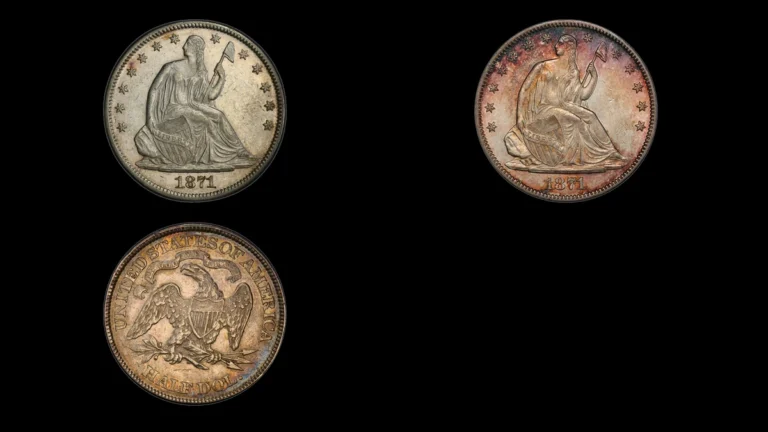
The arrows beside the date are normal for 1855, and the reverse should not have rays around the eagle. A normal unworn half weighs 12.44 grams and measures about 30.6 millimeters, with grooves around the edge.
1. 1855 Half Dollar An Extra Mark in the Last 5: Traditional Overdate Error
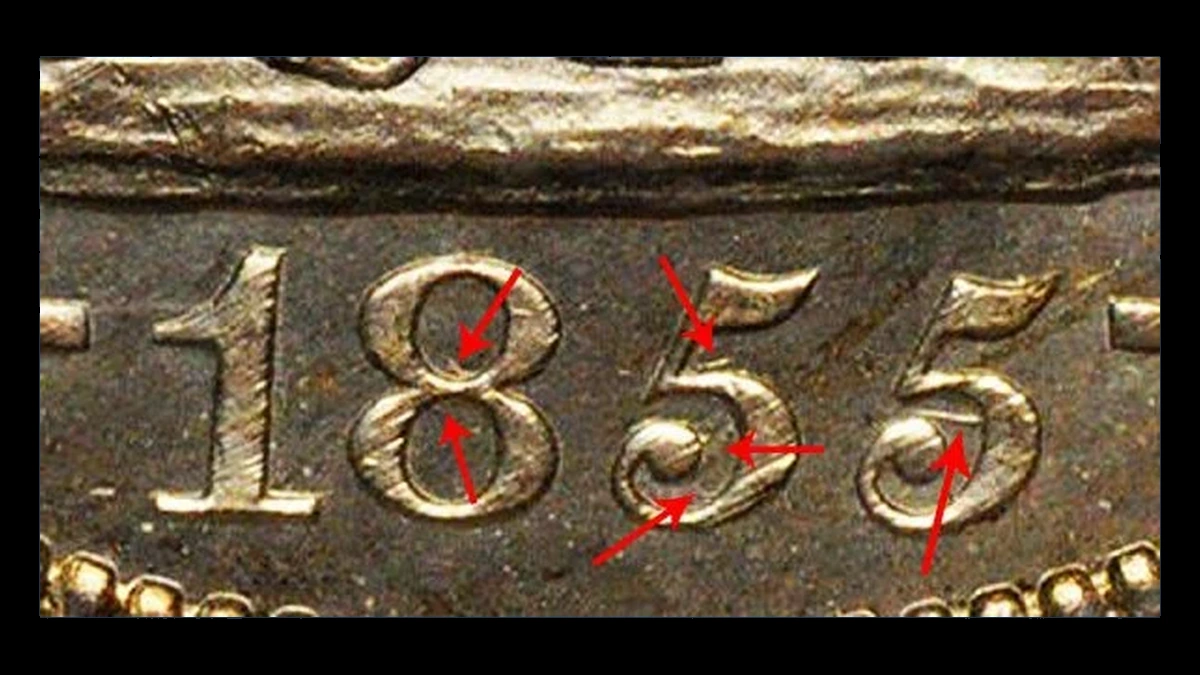
Inside the final 5, a short crossbar-like mark gave this Philadelphia variety its familiar 1855/54 name. The name suggests a 5 punched over an earlier 4.
An overdate forms when a date in the steel stamping tool, or die, is replaced by a later one. It does not mean the finished coin received two strikes.
For this variety, the explanation remains debated. A CAC-published analysis says the marks do not conclusively establish an underlying 4, even though the traditional name remains in use.
How to Identify
Compare the final 5 with a clear photo of the recognized 1855/54 variety. Follow the whole shape rather than assigning it from any horizontal mark inside the digit.
Check the nearby numbers too. The cataloged MS65 example showed faint earlier outlines around the first 5.
Move the light across the date to separate raised detail from a scratch or reflection. A matching pattern is more useful than trying to decide the history of one line in isolation.
Verify the absence of a mintmark below the eagle. The arrows beside the date are part of the intended design, not evidence of the overdate.
What It’s Worth
Estimated range: $400–$800 for worn examples around XF. A PCGS XF40 sold for $468 in September 2025.
Very fine unworn examples have a separate estimate of $8,000–$18,000. The PCGS MS65 sold for $17,825 in August 2011 and returned to auction for $10,200 in May 2025.
MS65 describes an unworn coin with strong overall preservation. That same coin also carries the struck-through mark discussed next, so its sale history should be counted once.
2. 1855 Half Dollar A Thin Depression by the Chest: Struck Through Error
A narrow depression lies above and to the left of Liberty’s chest on the documented MS65 1855/54. It was distinctive enough for Stack’s Bowers to use it when describing the coin.
During a struck-through error, material between the die and the blank blocks part of the design from forming normally. The object can fall away while its impression remains.
The catalog did not identify the material in this case. A thin shape alone does not establish that it was wire or thread.
How to Identify
Keep Liberty’s chest and the nearby folds visible in the reference image. A very tight crop can make a normal design line look like an unrelated depression.
Inspect the area above and left of the chest with a 10× magnifier and light from the side. Match the depression’s position and outline to the documented example.
Examine the boundary for sharp cutting and metal pushed aside by a later scratch. The auction description identifies the reference mark as part of manufacture, not damage after the coin left the Mint.
The normal measurements given above can help check a loose coin. They cannot, on their own, distinguish a struck-through mark from later damage in the same area.
What It’s Worth
Estimated comparison range: $8,000–$18,000 for a similarly fine unworn 1855/54 coin. This is a whole-coin range, not a general price for thin struck-through marks.
The $17,825 result from 2011 and $10,200 result from May 2025 are the transactions already discussed with the date variety. They belong to one coin with two notable features.
Its grade and recognized date variety contribute heavily to its value. A small depression on an ordinary worn half dollar does not place it in the same price bracket.
3. 1855 Half Dollar Raised Connections Between Letters: Reverse Die Crack Error
On the reported 1855-O example, two gaps in the reverse lettering are crossed by raised lines. One joins the last S of STATES to the O of OF.
The other joins the D in UNITED to the first S in STATES. Keeping those exact letters in view is important because there are several S letters nearby.
These lines copy cracks in the stamping die. Silver pressed into the narrow openings left ridges on the finished coin.
How to Identify
Read the complete UNITED STATES OF AMERICA legend before zooming in. Locate both of the described gaps, then compare them with the discovery photographs.
Check that each connection is raised under side lighting. Dirt between letters or a scratch across the background can look like a link from one angle.
Find the O below the eagle to confirm New Orleans. A similar line on a Philadelphia coin would not identify this mint-specific example.
Match both connections as a pattern rather than relying on a single line. The coin itself has not split; the raised marks record breaks in the tool.
What It’s Worth
Estimated whole-coin range: $200–$500 for worn but detailed New Orleans examples around XF to AU. XF means some wear remains clear, while AU indicates only slight wear.
Two ordinary 1855-O comparisons from 2022 brought $311.28 for an NGC XF45 CAC and $444 for a PCGS AU53 CAC. The CAC analysis cited above summarizes those results.
These sales support a date-and-condition comparison. They were not sales of the specific two-line pattern and do not establish a separate crack premium.
Conclusion
The date pattern, chest depression, and raised letter links each call for a different close-up. The first two also share a documented coin, so their sale prices must not be added together.
Use the $200–$18,000 estimates with their condition limits attached. The upper range belongs to exceptional unworn 1855/54 examples, well above the ordinary worn New Orleans comparisons.