Rare 1869 Half Dollar Errors (List & Pictures)
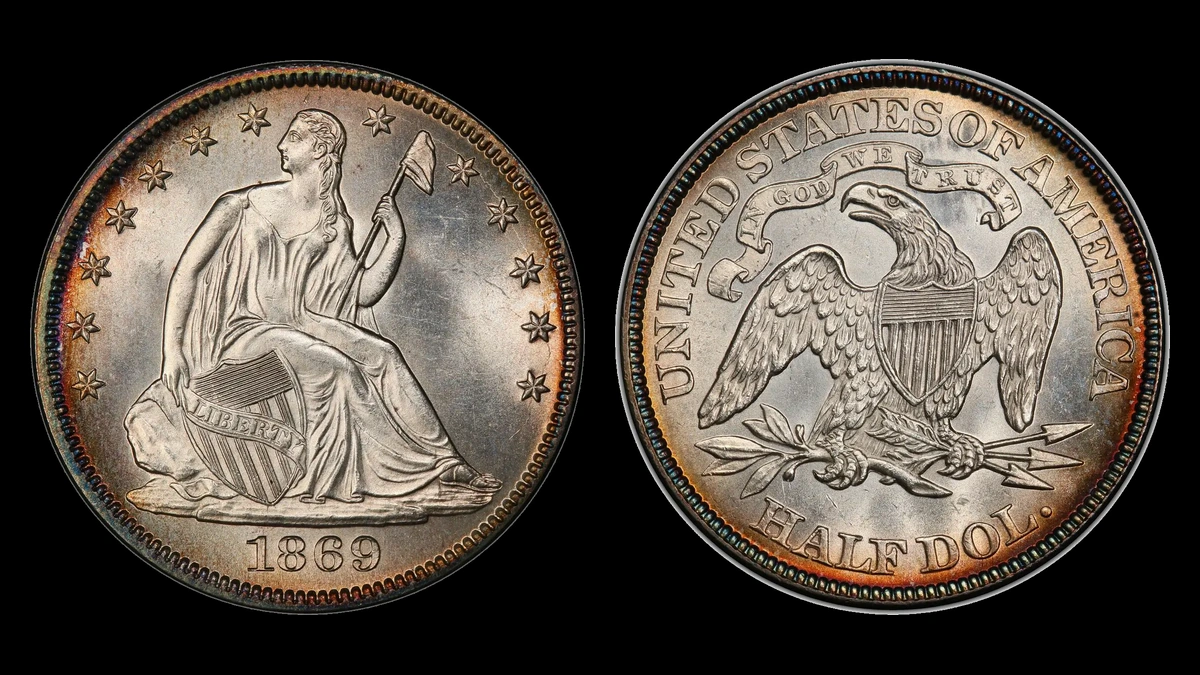
Missing detail can have more than one origin on an 1869 half dollar. Reduced elbow folds and tiny grease-affected spots both appeared on an 1869-S that sold for $14,400 in May 2025.
This guide to 1869 half dollar errors covers estimated values of $75–$15,000. Inspect the front’s soft areas first, examine extra date strokes next, and finish with raised lines on the back.
| What appears unusual | Location | Feature | Estimated value |
|---|---|---|---|
| Only traces of cloth folds | Beneath Liberty’s elbow | Overpolished drapery | $100–$15,000 |
| Small interruptions in the strike | Front of an S coin | Struck-through grease | $100–$15,000 |
| Repeated number fragments | 1 and 8 on a Philadelphia coin | Repunched date | $150–$500 |
| Raised lines along lettering | RICA and UNITED on an S reverse | Die cracks | $75–$750 |
Read the mintmark before choosing a reference: S identifies San Francisco, while the Philadelphia examples have none. Standard unworn measurements are about 12.44 grams and 30.6 mm, with grooves around the edge.
1. 1869 Half Dollar Cloth Folds Nearly Gone Below the Elbow: Overpolished Drapery Error
“Partial Drapery” describes the remaining traces of cloth beneath Liberty’s elbow on the documented 1869-S. The neighboring detail offers a useful check on why those shallow folds look so weak.
Polishing the working die can remove a shallow part of its design while deeper details remain usable. Later coins then reproduce the reduced folds even if their other features are sharply struck.
How to Identify
Compare the area immediately below the elbow with the adjacent protected folds. Loss limited to shallow design on an otherwise sharp coin differs from broad smoothing caused by circulation.
Look for faint surviving cloth lines as the light moves across the area. Also check for scratches and artificial shine that could indicate polishing of the finished coin itself.
Confirm both 1869 and the S before applying this description. The feature does not turn the coin into the intentional 1839 No Drapery design, and the normal reverse motto remains part of its design.
What It’s Worth
Estimated range: $100–$15,000 from worn examples to coins of exceptional preservation. The very broad span is driven largely by the condition of the complete 1869-S.
The Heritage description of the NGC MS67 records partial drapery on the coin that sold for $14,400 on May 4, 2025. Its MS67 grade recognizes exceptional preservation among coins that escaped circulation wear.
The same specimen had the small grease effects described next. Its one sale provides context for both features, not two independent values to add together.
2. 1869 Half Dollar Tiny Areas Where the Design Did Not Form: Struck-Through Grease Error
The MS67 catalog describes small grease particles pressed into the front during striking. It separately mentions a light scrape, so the listing records both a minting effect and later surface damage.
Grease between the die and silver can prevent full contact in a small area. The result is a local interruption in the stamped design rather than a cut made afterward.
How to Identify
Judge the shape of a suspect spot before its darkness. A change in color alone cannot reveal whether material blocked the original strike.
Use magnification and several light angles to see how the design ends around the spot. A sharp gouge with pushed-up metal would favor later damage instead.
Compare with the documented coin while keeping its separately described scrape out of the grease diagnosis. The catalog does not give a fixed coordinate for every particle, so there is no basis to label all spots in one area as grease.
Leave any attached material in place during inspection. Removing it could change the very surface evidence needed to understand the mark.
What It’s Worth
Estimated range: $100–$15,000 covers circulated coins through a specimen comparable to the MS67. The upper end reflects exceptional coin quality, not a standard premium for a tiny interrupted area.
The $14,400 May 2025 sale is the same transaction discussed for partial drapery. A small grease mark on a heavily worn half dollar needs a circulated comparison rather than that MS67 valuation.
3. 1869 Half Dollar Extra Strokes Beside the 18: Repunched Date Error
The Philadelphia report directs attention to the 1 and 8, especially near the base of the 1. Additional pieces there can preserve an earlier placement of the date punch.
The date was being added to the steel tool before any coins were struck. A later punch impression that only partly covered the first left extra shapes for the die to transfer to silver.
How to Identify
Take in the complete date before enlarging the 18. Try to fit each extra stroke to another position of its numeral rather than judging the overall thickness of the digit.
Confirm the absence of a mintmark for the Philadelphia reference. Several catalog names occur in the supplied material, so the visible stroke pattern matters more than a label viewed alone.
A hit can push metal against a digit and often disturbs the surrounding field. A low shelf caused by movement during striking also needs to be distinguished from an earlier punched shape.
What It’s Worth
Estimated range: $150–$500 for comparable circulated examples. An NGC XF40 identified as WB-3 sold for $309.38 in July 2026, as recorded in the GreatCollections repunched-date archive.
XF40 retains clear design despite circulation wear. Clean, undamaged surfaces and legible extra strokes help make another coin comparable, while this range says little about exceptional unworn pieces.
4. 1869 Half Dollar Ridges Following RICA and UNITED: Die Cracks Error
Turn to the reverse of an 1869-S and follow the upper edges of RICA. On later WB-3 examples, another crack starts at the rim, crosses the opening of UNITED, and approaches the bases of TED.
Bill Bugert’s reference uses these routes to describe the developing state of the dies. As fractures widened in the steel, silver entering them produced raised lines on subsequent coins.
How to Identify
Trace the RICA route first and the UNITED route separately. Joining unrelated scratches into one imagined pattern can produce an incorrect match.
Compare both with the 1869-S WB-3 die reference. Side lighting should show relief above the surface rather than a channel cut into it.
Earlier strikes from the same tools may show a less developed route. Keep the entire reverse and its S visible so a partial crack is assessed in the correct mint and die context.
What It’s Worth
Estimated range: $75–$750 for worn San Francisco examples with identifiable reverse cracks. No direct completed sale of this specific pattern is supplied here.
The $309.38 Philadelphia repunched-date sale above concerns a different mint and cause. It cannot establish a price for these S-coin cracks, just as the MS67’s $14,400 result cannot establish one for a worn example.
Conclusion
Localized missing detail, repeated number pieces, and raised reverse lines need separate explanations. The elbow folds and grease marks are especially instructive because they occurred together on one highly preserved San Francisco coin.
Estimated values range from $75 to $15,000 across the stated conditions. Match the visible feature, mint, and wear, then value the complete coin once even when more than one feature is present.