Rare 1824 Half Dollar Errors (List & Pictures)
Extra strokes near the 4 do not mean the same thing as a second outline of Liberty’s face. The five 1824 half dollar errors and date varieties below require different views of the coin.
Estimated comparisons span $200–$3,500. An Over Various Dates example graded AU58 sold for $3,338.40 including the buyer’s premium in August 2025.
Compare the date first, then the portrait, border, surface, and edge inscription.
| Clue | Category | Estimated range |
|---|---|---|
| Extra strokes concentrated near 4 | Overdate varieties | $200–$3,500 |
| Several repeated face details | Double strike | $2,200–$3,200 around VF20 |
| Slight displacement on both faces | Off-center strike | $500–$1,500 around VF25 |
| A local hollow or weak patch | Reported strike-through | $250–$700 when circulated |
| Repeated words around the edge | Reported doubled edge lettering | $200–$500 when circulated |
The normal unworn standard is about 13.48 grams and 32.5 millimeters across. This Capped Bust half has words around its edge, applied separately from the designs on its faces.
1. 1824 Half Dollar Extra Strokes around the Final 4: Overdate Varieties Error
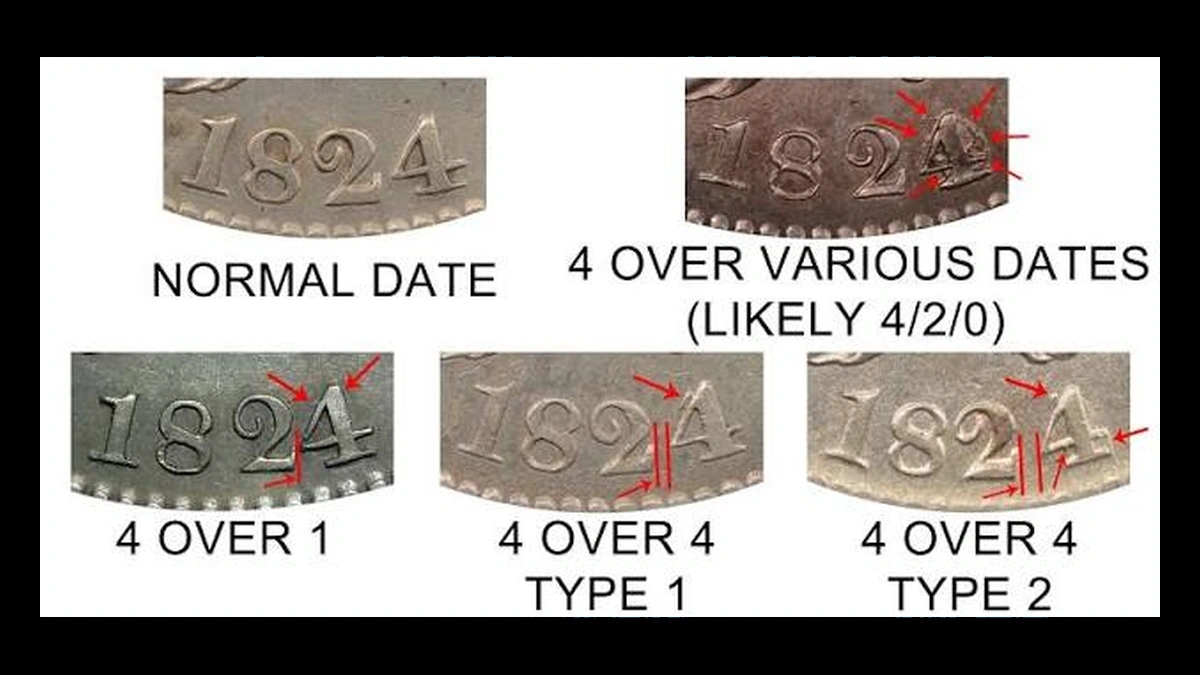
Two date arrangements need separate comparisons. The variety called 1824/1 has remnants associated with an earlier 1 near the 4, with the 2 close beside it.
Over Various Dates has a more tangled set of underlying strokes. You do not need to assign every small line to a particular earlier year to match that pattern.
The details were already in the stamping die. They remain concentrated in the date rather than forming another portrait or set of stars.
How to Identify
Keep the 2 and 4 together in an enlarged photograph. Their spacing and the surrounding strokes help distinguish the 1824/1 pattern.
Use the date comparison chart to separate the two arrangements. Match the complete group of marks rather than forcing each stroke into a guessed number.
Inspect for scratches or added cuts under changing light. Full front and back photographs keep the date connected to the correct die pairing.
What It’s Worth
Estimated range: $200–$3,500 from ordinary worn examples through an attractive lightly worn coin. Rare die pairings and exceptional unworn examples need separate comparisons.
Early Cents Auctions sold an O-103 Over Various Dates graded PCGS AU58 for $3,338.40 including premium in August 2025. AU58 indicates very little circulation wear.
The upper figure belongs to that well-preserved specimen. Counting more underlying strokes does not by itself establish a higher value.
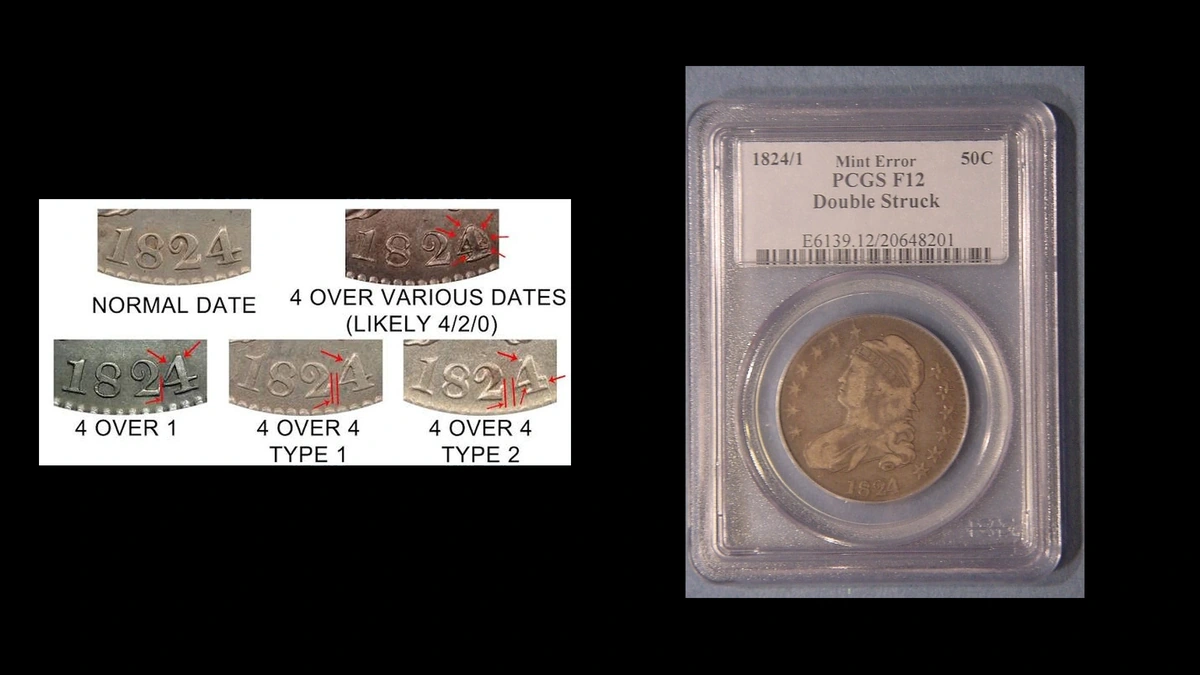
2. 1824 Half Dollar A Second Profile with Repeated Stars: Double Strike Error
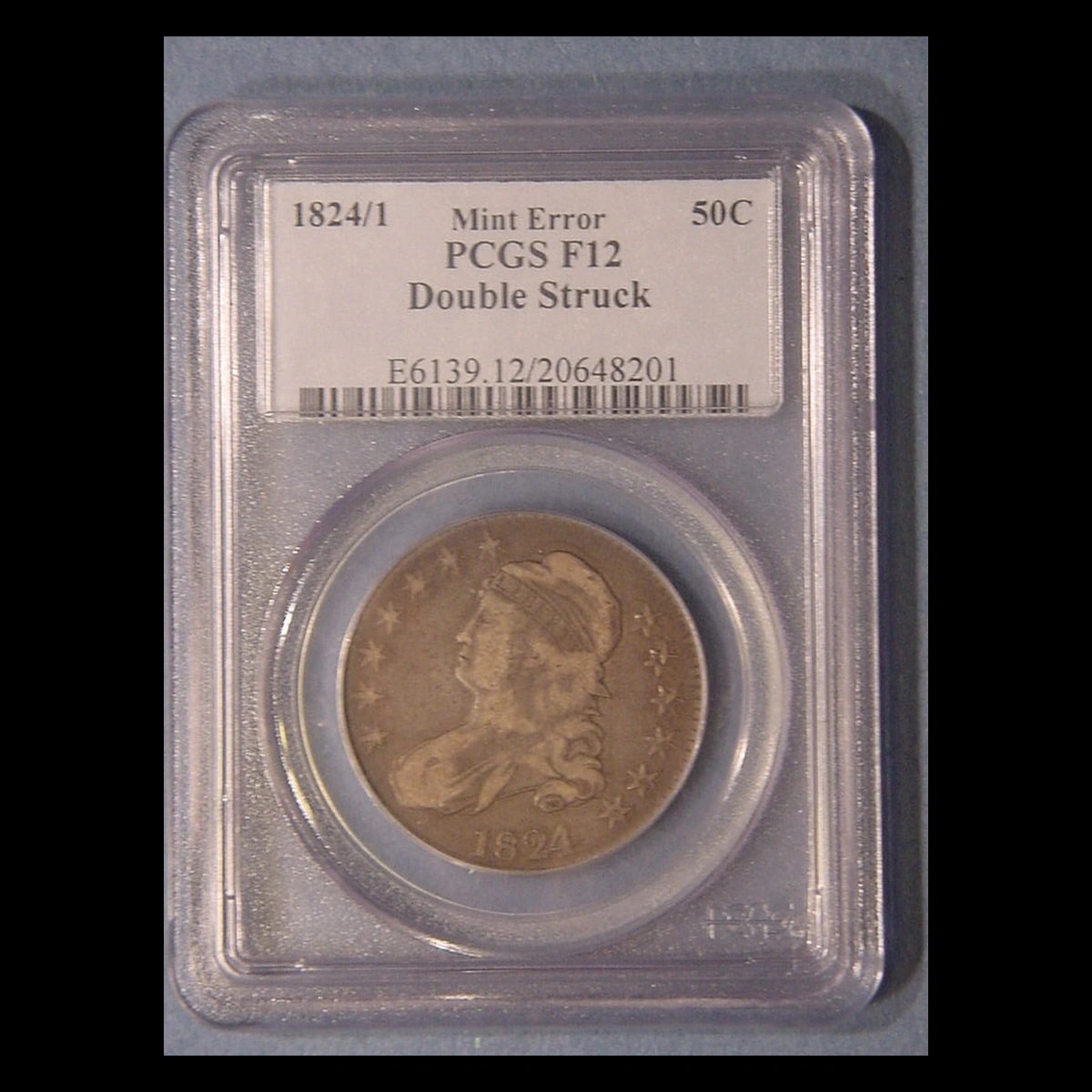
Another blow after the coin moves can repeat several parts of the design. The Weinberg catalog describes an 1824 with extra forehead, mouth, chin, bust, star, and date details.
That PCGS VF20 example also had reverse evidence. A separate Heritage record describes a VF20 as double struck on the front; matching grades do not prove the records show the same coin.
How to Identify
Trace the extra profile from forehead to chin, then compare the bust, stars, and date. Several details should fit a consistent second impression.
A single additional stroke beside 4 may instead belong to a date variety. Do not join unrelated nicks or flat shelves into an imagined second face.
Compare both faces with the Heritage record and the photographs of the actual specimen. Any reverse evidence must belong to that same coin.
What It’s Worth
Estimated range: $2,200–$3,200 for a comparable circulated coin with clearly separated impressions. VF20 means noticeable wear with major details still visible.
Heritage’s PCGS VF20 double-struck-front example sold for $2,880 on January 3, 2022. That result prices the complete identified coin.
A faint extra-looking profile without related design details is not the same comparison. The clarity of the second impression and overall condition both matter.
3. 1824 Half Dollar A Small Shift at the Border: Five-Percent Off-Center Strike Error
A seller lists an 1824 O-105 graded PCGS VF25 as struck five percent off center. O-105 identifies its die pairing, while VF25 describes noticeable wear.
The blank sat slightly outside its intended position between the dies. Early halves can also have uneven borders from normal production, so one thick rim is insufficient evidence.
How to Identify
Compare the full coin and label with the O-105 seller photographs. Trace where the design approaches one edge and retreats from the other.
The reverse should support the same displaced blank rather than remain fully centered. Keep both faces and the lettered edge in the photographic record.
Weight and width measurements are supporting checks. Normal early diameter variation makes a small size difference weak evidence by itself.
What It’s Worth
Estimated range: $500–$1,500 for an identified slightly off-center example around Very Fine. The listing supplies the VF25 grade and five-percent description without a verified completed sale price.
An 1809 half struck fifteen percent off center brought $3,300 including premium in a Sheridan Downey sale. That coin was heavily worn and scratched, with a PCGS Good Details grade.
The larger shift belongs to another year. Its price should not be transferred directly to the smaller 1824 error.
4. 1824 Half Dollar A Local Interruption in the Surface: Reported Strike-Through Error
Material trapped between the die and blank can block normal detail or leave a hollow. A strike-through names this obstruction during minting.
The supplied 1824 report does not identify a confirmed auction specimen, a particular object, or a fixed location. Each candidate must show its own physical evidence.
How to Identify
Move a light across the affected patch and nearby intact detail. Inspect whether its boundary fits an impression made during striking rather than a later cut.
A magnifier can reveal scraping tracks, torn metal, or a raised lip beside a gouge. Corrosion can also remove detail without preserving the shape of an obstruction.
Inspect both faces and the edge before judging an isolated enlargement. Do not name the trapped material from a shallow mark alone.
What It’s Worth
Estimated range: $250–$700 for a modest genuine strike-through on a circulated coin with moderate to slight wear. The interrupted area’s size and the coin’s preservation affect the comparison.
An 1833 O-102 graded NGC AU55 sold for $253 at Heritage in January 2006 with cataloged central grease streaks. That is a different year and a specific obstruction effect, not an identified 1824 sale.
5. 1824 Half Dollar Words Crossing the Edge Inscription: Doubled Edge Lettering Error
Before the portrait and eagle were struck, the blank passed through separate edge-lettering equipment. A slip or another pass could leave overlapping characters.
The 1824 report does not establish a securely identified individual specimen. Crowded spacing alone therefore needs closer examination before being called doubled lettering.
How to Identify
Photograph the edge in overlapping sections through a complete turn. Look for readable repeated letters crossing the normal inscription rather than a few crowded marks.
Compare the depth and surfaces of the extra strokes with nearby original lettering. Fresh cuts or modern engraving can imitate parts of the words.
NGC’s 1836 explanation illustrates the separate lettering process. Keep the 1824 front and back linked to its own edge photographs.
What It’s Worth
Estimated range: $200–$500 for a circulated coin with genuine overlapping edge letters. Readability and the overall surface condition both matter.
An 1834 ANACS Fine Details example with doubled edge lettering sold for $220 at Heritage in July 2026. It had been cleaned, so that other-year sale also reflects a condition problem.
Conclusion
Separate the location of the repeated detail before naming it: strokes near 4, coordinated face impressions, and overlapping edge words came from different steps. A local hollow or a shifted border needs its own evidence.
The $200–$3,500 estimates combine distinct conditions and varieties. Keep full-coin photographs with close-ups so the unusual feature does not replace an assessment of the whole half dollar.