Rare 1818 Half Dollar Errors (List & Pictures)
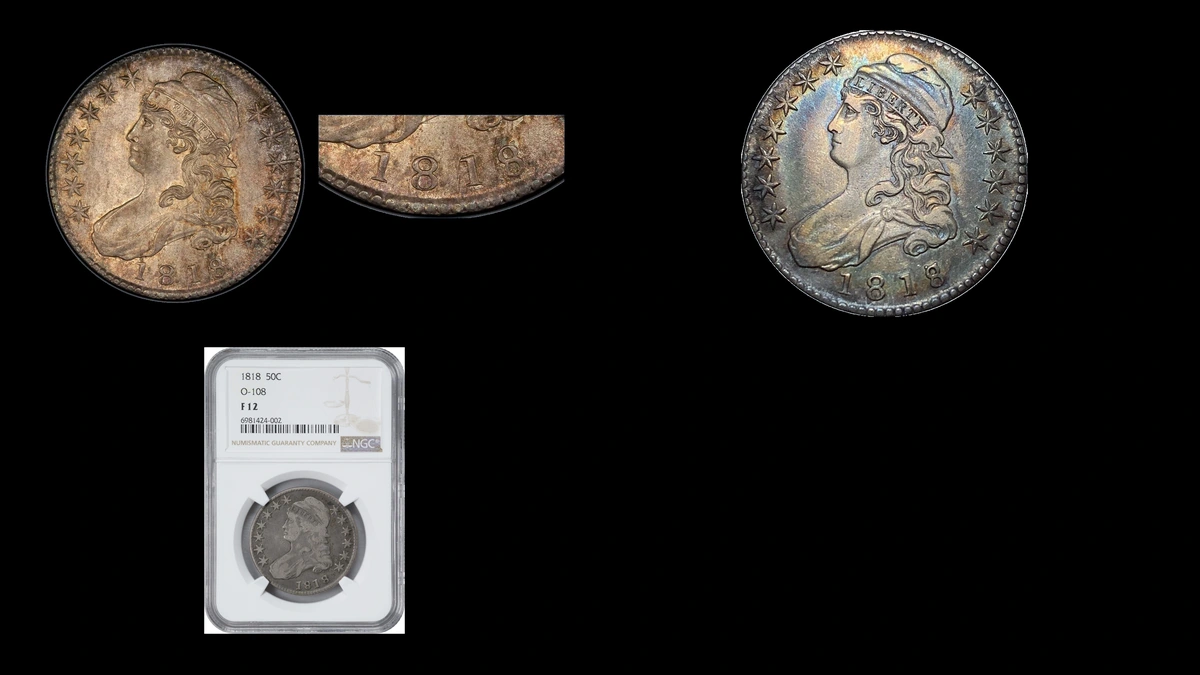
The first and last 8 answer different questions on an 1818/7 half dollar. One identifies the Small or Large 8 version; the other contains remnants of a 7.
This guide to 1818 half dollar errors spans estimated values of $120–$25,000, including a Large 8 MS64 sold for $19,388 in August 2016. Start with date and front landmarks, then compare centering and the edge inscription.
| Clue | Area | Feature | Estimated value |
|---|---|---|---|
| 7 traces under last 8 | Date | 1818/7 overdate | $250–$2,000 circulated; $6,000–$22,000 unworn |
| Small irregularity beside star 4 | Front | Natural planchet flaw | $250–$1,000 worn; $12,000–$25,000 comparable MS64+ overdate |
| Raised connecting routes | Date, curls, stars and cap | Die cracks | $120–$1,200 |
| Border-tooth tracks near cap | Front | Reported double strike | $600–$3,000 |
| Slightly displaced design | Both outlines | Off-center report | $300–$1,500 |
| Whole edge letters repeat | Entire inscription | Doubled edge lettering | $150–$700 |
| Word groups face opposite ways | Entire inscription | Partially inverted lettering | $300–$1,000 |
These Philadelphia halves have no mintmark and a lettered edge. Their unworn reference measurements are about 13.48 grams and 32.5 mm, allowing for normal early shape variation and subsequent wear.
1. 1818 Half Dollar The Last 8 Covers a 7: Overdate Error
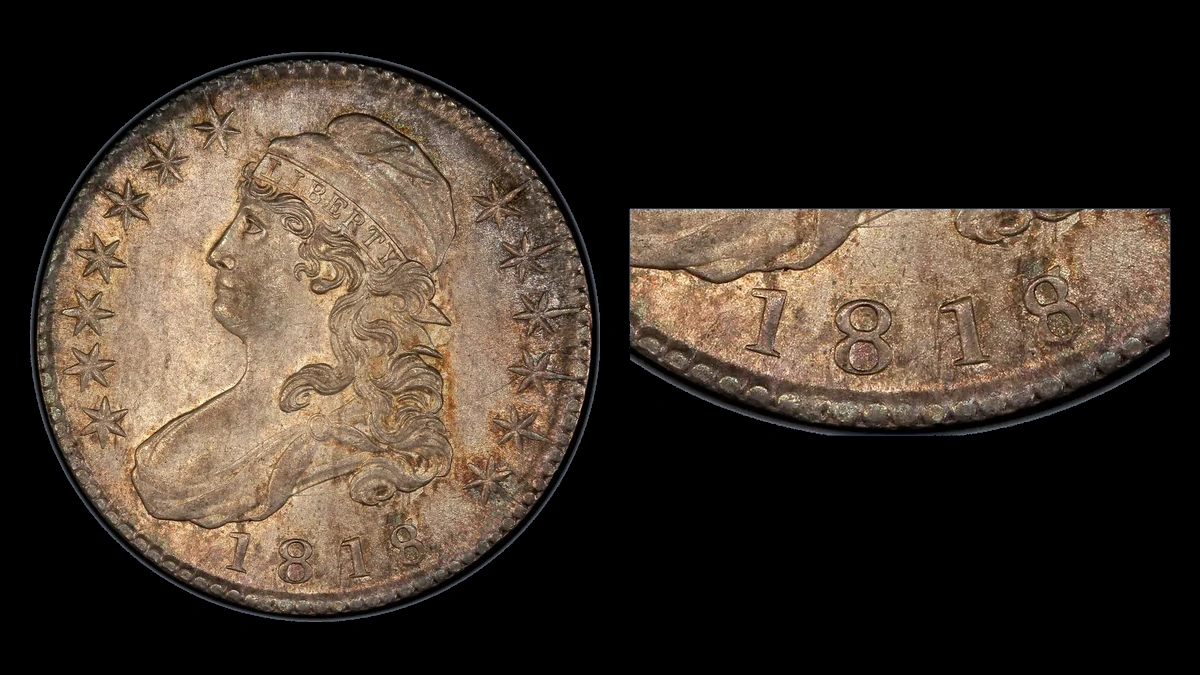
An 1817 front die was altered for 1818, leaving portions of the earlier 7 under the final 8. The old digit was part of the tool, so this did not require striking each coin twice.
Small 8 and Large 8 refer to the first 8 instead. Its middle connection is slanted and script-like on Small 8, and flatter on Large 8.
How to Identify
Examine the last digit for recognizable 7 remnants, then move to the first 8 to identify the version. Inspecting only one of them can answer the wrong question.
Compare the full date with a known overdate rather than accepting a thick outline or scratch. Confirm 50 C. on the reverse, since an 1818/5 quarter is a different coin.
What It’s Worth
Estimated ranges: $250–$2,000 for circulated examples and $6,000–$22,000 for higher-quality unworn coins. An NGC AU53 Large 8 brought $1,320 in April 2025.
PCGS records $19,388 for Large 8 MS64 at Heritage in August 2016. Keep the version and substantial difference in preservation attached to those prices.
2. 1818 Half Dollar A Tiny Irregularity Beside Star 4: Natural Planchet Flaw Error
Stack’s Bowers described a small natural flaw immediately right of star 4 on lot 4092 in March 2021. The coin was an 1818/7 Large 8 graded NGC MS64+.
The mark belongs to the original metal blank and helps identify that specimen. The catalog does not describe a peeling layer, so calling it lamination would go beyond the evidence.
How to Identify
Count upward from the lower-left star to the fourth and inspect directly to its right. Compare the boundary and texture with the cataloged MS64+ example.
Check the surrounding struck detail for a natural relationship to the flaw. Later gouges or corrosion may leave different edges, even in a similar location.
What It’s Worth
Estimated range: $12,000–$25,000 for a high-quality unworn overdate comparable to this specimen. The $19,388 MS64 result above is a neighboring condition reference, not the sale price of lot 4092.
A comparable small defect on a moderately to lightly worn coin instead belongs around $250–$1,000. The exceptional preservation and overdate supply far more value than the blemish itself.
3. 1818 Half Dollar Ridges Joining Date, Curls, and Stars: Die Cracks Error
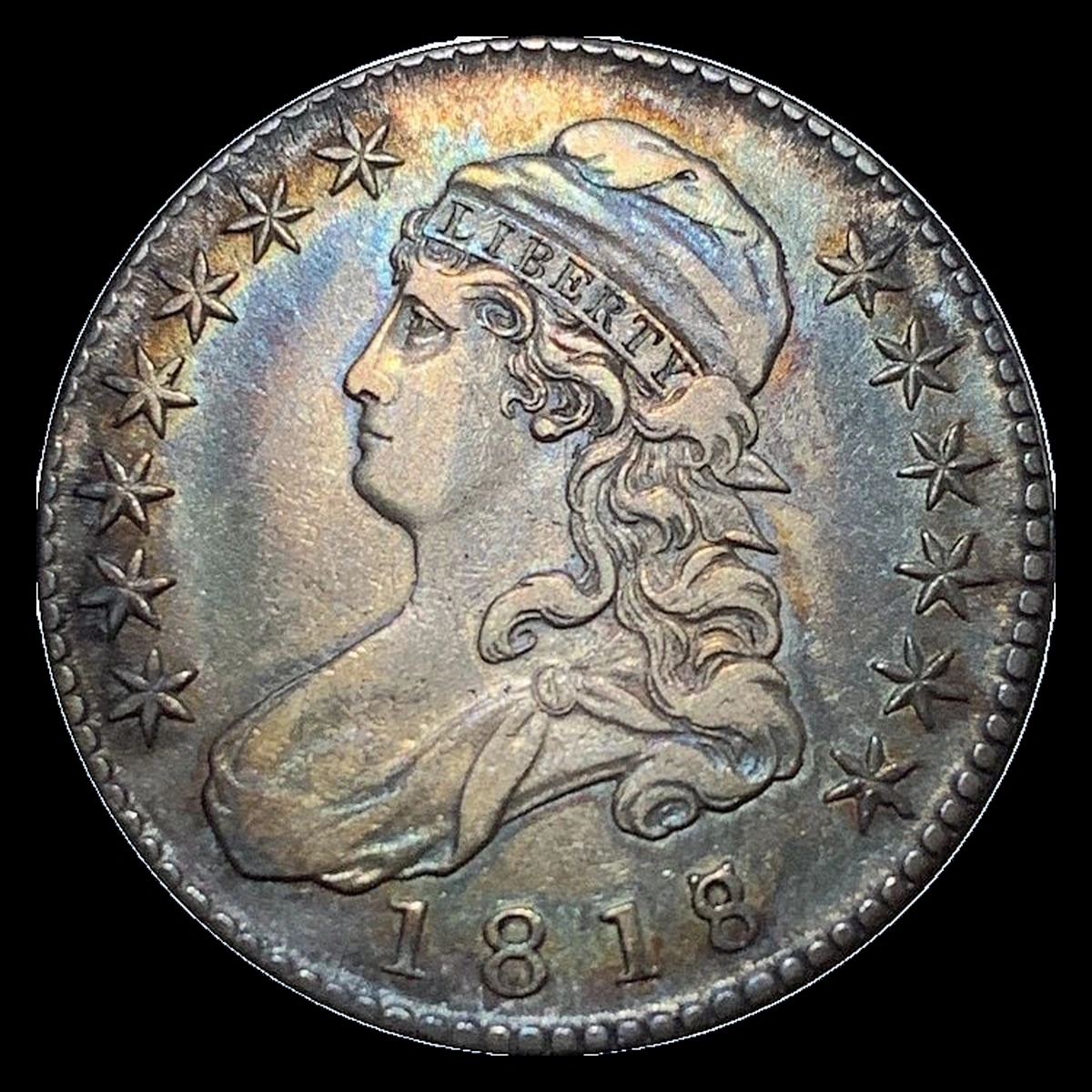
O-112 has reported routes through the date and lower curls, with intersections at star 11 and other sections across upper stars and the cap. The bottom of the first 8 and final 18 are useful landmarks.
These ridges formed as silver entered fractures in the stamping die. Wear may weaken a section without changing the origin of the surviving line.
How to Identify
Use the O-112 description and count stars from the lower left before tracing intersections. Match several visible junctions rather than connecting unrelated marks into an imagined route.
Low light from opposite directions helps distinguish a ridge from a scratched groove. A split through the coin’s own metal is also different from a line copied from the die.
What It’s Worth
Estimated range: $120–$1,200 for circulated examples, with attractive lightly worn coins and developed cracks toward the top. No exact O-112 sale is supplied.
An 1826 O-104 PCGS AU58 with cracks on both faces sold for $1,020 including fees in August 2025. That later Capped Bust comparison cannot supply the 1818’s grade or crack map.
4. 1818 Half Dollar A Short Row of Teeth Near the Cap: Reported Double-Strike Tracks Error
Dentils are the small toothlike border marks normally placed near the rim. A reported O-104a has subtle dentil tracks near the cap, possibly left by an earlier impression.
The report gives no full duplicate portrait or measured rotation. A second strike can obscure most of the first, but the remaining sequence still needs a convincing match.
How to Identify
Compare the cap-area row with normal border-tooth spacing and curvature. Look for original impressions rather than parallel scratches or contact dents.
The collector’s O-104a report also notes slight off-centering. Supporting remnants elsewhere may help, but equally strong repetition on the back is not required by the report.
What It’s Worth
Estimated range: $600–$3,000 for circulated examples whose tracks convincingly establish another strike. A different-year 1824 front double strike graded PCGS VF20 brought $2,880 in January 2022.
No sale amount is supplied for the O-104a. Its tracks and the centering discussed next belong to one coin and should not receive two added whole-coin values.
5. 1818 Half Dollar Slight Displacement Within the Border: Off-Center Report Error
The same O-104a appears slightly off center in the collector report. Its internal cap marks do not measure the displacement, which must be judged from complete faces.
Early open-collar manufacture allowed ordinary outline and border variation. No percentage or direction is established for this example, so the description remains slight.
How to Identify
Take straight-on uncropped photographs and compare each design’s center with the metal outline. A wide border on only one face may indicate a misaligned die instead.
Inspect the edge for impact or filing and consider normal early shape variation. Cap-area tracks answer the repeated-strike question separately from centering.
What It’s Worth
Estimated range: $300–$1,500 for a circulated coin with clear slight displacement and appealing surfaces. This is not a range for a large blank crescent.
The twenty-five-percent off-center 1811 Fine 12 sold for $11,162.50 in 2016 illustrates a much more dramatic error. Its value should not be transferred to this subtle 1818 report.
6. 1818 Half Dollar Complete Words Overlap at the Edge: Doubled Edge Lettering Error
The inscription was applied before the faces in a separate operation. Repetition or slipping during that operation could leave overlapping characters while the portrait and eagle remain normal.
A documented O-114a and a collector-reported O-107 are separate examples of this broad feature. One doubled stroke inside a character can have another origin in the lettering tool.
How to Identify
Photograph the whole inscription in overlapping sections while turning in one direction. Follow extra complete characters into neighboring words rather than judging one thick letter.
Compare the depth and surfaces with original lettering, checking for newly cut additions. The NGC XF40 O-114a listing provides an identified example.
What It’s Worth
Estimated range: $150–$700 for circulated 1818 coins with readable repetition. The XF40 listing supplies no usable sale amount here.
A cleaned 1834 doubled-edge coin graded ANACS Fine Details sold for $220 in July 2026. That damaged later example is a lower comparison rather than a ceiling for a better-preserved 1818.
7. 1818 Half Dollar Two Word Groups Face Opposite Ways: Partially Inverted Edge Lettering Error
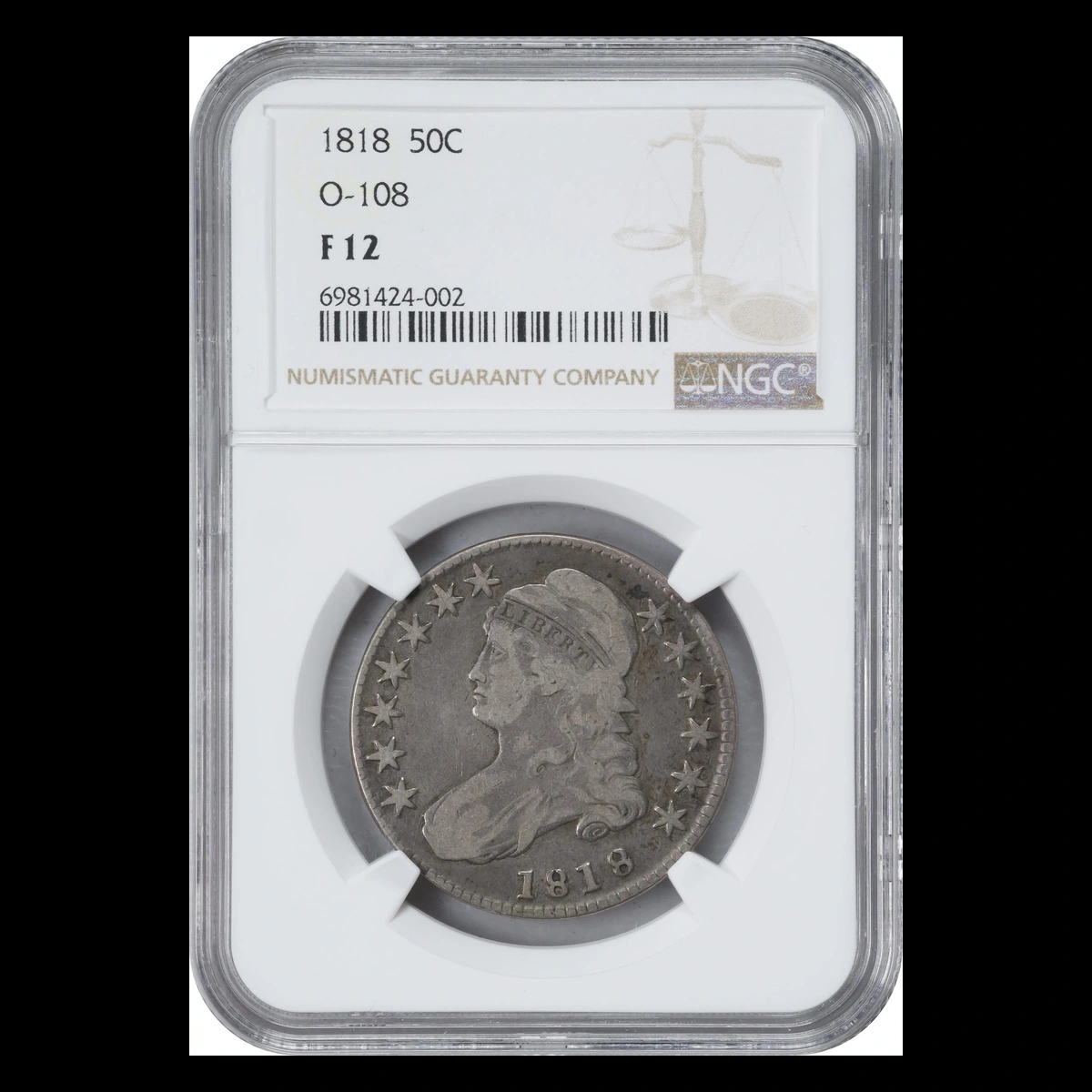
The reported O-108 has FIFTY CENTS OR in one direction and HALF A DOLLAR inverted relative to it. This is a mismatch within the inscription itself.
The collector account explains it as an inverted lettering bar. Uniformly upside-down lettering relative to Liberty is ordinary orientation and does not establish this error.
How to Identify
Keep the front upward and follow the first word group into the second without flipping the coin. Both groups must retain their opposing directions in the same continuous sequence.
A continuous edge video avoids reversing one photograph by mistake. Magnify unclear letter bottoms and leave unreadable portions unresolved rather than substituting dents for letters.
What It’s Worth
Estimated range: $300–$1,000 for clearly identified moderately to lightly worn examples. There is no recorded sale of the reported O-108 in the supplied material.
The $220 cleaned 1834 doubled-edge result is a recent edge-error comparison with a different mechanism. The upper allowance requires legible opposing groups and sound original surfaces.
Conclusion
The last 8 identifies the overdate, the first 8 identifies its major version, and the stars and cap help locate separate surface and strike features. Edge lettering needs an uninterrupted sequence to distinguish repetition from opposing directions.
The $120–$25,000 estimates span very different conditions. Shared features on O-104a and the tiny flaw on an exceptional overdate still belong to single complete coins.