Rare 1831 Half Dollar Errors (List & Pictures)
Inspect all three surfaces when looking for 1831 half dollar errors: normal-looking faces can conceal an entirely unlettered edge. Estimates across the categories below range from $150 to $15,000.
A documented plain-edge example brought $7,200 in November 2019. Start at the edge, inspect the coin’s complete design, then compare any cuts, raised lines, or faint transferred shapes.
| Observation | Where to check | Category | Estimated value |
|---|---|---|---|
| No words anywhere on the edge | Entire edge circumference | Missing edge lettering | $2,000–$9,000 |
| A backward sunken portrait | Face opposite normal Liberty | Full obverse brockage | $3,500–$15,000 |
| Normal portrait displaced lower right | Front center and border teeth | Off-center obverse | $150–$1,500 for minor displacement alone |
| Curved cut with metal retained | Matching arc on both faces | Incomplete planchet punch | $1,500–$3,500 |
| Thin raised connections | UNITED or first two date digits | Die cracks | $150–$800 |
| Faint extra design fragments | Both faces of matched example | Die clash | $175–$1,000 |
The normal edge reads FIFTY CENTS OR HALF A DOLLAR. An unworn coin weighs about 13.48 grams and measures approximately 32.5 mm across; wear and damage need consideration when comparing measurements.
1. 1831 Half Dollar A Completely Plain Edge: Missing Edge Lettering Error
A known 1831 O-118 has ordinary face designs but no edge inscription. An album that conceals the edge can hide the entire error.
The words were applied in a separate operation before the faces were struck. A blank could miss that operation and still receive its normal portrait and eagle.
How to Identify
View the full circumference in overlapping sections. Lettering may be shallow or unevenly spaced, so a single smooth stretch is insufficient.
Inspect the edge texture and its junction with both rims. Filing or polishing can leave fine lines, rounded borders, or an unnaturally smooth band where letters were removed.
Record weight and diameter as supporting checks for a loose coin. Reduced size can help reveal an edge turned down after striking, but the original-looking surfaces remain essential.
O-118 identifies the face die pairing, not the edge omission. An ordinary lettered-edge coin can share those same face details.
What It’s Worth
Estimated range: $2,000–$9,000 from authenticated worn coins to attractive unworn examples. Sheridan Downey’s Mail Bid 53 catalog records an unworn O-118 plain-edge coin sold for $7,200 in November 2019.
The missing inscription must be genuine for that comparison to apply. Matching the date and O-118 designs alone does not give a normal coin the error’s value.
2. 1831 Half Dollar Liberty Backward and Below the Surface: Full Obverse Brockage Error
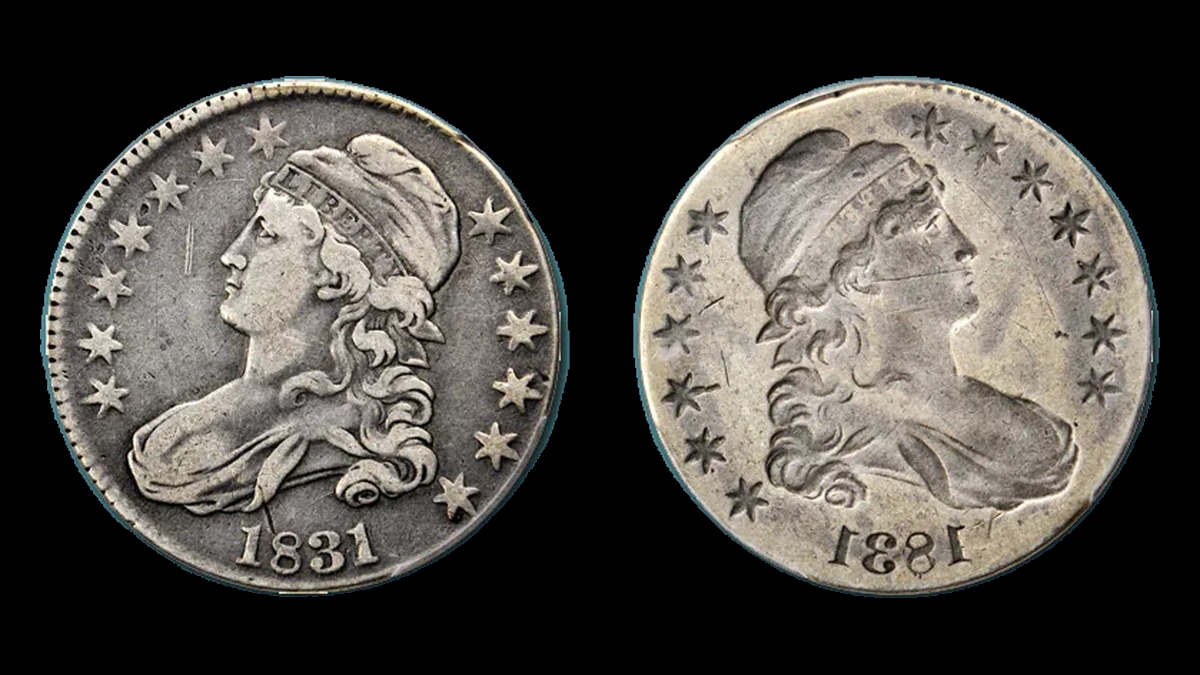
One side carries a normal raised Liberty, while the other has a complete sunken mirror image of the same front design. This is a full obverse brockage.
A struck coin remained in the press and acted against the next blank. Its raised design pressed into the new coin instead of the normal reverse tool, producing a backward, recessed portrait.
Stack’s Bowers featured a PCGS VF25 in November 2016 and compared it with a more worn example. The VF25 also has the shifted normal front examined in the next section.
How to Identify
Read the date and portrait direction on the affected face. Both should be reversed, and angled lighting should show the image sinking into the surface.
Compare the complete pattern with the documented VF25 brockage. Faint clash fragments do not reproduce this full backward head.
Examine the edge and both faces for damage from pressing finished coins together later. The image must fit an original striking event, making specialist authentication useful for a major purchase.
What It’s Worth
Estimated range: $3,500–$15,000 for a full authenticated half-dollar brockage. No realized price is supplied for either documented silver half.
An 1831 large-cent brockage sold for $3,600 including fees in July 2023. That copper one-cent coin is a different denomination and metal.
The comparison provides context for the general error, while the wider half-dollar estimate reflects the silver examples’ scarcity and visible detail. It is not a reported sale of the VF25.
3. 1831 Half Dollar The Normal Front Sits Lower Right: Off-Center Obverse Error
On that same VF25 brockage, the normal front design is shifted toward roughly three to four o’clock. Some of the small lower-right border teeth are missing where the design reaches the edge.
The backward portrait on the other face is centered. These two observations describe different parts of one coin rather than two independent specimens.
How to Identify
Compare the space between the front design and rim around the entire circumference. The design’s center should shift lower right together with the loss of border teeth.
A rim knock or wear can erase individual teeth without shifting the whole impression. Missing teeth by themselves therefore cannot identify the cataloged feature.
Photograph the opposite face at the same scale and preserve the centered brockage in the record. This example differs from a large off-center blank leaving a broad unstruck crescent on both faces.
What It’s Worth
Estimated whole-coin range: $150–$1,500 for minor displacement alone across worn grades. Ordinary 1831 condition comparisons provide the basis for that limited estimate.
The documented VF25 belongs to a different value group because it also has the full brockage. Its total cannot be assigned solely to the shifted front, and the two section estimates must not be added together.
4. 1831 Half Dollar A Curved Cut With the Metal Still Attached: Incomplete Planchet Punch Error
A visible arc can record a cut that began before the coin had a design. An incomplete planchet punch occurs when the tool starts cutting a blank from strip but fails to pass completely through.
Later cutting and striking can leave the unfinished curve within an otherwise complete coin. Unlike a clip, the described error retains the metal inside the arc.
The listed 1831 NGC XF45 has a front curve and corresponding reverse evidence. Specialist Henry Hilgard also described another variety, whose pattern should be compared separately.
How to Identify
On the described XF45, trace the front arc from approximately ten to one o’clock. Turn the coin over and locate the matching line.
Inspect the relationship between the struck design and the existing cut. A scratch made later may slice completed details and leave sharp burrs rather than the documented manufacturing pattern.
The metal remaining attached means substantial weight loss is not required. Use the rounded route, retained metal, and matching two-face evidence together.
What It’s Worth
Estimated range: $1,500–$3,500 for a verified worn example with a clear arc. The 2026 Sheridan Downey XF45 listing estimated its coin at $1,500 and up.
That listing cited a similar 1826 VF30 sold for $2,040 in March 2024. The different-year sale supports the error comparison but is not the realized price for the 1831 lot.
5. 1831 Half Dollar Thin Connections Between Letters or Digits: Die Cracks Error
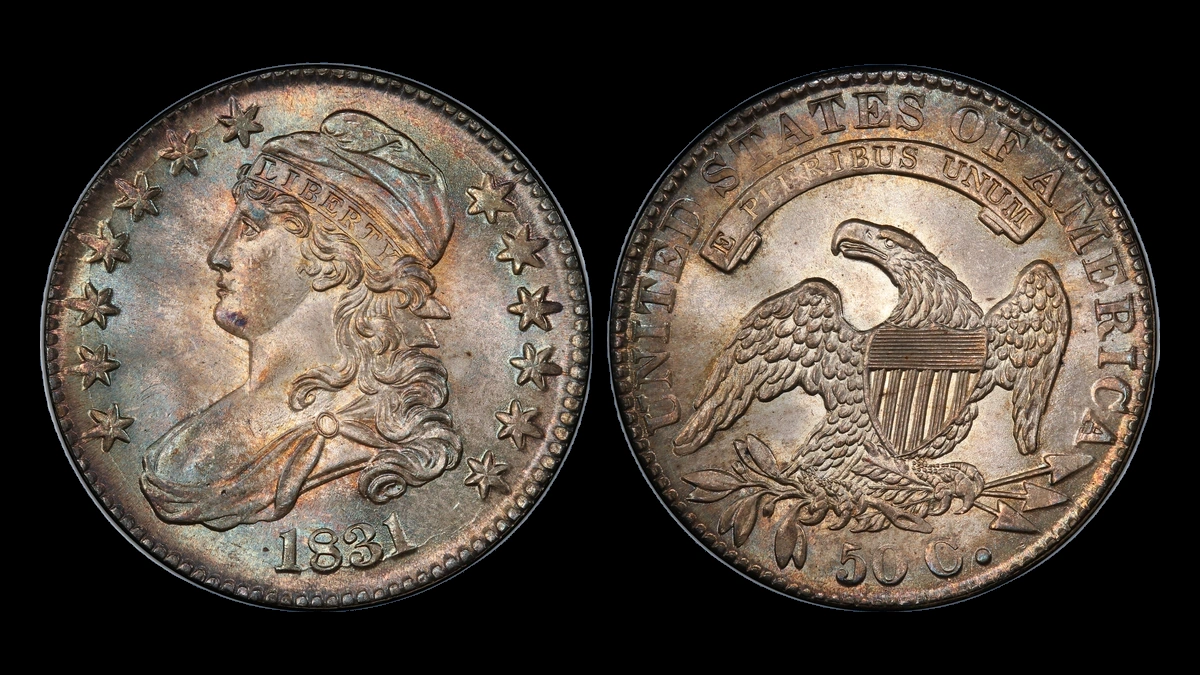
For O-118, inspect the tops of UNITED on the back for a fine raised connection. On another variety, O-103, a short raised line joins the lower parts of the first 1 and the 8.
These numbers label different die pairings. Their two routes should not be combined into a pattern expected on every 1831.
A split in the die, the steel stamping tool, filled with silver during striking. Its opening became a ridge above the coin’s surface.
How to Identify
Select the reference for the relevant route before magnifying it. For O-118 follow UNITED; for O-103 return to the first two date digits.
Light the line from several directions and judge its center as well as its edges. A scratch cuts down into metal and may push up irregular borders around that cut.
Dirt or surface color can imitate a connection in one photograph. Keep the coin uncleaned and use changed lighting to establish the raised shape.
What It’s Worth
Estimated range: $150–$800 for worn examples with these ordinary crack lines. Wear and surfaces account for much of the variation.
The O-118 auction record lists an NGC AU55 at $456 in January 2025. That nearly unworn variety comparison values the complete coin, not the thin line alone.
6. 1831 Half Dollar Faint Fragments of the Opposite Design: Die Clash Error
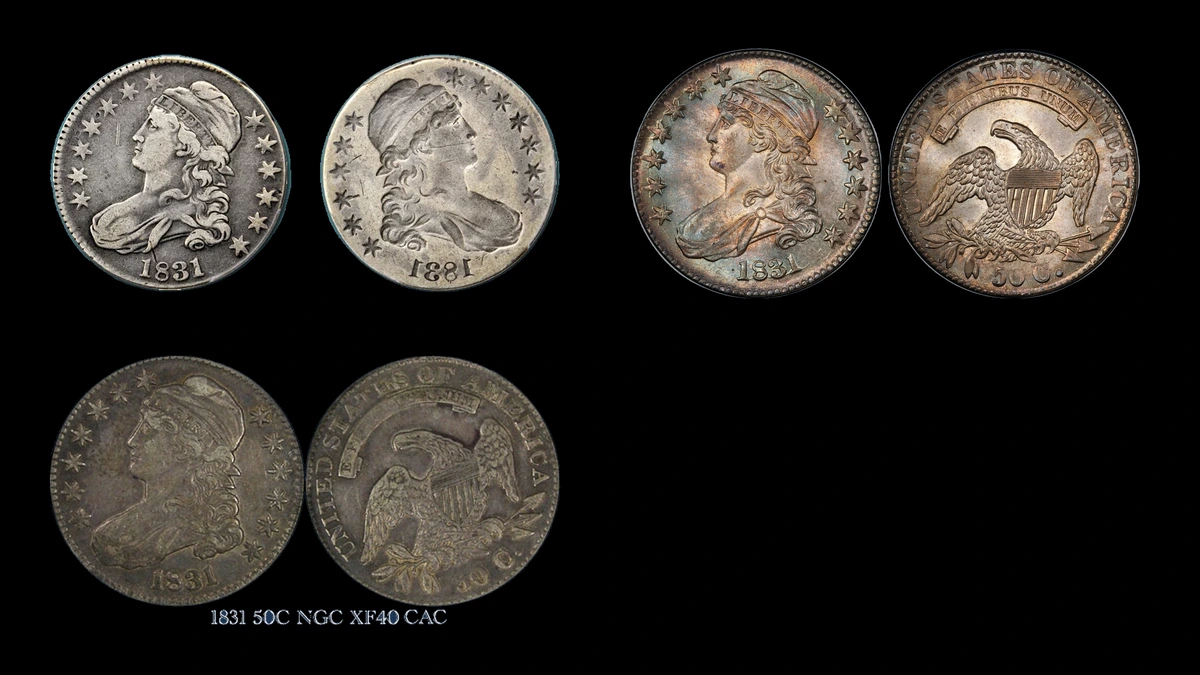
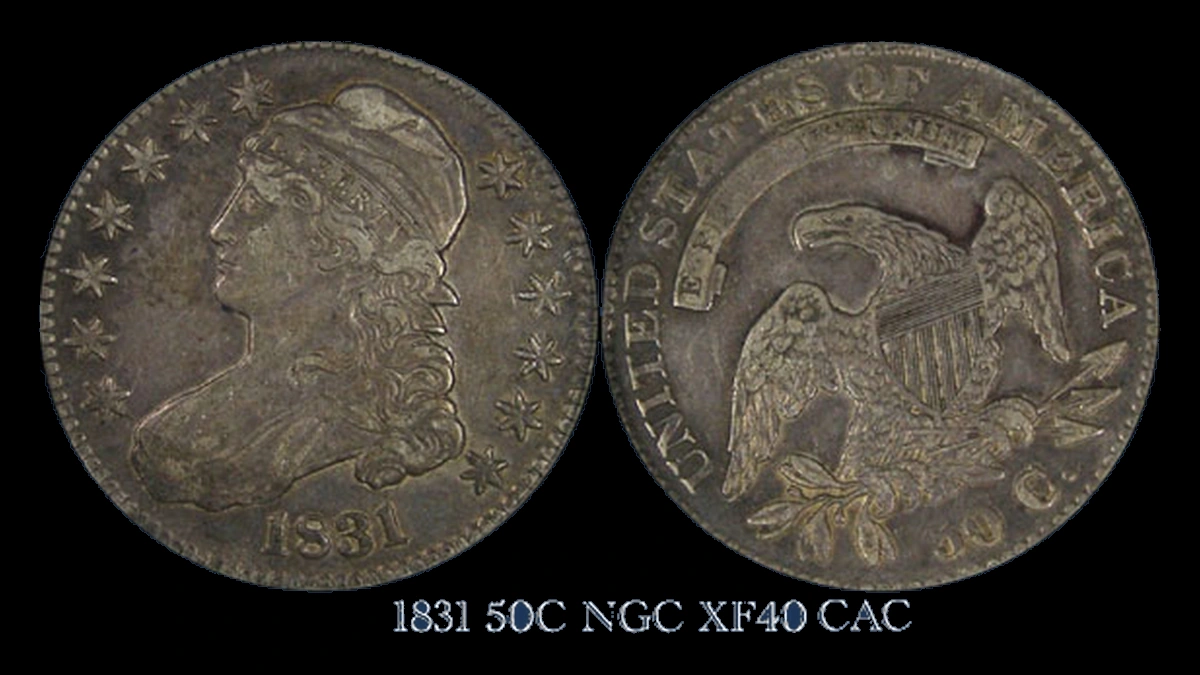
A dealer described clashes on both faces of an NGC XF40 1831. The description also mentions a small contact mark near star ten, which is separate from the transferred design traces.
When the dies meet without a blank, their designs can leave marks on one another. Those marks may then be copied onto the coins struck afterward.
How to Identify
Compare enlarged face photographs while accounting for how the dies opposed each other. A mirrored reference view can help relate an extra fragment to the opposite design.
The description gives no complete location map, so use the actual coin image to locate each trace. Do not treat the isolated star-ten contact mark as proof of clashing.
Under magnification, distinguish recognizable design fragments from scratches, cleaning lines, and narrow cracks. The shape’s relationship to the other face is the key evidence.
What It’s Worth
Estimated range: $175–$1,000 for worn examples with identifiable clash shapes. Original surfaces and the visibility of the traces help determine a useful comparison.
The dealer listed the XF40 at $275 and marked it sold in January 2011. This is a historical dealer listing, not an auction realization.
Conclusion
The edge, full face designs, and small surface features answer different questions. Keep complete photographs with each close-up so a plain edge, unfinished punch, or backward portrait remains tied to the correct coin.
The $150–$15,000 estimates cover very different errors and conditions. The shifted front and full brockage share one specimen, while dealer figures, presale estimates, and completed sales must retain their separate meanings.