Rare 1875 Half Dollar Errors (List & Pictures)
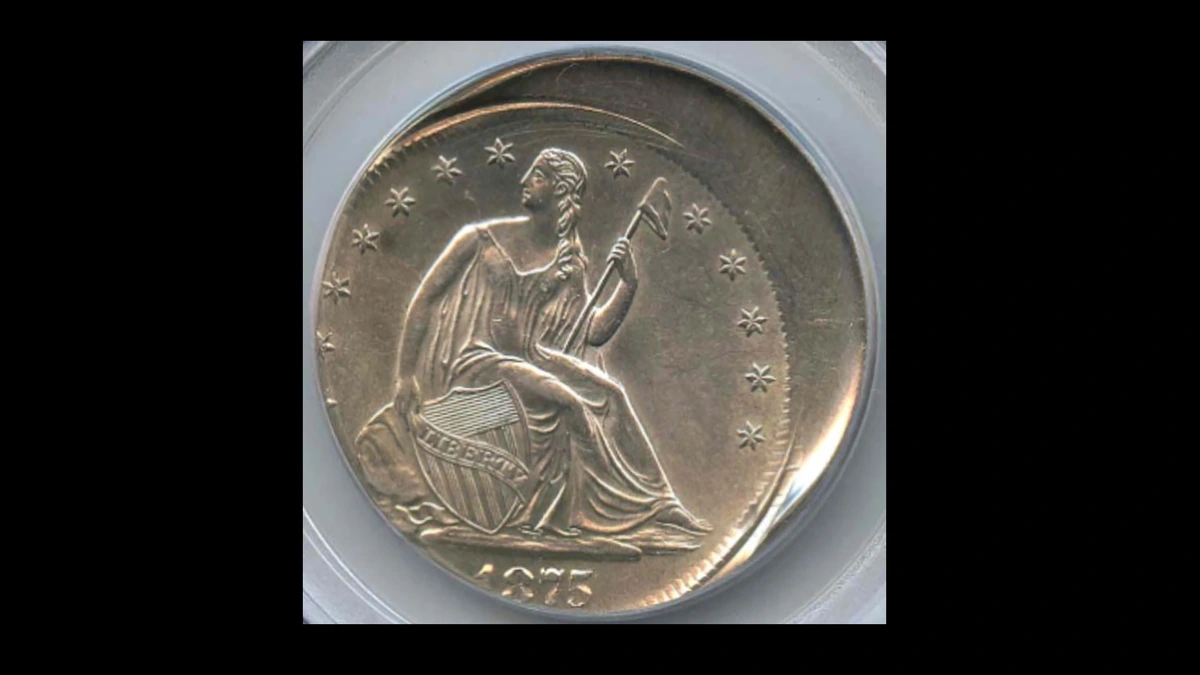
A step along the edge, an extra numeral in Liberty’s rock, and a ridge below the date can all occur on 1875 halves. Each points to a different part of the minting process.
Estimated prices for 1875 half dollar errors span $100–$25,000. The largest supplied auction comparison, $16,800, belongs to an off-center 1875-S twenty-cent piece, not a half dollar.
Examine the edge and outline before moving to mintmarks, date fragments, and smaller raised marks.
| What to inspect | Possible feature | Estimated value |
|---|---|---|
| Two levels along the edge | Partial collar | $400–$1,500 |
| Expanded outline, complete design | Broadstrike | $1,500–$5,000 |
| Large blank crescent | Off-center strike | $7,500–$25,000 |
| Extra mint-letter contour | Repunched mintmark | $150–$2,500 |
| Extra numeral | Repunched or misplaced date | $200–$7,000 |
| Raised point by 5 or TRUST | Die gouge | $150–$750 |
| Continuous raised line | Die crack | $100–$500 |
| Faint opposing-design outline | Die clash | $100–$450 |
The ordinary half dollar has a standard weight of 12.50 grams, a diameter near 30.6 millimeters, and a grooved edge. Measure only when safely accessible, allowing for circulation wear and recording unusual shape rather than relying on one width.
1. 1875 Half Dollar A wide band sits beside a narrow grooved band: Partial Collar Error
Turning the coin sideways may reveal an error that the portraits do not immediately show. The stepped edge called a railroad rim forms when only part of the blank’s thickness is restrained by the collar during striking.
The restrained section stays narrower and receives grooves while the exposed section spreads. Bill Bugert records partial collar strikes for the 1875-S Small Wide S variety.
How to Identify
Rotate the edge under a light and photograph the transition between its two levels. Compare widths at several points without assuming a standard amount of expansion.
A later machined channel may show sharp cuts or tool marks, while solder or seams raise other concerns. The useful evidence is original spreading alongside a narrower grooved band, together with the correct small, wide S.
What It’s Worth
Authenticated worn through nearly unworn examples have an estimated $400–$1,500 range. A clearly preserved step and undamaged edge improve the comparison.
An 1858-O with off-centering and partial edge grooves drew a $300 floor bid in 2020 before the buyer’s fee. That different-year combined-error result is not a recorded 1875-S partial collar sale.
2. 1875 Half Dollar The full design fits inside an enlarged outline: Broadstrike Error
Complete lettering on an abnormally wide coin suggests a different degree of collar failure. Without the ring’s normal restraint, silver can spread outward while still receiving the entire design.
An 1875-S graded AU58 appeared in the May 2009 Long Beach auction, and the Small Wide S variety reference records broadstruck examples. AU58 means nearly unworn.
How to Identify
Check both faces for a complete main design before judging the amount of spreading. An off-center error instead loses some intended design beyond the edge.
Inspect the expanded border and edge for natural striking texture and incomplete or absent grooves. Crushed details may point to a later hammer blow or flattening.
Expansion redistributes metal rather than removing it, so weight should remain consistent with the coin’s wear. Extra width without compatible design and edge evidence cannot establish a broadstrike.
What It’s Worth
The estimated range is $1,500–$5,000 for genuine worn through nearly unworn Seated half-dollar broadstrikes. The illustrated 1875-S AU58 failed to meet its reserve in 2009 and therefore has no auction sale price from that appearance.
The May 2025 Mint Error News guide estimates later Barber examples at $1,000–$2,000 in XF/AU and $2,000–$4,000 unworn. Those different-series guide values offer context without converting the unsold 1875 coin into a sale.
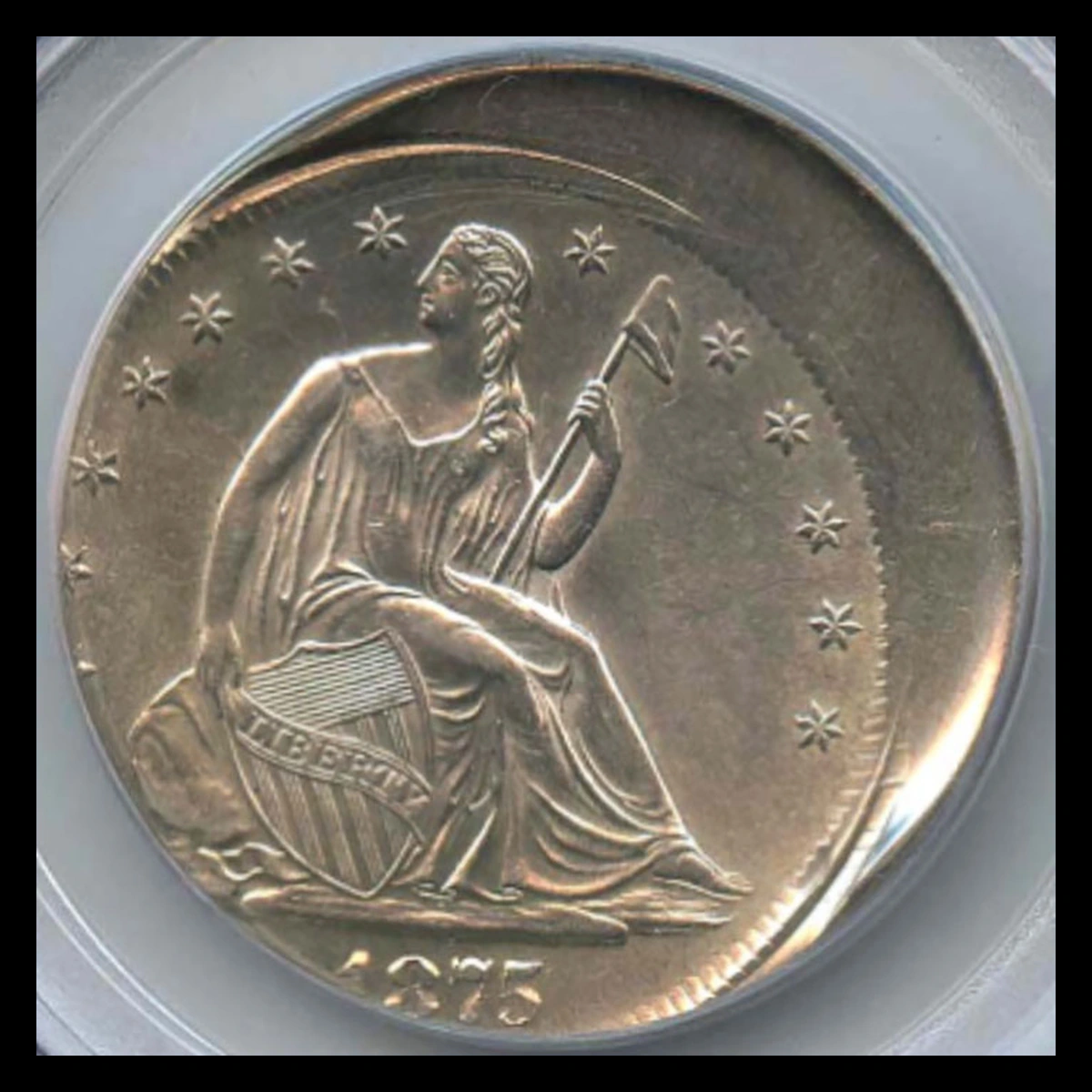
3. 1875 Half Dollar A wide blank crescent borders the shifted design: Off-Center Strike Error
The known PCGS MS62 1875-S has a 20% off-center strike and design on both faces. Another published example is described as 15% off center.
The blank sat partly outside the intended striking position, leaving an untouched area opposite the missing design. Neither example should be described as having one entirely blank face.
How to Identify
Follow the blank crescent on both faces and compare it with the design cut off at the opposite edge. The displacement should describe the same piece of metal when the coin is turned over.
Preserve photographs of the readable 1875 date and S, and inspect the edge for cutting, seams, or flattening. The crescent is unstruck metal, not a missing piece cut from the coin.
What It’s Worth
An estimated $7,500–$25,000 covers major identifiable 1875-S offsets in nearly unworn to unworn condition. The dealer’s MS62 example is marked sold, but its amount is not published.
An 1875-S twenty-cent piece graded NGC MS63 and struck 25% off center realized $16,800 in 2022. Its different denomination makes it a broad major-error comparison rather than a half-dollar sale.
4. 1875 Half Dollar An earlier C or S survives beside the final letter: Repunched Mintmarks Error
The mintmark identifies which comparison to use before its extra contour can be interpreted. One Carson City variety has additional metal above the first C, while the San Francisco Small S has an earlier impression below and to the right.
These letters were punched into the die by hand. A shifted repeat punch could leave remnants that later coins reproduced as raised details.
How to Identify
For CC, inspect above the first C; for the described Small S, inspect below and to its right. Seek a rounded, recognizable part of the earlier letter in the correct location.
A flat shelf or a normal large or small mintmark does not establish repunching. Compare the whole shape with a clear reference and inspect nearby metal and the edge for alteration.
What It’s Worth
The estimated range is $150–$2,500 across worn examples and selected unworn coins. Mint and preservation remain important parts of the whole-coin value.
PCGS records a $1,900 eBay sale on April 19, 2023 for an unworn MS64 Recut S. A Carson City specimen needs comparison with similarly preserved CC coins rather than automatic use of that San Francisco result.
5. 1875 Half Dollar A date digit leaves another trace: Repunched and Misplaced Dates Error
On the San Francisco misplaced-date variety, the base of an extra 1 projects from Liberty’s rock directly above the intended first digit. The reverse carries a very small S.
A separate Philadelphia discovery has repeated marks on the 1 and 5, paired with the earlier reverse design. One feature lies outside its intended location, while the other records another position of the date punch near the finished digits.
How to Identify
Use the mintmark first: no mintmark for the Philadelphia example, very small S for the cited San Francisco variety. On the latter, trace the extra 1 base in the bottom of the rock.
For Philadelphia, inspect the lower flag of the 1 and lower loop of the 5 against the discovery report by Bill Bugert. A common tiny flaw in an ordinary 1 is insufficient without the matching additional date detail.
What It’s Worth
Worn date-punch varieties have an estimated $200–$1,200 range. A very well-preserved San Francisco misplaced-date coin in MS66 has a separate $4,000–$7,000 estimate.
Stack’s Bowers described an MS66 example in June 2024, but no price from that appearance is used here. An ordinary PCGS MS66 sold listing reported $4,882.50 in April 2025, providing a condition comparison rather than a sale of the cited misplaced-date coin.
6. 1875 Half Dollar A point extends from 5 or a mark rises beside TRUST: Die Gouges Error
The Spiked 5 variety has an extra point joined to the last date digit. A separate 1875-S variety carries a raised mark beside the first T in TRUST.
A gouge cut into a die creates a hollow that fills with silver during striking. The resulting mark is raised on the coin, unlike a cut made directly into its finished surface.
How to Identify
For Spiked 5, compare exactly where the point meets the digit and the point’s shape. The TRUST feature belongs to another variety and need not appear with it.
A specialist study confirms the raised first-T mark on genuine 1875-S halves. Match the feature without treating every bump, fresh cut, or pushed-up lip as equivalent.
What It’s Worth
Estimated values are $150–$750 for worn through nearly unworn examples with a clear raised feature. The range is not a list of realized Spiked 5 sales.
An ordinary NGC XF45 appeared in completed-sale listings at $225 in July 2026. Its remaining detail offers a condition comparison, while polishing or surface damage can diminish the appeal of a gouge variety.
7. 1875 Half Dollar A continuous ridge crosses the surface: Die Cracks Error
Reported 1875-S crack routes include a line below the date and another from Liberty’s toes toward the last star. Other examples have lines through TRUST or parts of STATES OF AMERICA.
Silver entered fractures in the dies and formed raised ridges. These routes do not all have to occur on one coin, and a long narrow crack is not automatically a larger die break.
How to Identify
Move the light from one side of the suspected line to the other and follow its height across nearby details. A die crack leaves a continuous ridge, whereas a scratch usually has a recessed channel that may have a raised lip beside it.
Match the actual route and confirm the S before choosing a reference. Length or general location alone cannot establish the same die or its stage of cracking.
What It’s Worth
Estimated whole-coin values run from $100–$500 for worn examples with visible cracks. Attractive surfaces and better surviving detail generally improve the comparison.
An ordinary 1875-S in XF40 sold for $250 in June 2025. That is a condition reference, with no separate amount assigned to a fracture; cleaning and damage can outweigh interest in a thin line.
8. 1875 Half Dollar Faint foreign outlines cross the clothing and shield area: Die Clash Error
On the described 1875-S variety, unusual traces appear in Liberty’s clothing and near the lower right of the reverse shield. The small, wide S identifies the mintmark style, but examples struck before the clash can share it without the extra marks.
The traces began when the dies struck each other without a blank between them. Contact left portions of the opposing designs on the tools, which later transferred them to coins.
How to Identify
Tilt the coin to reveal shallow outlines in the clothing and beside the shield. Compare those shapes with the opposite design and with clear photographs of the clashed variety.
Random scratches need not follow the opposing design, and the mintmark alone cannot confirm clashing. Seek the matching transferred shapes in both documented areas.
What It’s Worth
The estimated range is $100–$450 for worn examples with readable clash traces. Wear may account for more of the price than a faint extra outline.
Completed-sale listings include ordinary examples at $175 in PCGS VF30 in August 2025 and $250 in XF40 in June 2025. Neither result isolates a clash premium.
Conclusion
An edge step, expanded outline, and blank crescent record different ways the metal met the press. For smaller features, choose the correct mint and variety before matching a numeral, point, or raised path.
The highest comparison in this article belongs to another denomination, and the illustrated broadstrike went unsold at its cited auction. Keeping those distinctions intact makes the estimates more useful than a dramatic image alone.