Rare 1825 Half Dollar Errors (List & Pictures)
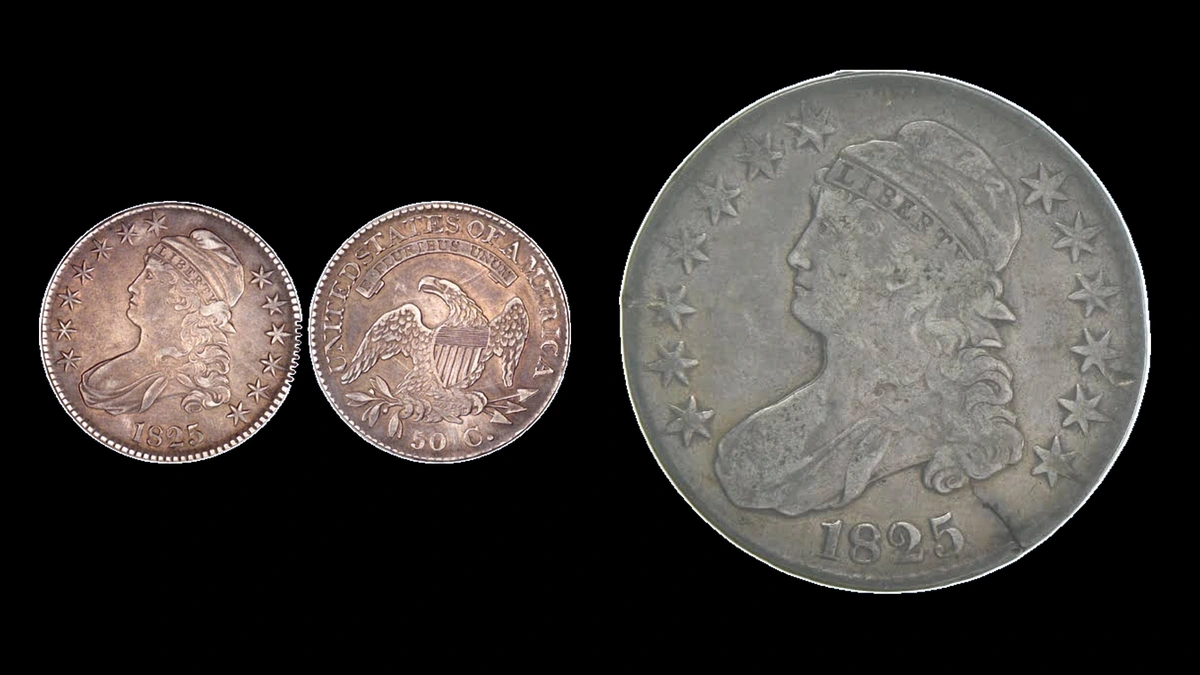
Do not stop at the two faces of an 1825 half: its lettered edge can carry a mistake of its own. Repeated HALF A DOLLAR wording is one of the 1825 Capped Bust half dollar errors covered here.
Estimated whole-coin ranges extend from $100–$5,000 in the conditions discussed. An unworn O-106a with strong reverse cracks sold for $977.50 in January 2006.
Read the edge first, then compare the portrait, back details, and alignment.
| Clue | Category | Estimated range |
|---|---|---|
| Repeated words on the edge | Multiple edge lettering | $150–$900 |
| Expanded area with weak border teeth | Reported incomplete edge preparation | $200–$900 |
| An opening near the stars | Reported split blank | $250–$1,800 |
| A repeated face outline | Doubled portrait profile | $150–$5,000, depending on grade |
| Vertical shield line | Die defect | $100–$1,000 |
| Extra 50 C strokes | Repunched denomination | $150–$1,200 |
| Raised reverse paths | Die cracks | $100–$2,000, depending on grade |
| Uneven margins on both faces | Off-center strike | $400–$1,800 |
| Tilt after a controlled flip | Reported rotation | $150–$400 |
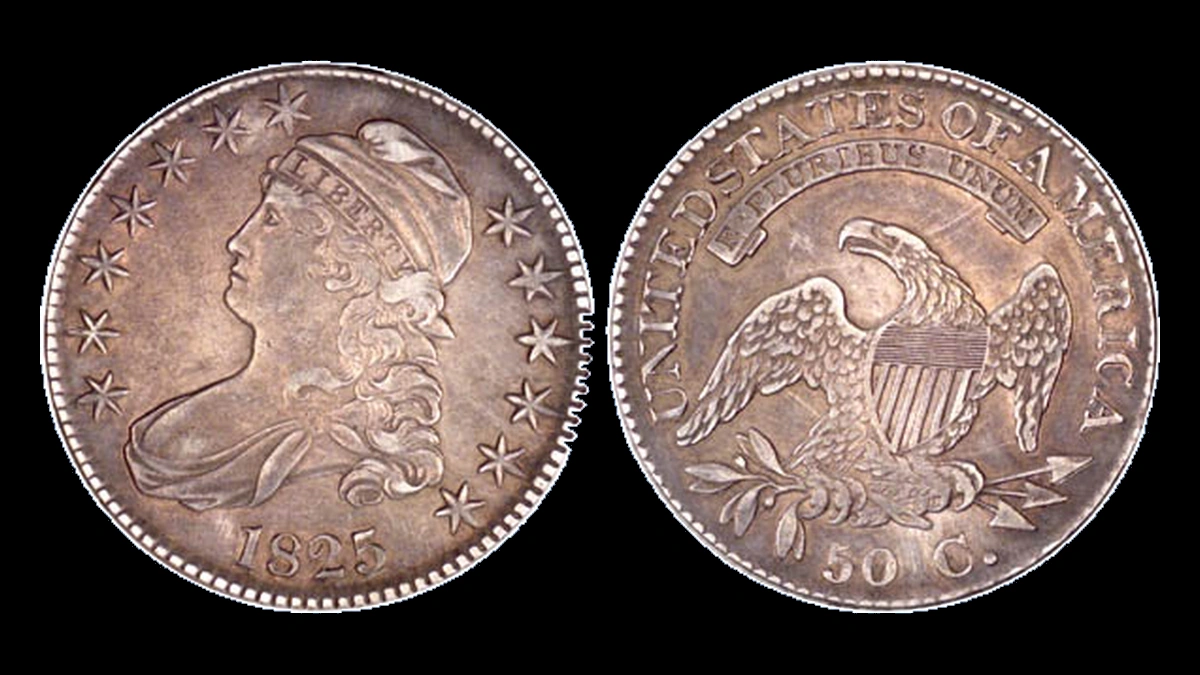
These Philadelphia coins have no mintmark, an original weight of 13.48 grams, and a diameter of roughly 32.5 mm. Numbers such as O-101 identify the pair of dies, or steel stamping tools, used to make a particular variety.
1. 1825 Half Dollar HALF A DOLLAR Repeats around the Edge: Multiple Lettering Error
The Logan collection’s O-101 has repeated impressions through HALF A DOLLAR. The description concerns a sequence of extra letters rather than one isolated doubled stroke.
Edge lettering was applied before the two faces were struck. Repeated contact at that earlier step could duplicate the words without creating a second portrait.
How to Identify
Read around the full edge with a magnifier and follow the overlapping words continuously. The Logan description gives the recorded wording for comparison.
A little overlap where a normal lettering sequence meets is insufficient. Look for the additional sequence through the stated words and inspect for later recutting.
Keep full face photographs with the edge views to confirm 1825 and O-101. Polishing and fine scratches on the described coin are separate surface problems.
What It’s Worth
$150–$900 is the estimated range for circulated examples with clearly repeated wording. No sale amount is assigned to the Logan coin here.
An 1834 doubled-edge half graded Fine Details, with cleaning noted, sold for $220 in July 2026. That impaired different-year example provides context, while sharper lettering and natural surfaces can support greater interest.
2. 1825 Half Dollar A Wider Section Has Weak Border Teeth: Reported Incomplete Edge Preparation Error
An owner described an O-107 with an expanded area beside weak or missing border teeth. The informal nickname “Guido” accompanies the suggestion that part of the blank missed its normal edge treatment.
Under that explanation, the untreated area spread differently when struck. The proposed cause is the owner’s interpretation, not an independently certified finding.
How to Identify
Compare the weak teeth with normal teeth immediately beside them, then inspect the corresponding edge section. A genuine preparation difference needs evidence beyond missing border detail alone.
Measure the outline in several directions and note any change in thickness. Filing, hammering, ordinary wear, or a shifted picture can produce superficially similar areas.
Photograph the entire outline and edge. The nickname does not replace those physical checks.
What It’s Worth
$200–$900 is the estimate for a circulated O-107 where the evidence supports the reported preparation problem. The collector’s account supplies no sale price.
An 1825 AU53 struck 3% off center sold for $600 in June 2024. Its different border problem offers a same-year condition comparison, without confirming the cause or price of the “Guido” feature.
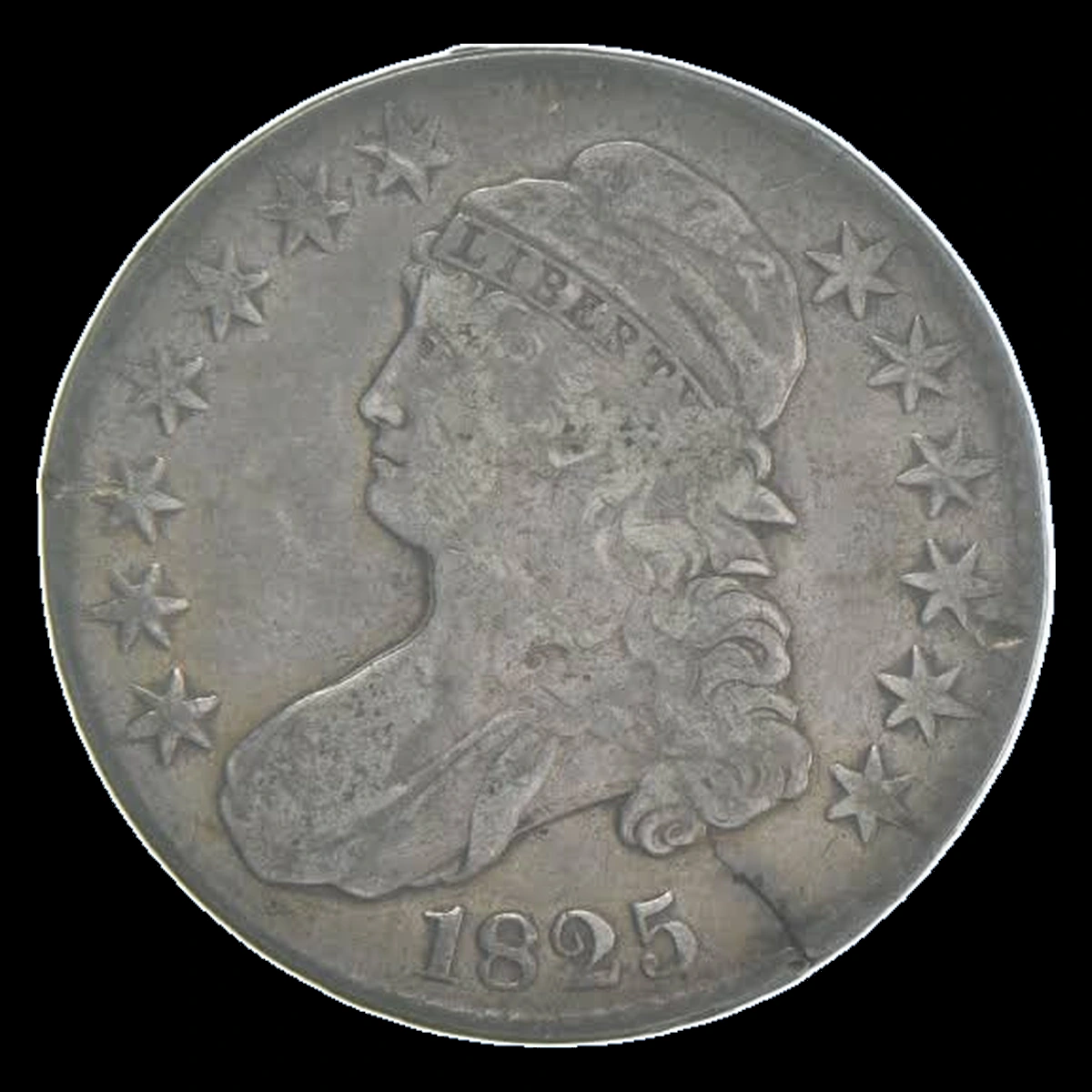
3. 1825 Half Dollar An Opening Enters near Star Four: Reported Split Blank Error
The reported O-113 has an opening near star four, extending toward the upper stars and Liberty’s cap. Its owner believed the metal was damaged before the coin was struck.
If a blank already contained a split, the design could form across and around that opening. A finished coin broken by bending or cutting tells a different story.
How to Identify
View the opening from both the front and edge. Examine how the struck details meet it, especially toward stars five through seven and the cap.
The collector’s O-113 account identifies that route. It does not independently certify the timing of the damage.
Look for cuts, bending, or disrupted edge letters. An actual opening in the coin differs from a raised ridge copied from a crack in the die.
What It’s Worth
$250–$1,800 is the estimate for a circulated 1825 with convincing evidence of a split present before striking. The design’s relationship to the opening is central to that comparison.
An 1832 half with a small rim defect sold for $263.25 including premium in July 2025 in XF45 condition. Its modest flaw is a different-year reference, not a sale of the reported O-113 split.
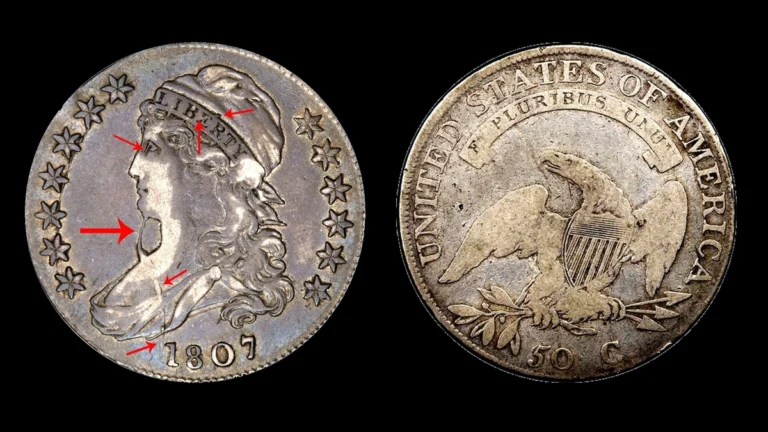
4. 1825 Half Dollar A Second Outline Follows Liberty’s Face: Doubled Profile Error
An O-105 graded PCGS MS63 was described by an auctioneer as having a “double struck” profile. The supplied description does not record two complete dates, borders, or reverse designs.
The visible claim is therefore narrower: an extra outline follows Liberty’s face. Movement during striking can repeat a local contour without producing a full second picture.
How to Identify
Follow the profile through several points under a magnifier. Decide whether the extra edge is rounded, a flat shelf, or displaced metal beside damage.
Then examine the rest of both faces for additional impressions. Their presence or absence limits what can be concluded from the face outline alone.
Change the light and use a sharp photograph to rule out glare or blur. Other doubled-looking 1825 profiles need their own examination.
What It’s Worth
$2,000–$5,000 is the estimate for a well-preserved coin comparable to the MS63 example. Worn pieces with a modest repeated contour may fall around $150–$700.
The 2016 catalog identifies the MS63 piece, but no sale price for it is used here. The $977.50 MS61 cracked coin is a lower-grade same-year comparison, not this coin’s transaction.
5. 1825 Half Dollar A Vertical Line Crosses the Shield Bars: Die Defect Error
On the reported O-112, a vertical line crosses the top four horizontal shield bars on the right. That precise position is more useful than simply finding an unusual line somewhere on the eagle.
A recessed mark in a die can create a raised line on the coin. The reference calls this a die defect without establishing the exact tool or accident that caused it.
How to Identify
Keep the upper-right shield bars in view and trace the line through all four. Light it from opposite sides to check its height.
A scratch may have raised edges but a sunken center. Compare the entire coin with O-112 before assigning the reported feature.
What It’s Worth
$100–$1,000 is the estimate for circulated O-112 examples with a clear matching line. The range prices the whole coin, including its condition.
The O-106a with raised reverse cracks sold for $977.50 in January 2006 in MS61 condition. It is a different variety and an unworn comparison, so a worn shield-line coin should not inherit that figure automatically.
6. 1825 Half Dollar Earlier 50 C Strokes Sit Higher: Repunched Denomination Error
The O-111 report places remnants of an earlier 50 C above the final denomination. The punch was moved lower, leaving some of its first impression in the die.
Each later coin could receive those extra strokes in one strike. There is no need for a second complete picture to explain the localized repetition.
How to Identify
Inspect the denomination and the space directly above it together. Match the higher remnants to the shapes and spacing of the final characters.
The date reference describes the higher placement. Use changing light to separate raised remnants from scratches or flat shelves.
Compare more than one character when enough detail survives. A single unexplained line above 50 C is less convincing than related parts of the same punched wording.
What It’s Worth
$150–$1,200 is the estimate for circulated examples with readable extra denomination strokes. Better detail and natural surfaces support the upper portion.
The $600 June 2024 sale of a mildly off-center 1825 AU53 provides a same-date, lightly worn comparison. It is not an O-111 sale or a fixed premium for repunching.
7. 1825 Half Dollar Raised Paths Cross 50 C and UNITED: Reverse Die Cracks Error
The O-106a from the Jules Reiver collection has two useful routes to trace. One runs from ICA through the base of 50 C; another starts below the leaves and passes through UNITED.
Metal entered narrow cracks in the stamping tool and formed ridges on the finished coin. These are raised lines, not splits through the coin itself.
How to Identify
Start with ICA and follow the first ridge into the denomination. Then trace the separate route beneath the leaves and through UNITED.
A magnifier and low side lighting should show continuous raised tracks. Matching both paths is stronger evidence than identifying a short scratch across one letter.
What It’s Worth
$100–$800 is the estimate for circulated examples with readable cracks. Comparable lower Mint State coins, which have no circulation wear, have an estimated range of $900–$2,000.
The NGC MS61 O-106a sold for $977.50 on January 27, 2006. A different 1826 cracked half in AU58 sold for $1,020 in August 2025.
Those figures include the value of the coins at their respective grades. One thicker ridge does not replace an assessment of wear, cleaning, and surface marks.
8. 1825 Half Dollar Both Pictures Have Uneven Margins: Mild Off-Center Strike Error
The documented O-113 graded PCGS AU53 was struck 3% off center. Most of its picture remains, so the full borders are especially important for seeing the small shift.
Other reports describe 5% and 7% examples. Those percentages refer to different coins, not additional measurements of the AU53 specimen.
How to Identify
Compare the center of each design with the complete metal outline. Both faces should support a misplaced blank; a shift limited to one face can involve a single die instead.
Distinguish weakly struck border teeth from teeth worn or damaged away. Cropping a photograph closely can also exaggerate an uneven border.
No shift direction is supplied for the AU53 example. Match its actual photographs before adding a direction to your notes.
What It’s Worth
$400–$1,000 is the estimate for a similarly mild, lightly worn example. More pronounced confirmed shifts in circulated condition have an estimated range of $600–$1,800.
PCGS records $600 for the 3% AU53 in June 2024. The same coin had sold for $432 in November 2017.
9. 1825 Half Dollar The Eagle Tilts after a Flip: Reported Rotated Reverse Error
A seller reports rotation on an O-114 graded NGC VF20. That grade describes a moderately worn coin; it does not by itself show that the service certified the rotation.
A turned die changes the angle between the two faces while leaving both pictures centered. The listing gives no measured angle or direction.
How to Identify
Hold Liberty upright and flip the coin straight from top to bottom without twisting it sideways. The eagle should finish upright on a normally aligned half.
Repeat against a fixed vertical line and measure any consistent tilt. Two photographs separately turned upright cannot demonstrate the relationship.
Inspect the lettered edge for seams or alteration. A clear controlled-flip view is more useful than the seller’s label alone.
What It’s Worth
$150–$400 is the estimate for a similarly preserved coin with demonstrated modest rotation. The VF20 listing asks $228.99 or Best Offer.
That amount is not a completed sale and does not establish a value per degree. A claim of major rotation needs an actual measurement and a closer comparison.
Conclusion
Repeated edge words, a repunched denomination, and a doubled face outline come from different questions about manufacture. Examine the whole feature before grouping them under the same label.
Keep the front, back, and lettered edge together in your records. For the reported split and incomplete edge preparation, physical evidence of how the coin was struck matters more than a nickname or a broad seller description.