Rare 1913 Half Dollar Errors (List & Pictures)
Four eagle wings and three feet are more than a striking appearance: they record two blows to a 1913 half dollar. The heavily worn example sold for $3,450 in January 2004.
Estimated values for these 1913 half dollar errors run from $100 to $4,000. Compare overlapping pictures and the overall outline first, then examine a missing edge section or separating surface layer.
| What stands out | Inspection target | Error | Estimated value |
|---|---|---|---|
| Extra wings, feet, and motto | Both faces | Double struck in collar | $3,000–$4,000 |
| Blank metal beside missing design | Full coin outline | Off-center strike | $400–$1,500 |
| Complete designs inside a wider edge | Both faces and diameter | Broadstrike | $750–$3,000 |
| A tiny missing section | Edge of the reported 1913-S | Clipped planchet | $2,000–$3,500 around MS64 |
| A thin flap or lost surface layer | Surface metal | Lamination | $100–$500 |
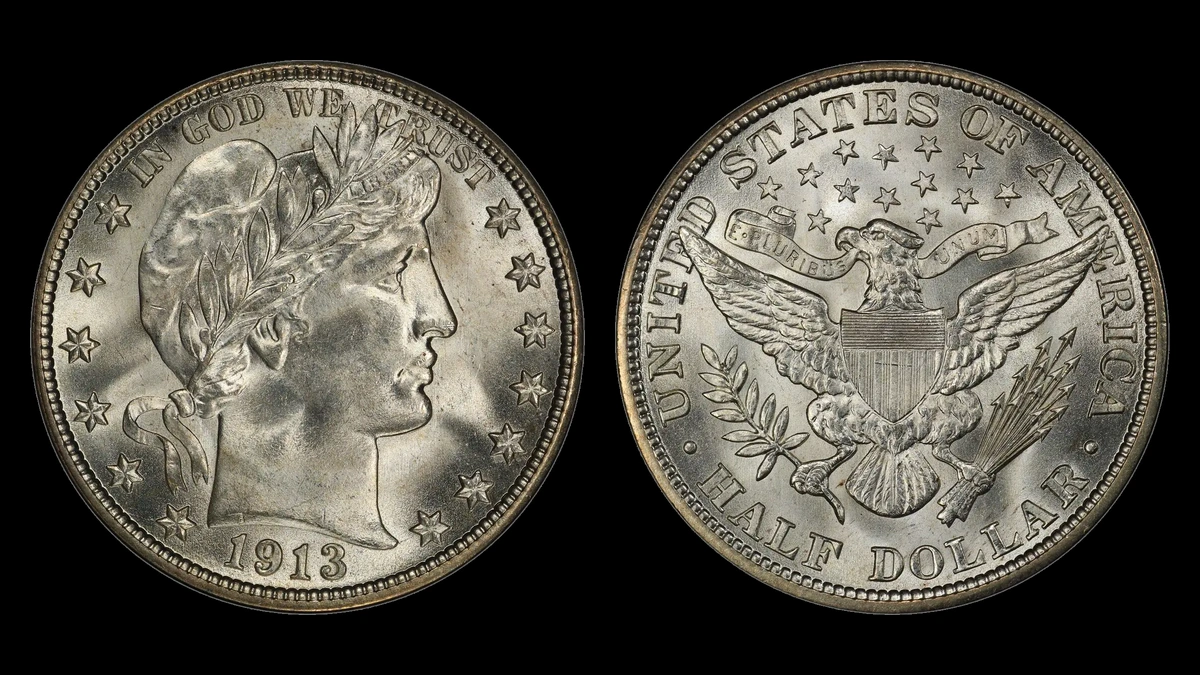
The mintmark, when present, is below the eagle; S means San Francisco, and no letter means Philadelphia. Normal unworn Barber halves are about 12.50 grams and 30.6 mm with a grooved edge.
1. 1913 Half Dollar The Eagle Has Too Many Wings and Feet: Double Struck in Collar Error
The Philadelphia auction coin retains four wings and three feet despite its heavy wear. On the front, the motto also appears in two different positions.
It rotated clockwise by more than ten degrees between strikes while still inside the collar, the ring surrounding the blank. The second blow partly flattened the first design but left enough to trace both pictures.
How to Identify
Start by following each wing and foot individually. Some worn outlines may blend together, so keep the complete eagle visible while using the close-up.
Turn to the motto and compare its two positions. The relative turn between the repeated designs should make sense on both faces of the same coin.
A doubled die is a different mechanism: the tool already carries repeated detail before striking. Here, the broad overlapping pictures show movement of the coin between separate blows.
Compare the surviving designs with the documented coin and inspect the edge for later damage. The collar restricted the outline, so an in-collar double strike need not look greatly enlarged.
What It’s Worth
Estimated range: $3,000–$4,000 for worn examples with comparably clear overlap. The PCGS VG8 coin sold for $3,450 on January 10, 2004.
VG8 indicates heavy circulation wear with the principal details still visible. Its recognizable extra eagle parts help explain the strong result despite that wear.
The price is historical, rather than a recent transaction. A candidate with only vague extra lines cannot be assessed as the same clearly readable double strike.
2. 1913 Half Dollar A Blank Crescent Accompanies Missing Design: Off-Center Strike Error
An off-center coin did not sit beneath the dies in the intended position. Part of the design missed the blank while another part of the metal remained unstruck.
The supplied 1913 reference reports the category without identifying a mint or amount of displacement. Both faces therefore need direct examination before assigning those details to a candidate.
How to Identify
Arrange front and back photographs at the same scale. The incomplete designs should agree with the same position of the blank, rather than showing only one uneven rim.
A single shifted die can affect one face without moving the entire blank off center. The plain crescent and missing picture together provide stronger evidence of the stated error.
Read the date before using a 1913 comparison. If the mintmark area did not receive a design, do not infer which mint letter was once intended there.
Inspect the unstruck area and surviving edge for cuts or filing. Record weight and outline dimensions when the coin is accessible, allowing for wear and distortion.
What It’s Worth
Estimated range: $400–$1,500 for a genuine worn 1913 with a readable date and moderate displacement. No direct 1913 sale is supplied for this category.
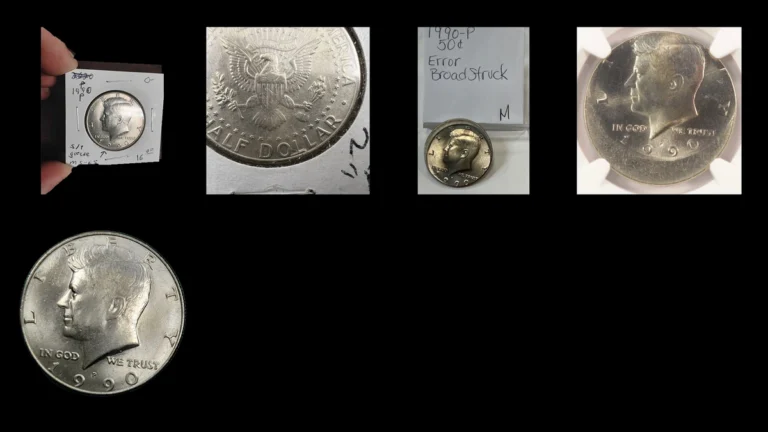
A 1976 Kennedy half struck 15% off center sold for $480 at Heritage in December 2025. Its NGC MS64 grade denotes unworn condition, making it a different-design and different-condition comparison.
3. 1913 Half Dollar The Picture Remains Complete but the Coin Is Wider: Broadstrike Error
When the collar fails to restrain a blank, the struck metal can spread farther outward. A broadstrike may therefore have both complete designs inside an unusually wide outline.
The 1913 report supplies no certified individual example or mint. An enlarged coin must be checked for later flattening as well as a genuine failure of the collar.
How to Identify
Follow every outer part of the design before measuring. If design has fallen outside the metal, the off-center category deserves consideration instead.
Measure several diameters and compare with the usual 30.6 mm. A scale should remain reasonably close to the half-dollar weight because spreading does not itself remove metal.
The collar normally forms the edge grooves, so examine their absence or uneven development alongside the shape. Filing can remove grooves, and hammering can widen a coin while flattening its details.
All three observations should agree: natural expansion, intact designs, and an edge consistent with the striking event. None of them should be inferred from width alone.
What It’s Worth
Estimated range: $750–$3,000 for genuine 1913 broadstrikes with clear expansion and attractive circulated surfaces. The stronger end allows for only slight wear.
A 1944 Walking Liberty broadstrike brought $3,120 at Heritage in August 2020 at PCGS MS62. That unworn coin had a different design sitting unevenly within its widened blank, so it provides a comparison rather than a 1913 result.
4. 1913 Half Dollar A Tiny Section Is Missing from the Edge: Clipped Planchet Error
The reported 1913-S clip is small enough to overlook in a full-coin photograph. Collector Sean Reynolds discussed the PCGS MS64 half in 2006 before it appeared as Heritage January 2007 lot 4590.
A planchet is the metal blank, and a genuine clip begins when that blank is cut incorrectly before striking. A notch removed from the finished coin has a different origin.
How to Identify
Use the Sean Reynolds discussion carefully: it also covers an 1898 quarter. Confirm you are examining the 1913-S half with the S below the eagle.
Magnify the missing edge section and the small border details beside it. Weakness in the opposite rim can support a clip, though that effect may be modest for such a tiny missing piece.
Compare the actual edge shape with the lot photographs rather than assuming any small notch is original. A minute clip may cause little measurable weight loss.
What It’s Worth
Estimated range: $2,000–$3,500 for the reported coin’s MS64 condition level. MS64 means unworn with some surface marks.
The auction-platform entry gives a $1,900 starting price for lot 4590, not a final result. Much of the estimate concerns the well-preserved 1913-S itself, and a tiny clip should not be priced like a large missing section.
5. 1913 Half Dollar A Surface Layer Begins to Lift: Lamination Error
A flap attached to the surface can reveal weakness inside the coin’s metal. With lamination, a thin layer separates and may eventually leave a rough patch if it falls away.
The 1913 report does not assign the feature to a particular mint or face. Inspect the actual layer instead of searching for an assumed fixed location.
How to Identify
Use a low viewing angle to see whether a distinct layer lifts above the surrounding silver. A straight-down photograph can hide its thickness.
Follow the connection between the flap and intact metal without bending or lifting it. Repeated scrape lines, a sharp cut, or corrosion pits call for a different explanation.
The date and mintmark should remain part of the comparison photographs. A small peel may have little effect on weight, while ordinary circulation wear can also make the coin lighter.
What It’s Worth
Estimated range: $100–$500 for circulated examples with genuine lamination. A nearby-year 1912-S with an attached flap sold for $89 at Heritage in March 2026.
That comparison was graded PCGS VG8, indicating heavy wear. It supports discussion of the error type without providing a sale price for a 1913 coin.
Conclusion
The whole outline separates several striking errors, while a tiny clip or lamination calls for a close view of the metal’s boundary. The double strike provides an especially clear check because the repeated wings, feet, and motto belong to one consistent turn.
Estimated values of $100–$4,000 cover different mints and grades. Keep the documented Philadelphia double strike separate from the reported MS64 San Francisco clip and the broader reported categories.