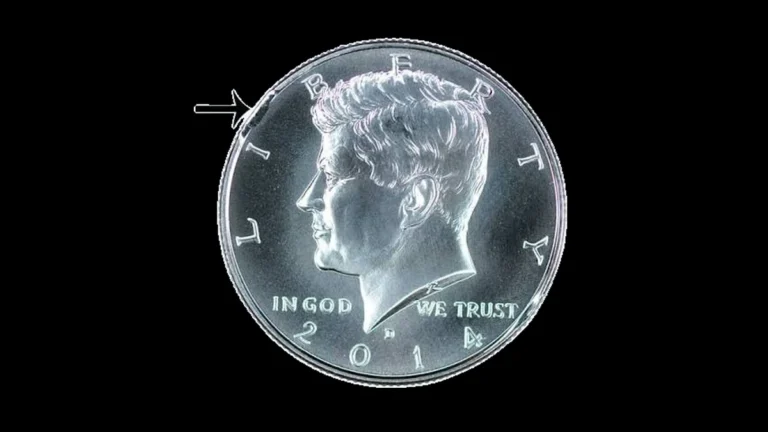
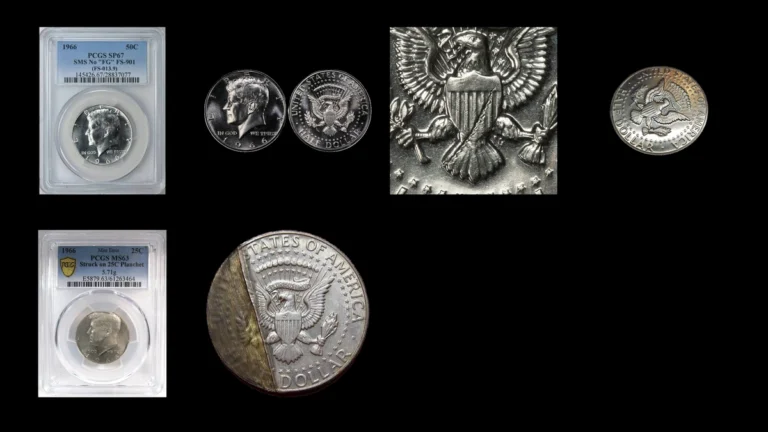
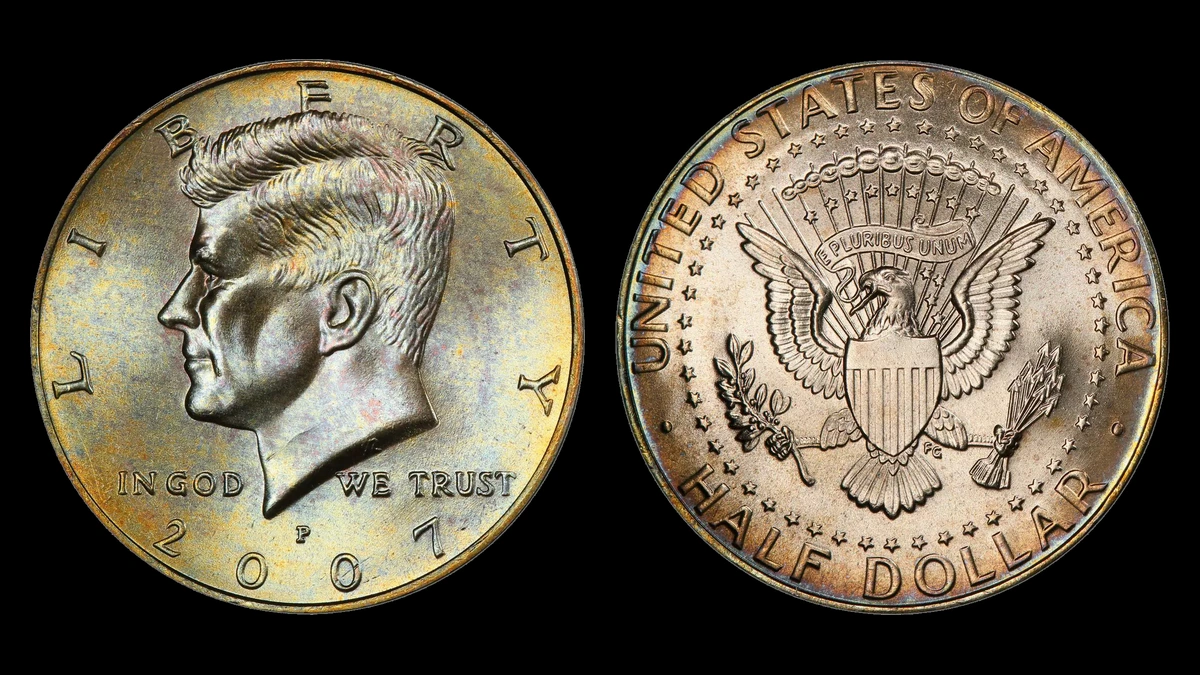
Rare 2007 Half Dollar Errors (List & Pictures)
Several names attached to 2007 half dollar errors describe possibilities rather than confirmed dated varieties. The first task is to establish what the coin actually shows: raised metal, a depression, missing detail, or a physical gap.
Estimated values run from $5 to $700 for confirmed examples. The largest supplied sale, $900, concerns a recognized 1972-D No FG and does not establish a 2007 discovery.
Inspect lettering and surface height before checking lost metal and face alignment.
| Area or clue | Reported category | Conditional estimate |
|---|---|---|
| Designer initials | Missing FG candidate | $75–$400 |
| Repeated raised outlines | 2007-D doubled die | $60–$350 |
| E in AMERICA on Proofs | Strike-through candidate | $75–$500 |
| Raised line or lump | Die crack or chip candidate | $5–$75 |
| Copper showing through a face | Missing clad layer | $125–$700 |
| Missing rim portion | Clipped planchet | $50–$300 |
| Eagle tilts after a flip | Rotated-die candidate | $40–$250 |
A clad half normally weighs 11.34 grams, while a 90% silver Proof weighs 12.50 grams; both are about 30.6 millimeters across with grooved edges. S-mint Proofs can use either composition, so S alone does not establish silver.
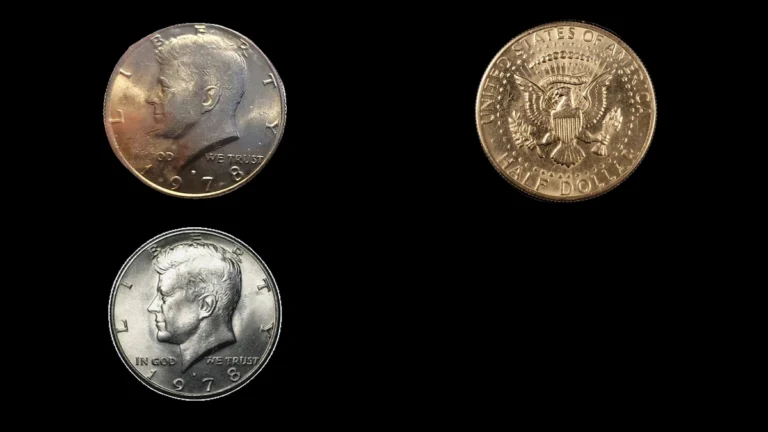
Proofs are specially made collector coins, and satin mint-set surfaces are also intentional finishes. Compare like finishes before treating their appearance as an error.
1. 2007 Half Dollar The tiny designer initials seem absent: Missing-FG Candidate Error
FG stands for designer Frank Gasparro and appears between the eagle’s tail and the leg on the viewer’s right. Glare can hide these shallow letters even when metal remains.
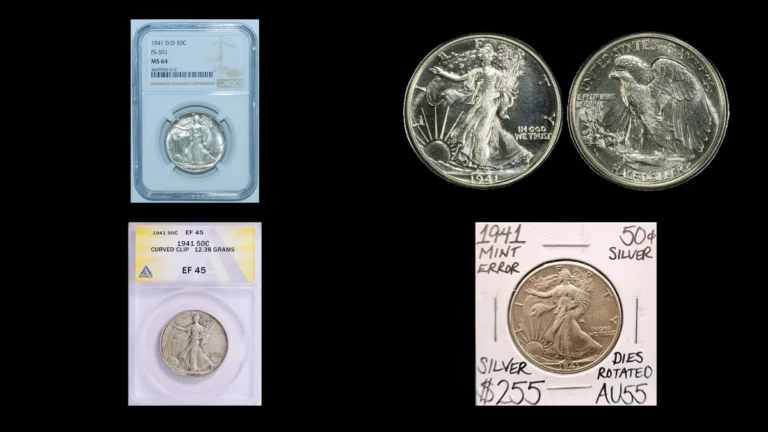
The 2007 guide illustrates its discussion with other years rather than a documented matching 2007 example. Die polishing removed initials on recognized older varieties, but wear, obstruction, and deliberate smoothing offer other explanations for apparent absence.
How to Identify
Move the light across the area before increasing magnification and search for any remaining part of F or G. Even a faint fragment means that FG is not completely missing.
Inspect adjacent feathers and the leg for scraping, polishing lines, or unusual weakness. A second matching coin can help support a die-related cause, but both letters must first be demonstrably absent.
What It’s Worth
The conditional estimate is $75–$400 after complete mint-made loss is confirmed on a collectible 2007 half. Faint initials or later smoothing do not meet that condition.
A 1972-D No FG FS-901 in NGC MS64 sold for $900 in December 2022. Its recognized attribution demonstrates interest in that older variety, not a recorded 2007 price.
2. 2007 Half Dollar Extra rounded contours repeat in the design: Reported Doubled Die Error
The Denver year listing includes doubled dies without identifying a particular die, affected face, or diagnostic letter. Suggestions to inspect LIBERTY and IN GOD WE TRUST are search areas, not proof of a named variety.
True die doubling exists in the tool before striking, allowing the same added shape to recur on coins made from it. Thick-looking lettering alone does not establish that process.
How to Identify
Separate circulation and satin mint-set coins, then inspect both faces under consistent light. Look for rounded raised extra edges that match another example of the proposed variety.
Flat shelves can result from movement during striking, while worn tools can leave ragged letter edges. The 2007-D category listing does not supply an exact pattern that can be inferred from either effect.
What It’s Worth
A clearly identified unworn 2007-D with separated raised doubling has an estimated $60–$350 range. The upper figure assumes a stronger, convincingly matched feature.
The year guide’s figures around $60 and upward are advice rather than completed sales. A thick letter without repeatable diagnostic evidence does not qualify automatically.
3. 2007 Half Dollar The E in AMERICA looks altered on a Proof: Strike-Through Candidate Error
A collector noticed an unusual E area on halves from two 2007 Proof sets. The matching location provides something to compare, but it does not establish whether an object interrupted the strike.
A lasting die defect, scratching, or packaging contact could also change the letter’s appearance. The report does not establish whether the coins are clad or silver Proofs.
How to Identify
Compare both E marks under the same lighting and determine whether each is recessed, raised, or merely different in shine. Identical shapes may suggest a persistent tool feature rather than a loose object.
The collector’s two-set report remains a candidate observation. Check packaging or a grading label for composition and leave sealed holders closed while inspecting the reflective surfaces.
What It’s Worth
A small confirmed strike-through on a well-preserved Proof has an estimated $75–$500 range. The two reported E marks have no supplied realized price or settled cause.
A 1992-D circulation coin struck through a small edge-groove fragment sold for $336 in 2021, graded NGC MS64. Its recognizable impression makes it a different-year comparison rather than identification of either Proof mark.
4. 2007 Half Dollar A ridge or compact bump rises from the surface: Die-Crack and Chip Candidates Error
A crack in a die can fill with metal during striking and leave a raised line. A small missing piece of the tool can instead form a compact raised lump.
The general 2007 guide does not document a dated example, and its eye-related nickname does not establish a feature at Kennedy’s eyes. A discussion’s posting year also need not be the date on its coin.
How to Identify
Include the actual date, mintmark, and mark in the same record. Under changing light, distinguish raised original metal from a recessed scratch or material resting on top.
Do not scrape a suspected deposit to test it. The line or lump must fit the coin’s struck surface before a die-damage explanation is adopted.
What It’s Worth
The estimate is $5–$75 for genuine small cracks or chips on ordinary collectible 2007 halves. No completed 2007 sale is supplied.
A more conspicuous 1998-D triple clip in MS63 sold for $99 in March 2025. That missing-metal error provides only broad scale context and does not price a crack or chip.
5. 2007 Half Dollar Copper appears where a face layer should be: Reported Missing Clad Layer Error
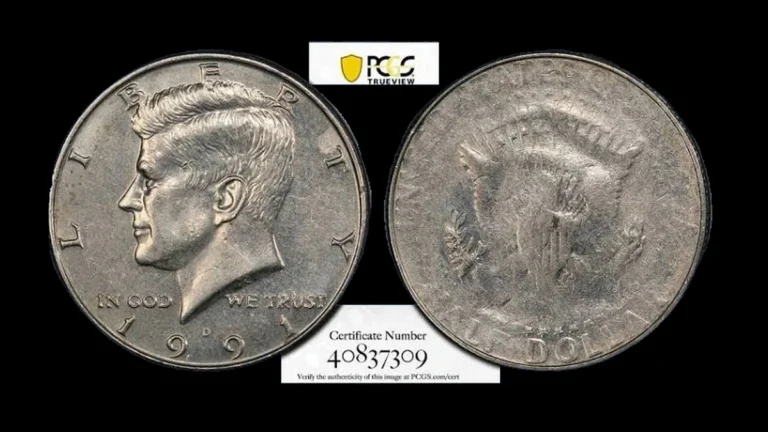
The Denver issue has copper-nickel outer layers bonded around a copper core. Failed bonding can expose that core over part or much of a face, sometimes with a visible step beside surviving outer metal.
The 2007-D listing reports partial and more extensive loss without naming a face, patch size, or weight. This construction should not be applied to a 90% silver S Proof.
How to Identify
A copper stripe around the edge is normal and does not establish a missing face layer. Inspect the suspected patch for an actual physical boundary or exposed interior surface rather than flat brown staining.
Compare accessible weight with the clad standard and examine the opposite face and edge for grinding, stripping, or added plating. A color change by itself cannot distinguish those possibilities.
What It’s Worth
An unworn 2007-D with confirmed original layer loss has an estimated $125–$700 range. A clearly readable larger area can attract stronger interest than a small uncertain patch.
A 1998-P NGC MS63 with defective obverse cladding sold for $149 in March 2023. A separate 1998 ANACS MS64 partial-loss coin was offered at $349.97, an asking price rather than a second sale.
6. 2007 Half Dollar A portion of the rim was never present: Reported Clipped Planchet Error
The reported 2007-D clips have no specified curved, straight, or ragged shape. A planchet is the blank before striking, and an incomplete one can result when a cutting punch overlaps a previous hole or the strip’s edge.
The press then forms design around the existing gap. A finished coin cut or filed later may lose similar metal while preserving a different boundary.
How to Identify
Follow the border on each side of the missing section and compare with a normal 2007-D. File lines, sharp burrs, and a sheared wall may indicate a later cut through finished details.
Inspect how the outer metal flowed toward the gap and record intact diameter spans and weight. Opposite-rim weakness may support the diagnosis but is not required to be clear on every clip.
What It’s Worth
Collectible unworn examples have an estimated $50–$300 range for modest through obvious clips. A clear original boundary and attractive surfaces support the stronger comparisons.
A 1998-D with three clips totaling 10%, graded PCGS MS63, sold for $99 in March 2025. Its three-gap arrangement and percentage cannot be copied onto an unspecified 2007-D report.
7. 2007 Half Dollar The eagle repeatedly finishes tilted: Rotated-Die Candidate Error
Rotation changes the alignment between the two faces when a die turns from its intended position. The 2007 guide discusses the mechanism using another year, without documenting a measured 2007 specimen.
A photograph can conceal or create an apparent tilt if the faces are straightened independently or the camera is angled. The physical relationship requires a controlled flip.
How to Identify
Start with Kennedy upright and flip top to bottom without twisting sideways; the eagle should normally finish upright. Repeat the same movement against a fixed reference and measure any persistent tilt.
A left-to-right turn uses a different axis and should not be mixed into the test. Inspect the edge for seams that could indicate joined coins, and keep a loose coin from slipping in its holder.
What It’s Worth
An obvious confirmed rotation has an estimated $40–$250 range on a collectible 2007 half. Very small tilts generally make weaker comparisons than large turns.
A 2000-P in PCGS MS61 with a 75-degree clockwise reverse rotation sold for $79 in March 2025. Neither that angle nor its certification establishes the same details for an unmeasured 2007 candidate.
Conclusion
Several 2007 categories remain broad reports or unresolved candidates, so the physical evidence must lead the attribution. Missing initials, a modified Proof letter, and repeated raised outlines each require their own test.
Normal satin finish and the copper stripe on a clad edge should remain part of the comparison coin, not become errors themselves. Use conditional estimates only after the mint-made feature and the correct composition are established.