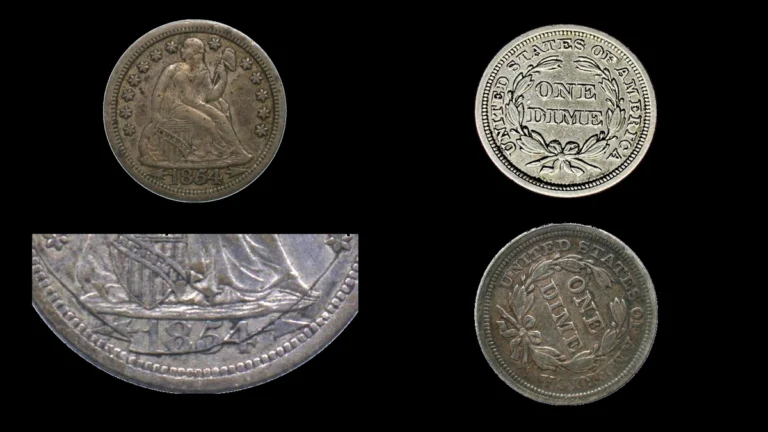
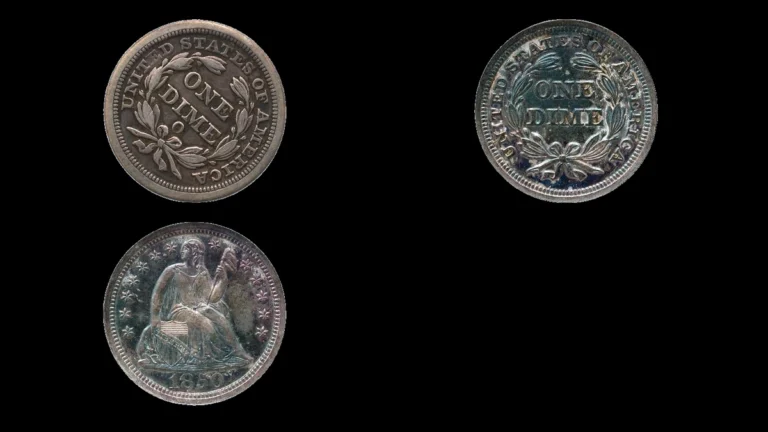
Rare 1844 Dime Errors (List & Pictures)
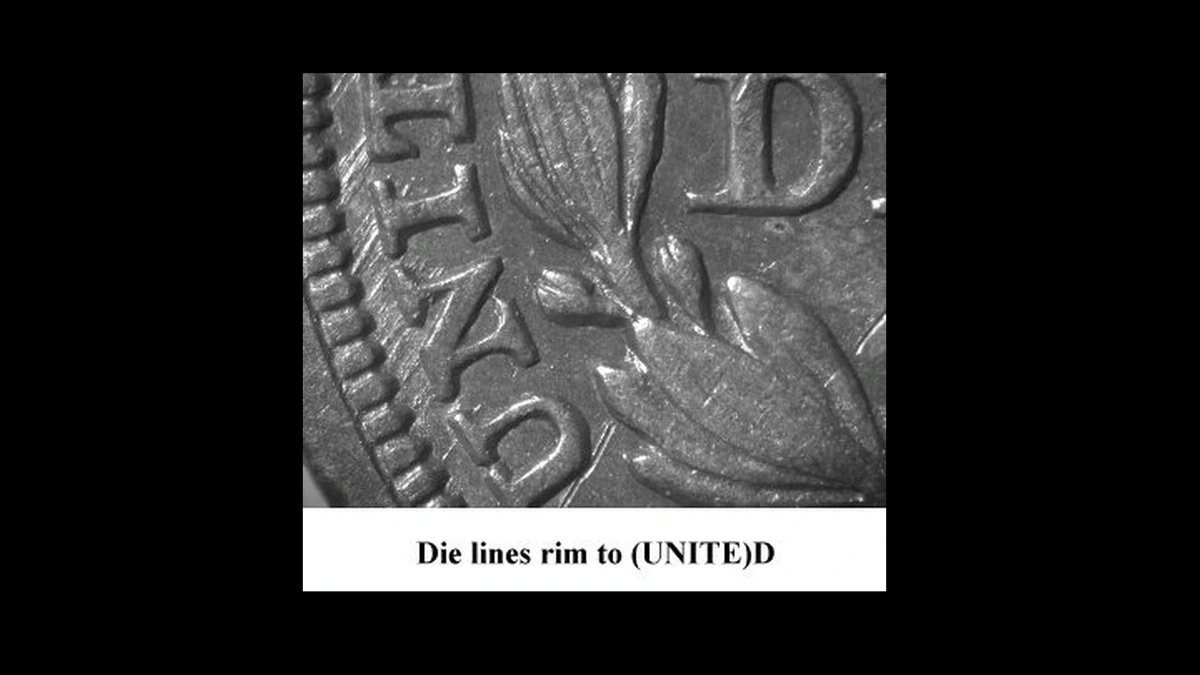
The feature covered in this guide to 1844 dime errors is a repeated pattern of fine reverse die lines. An F-102 graded AU50 sold for $2,760 in May 2005, within an estimated $200–$3,000 range for circulated examples.
Locate both groups of lines, then use the date’s position to test whether the two faces match the recorded variety.
1844 Dime Fine Lines beside UNITED and AMERICA: F-102 Reverse Die Lines Error
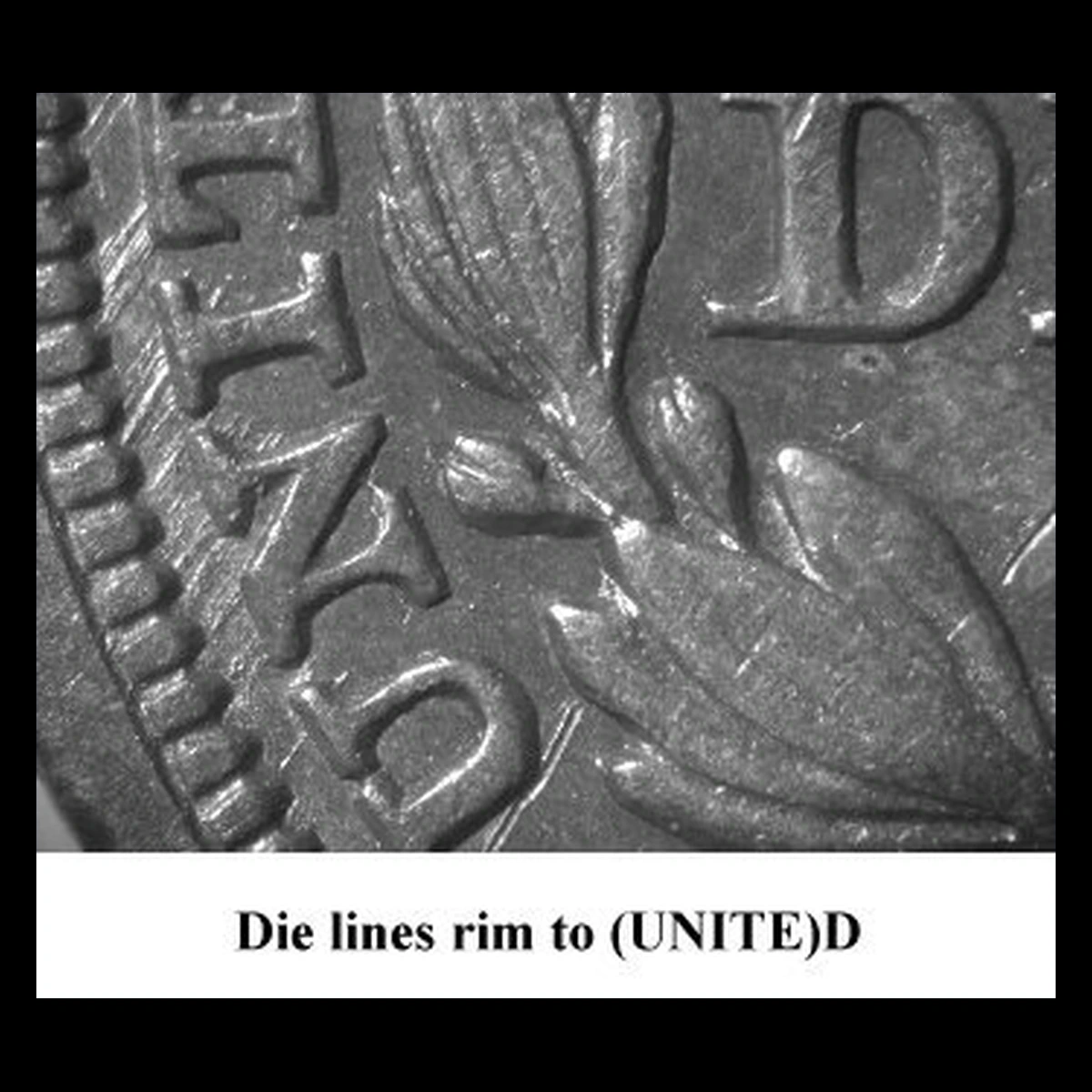
The open space between the lettering and rim holds the key details. One group of lines lies beside D in UNITED, and another sits beside ERIC in AMERICA.
Specialist Gerry Fortin identifies these as die lines: marks associated with the tool that struck the reverse. The supplied evidence does not establish a crack or trapped-material impression as their cause.
F-102 names a particular pairing of front and back dies. Its obverse has a high date that slopes upward, giving a second side of the coin to check before accepting the attribution.
How to Identify
Use a magnifier to isolate the small area outside D in UNITED, keeping the letter and rim in view. Compare the arrangement with Fortin’s F-102 photographs, then repeat the exercise beside ERIC.
Both groups should agree with the reference rather than merely contain some lines. Random scratches or cleaning marks that sweep across unrelated areas do not establish the same reverse die.
Turn the coin over and examine the high, upward-sloping date as a complete group of numerals. That relationship helps separate F-102 from the different F-101 pairing.
These small marks can become difficult to see on a worn surface, so an unclear photograph may leave the identification unresolved. Side lighting and a sharp full-date image are more useful than assigning a variety from one uncertain streak.
For a basic physical check, the 90% silver dime originally weighed about 2.67 grams and measures roughly 17.9 millimeters. Its edge is grooved, and circulation may account for some loss of weight or edge detail.
What It’s Worth
Estimated whole-coin values are $200–$3,000 for correctly identified circulated pieces. The recorded AU50 result was $2,760 in May 2005, for a coin showing some circulation wear.
A 2025 specialist catalog placed a $1,150 guide figure beside an EF40 example. That number is pricing guidance, not evidence that the illustrated coin sold for that amount.
The lines mainly assist attribution, while the scarce underlying dime, remaining detail, and original surfaces carry much of the value. Neither reference isolates a separate premium payable just for the reverse lines.
Conclusion
An F-102 identification is strongest when three observations agree: the line group beside UNITED, the group beside AMERICA, and the high upward-sloping date. Keep the description as die lines unless stronger evidence establishes a more specific cause.
Once the pairing is secure, compare coins of similar wear and surface quality; the estimated range applies to the whole dime, not to a few isolated marks.