Rare 1893 Dime Errors (List & Pictures)
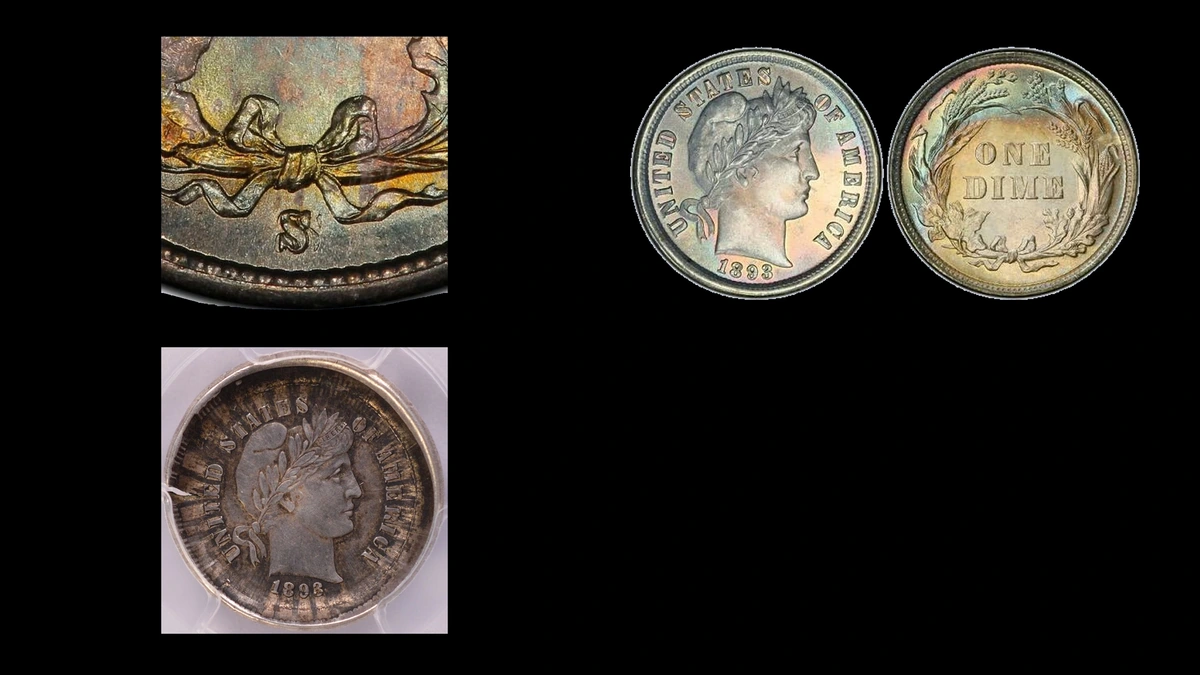
The traditional 1893/2 name and a cup-shaped brockage both need careful explanation in a guide to 1893 dime errors. Estimated whole-coin values span $25–$25,000; the highest supplied completed sale is $11,500 in 2006 for an MS66 under the traditional date name.
Start with mint and date details, then inspect raised lines, displaced designs, and the unusual reversed portrait.
| Observation | Feature | Estimated whole-coin value |
|---|---|---|
| Another S or O outline | Repunched mintmark | $35–$6,000, depending on mint |
| Extra structure in or near date numerals | Date-punch varieties | $50–$12,000, depending on issue |
| A raised line crosses the design | 1893-O die crack | $25–$1,800 |
| Missing design opposite a blank crescent | 1893-O off-center strike | $200–$2,500 |
| Sunken backward Liberty on a cupped coin | Cupped broadstrike with reverse brockage | $8,000–$25,000; top published figure was an ask |
1. 1893 Dime A second mint-letter curve survives: Repunched Mintmark Error
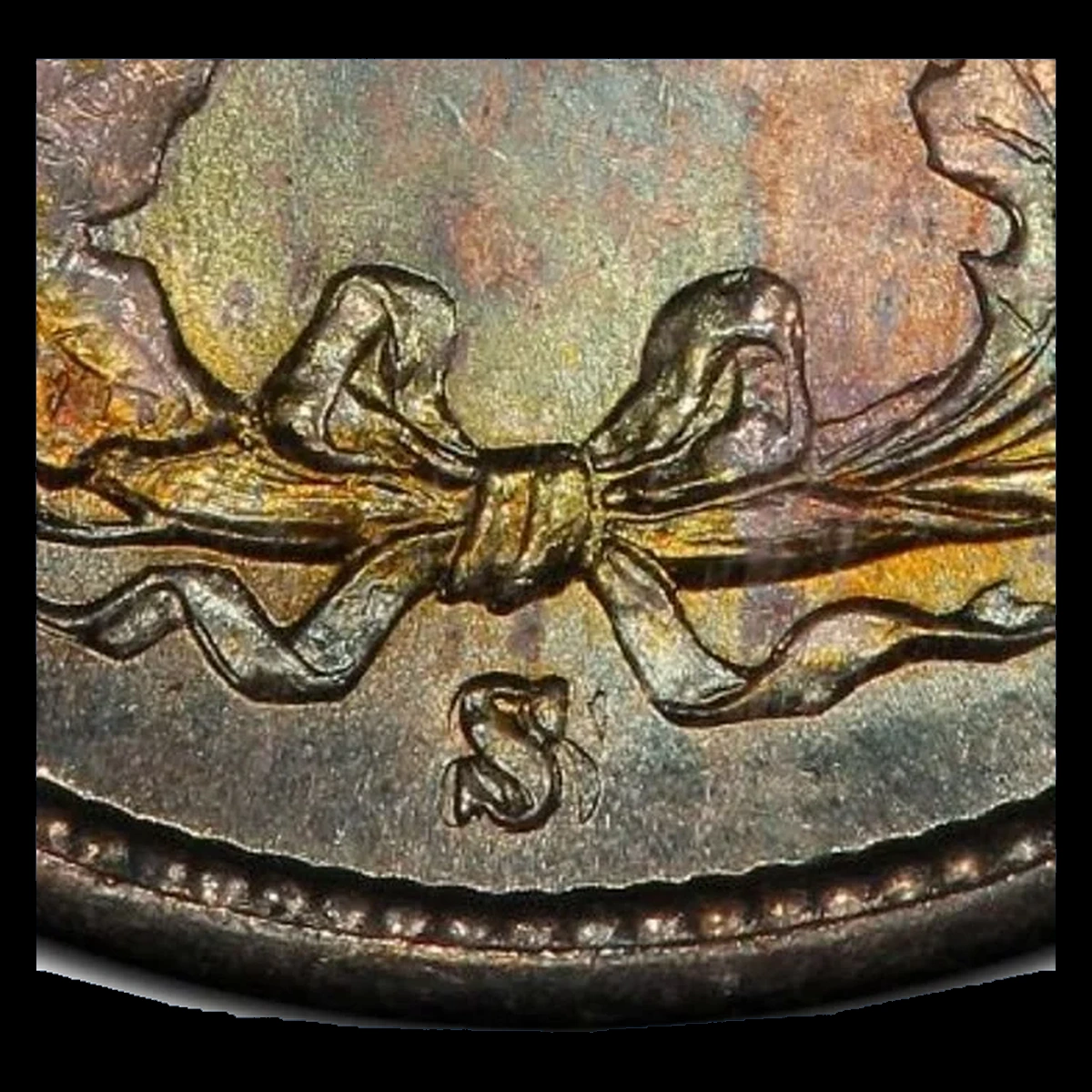
On the San Francisco FS-501, an earlier S remains to the right of the final S. Wexler’s reference identifies the relationship between those curves and the variety name.
A mint-letter punch entered the die more than once, leaving portions of its earlier position behind. Later coins reproduced that extra detail.
A separate New Orleans report describes O-over-O. Its remnant direction is not established by the rightward S pattern and must be judged on its own evidence.
How to Identify
Confirm the mintmark below the wreath before choosing a reference. For San Francisco, inspect immediately to the right of S for the matching earlier curves.
A shallow shelf caused by movement during striking can appear around an already repeated letter. That can look like a third outline without proving three separate punch positions.
For the reported O/O, require a recognizable O-shaped remnant and inspect for corrosion, damage, or added metal. Do not copy the San Francisco direction into its description.
An accessible Barber dime can be compared with original specifications of 2.50 grams and 17.90 millimeters, with a grooved edge. Those checks support basic examination but cannot establish tiny punch remnants.
What It’s Worth
Estimated ranges are $75–$6,000 for S-over-S and $35–$1,800 for a genuine example of the separately reported O-over-O. Both describe whole coins across worn and unworn condition levels.
An S-over-S graded MS65 sold for approximately $5,463 in January 2005. Its high preservation is part of that result.
The New Orleans estimate does not borrow the San Francisco sale as proof of an O/O transaction. Mint and visible remnants need separate assessment.
2. 1893 Dime Extra strokes appear within and below 3: Date-Punch Varieties Error
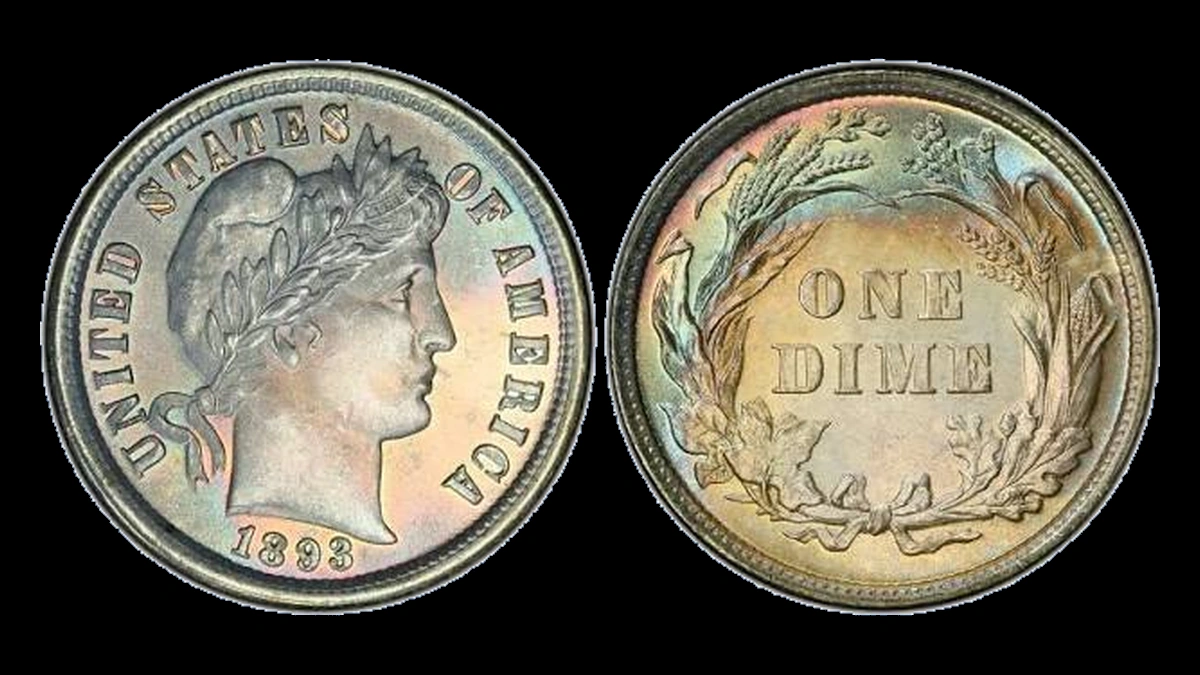
The familiar Philadelphia 1893/2 name refers to extra structure in the lower loop and base of the final 3. PCGS retains that traditional name.
Research on a Proof, a coin specially made for collectors, supports a repunched 3 rather than an underlying 2. The collectible visible feature remains, even though the explanation attached to the name is disputed.
San Francisco also has separate repeated-date varieties. Neither the Philadelphia nickname nor the Proof research automatically identifies the marks on an S-mint coin.
How to Identify
For Philadelphia, compare the slanting and lower remnants in and beneath 3 with the appropriate reference. Keep the full date visible while examining that small area at 10× magnification.
Describe the actual raised shapes instead of assuming the catalog name proves a 2. For an S-mint coin, select a separate San Francisco date comparison.
Keep Proof references distinct from regular strikes made for circulation. A reflective surface by itself does not prove collector manufacture or transfer the Proof research to every other example.
What It’s Worth
Estimates are $100–$12,000 for Philadelphia regular strikes, $600–$12,000 for matching Proofs, and $50–$3,000 for San Francisco repeated dates. Each is a whole-coin range.
The traditional Philadelphia variety sold for $11,500 at MS66 in 2006, while an NGC MS64 with CAC approval brought $3,480 in December 2020. Both were unworn, with preservation contributing to their different comparisons.
An NGC Proof-61 offered under the 1893/“2” designation is indexed at a $960 sale in March 2026. That lower condition level shows why the older MS66 result cannot serve as a minimum.
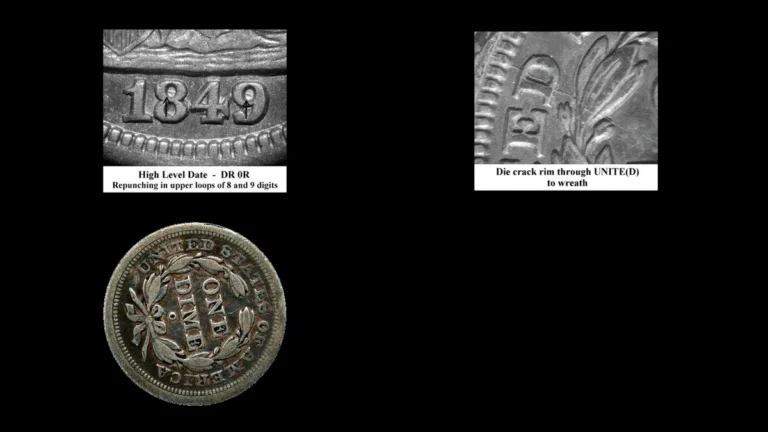
3. 1893 Dime A raised line cuts across normal design: Die Crack Error
The New Orleans report identifies die cracking without establishing one fixed route. Each damaged tool can leave its own raised path through the surrounding letters or picture.
A die is the steel tool that stamps the coin. Silver entering a crack in it forms a ridge on the finished dime, rather than a cut into the coin’s surface.
How to Identify
Photograph both faces so the O and suspected line clearly belong to the same specimen. Follow the ridge through neighboring design under changing light.
Distinguish raised metal from a scratch, irregular corrosion, or a normal wreath stem. The point where a line crosses a letter or other design element can be more revealing than its darkness in a photograph.
No clock position or complete route is required by this general report. Assign a more specific pattern only when the coin and an appropriate reference support it.
What It’s Worth
The whole-coin estimate is $25–$1,800 for worn through attractive unworn examples. Date, mint, and condition account for much of that amount.
An ordinary 1893-O graded NGC MS65 is indexed at $1,680 in September 2024. It was unworn with relatively few marks.
The record does not establish the pictured crack or a separate premium for a small line. It supplies context for the underlying New Orleans issue.
4. 1893 Dime A blank crescent faces missing design: Off-Center Strike Error
The public 1893-O report describes an off-center coin without assigning a direction or percentage. Its actual outline must supply those details.
When the blank sits outside its intended position, some design misses the metal and another area remains unstruck. A wide rim alone does not establish that relationship.
How to Identify
Locate both the date and O, then compare the displaced designs on the two faces. Losing either identifying detail makes this exact year-and-mint attribution harder.
Inspect the struck-to-blank boundary for trimming, filing, or removed design. Genuine unused metal should relate to the missing design opposite it.
A fully retained picture within an enlarged outline may be a broadstrike. If only one face has shifted while the other is centered, a misaligned die needs consideration instead.
What It’s Worth
The estimated range is $200–$2,500, from modest worn offsets through larger attractive examples with readable date and mintmark. Original blank metal and surface quality help determine the comparison.
A 1902 off-center Barber dime graded ANACS AU50 sold for $561.20 in June 2026. It is a different-year comparison with light wear, not a completed sale of the reported 1893-O.
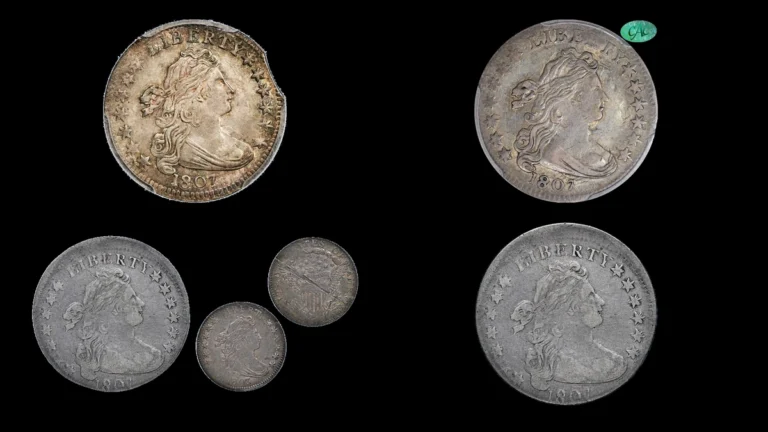
5. 1893 Dime Liberty appears backward inside a cup: Cupped Broadstrike with Reverse Brockage Error
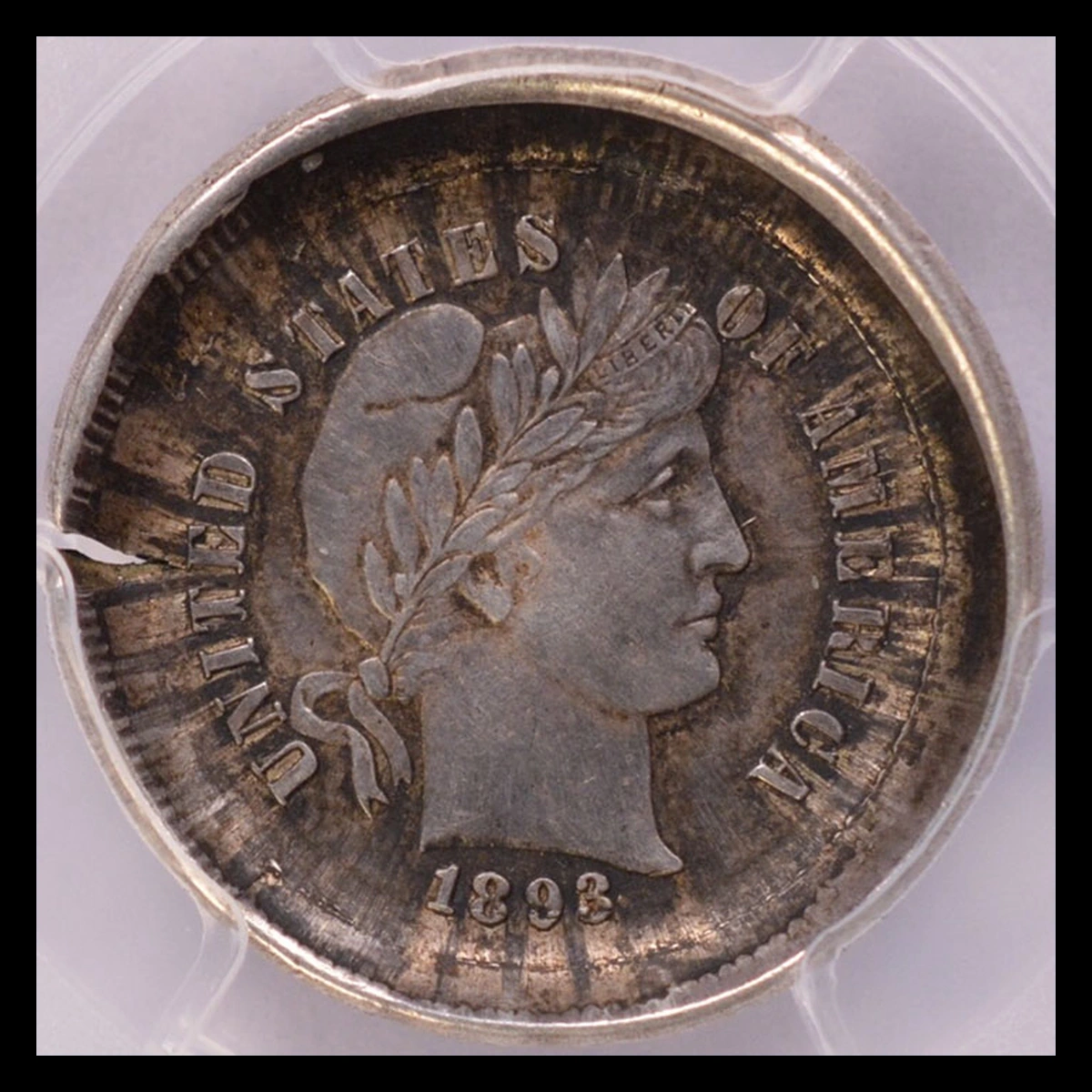
The unusual PCGS AU55 dime shows Liberty normally raised on the obverse and backward and sunken on the reverse. The reversed impression, called a brockage, formed through contact with an already struck coin.
The piece also has a cup shape and a split near ten o’clock. Although it was offered as a die cap with reverse brockage, experts quoted by Coin World described a cupped broadstrike as well.
The shape does not by itself prove that the coin remained attached to a die and struck additional blanks. That further history should not be assumed from the seller’s label.
How to Identify
Compare the orientation and depth of the two portraits, then view the cup in profile. Match the split near ten o’clock with photographs of the documented specimen.
Inspect the opposite face, walls, and edge for crushing or evidence of later pressing. Bending a dime or squeezing coins together can create misleading forms that require a different explanation.
Record the actual expanded dimensions without flexing the coin at the split. The strongest comparison involves the reversed recessed portrait, cup shape, and matching split together.
What It’s Worth
The supplied estimate is $8,000–$25,000 for this unusual combination. The published 2015 dealer offering asked $25,000, while the later sold listing does not disclose the amount paid.
A different 1898 Barber dime die cap graded PCGS MS61 sold for $8,235 in January 2026. It was unworn with many marks, while AU55 on the 1893 denotes slight wear.
The 1898 coin’s mechanism and surfaces differ, so its price is comparative evidence rather than a direct valuation of this brockage. Neither record proves a completed $25,000 sale for the 1893 piece.
Conclusion
Match the mint and visible shape before accepting a variety name or striking explanation. The rightward S remnant, structure inside 3, and reversed portrait each provide specific evidence, while the general crack and offset reports leave details unresolved.
The $25–$25,000 estimates concern complete coins. Keep the disputed date interpretation qualified and the cup’s published $25,000 offering separate from an undisclosed final transaction.