Rare 1830 Dime Errors (List & Pictures)
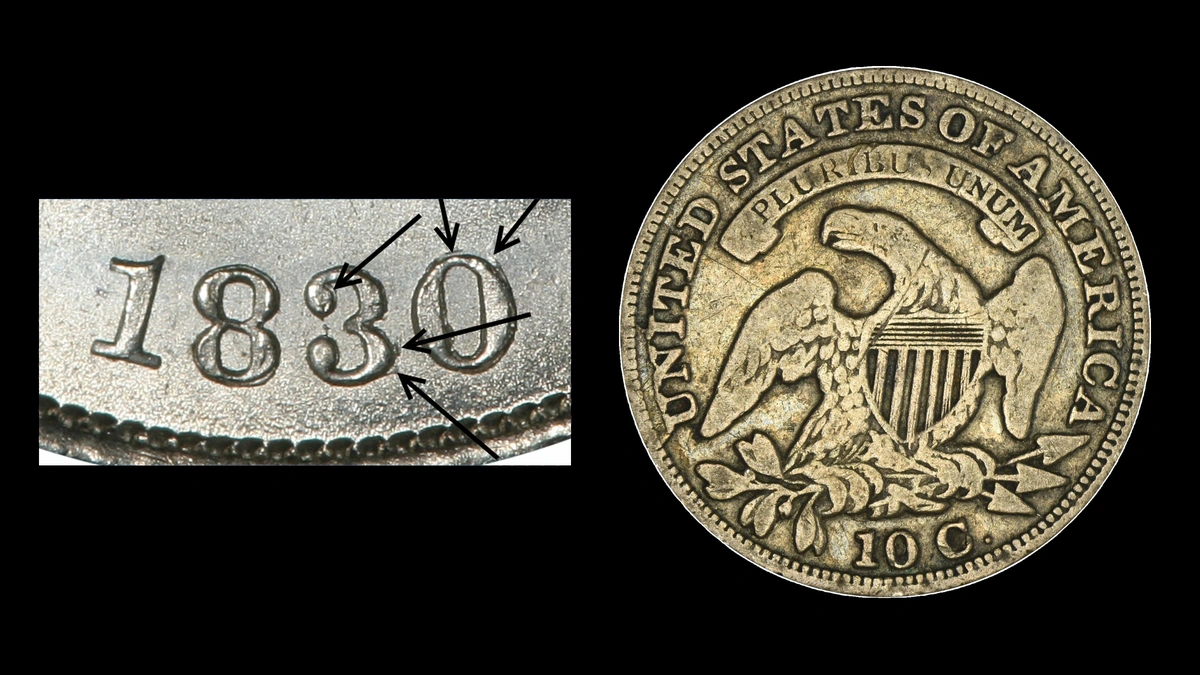
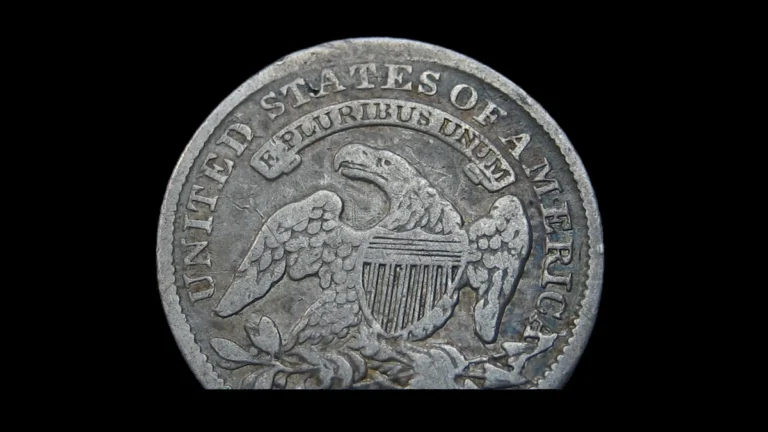
The Pogue MS67 overdate brought $64,625 in February 2016, illustrating how exceptional preservation can dominate the value of 1830 dime errors. Across the features below, estimated whole-coin values range from $75–$70,000.
Read the date first, follow any raised breaks and edge shortage, then test reverse alignment while keeping regular strikes and Proofs in separate price groups.
| Visible clue | Feature | Estimated range |
|---|---|---|
| Earlier strokes beneath 30 | 1830/29 overdate | $100–$70,000 for regular strikes; $5,000–$30,000 for Proofs |
| Raised lines or bordered patches | Cracks and die breaks | $100–$1,200 circulated |
| Small notch at the edge | Clipped blank | $300–$1,500 |
| Tilted eagle after a fixed flip | Rotated reverse | $75–$1,000 regular strikes; $5,000–$30,000 Proofs |
The normal dime is approximately 89.2% silver, originally 2.70 grams and 18.5 millimeters across, with a grooved edge. JR numbers identify die pairings, while Proof describes special collector manufacture rather than simply a shiny surface.
1. 1830 Dime Earlier Numeral Traces beneath 30: 1830/29 Overdate Error
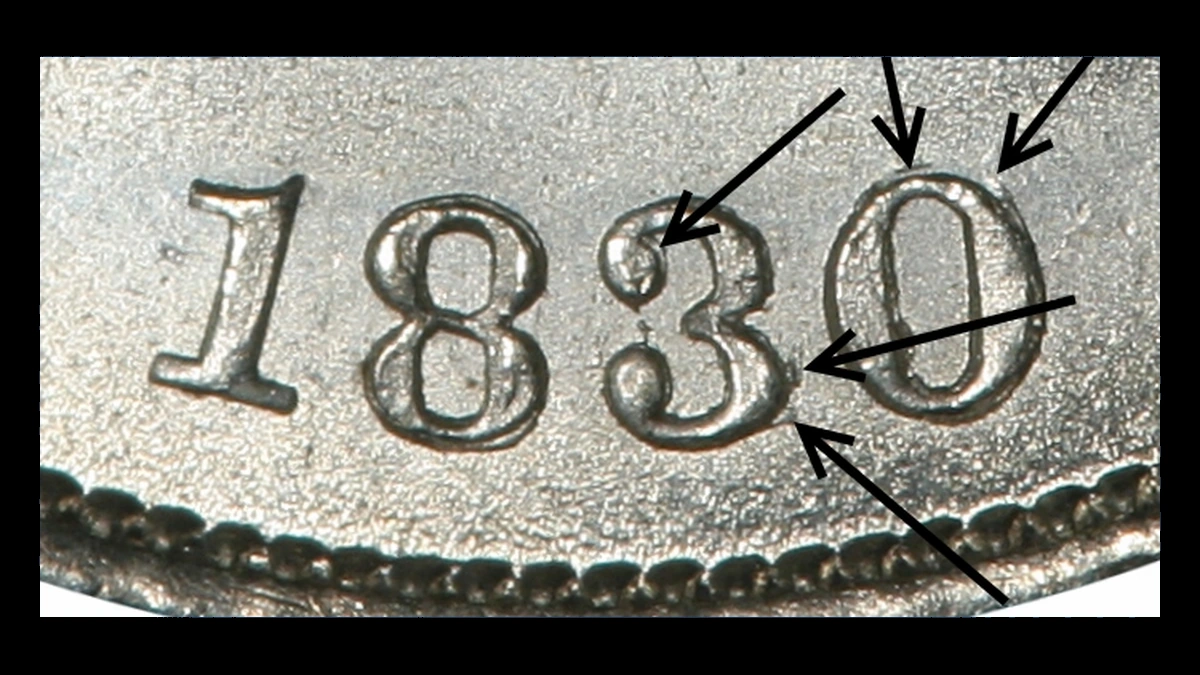
The die originally carried an 1829 date before the final numerals were changed for 1830. A 3 entered over 2 and a 0 entered over 9 left portions of the earlier figures uncovered.
That obverse die was paired with more than one reverse, and both regular strikes and Proofs are reported. Later die polishing could weaken the remnants, particularly in the Proof descriptions.
How to Identify
Compare actual surviving strokes around the final two numerals, especially remnants of 9 near the 0. Do not expect a fully legible 29 beneath every example.
Under changing light, distinguish raised remnants from scratches, corrosion, or toning borders. Where the date evidence is faint, the complete obverse and matching reverse become useful supporting comparisons.
Finish requires its own assessment. A polished regular strike can look bright without having been manufactured as a Proof.
What It’s Worth
Circulated overdates are estimated at $100–$2,500, with unworn regular strikes around $3,000–$70,000. The exceptional Pogue PCGS MS67 sold for $64,625 in February 2016.
Proofs have a separate supplied estimate of $5,000–$30,000. The Pogue result belongs to a regular strike and does not establish a Proof price or a routine premium for faint date remnants.
2. 1830 Dime Raised Patches above the Cap and Lettering: Die Cracks and Cuds Error
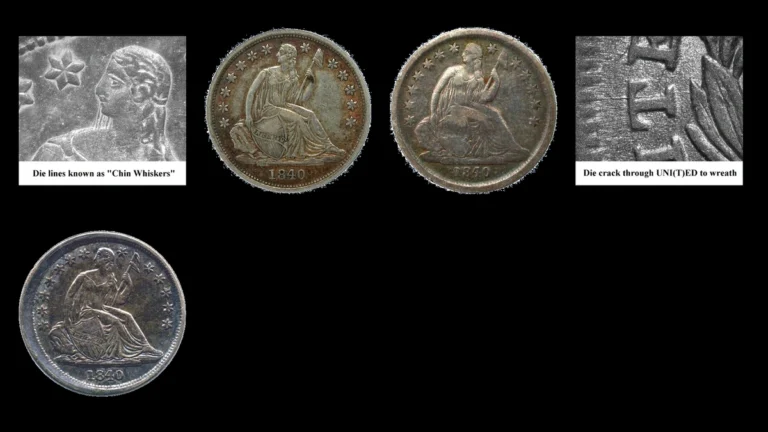
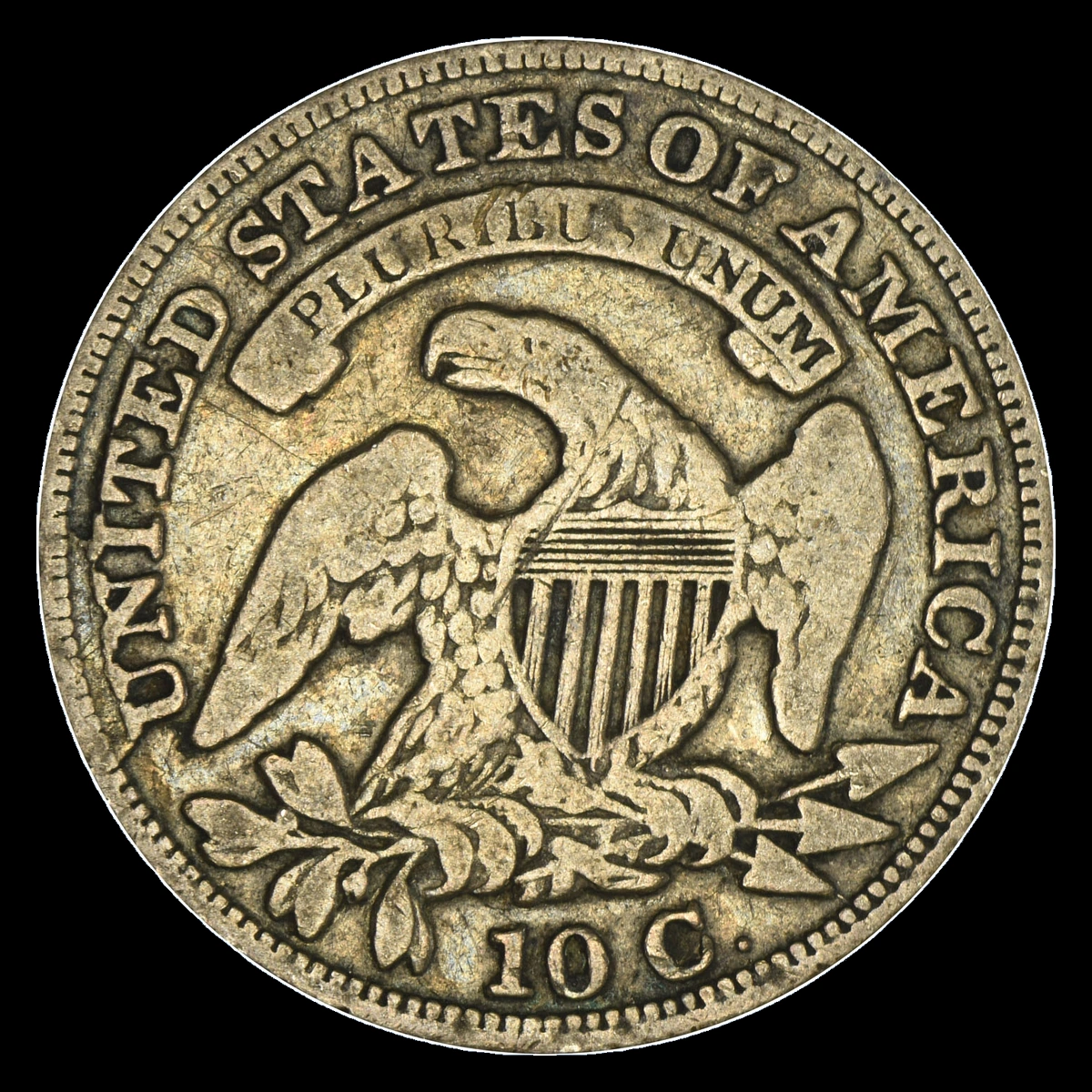
JR-3 shows breaks above Liberty’s cap, a bordered raised reverse patch over NITE, and a crack above IC. Openings in damaged dies filled with metal and left these raised features on the dime.
A retained break means the cracked piece of die stayed in place, potentially preserving design within the affected patch. The supplied showcase also lists JR-1 without giving a local feature, so its break locations should remain unspecified.
How to Identify
Use the JR-3 reference photographs to compare both faces as a group. Find the cap-area breaks, then check the NITE patch and the line above IC.
Inspect any remaining design inside a retained break instead of assuming the die piece had fallen out. Added solder, a folded rim, or a random impact lump does not provide the same set of tool-made features.
What It’s Worth
Circulated examples are estimated at $100–$1,200. A different-year 1832 JR-3 with a retained break sold for $139 in February 2022, but its AU Details designation noted whizzing, or mechanical brushing of the surface.
That damaged comparison illustrates the mechanism at a modest price. It is not a sale of the pictured 1830 JR-3 or an amount to add for each crack.
3. 1830 Dime A Small Notch near 8 O’Clock: Planchet Clip Error
The John W. McCloskey Collection JR-7 has a small edge notch near 8 o’clock with the front upright. Its catalog identifies a clip in the blank before the dime was struck.
The Medium 10C example was graded NGC AU58, with only slight circulation wear and much original detail. The record gives neither a clip percentage nor a precise geometric type.
How to Identify
Examine both ends of the notch and how the rim formed around the shortage. A later cut may slice through finished detail or leave fresh tool marks instead.
Opposite-rim weakness can support a clip but is not required in every case. Keep the description proportional to the documented small notch rather than estimating an unsupported large missing area.
What It’s Worth
Comparable circulated through lightly worn examples are estimated at $300–$1,500. The AU58 JR-7 sold for $1,080 on February 6, 2022.
The well-preserved die variety forms an important part of that total. It does not isolate the small clip’s premium, and a heavily worn or later-cut coin needs a different comparison.
4. 1830 Dime The Eagle Finishes Tilted: Rotated Reverse Error
An 1830/29 JR-4 Proof in a 2013 catalog has its reverse about 25 degrees clockwise from normal alignment. Its overdate and rotation describe different aspects of manufacture on the same coin.
A regular-strike rotation is also reported without an angle. It cannot be assigned the Proof’s 25-degree measurement from the date alone.
How to Identify
Hold Liberty upright against a vertical reference, then flip the coin top to bottom without correcting the eagle’s tilt. Repeat the motion and measure the consistent angle while keeping the viewing direction fixed.
The JR-4 Proof description provides the approximately 25-degree comparison. Confirm Proof manufacture independently and inspect the edge for seams or alteration.
Rotation changes the relationship between the dies and does not require a displaced second blow. Normal dimensions also do not rule out this alignment error.
What It’s Worth
Moderately rotated circulated regular strikes are estimated at $75–$1,000, while the much scarcer Proof type has a whole-coin estimate of $5,000–$30,000. No separate completed sale is established for the cataloged rotation.
The Proof range includes its special manufacture and condition, rather than a fee for the tilt. The $64,625 MS67 overdate result is a regular-strike comparison and cannot be relabeled as a rotation sale.
Conclusion
The final date digits, cap and letter breaks, edge notch, and reverse angle each require a different observation. Several can occur together, but the complete dime still has one value based on its identity, finish, and preservation.
Keep modest circulated examples, scarce Proofs, and exceptional unworn survivors in separate comparison groups, and retain each documented sale’s specific specimen rather than transferring its price to another feature.