Rare 1921 Dime Errors (List & Pictures)
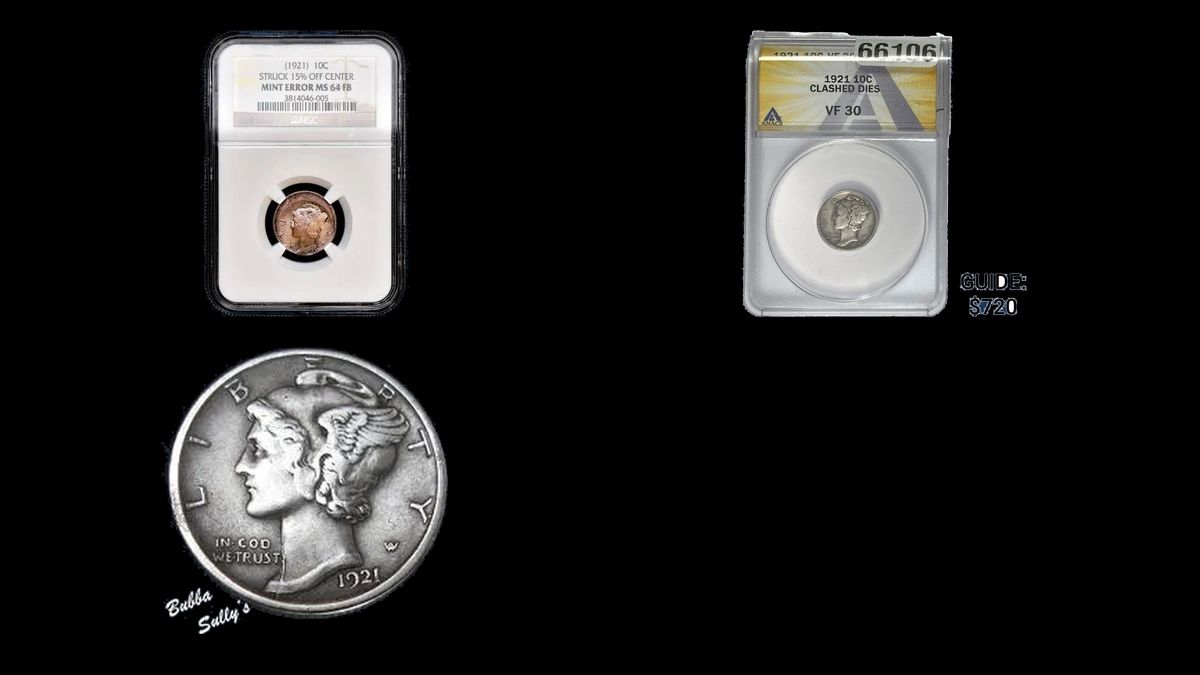
A 15% off-center dime cataloged as “(1921)” sold for $1,500 in June 2018; that notation does not promise a fully visible date. Estimated whole-coin values for the 1921 dime errors below span $60–$6,000.
Establish the surviving date and mint evidence before examining separated metal, repeated letters, or neck-area lines.
| Visible clue | Feature | Estimated whole-coin range |
|---|---|---|
| Part of the design is displaced off the blank | Off-center strike | $300–$6,000 |
| A flap or larger sheet separates | Denver lamination or split planchet | $80–$2,500 |
| An earlier D lies above and left | Repunched mintmark | $100–$3,500 |
| A curve resembles the reverse design | Die clash | $60–$2,000 |
| An irregular raised ridge crosses detail | Die crack | $70–$2,200 |
1. 1921 Dime A shifted design leaves some date evidence missing: Off-Center Strike Error
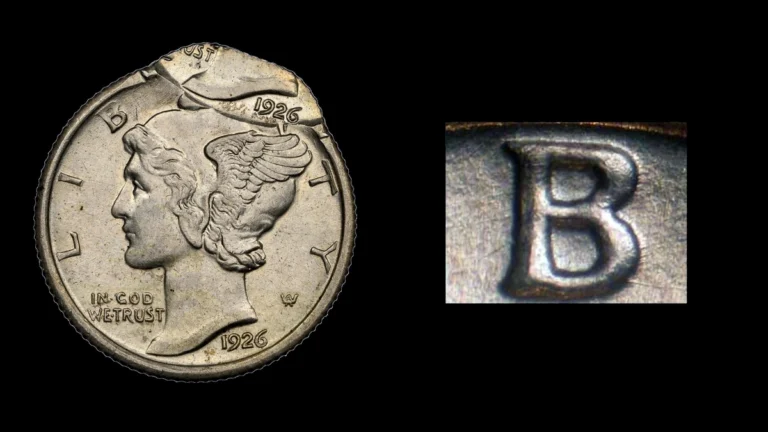
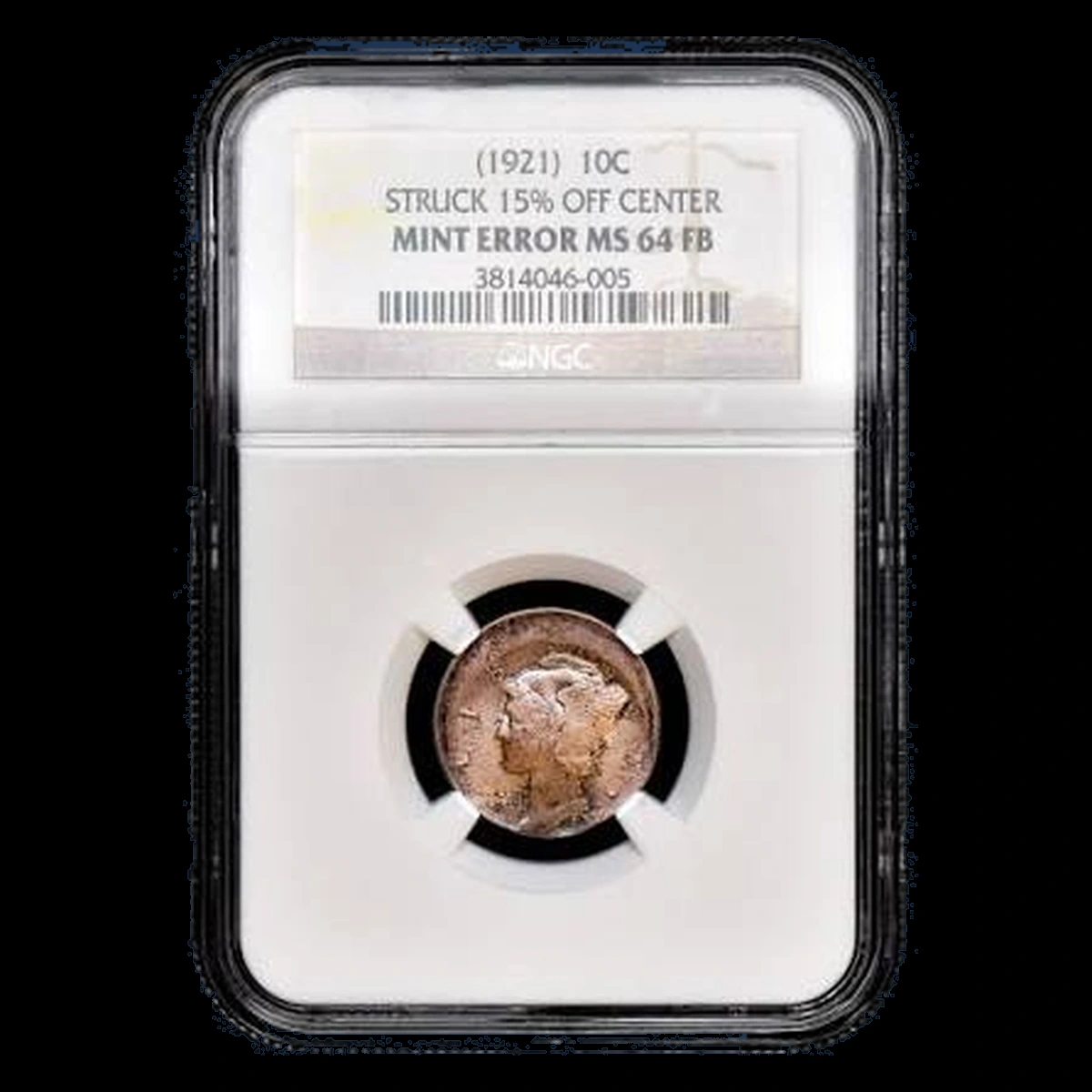
The auctioned NGC MS64 Full Bands was described as 15% off center and cataloged with the year in parentheses: “(1921).” That qualification should stay attached to its identification.
The blank was outside the proper striking position, leaving a crescent of metal unused beside the displaced picture. The remaining design does not necessarily include all four date digits.
MS64 means unworn with some marks, and Full Bands refers to separated horizontal bands on the reverse bundle. Reports also mention Denver offsets separately, without assigning this auction coin’s grade or percentage to them.
How to Identify
Record exactly which date digits survive before assigning a year. A visible 19 or 192 cannot establish a missing final digit on its own.
Keep any attribution limitation visible in the description and photographs. A partially dated example needs a sound comparison with an identified coin rather than an assumption based on a desirable year.
Compare struck and unstruck areas on both faces to establish the displacement. Inspect their boundary and edge for grinding, trimming, or other later changes.
The ordinary dime started at 2.50 grams and 17.90 millimeters, with a grooved edge. Record measurements of an accessible coin while allowing for wear and the changed outline.
What It’s Worth
The estimate is $300–$6,000 for worn offsets through attractive unworn coins assigned to this scarce year. Heritage recorded $1,500 in June 2018 for the 15% NGC MS64 Full Bands cataloged as “(1921).”
This historical result is not a universal value for fully dated examples. Surviving date evidence, mint identification, surfaces, and displacement all affect a useful comparison.
2. 1921 Dime Metal peels locally or separates across a larger area: Lamination and Split Planchet Error
A documented 1921-D graded NGC VG8 has reverse peeling. A separate AU50 Details report describes a broader split through the blank and notes that the coin was cleaned.
A lamination can leave a thin attached flap on an otherwise intact coin, while a more extensive split can separate a sheet from much of its body. Both involve weakness within the metal but are not the same specimen or necessarily the same extent of separation.
Mercury dimes contain silver mixed with copper throughout. They do not have a modern copper core between separate outer layers.
How to Identify
Inspect a peeling area without lifting the flap. Look for a natural separation boundary rather than a smooth gouge made by removing metal later.
For a broader split, compare the two faces, exposed texture, and remaining edge thickness. A large separation surface differs from one small missing patch.
Surviving design may help assess when the separation occurred, but the term alone does not prove it happened before or after striking. Measurements can reveal lost weight or unusual thinness without settling that timing.
What It’s Worth
The supplied whole-coin estimate is $80–$2,500 across worn laminations and more extensive splits. The NGC VG8 reverse-lamination example sold for $74 in February 2013.
That older result falls slightly below the estimated range and concerns a modest flaw on a worn coin. It is not a sale of the separate AU50 Details split.
The latter coin’s cleaning remains relevant even if its separation is genuine. Details flags that condition problem rather than erasing the collectible mint feature.
3. 1921 Dime Another D projects above and left of the mintmark: Repunched Mintmark Error
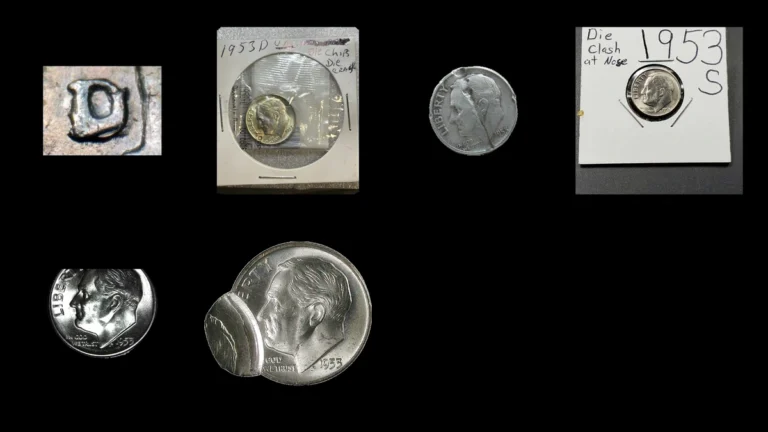
Wexler describes the 1921-D variety as D over D to the northwest. Pieces of the earlier punch position appear above and to the left of the final letter.
The repeated entry occurred in the die before coins were struck. Each later coin could receive the same surviving outline from that tool.
No significant additional die markers are listed with this variety. An unrelated scratch or crack elsewhere cannot compensate for a poor match at the mintmark itself.
How to Identify
Find D beside the lower reverse bundle and compare its full outline with Wexler’s enlarged reference images. Focus on the earlier upper-left impression.
A flat shelf can result from movement during striking instead of a second punched letter. The extra rounded stroke should occupy the matching position and belong naturally to the original surface.
Inspect the letter’s base for a seam or disturbed metal that might indicate an added mintmark. Keep the surrounding reverse in view rather than relying on an isolated close-up.
What It’s Worth
The estimate is $100–$3,500 for worn coins with clear remnants through lower-grade unworn examples. The scarce Denver issue contributes much of that whole-coin value.
An ordinary PCGS AU50 1921-D sold for $1,020 in March 2025. Its light wear provides condition context, not a confirmed price for this repunched D.
Readable extra strokes can add interest, while cleaning or other damage still affects the comparison. A matching variety does not make surface condition irrelevant.
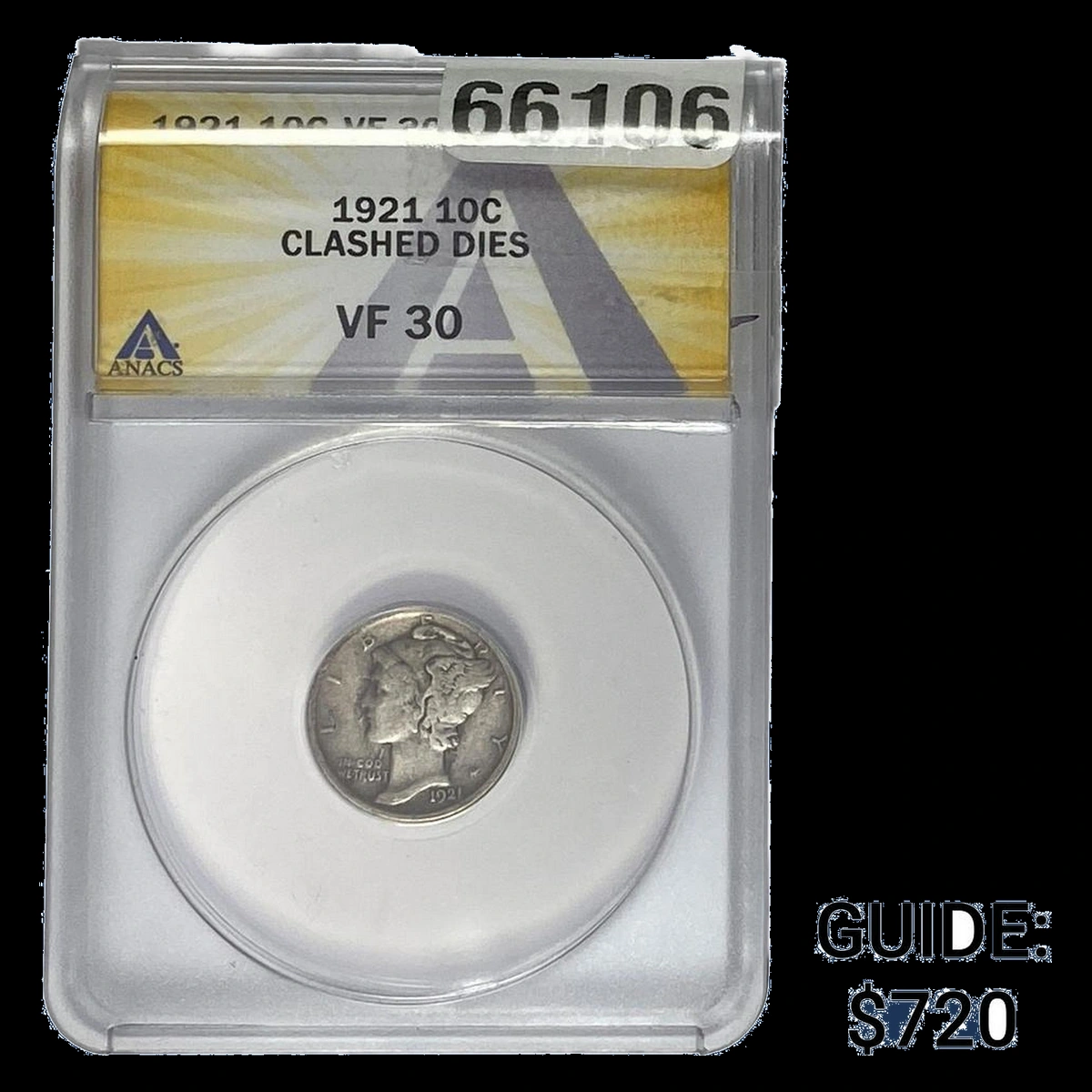
4. 1921 Dime A neck-area curve resembles the opposite design: Die Clash Error
Collectors identified clash marks on a Philadelphia 1921 example, and discussions also considered neck-area traces on Philadelphia and Denver coins. A location near Liberty’s neck alone does not establish the cause.
A clash begins when the dies meet without a blank between them. They can acquire parts of the opposing design, which then appear on later coins as unexpected shapes.
How to Identify
Use a confirmed clash image to establish the correct relationship between the faces. Compare any curve near Liberty with recognizable bundle or branch shapes from the reverse.
Vary the light to reveal faint contours without mistaking scratches for transferred design. Keep both faces available for comparison rather than deciding from one line near the portrait.
An unrelated die crack may pass through the same region. A recognizable opposite-side shape offers more specific evidence for a clash than location by itself.
What It’s Worth
The estimated whole-coin range is $60–$2,000 for worn through lightly worn examples. Ordinary value of the scarce year accounts for much of the amount.
The normal Denver AU50 sale at $1,020 in March 2025 was not a clash record. A faint transferred line does not automatically double the value of an otherwise comparable coin.
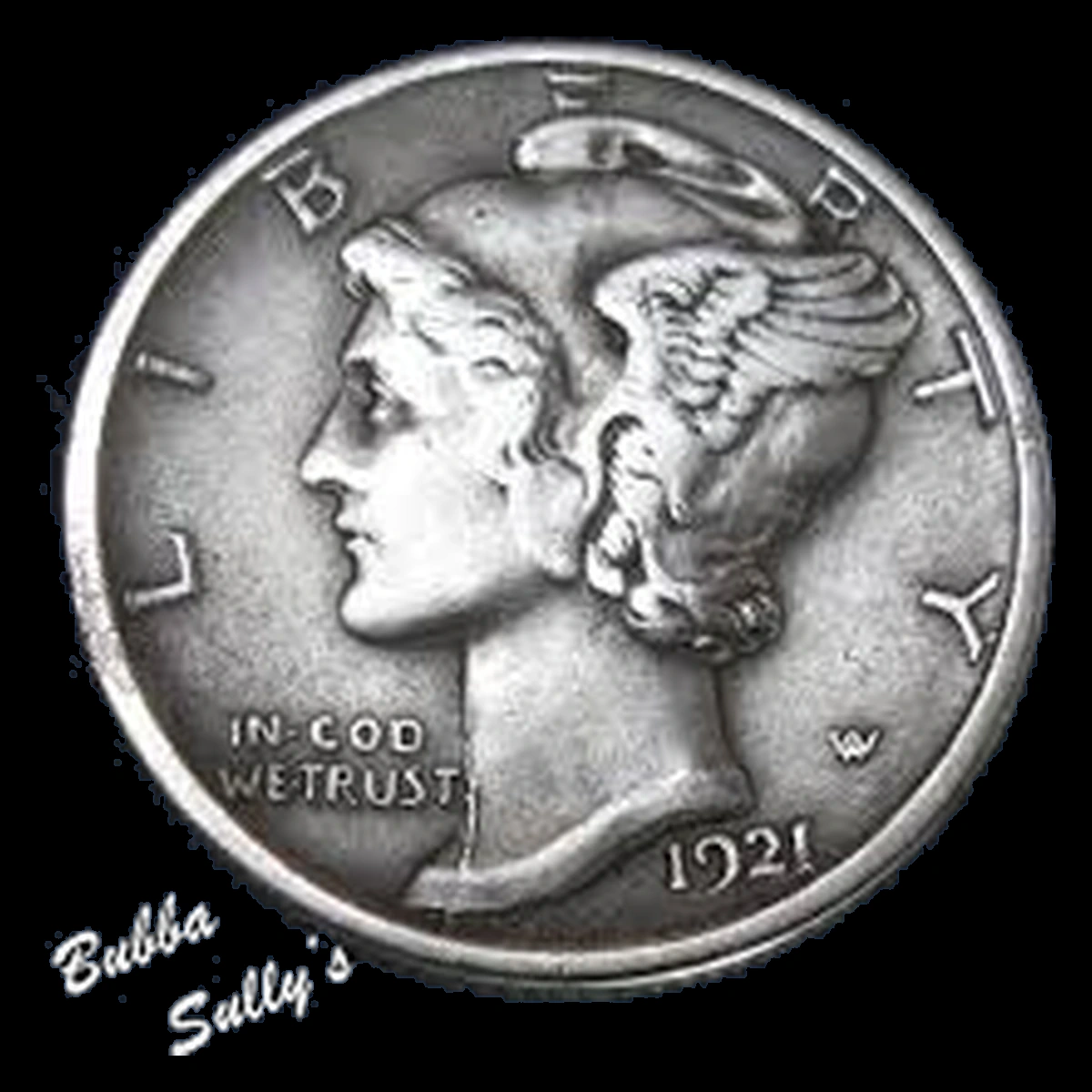
5. 1921 Dime An irregular raised ridge crosses the surface: Die Cracks Error
Crack reports include Denver and also mention Philadelphia, but neck-area marks have been discussed as possible clashes too. Each coin needs its own visible route rather than a diagnosis inherited from the general location.
A crack in the stamping tool allows silver to form a raised ridge during striking. Its irregular path need not resemble any element of the opposite face.
How to Identify
Follow the entire suspected line under a 10× magnifier and side lighting. Determine whether it rises above the field rather than forming the edge of an incised scratch.
Where the shape resembles a branch or bundle, test the clash explanation as well. A single bright point cannot distinguish a fracture from a transferred design fragment.
Examine how the route continues through nearby letters, portrait detail, or open areas. Raised continuity in the struck metal is more useful than the label on a photograph.
What It’s Worth
The supplied estimate is $70–$2,200 for heavily worn through lightly worn whole coins with visible cracks. Small ridges generally add modest collector interest.
The ordinary $1,020 Denver AU50 sale compares the underlying date and condition. It does not establish a crack premium.
A bold break can attract more attention, especially with original surrounding surfaces. Cleaning, heavy wear, or damage can still reduce the value when the ridge survives.
Conclusion
Identify the year and mint before applying a scarce-date price comparison. For small features, distinguish a borrowed reverse shape from an irregular raised crack, and match Denver’s repeated D above and to the left.
The $60–$6,000 estimates describe whole coins across different conditions. Keep the auction’s “(1921)” qualification visible and the worn lamination separate from the cleaned, more extensive split.