Rare 1980 Nickel Errors (List & Pictures)
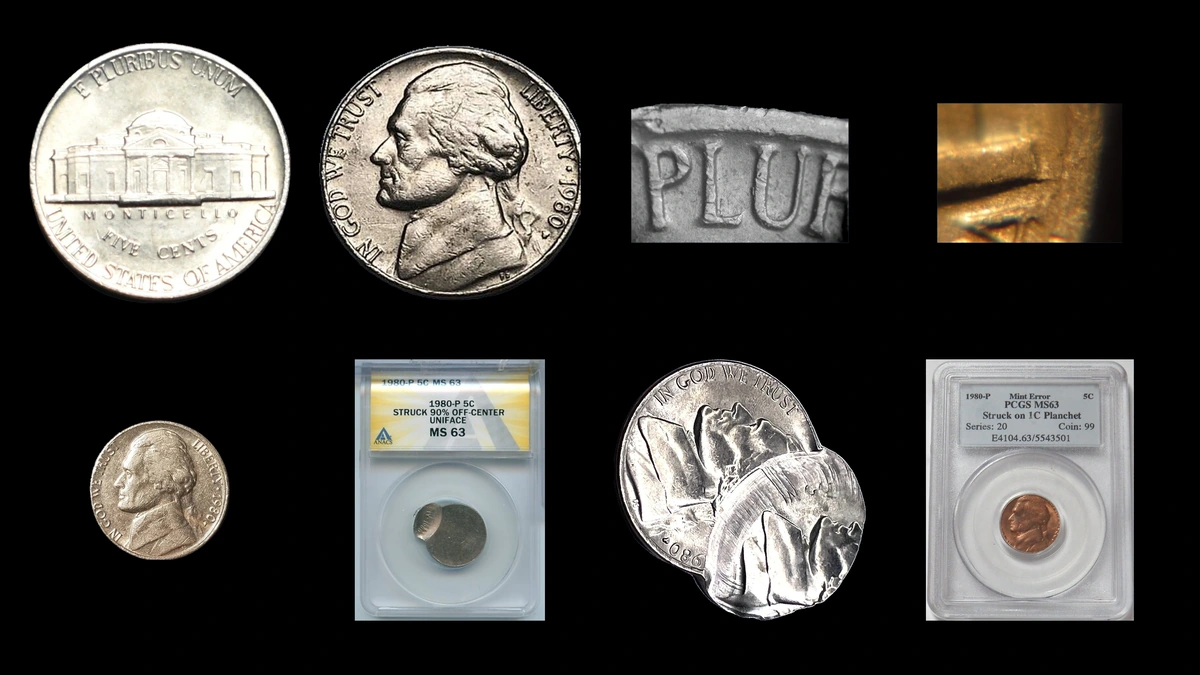
A matching 1980-P nickel-and-cent-blank error pair has a documented Heritage result of $7,475. That amount covers both connected pieces.
Estimated values for 1980 nickel errors range from $10–$12,000, with the highest tier reserved for pairs. Inspect small design details first, then distinguish missing metal, thin blanks, smaller blanks, and impressions over already struck coins.
| Clue | Category | Estimated value |
|---|---|---|
| Weak or repeated fine details | Strike-through, reported RPM, or doubled die | $10–$500 |
| Raised line or rim patch | Die crack or cud | $10–$600 |
| Missing, thin, or expanded metal | Clip, thin blank, or broadstrike | $20–$750 |
| Displaced or repeated designs | Off-center or multiple strike | $35–$1,500 |
| Different metal or earlier denomination | Wrong blank, fragment, or overstrike | $150–$4,000 |
| Two matching contact surfaces | Mated pair | $3,000–$12,000 per pair |
A normal nickel weighs 5 g and measures 21.21 mm, with a plain edge. Keep each unusual specimen’s measurements with that coin, especially when a catalog places its attributed year in parentheses.
1. 1980 Nickel A Small Patch of Detail Is Missing: Struck Through Material Error
Material in a die recess can prevent metal from forming the intended design. The 1980 reports include grease-filled or otherwise blocked detail without establishing every possible obstruction type.
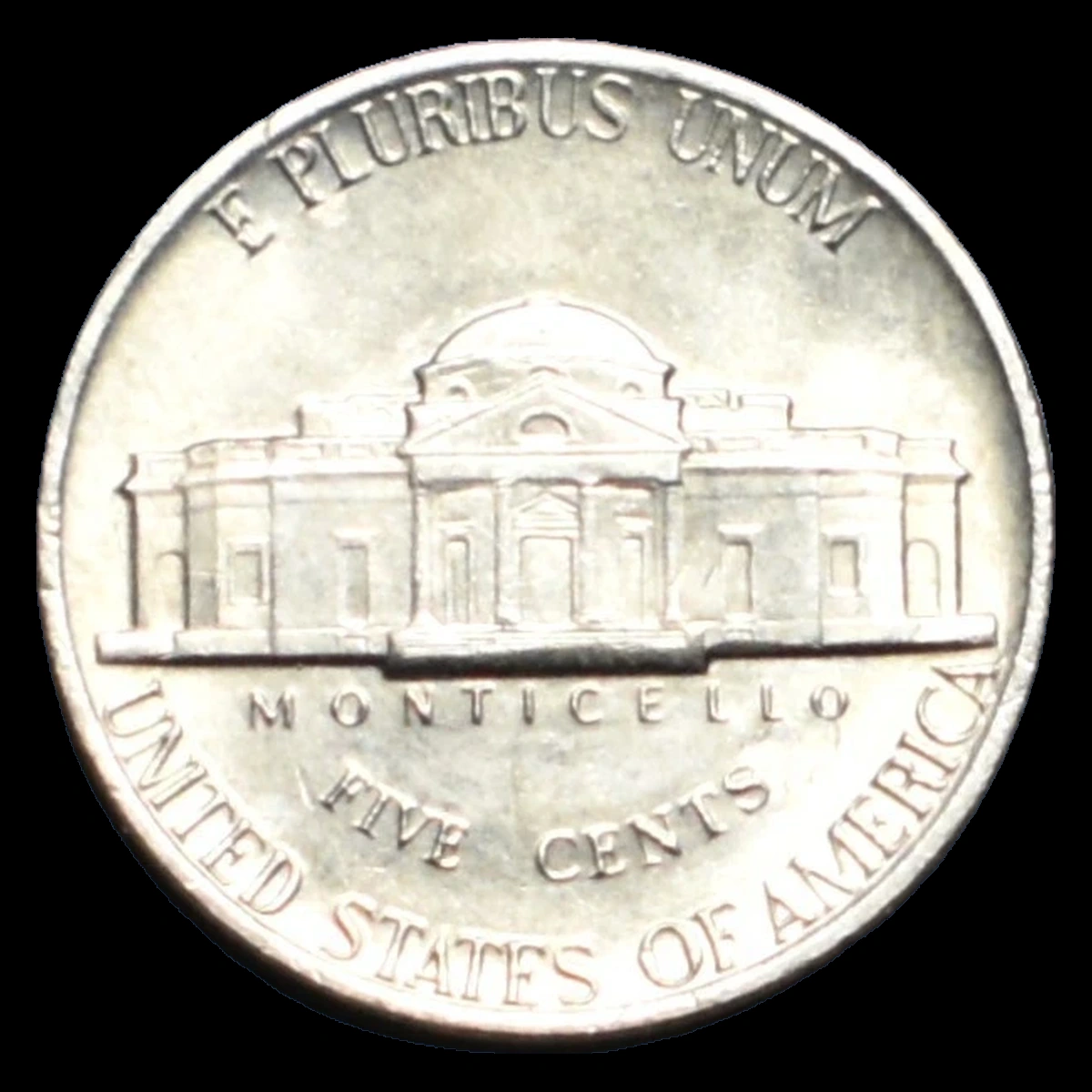
How to Identify
Compare the weak patch with nearby protected lettering and exposed portrait features. General high-point wear requires a different explanation from a local interruption beside sharp detail.
Inspect the transition for polishing or scraping. Name cloth, wire, or grease only when the actual evidence supports that description.
What It’s Worth
Estimated values are $10–$250, with ordinary local blockage around $10–$75. Stronger attractive examples may bring more.
A 2000-P nickel with a front strike-through sold for $84 in February 2015. Its different date and affected area do not establish a 1980 sale.
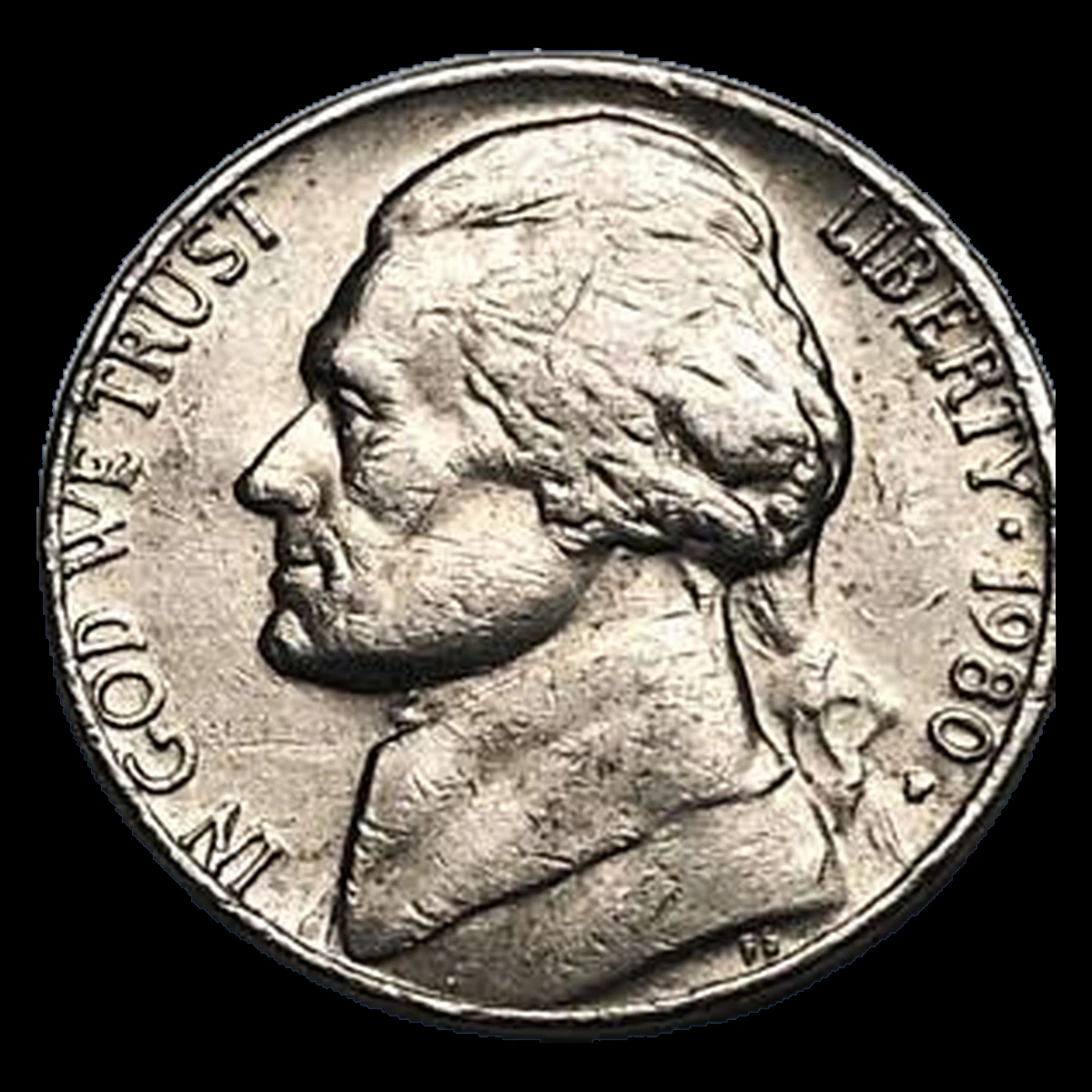
2. 1980 Nickel An Extra Stroke beside P or D: Reported Repunched Mintmark Error
Mintmarks were individually punched into working dies during this period. A shifted second application could preserve part of an earlier letter.
The year reports list Philadelphia and Denver candidates without a specialist-confirmed catalog number or direction here.
How to Identify
Keep the date and actual mintmark visible while comparing the extra curve or straight stroke. Damage, glare, and a flat shelf can imitate an additional letter edge.
Seek a specific specialist match before assigning a number or direction. A reference for D cannot identify a candidate P.
What It’s Worth
Conditional estimates are $10–$300, with minor genuine examples around $10–$100. Clearer attractive repunching may support the higher range.
No specialist-confirmed 1980 sale is supplied by the year report. Identification must come before the variety estimate.
3. 1980 Nickel Thickened Reverse Letters with Separation: Doubled Die Error
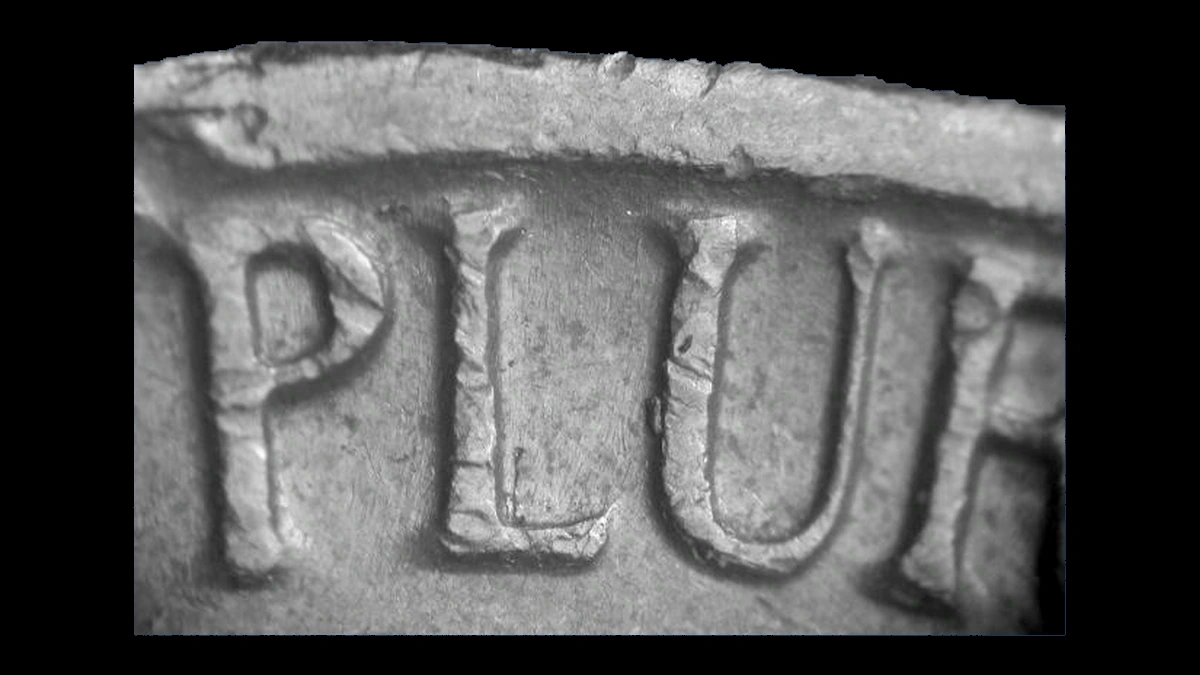
Philadelphia WDDR-001 affects E PLURIBUS UNUM, the country name, and the right side of Monticello. The die carried repeated detail before striking the coin.
How to Identify
Compare the main pattern with the cataloged reverse. Thickening and small separated portions matter even where two widely spaced letters are absent.
Supporting marks include one above G’s crossbar in GOD and a diagonal line near the reverse E. These can change with die wear and should not replace the main doubling match.
Separate front-doubling reports need their own attribution. They do not share this reverse number across all 1980 mintmarks.
What It’s Worth
Estimated values are $20–$500, with modest matched examples around $20–$125. Stronger, attractive coins occupy the higher range.
No verified WDDR-001 sale is supplied here. Ordinary flat strike doubling should not inherit its variety estimate.
4. 1980 Nickel A Raised Line or Reverse Rim Patch: Die Crack and Cud Error
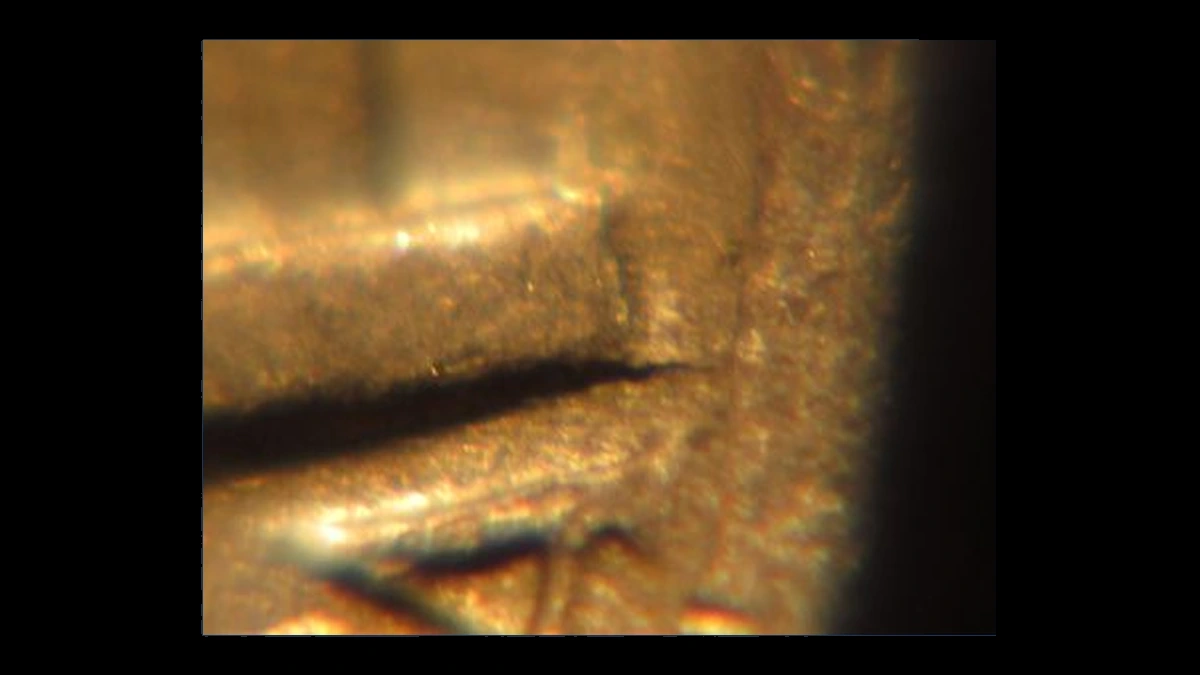
A specialist catalog lists a Philadelphia reverse cud under two cross-referenced names. They identify one pattern rather than two separate errors.
Other reports include ordinary cracks. A crack leaves a narrow ridge, while a cud replaces design in a larger area connected to the rim.
How to Identify
Compare the reverse cud with its actual photograph. The written evidence supplies no clock position and does not require a front crack as well.
Inspect the edge for impact damage, attached metal, or solder. An interior lump without a rim connection needs another description.
What It’s Worth
Estimated values are $10–$100 for small clear cracks and $100–$600 for larger attractive rim breaks. These are whole-coin ranges.
A 1984-P nickel with cuds and clashes sold for $159 in July 2022. That slightly worn different-year combination does not price every 1980 ridge equally.
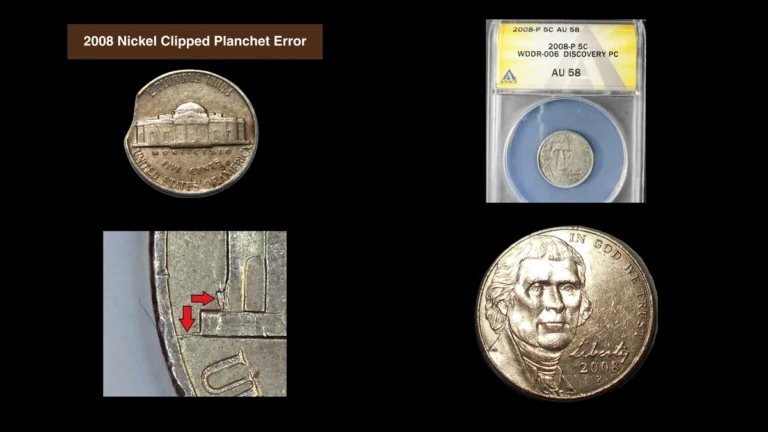
5. 1980 Nickel Part of the Outline Is Missing: Clipped Blank Error
The reported 1980 clip category has no particular mintmark, percentage, or certified specimen established here. An incomplete blank received the design around its missing metal.
How to Identify
Inspect both ends of the gap and the adjacent struck details. Saw lines or file marks through finished lettering indicate later removal.
Opposite-rim weakness can support a clip but is not decisive alone. Low weight also fits a coin cut after striking.
What It’s Worth
Estimated values are $25–$400, with ordinary genuine clips around $25–$150. Larger attractive gaps or multiple clips may reach more.
A 1997-P nickel with a 20% curved clip sold for $124 in March 2025. Its percentage belongs to that separate coin.
6. 1980 Nickel A Wide Disc Retains the Full Design: Broadstrike Error
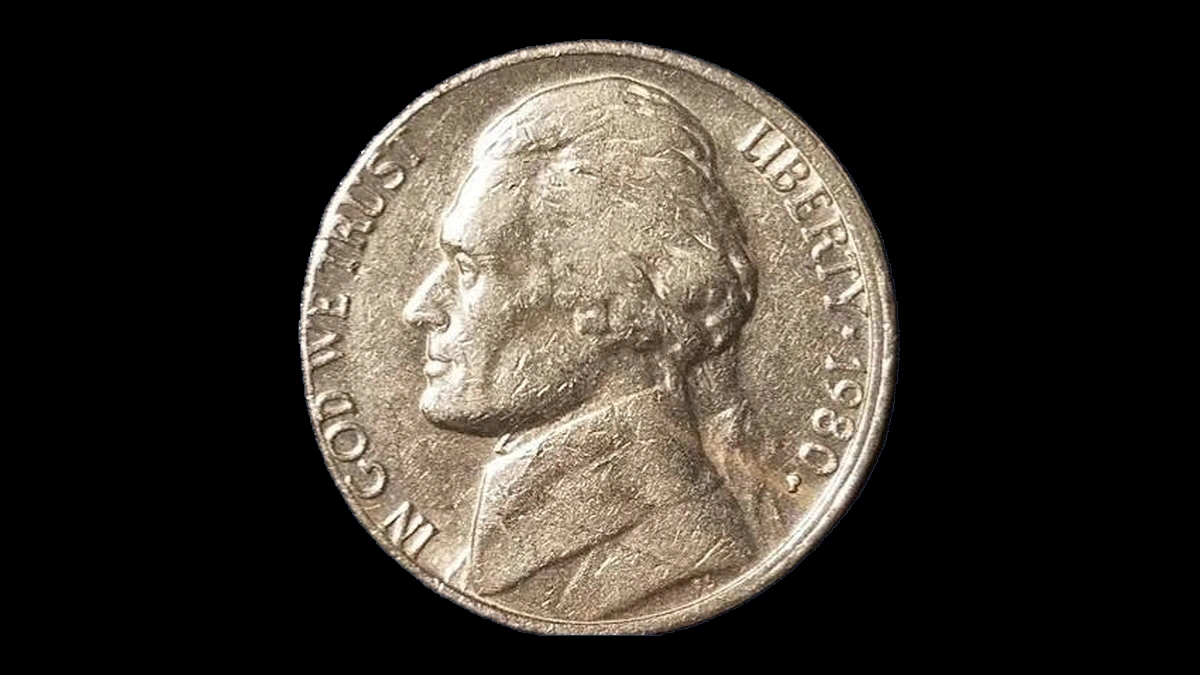
Philadelphia and Denver examples are reported with outward expansion from insufficient collar restraint. The collar normally limits the blank’s spread during striking.
How to Identify
Follow the outer inscriptions on both faces. Complete intended design on an expanded outline supports broadstriking, while design lost beyond the blank suggests an off-center blow.
A normal nickel already has a plain edge. Look for original flow and exclude later hammering or squeezing that smeared completed details.
What It’s Worth
Estimated values are $20–$400, including $20–$125 for straightforward broadstrikes. Pronounced attractive expansion may support more.
A Philadelphia broadstrike dated 1984 sold for $20 in August 2021. It offers a modest different-year transaction.
7. 1980 Nickel Normal Width but Reduced Weight: Thin Planchet Error
A Philadelphia specimen described as struck on a blank of cent thickness weighs 3.7 g. A separate report lists another Philadelphia coin at 4.4 g.
How to Identify
Compare the full-size nickel outline with a normal example before interpreting the weight. Cent thickness describes thickness, not the smaller diameter or copper alloy of a cent blank.
Inspect original surfaces and the edge for grinding or chemical loss. Keep the two reported weights with their respective coins.
What It’s Worth
Estimated values are $75–$750, with genuine worn thin blanks around $75–$250. Attractive unworn examples may bring more.
The 3.7 g NGC AU50 specimen has an indexed sale of $156 in October 2021. That result does not belong to the separate 4.4 g report.
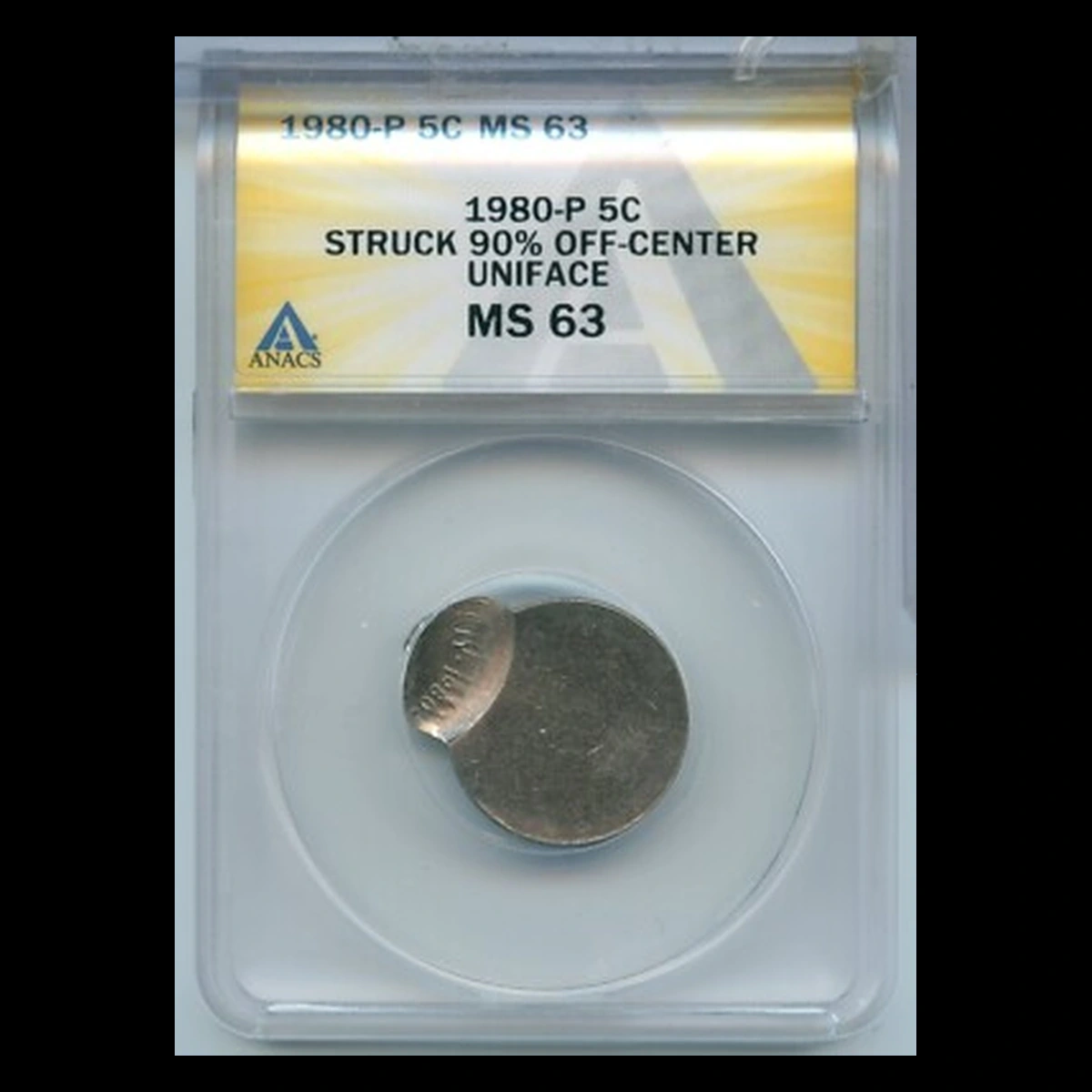
8. 1980 Nickel A Small Struck Area beside Much Bare Metal: Off-Center Strike Error
An ANACS MS62 Philadelphia example is recorded as 75% off-center toward eleven o’clock. It represents one misplaced strike, not automatically another blow or a wrong blank.
How to Identify
Keep the surviving date, P, and complete disc visible while setting the portrait upright. Compare how both designs occupy the same misplaced blank.
Inspect the unstruck area for original surface rather than removed lettering or grinding. A separate surviving impression would require an additional-strike explanation.
What It’s Worth
Estimated values are $75–$1,000, with clear dated examples around $75–$300. Dramatic attractive pieces may occupy the higher range.
A 1984-P nickel struck 50% off-center sold for $132 in March 2021. That result does not transfer its condition or displacement to the 1980 reference.
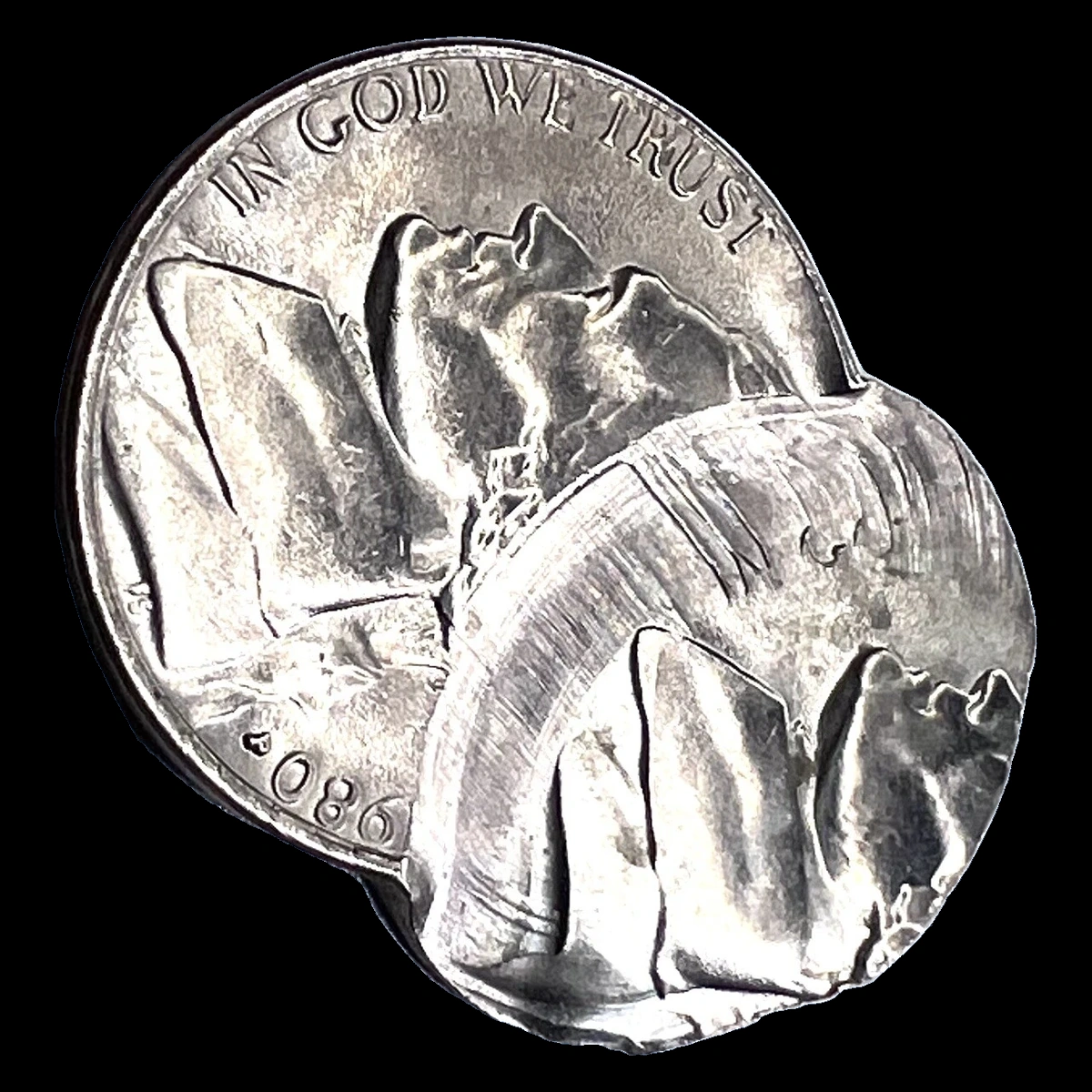
9. 1980 Nickel More than One Blow on a Face or Edge: Multiple Strike Error
Separate Philadelphia examples include a 95% off-center second strike with one face blocked, a 70% second strike, and a triple with later blows 75% and 90% off-center. Another double remained within the collar.
An additional example received a second strike on its edge. Five Full Steps describes the building’s detail quality, not another mint error.
How to Identify
Trace each recognizable impression through related portrait or building details. An edge strike needs side views, while an in-collar double can keep a fairly ordinary outline.
Do not demand a full second design on the blocked face of the 95% example. Catalog shorthand D/S here means double struck, not Denver over San Francisco.
What It’s Worth
Estimated values are $35–$500 for readable ordinary doubles and $500–$1,500 for exceptional triples or edge-strike combinations. Each range values one coin.
The 70% second-strike coin sold for $336 in December 2024. The separate ANACS AU50 95% example has an indexed $35 result in August 2021.
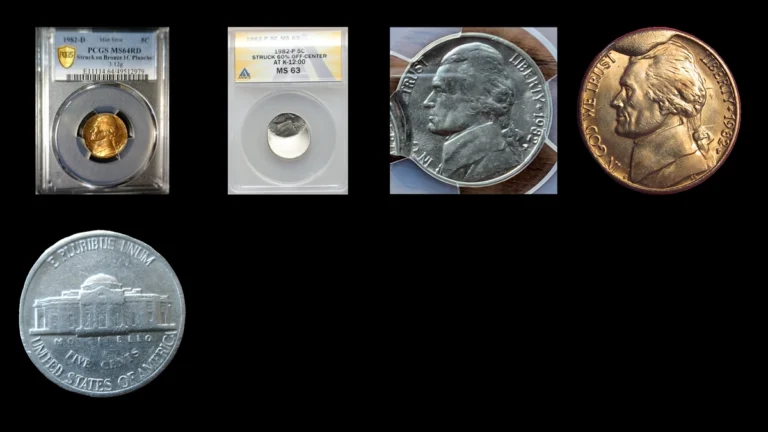
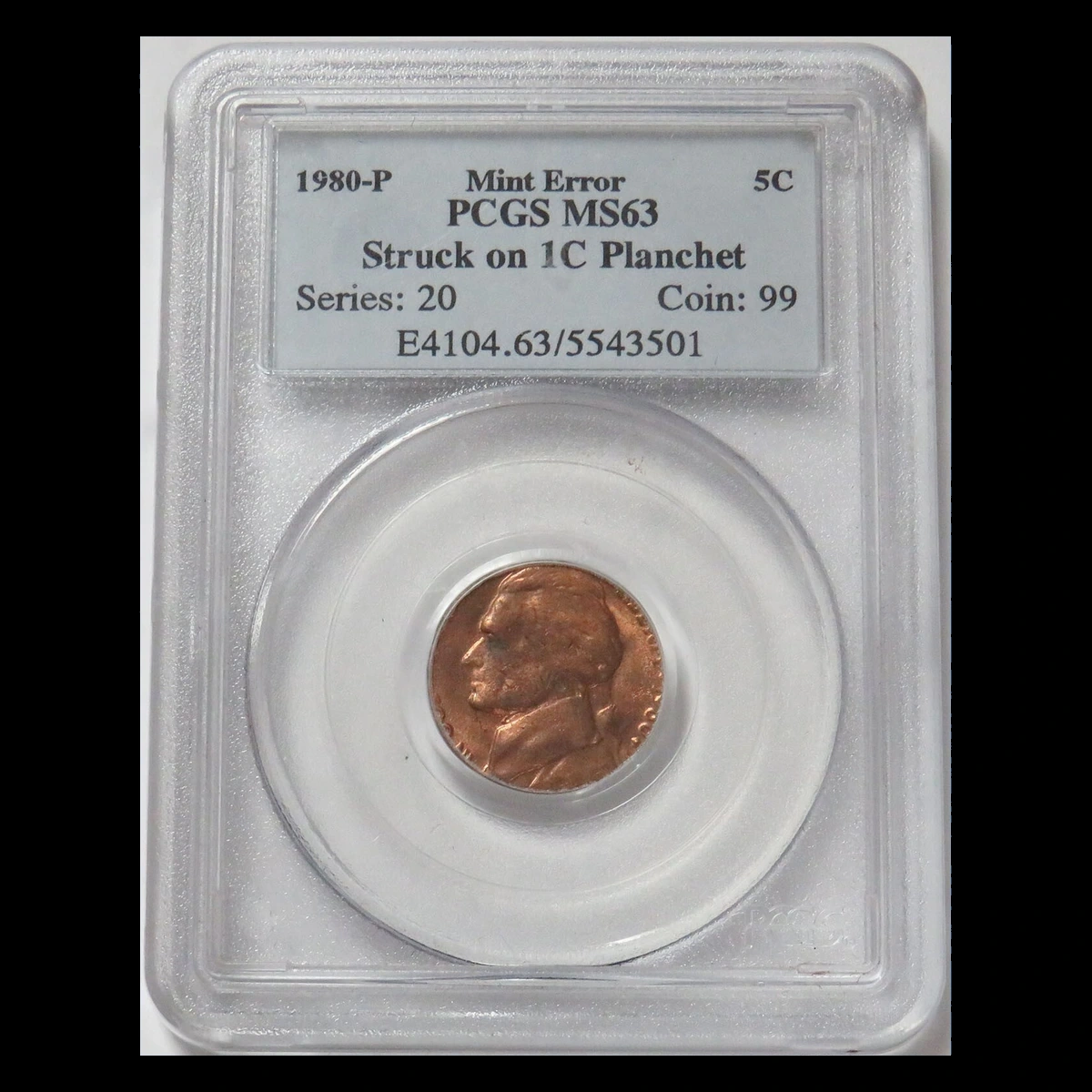
10. 1980 Nickel Nickel Designs on a Copper Cent Disc: Cent Planchet Error
Recorded P and D examples weigh about 3.1 g, while another Philadelphia specimen is listed at 3.05 g. A separate Philadelphia cent-blank coin was struck about 20% off-center.
How to Identify
The period’s cent blank began near 3.11 g and 19.05 mm, though a nickel strike can spread it. Match the copper alloy, edge, and naturally cropped outer design together.
An unused blank carries no Lincoln design. On the 20% example, distinguish actual unstruck metal from letters that simply could not fit the smaller disc.
What It’s Worth
Estimated values are $150–$2,000, with ordinary clear cent-blank strikes around $150–$800. Especially attractive or off-center combinations may bring more.
The Denver 3.1 g example sold for $431.25 in August 2010, and a Philadelphia 3.1 g coin brought $384 in December 2024. Their grades and color descriptions differ, and neither transaction prices the separate 20% specimen.
11. 1980 Nickel Three Impressions on an Irregular Scrap: Attributed Fragment Error
A 1.3 g fragment was cataloged as triple struck and graded NGC MS66. Its designation is (1980)-P, preserving attribution rather than claiming a complete visible date.
How to Identify
Follow how the three impressions meet the irregular boundary. Later cutting through completed design cannot be treated as the same original scrap-striking sequence.
Retain the parentheses around the year when relying on that attribution. Record the actual irregular dimensions rather than demanding normal nickel diameter.
What It’s Worth
Estimated whole-object values are $400–$2,500, with clear comparable fragments around $400–$1,200. Especially attractive, well-supported combinations may reach more.
The 1.3 g triple-struck fragment has an indexed result of $720 in December 2022. Its light weight alone does not authenticate another cut piece.
12. 1980 Nickel Lincoln Details Remain underneath: Nickel over a Struck Cent Error
A finished cent can enter the nickel press with its earlier design still present. A recorded Philadelphia double-denomination example was graded NGC MS64 Brown.
How to Identify
Find recognizable older Lincoln design beneath the later nickel impression. Copper color or a small blank by itself is insufficient.
The supplied description does not establish the cent’s exact date. Keep that host date unknown rather than copying 1980 from the later nickel design.
What It’s Worth
Estimated values are $350–$3,000, with readable examples around $350–$1,200. Clear overlapping designs and attractive surfaces support more.
An indexed 1980-P nickel-over-cent result was $444 in December 2025. It provides a same-year type comparison without proving it is the separate GreatCollections specimen.
13. 1980 Nickel Half the Nickel Design Misses a Dime Blank: Combined Wrong-Blank Strike Error
A Denver example on a 2.3 g dime blank was struck about 50% off-center toward nine o’clock. Both the 1980 date and D remain complete.
How to Identify
The layered edge should fit a dime blank rather than uniform nickel alloy. A contemporary dime blank started near 2.268 g and 17.91 mm, with possible expansion during the nickel strike.
An unused dime blank need not have the grooves of a struck dime. Surviving Roosevelt design would require a different host-coin explanation.
What It’s Worth
Estimated values are $600–$3,500, with clear comparable combinations around $600–$1,500. Exceptional preservation can support the higher tier.
The NGC MS67 Denver example sold for $1,495 in August 2010. Its wrong blank and displacement are already included in that price.
14. 1980 Nickel A 1980-P Dime Lies beneath an Undated Nickel Strike: Double Denomination Error
A Stack’s Bowers description places Jefferson’s portrait over the reverse of a finished 1980-P dime. The later nickel strike has no established date.
The coin was graded NGC MS65, and the catalog retains the host attribution as (1980)-P. Its dime date does not date the nickel dies.
How to Identify
Identify the underlying dime’s date and P separately from the later portrait. Both genuine designs must fit the overstrike sequence.
The finished dime retains edge grooves from its first strike, unlike an unused blank. Examine those grooves and the overlapping details without assuming the nickel strike occurred in 1980.
What It’s Worth
Estimated values are $600–$4,000, with clear examples around $600–$2,000. Exceptional preservation and readable intersections can support more.
No sale amount is supplied for the cataloged specimen. The $444 1980-P nickel-over-cent result concerns a different host and is only a broader double-denomination comparison.
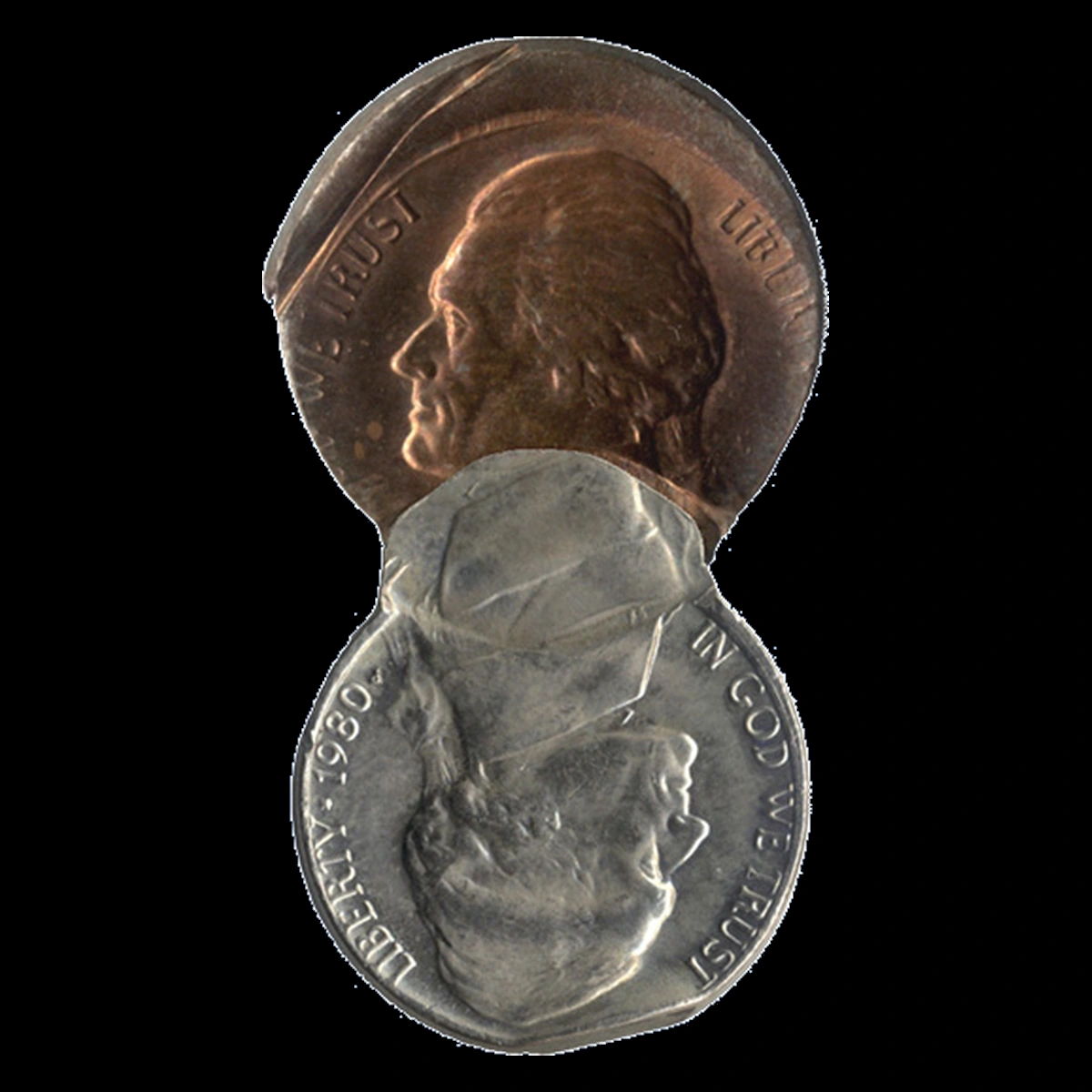
15. 1980 Nickel Two Pieces Preserve Matching Contact: Mated Error Pair Error
One piece used a normal nickel blank and the other a copper cent blank. Faint RIBUS UN on the expanded nickel corresponds to recessed backward lettering on the copper piece.
Both carry nickel designs and were graded NGC MS66 and MS66 Red and Brown. Their shared contact explains two objects, not a third cent inserted between two nickels.
How to Identify
Compare photographs of the contact surfaces without pressing the pieces together. Confirm that the matching letters are raised normally on one piece and reversed and sunken on the other.
Record the weights separately against the nickel’s original 5 g and cent blank’s approximately 3.11 g. Two unrelated coins of different colors do not establish a mated pair.
What It’s Worth
Estimated pair values are $3,000–$12,000, with clear well-preserved pairs around $3,000–$8,000. Exceptional examples may reach the higher range.
Mint Error News lists a $7,475 Heritage result for this two-piece type without giving the transaction date in its table. The figure covers the pair, and dividing it evenly loses the value of the match.
Conclusion
Lightweight 1980 nickel candidates can represent very different objects: thin full-size blanks, smaller denomination blanks, or irregular fragments. Their surfaces, outlines, and surviving designs must support the same explanation.
Preserve catalog qualifications when a year is attributed or belongs to an earlier host coin. A combined strike has one value, while the highest estimated range here concerns two pieces whose matching contact makes them a pair.