Rare 1986 Nickel Errors (List & Pictures)
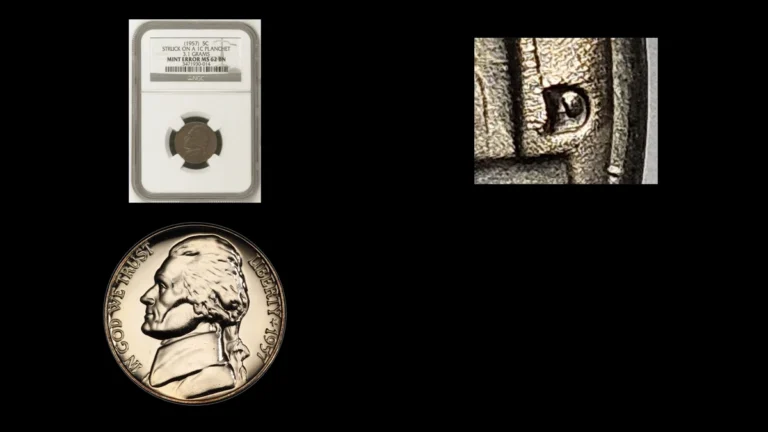
A cent’s surviving date makes one of the most distinctive 1986 Jefferson Nickel errors recognizable. The same nickel-over-cent specimen brought $1,265 in January 2011 and $1,020 in September 2019.
Estimated values across the categories below span $5–$2,200. Look first at the disc and edge, then use the smaller design clues to distinguish a documented error from wear, damage, or an ordinary mintmark variation.
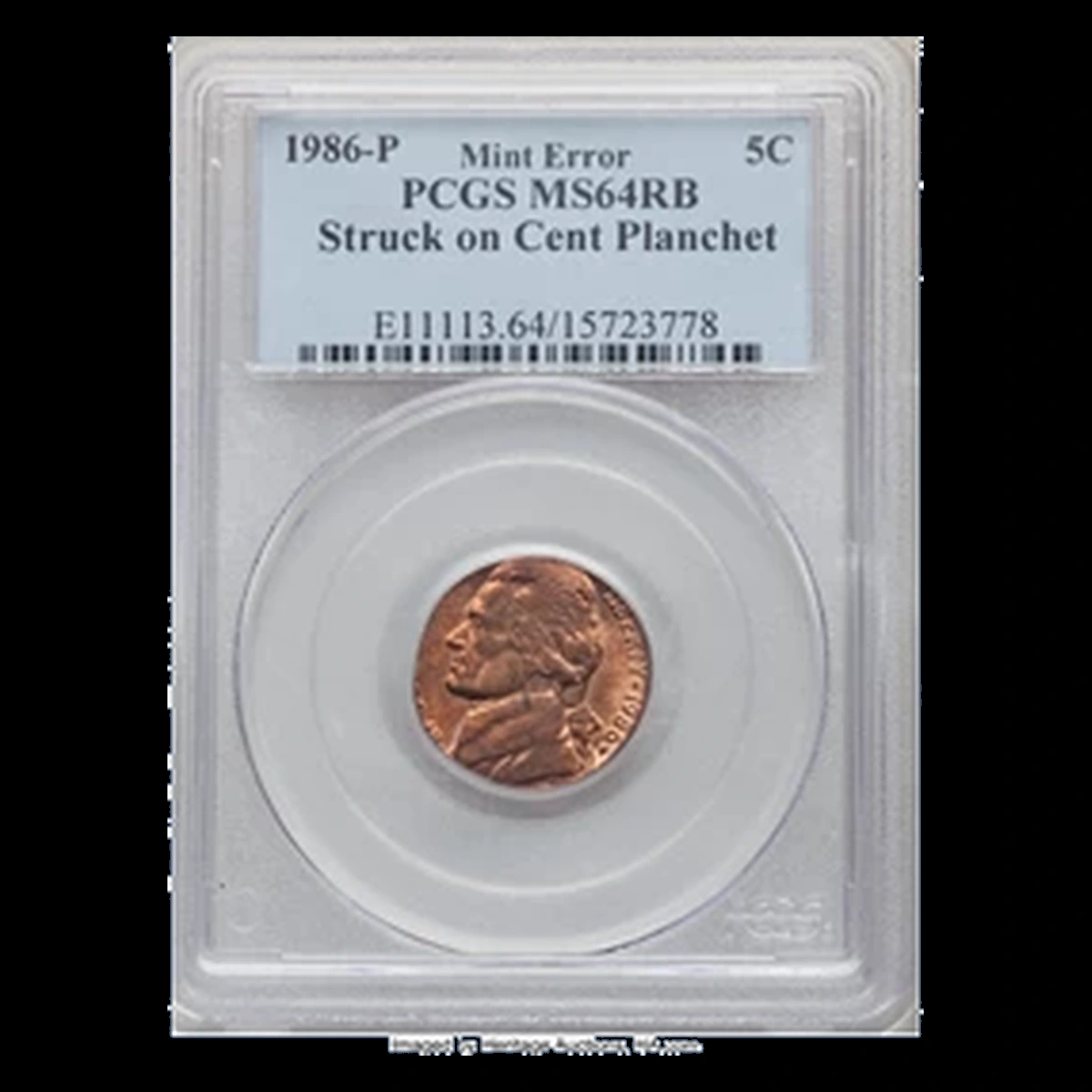
1. 1986 Nickel Copper Color with Cropped Nickel Lettering: Cent Blank Error
A cent blank is smaller than the disc intended for Jefferson’s design. If it enters the nickel press, parts of the outer lettering may not fit on the copper-colored metal.
The recorded 1986-P example was graded ANACS MS60 Red and Brown. It was struck on an unused blank, so no earlier Lincoln design is required.
How to Identify
A normal nickel is 5 grams and 21.21 millimeters, with a plain edge; a modern cent blank starts near 2.5 grams and 19.05 millimeters. Those are standards, since the recorded wrong-blank specimen has no actual weight supplied here.
Look for natural cropping of the nickel design and an edge consistent with the smaller blank. Later grinding or plating may imitate size or color, and a genuine blank can spread beyond its starting diameter during striking.
What It’s Worth
Comparable authenticated cent-blank nickels are estimated at $200–$700. The ANACS MS60 Red and Brown example sold for $312 in November 2020.
Its price reflects a marked but unworn coin with mixed red and brown color. It should be compared separately from coins that retain a finished cent’s earlier design.
2. 1986 Nickel Cent Digits Survive in Jefferson’s Hair: Double Denomination Error
The earlier digits 986 remain in Jefferson’s hair on a recorded 1986-P nickel struck over a finished Lincoln cent. Its nickel mintmark is sharp, while the upper part of the nickel date is weak.
NGC graded this combined design MS64 Red. The old cent impression provides the evidence that a finished coin, rather than an empty blank, entered the nickel press.
How to Identify
Find the old digits and follow where the newer portrait crosses or flattens them. Copper color and low weight alone cannot distinguish a double denomination from the unused-blank error above.
Document both designs and inspect the edge for an added coating or seam. The modern cent’s 2.5-gram standard is not a published measurement of this particular specimen.
What It’s Worth
Authenticated examples with recognizable remnants of both designs are estimated at $700–$2,200. The NGC MS64 Red coin brought $1,020 in September 2019.
Its recorded earlier sale was $1,265 in January 2011. These are two sales of the same specimen, not evidence of two separate coins.
3. 1986 Nickel Several Curved Gaps Interrupt the Disc: Clipped Planchet Error
Repeated overlaps during blank punching can leave several curved openings before any design is applied. One 1986-P PCGS MS64 example has a 10% triple curved clip.
Another Philadelphia piece, graded NGC MS65 Full Steps, has two overlapping curved clips. Its clear Monticello stairs explain the Full Steps designation, while the openings record the blank-making error.
How to Identify
Trace the curve boundaries and their endpoints instead of merely counting gaps. Overlapping clips can join within one opening, and the triple clip’s 10% describes the whole missing amount rather than each gap.
Inspect the struck rim as it approaches every opening. Natural weakness or metal flow differs from saw grooves, fresh file marks, and folded edges created later.
What It’s Worth
Comparable genuine clips are estimated at $25–$250. The triple-clip MS64 piece sold for $109 in July 2022, while the overlapping-clip MS65 Full Steps coin brought $49 in July 2021.
Each price covers one complete coin. The number of gaps does not provide a simple price multiplier.
4. 1986 Nickel Complete Words Sit inside a Wider Border: Broadstrike Error
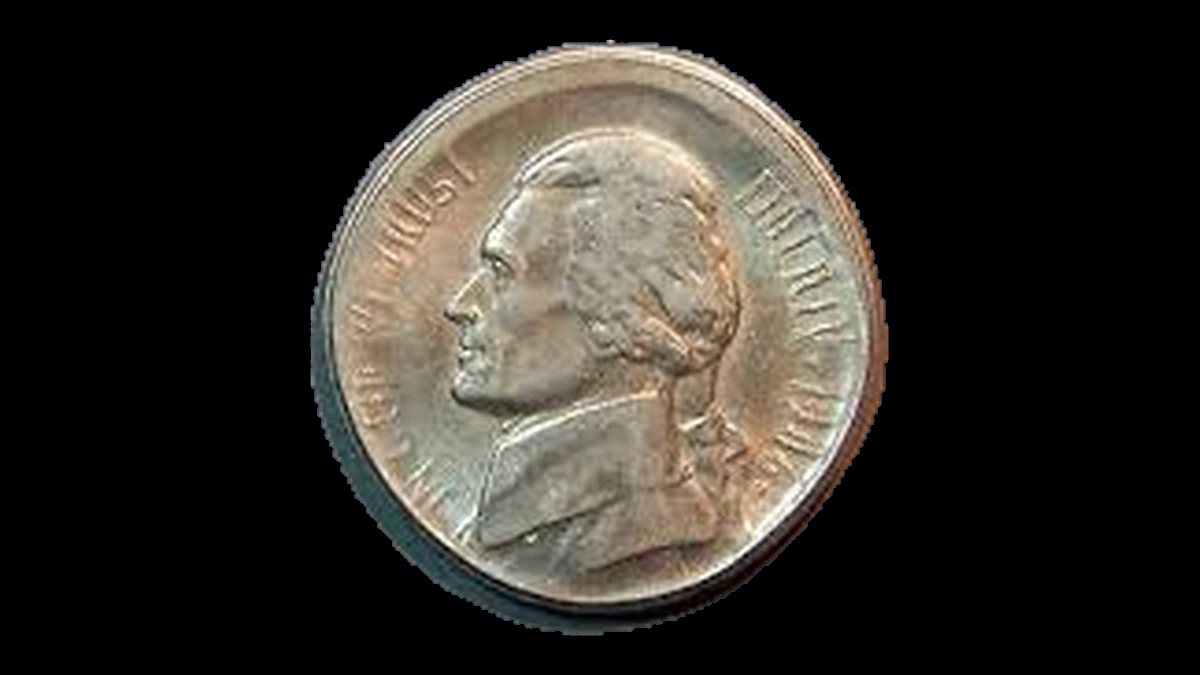
The collar normally prevents a nickel from spreading beyond its intended diameter. Failure to contain the blank can produce a broadstrike with a full design inside expanded metal.
Both Philadelphia and Denver examples are reported for 1986. A separate Philadelphia multiple-strike coin also has broadstriking and belongs with the combined-error discussion below.
How to Identify
Read the entire outer inscription on each face. A broadstrike can have an uneven extra border, but the original design should remain on the metal.
Check expanded areas for hammer marks and crushed details that could explain later widening. Metal spreading during a normal broadstrike changes the outline without ordinarily removing weight.
What It’s Worth
Ordinary single-strike broadstrikes are estimated at $25–$300. A 1999-P example brought $89 in March 2025 as an other-year comparison.
That sale does not establish dimensions or a price for a particular 1986 specimen. Extra blows and overlapping images need a comparison that includes the whole combination.
5. 1986 Nickel A Thin Raised Edge Borders an Offset Design: Off-Center Strike with Finning Error
A reported Philadelphia coin combines an off-center design with a finned rim. The offset leaves unstruck metal, while pressure forcing metal into a narrow gap creates the thin projecting fin.
No fixed percentage, direction, or fin height is supplied for this 1986-P report. Those measurements must come from the actual coin.
How to Identify
Take a side view without pressing or bending the delicate edge. A thin projection differs from a thick rolled border or metal folded upward after minting.
On both faces, locate the unused blank area and the design missing beyond the opposite edge. Keep the date and P visible so the combined features remain tied to the same specimen.
What It’s Worth
A genuine dated example with both features is estimated at $35–$450. No individual sale is supplied for the reported Philadelphia piece.
A 1999-D nickel struck 65% off center sold for $75 in September 2024. It is a comparison for displacement, not evidence of finning or the same percentage on the 1986 coin.
6. 1986 Nickel Overlapping Portraits Record Extra Blows: Multiple Strikes Error
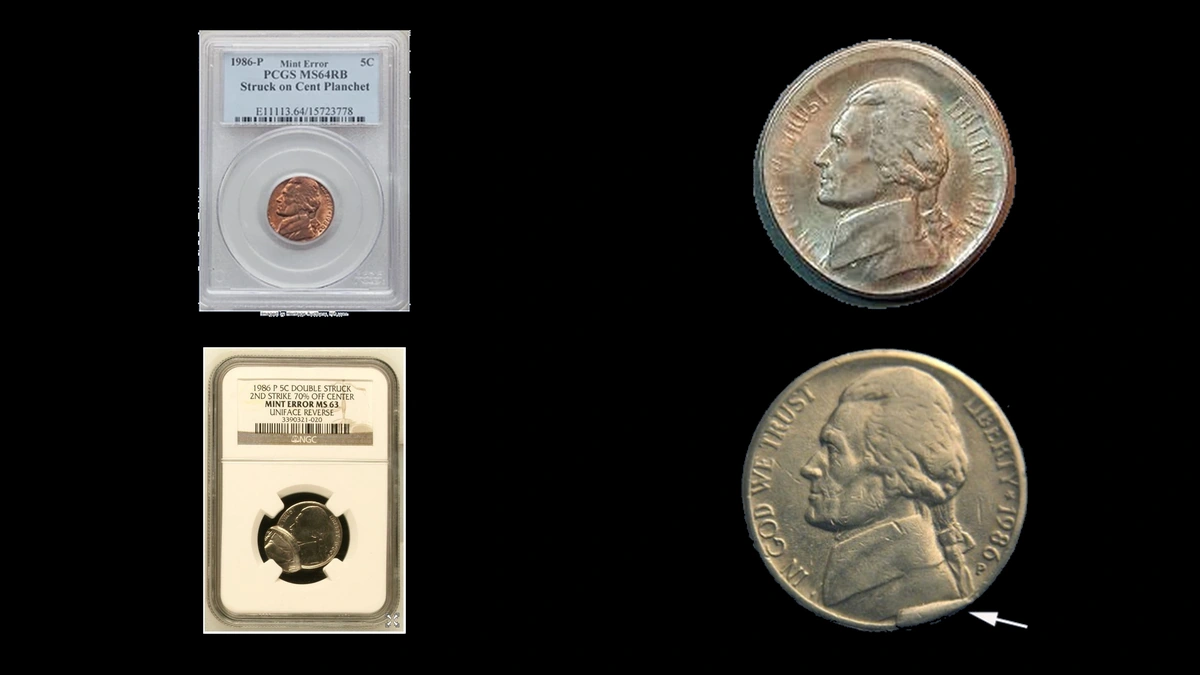
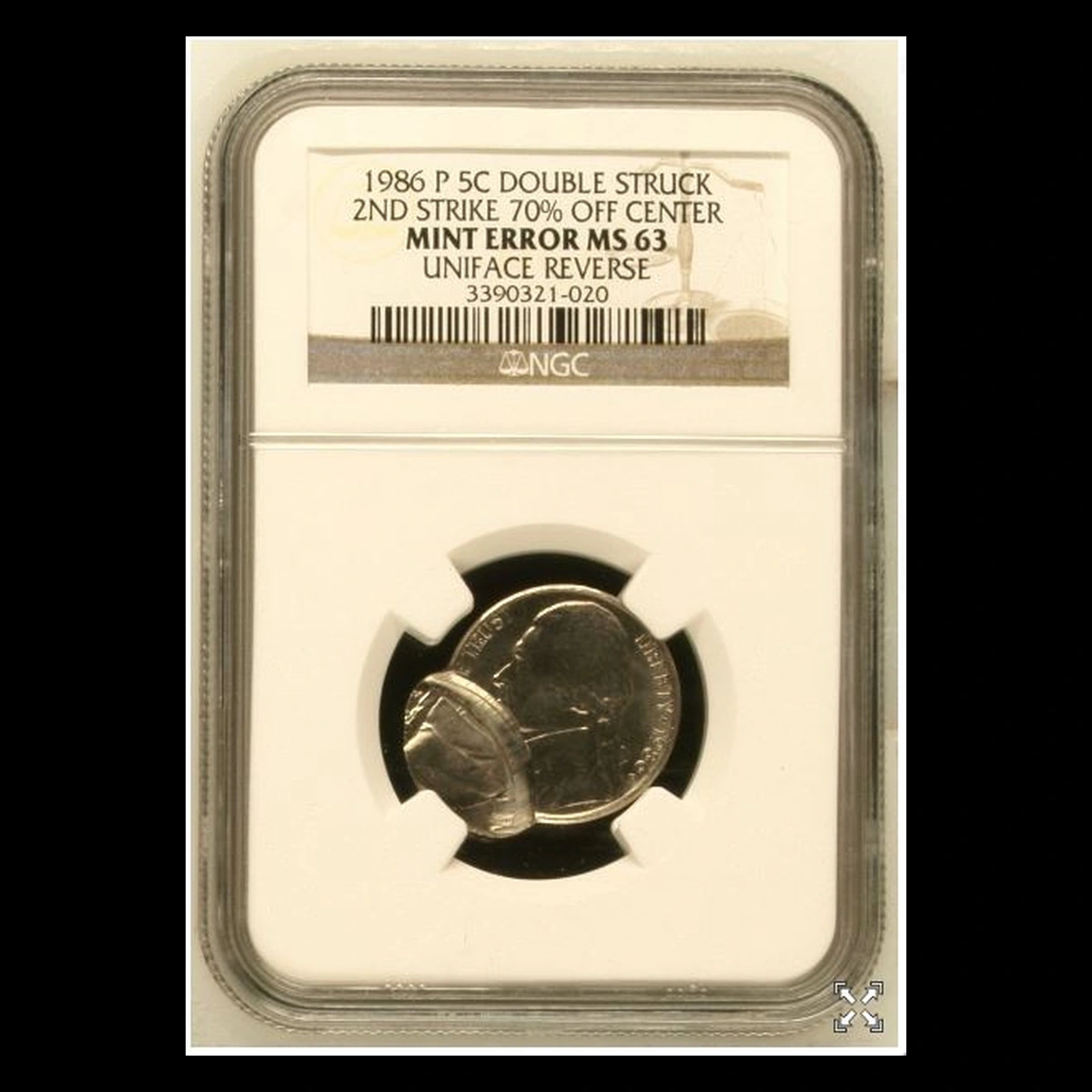
A coin that remains in the press can move before another blow lands. One 1986-D PCGS AU55 example received a second strike 70% off center.
A separate Denver coin has an off-center second strike and reverse damage, while a Philadelphia NGC MS67 piece combines multiple strikes with broadstriking. No exact strike count is supplied for the Philadelphia coin.
How to Identify
Trace identifiable portraits or letters through the overlap on both faces. Later scratches do not count as additional design impressions.
The Philadelphia multiple broadstrike needs both repeated images and an expanded outline. For the damaged Denver piece, keep its original strikes separate from the later reverse damage.
What It’s Worth
Comparable double and multiple strikes are estimated at $80–$800. The AU55 Denver coin with a 70% second strike brought $253 in June 2008.
The reverse-damaged Denver example sold for $99 in June 2023 and was described as unworn but damaged, without a numerical grade. No individual sale is assigned to the Philadelphia MS67 coin.
7. 1986 Nickel A Raised Patch Joins the Rim: Cud Error
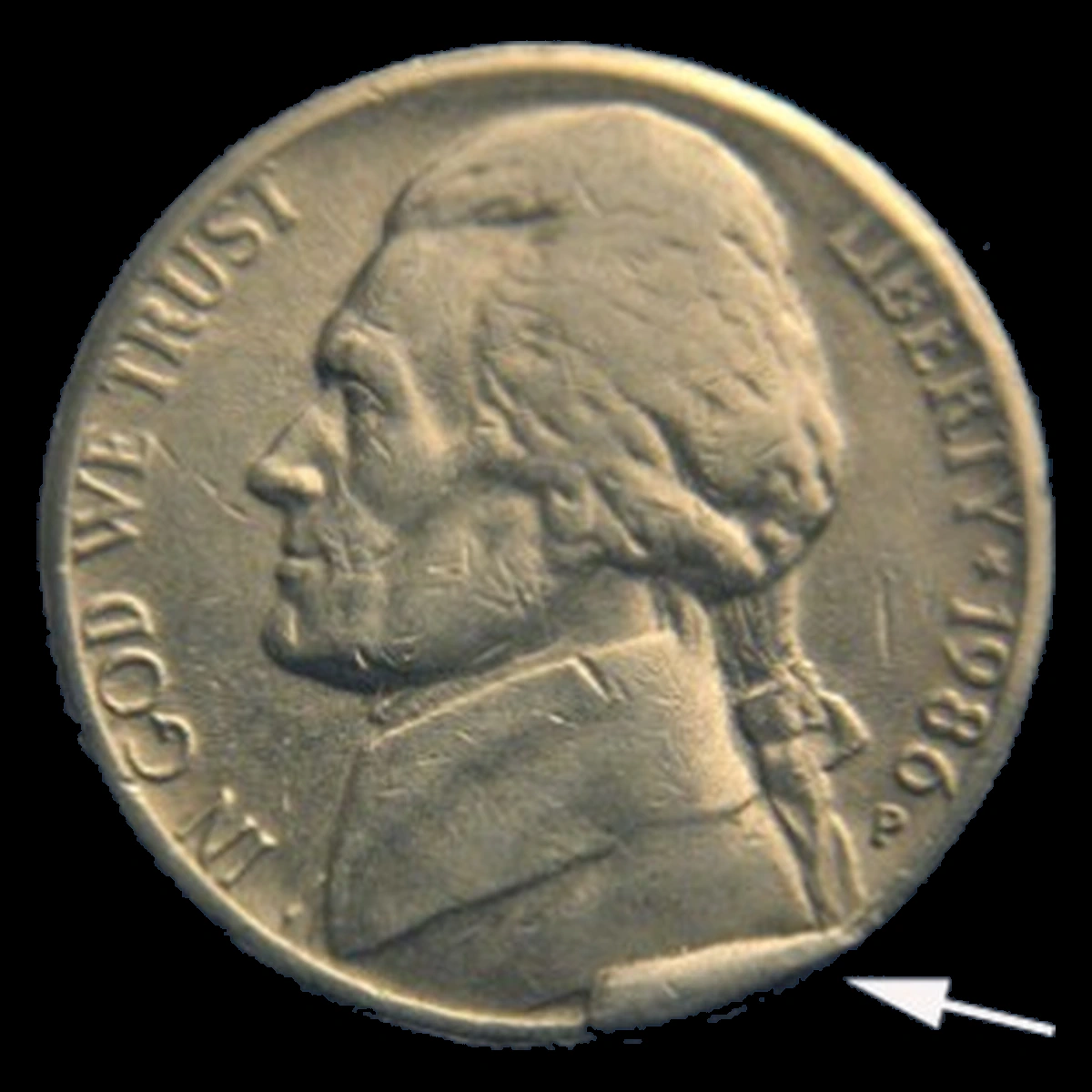
A broken die edge can leave an opening that fills with coin metal under pressure. The resulting raised patch attached to the rim is called a cud.
Three Philadelphia cud listings are recorded for 1986. They describe separate patterns rather than three required patches on a single nickel.
How to Identify
Match the outline, rim connection, and nearby lettering against the Philadelphia cud catalog images. A date match alone cannot identify the pattern.
Examine the adjacent edge for a dent, seam, or solder. An impact can push metal onto the face, and an isolated interior lump is not the same rim-connected error.
What It’s Worth
Genuine cuds are estimated at $15–$350, depending on their size, clarity, and surrounding condition. A worn 1983-P example sold for $63 in July 2022.
That different-year sale does not individually price the three 1986 listings. Larger clearly formed breaks offer stronger comparisons than uncertain small bumps.
8. 1986 Nickel A Deep Front Depression Interrupts Detail: Struck Through Error
The documented Philadelphia example has a deep front impression where material obstructed the strike. Its reverse stairs remained clear enough for an NGC MS65 Full Steps grade.
The catalog did not identify the substance. Depth alone cannot establish cloth, wire, or another particular object.
How to Identify
Compare the preserved reverse with the locally affected front, then inspect where the front design meets the depression. A striking obstruction prevents design from forming where it sits.
A later dent can crush completed details and force a lip of metal outward. Photograph the boundary under changing light to keep those possibilities distinguishable.
What It’s Worth
Comparable genuine strike-throughs are estimated at $40–$400. The MS65 Full Steps example sold for $204 on June 12, 2023.
The result concerns a deep front impression with an unidentified obstruction. A shallow weak patch or a damaged coin needs its own assessment.
9. 1986 Nickel Darkness Covers the Original Surface: Improper Annealing Error
Blanks are heated before striking to soften them, a process called annealing. Preparation problems can leave a dark surface on the finished nickel.
Philadelphia and Denver examples are reported, sometimes under the nickname Black Beauty. A normal nickel’s copper and nickel are mixed throughout, so darkness does not establish a missing outer layer.
How to Identify
Tilt the coin under neutral light and examine the surviving struck texture and moving shine. Crust, corrosion, coatings, and later heat can produce similar color with different surface evidence.
Keep the surface intact for examination. Rubbing away a dark spot destroys information, while a seller’s nickname does not prove a mint preparation error.
What It’s Worth
An identified annealing error with original surfaces is estimated at $20–$150. The strength of the identification matters more than how black the coin appears.
A 2005-D improperly annealed nickel graded MS62 sold for $119 in December 2022. That later-date comparison cannot establish the cause of a dark 1986 surface.
10. 1986 Nickel Out-of-Place Lines Match the Other Face: Die Clash Error
Dies can hit each other when no blank is present. Marks from that contact may appear on later coins as traces of the opposite design.
The reported 1986 clash category does not establish one mint, location, or cataloged pattern. A strange line becomes meaningful only when its shape and placement fit the opposing design.
How to Identify
Use front and mirrored reverse photographs to test how the suspected traces align. Connected parts of a recognizable design are more persuasive than one short mark.
Inspect adjoining traces through a magnifier rather than forcing every line into a single raised-or-sunken rule. Random scratches and polishing marks lack the necessary connected arrangement.
What It’s Worth
An identified clash is estimated at $10–$200. Faint traces on a worn coin generally compare lower than clear, recognizable outlines.
No individual 1986 sale is assigned here. An unexplained line near Jefferson or Monticello cannot inherit the range without a defensible design match.
11. 1986 Nickel Several Letters Have Extra Outlines: Doubled Die Error
Repeated detail can be built into the die rather than created by another blow on the coin. Denver reports mention the portrait, date, and IN GOD WE TRUST on the front.
Reported reverse areas include MONTICELLO, FIVE CENTS, E PLURIBUS UNUM, and building details. These are places to inspect, not one universal pattern required on every 1986-D nickel.
How to Identify
Choose a word and compare the added strokes across several letters with an identified Denver example. Record where each outline sits instead of naming a variety from one thick corner.
Rounded repeated strokes differ from broad flat shelves caused during striking. Changing the light also helps separate a fixed raised shape from glare.
What It’s Worth
Clearly identified doubled designs are estimated at $20–$250. Visibility and surface condition influence their place within the range.
The supplied reports provide no adopted sale or numbered Denver variety. Ordinary striking movement or worn thick lettering does not qualify merely because two edges seem visible.
12. 1986 Nickel An Extra P or D Stroke Remains: Repunched Mintmark Error
Mint letters were added separately to dies during this period. A shifted repeat punch could leave part of an earlier P or D beside the stronger letter.
Both Philadelphia and Denver repunching are reported for 1986. The supplied category does not establish a particular direction or numbered variety.
How to Identify
Compare the complete mintmark with an identified example from the same mint. An extra stem or curve should resemble part of another P or D.
A flat shelf, glare, or a damaged corner can imitate a second outline. Use several lighting angles to keep the actual raised strokes visible.
What It’s Worth
An identified repunched mintmark is estimated at $10–$150. Clear remnants on attractive surfaces support stronger comparisons than faint marks obscured by wear.
No individual 1986 sale is supplied for this general category. The estimate follows a matched repunch, not every extra-looking edge.
13. 1986 Nickel The P Sits Unusually High: Reported Mintmark Placement Error
A high-looking P concerns the position of the entire letter, rather than a second punched outline. A year report calls attention to this Philadelphia feature.
Hand placement of mintmark punches allowed ordinary variation. A small shift alone does not establish a rare error.
How to Identify
Compare several ordinary 1986-P nickels at the same image scale, with Jefferson upright and the date visible. Judge the P against the same portrait and design landmarks.
A tightly cropped or tilted photograph can exaggerate distance. Check the surrounding surface for damage before treating the apparent placement as original.
What It’s Worth
A documented unusual placement with collector interest is estimated at $5–$50. Ordinary small differences may add no premium beyond the coin’s condition value.
This range is not a completed sale of a confirmed high-P specimen. The comparison must establish why the position is unusual before the label carries value.
Conclusion
For a 1986 nickel, the useful clue may be as large as a missing section or as small as an extra mintmark stroke. Match the feature to the correct mint and actual specimen before applying a price.
Preserve thin fins and original surfaces, and photograph both faces with the edge when relevant. The repeat sales of the nickel-over-cent coin also show why one striking error does not have a permanent fixed value.