Rare 1957 Quarter Errors (List & Pictures)
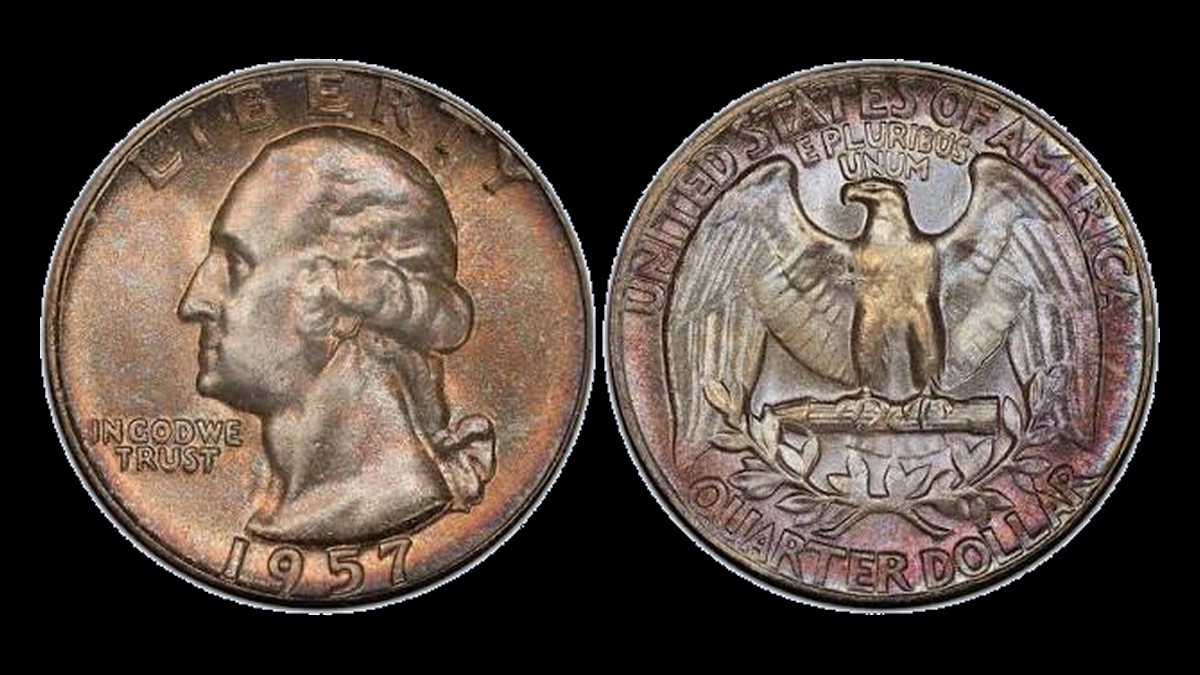
Two quarters dated 1957 can share the same silver content yet differ greatly in collector interest. Supplied estimates for 1957 quarter errors and associated varieties range from $15 to $3,000.
A 1957-D re-engraved tail-feather variety graded MS64 has a recorded $2,200 sale in October 2021. Begin with the eagle side’s lettering, mint mark, and feathers before checking the surfaces and edge for minting accidents.
| Inspection point | Feature | Estimated value |
|---|---|---|
| End of STATES | Type B reverse | $20–$300; exceptional $300–$1,000 |
| D below the eagle | Misplaced or repunched mint mark | $25–$2,000 |
| Eagle’s tail | Re-engraved feathers | $40–$2,500 |
| Repeated letters or artwork | Doubled die | $30–$600 |
| Extra raised metal | Die crack or break | $15–$150 |
| Interrupted design | Struck through | $40–$700 |
| Missing curved section | Clipped planchet | $25–$300 |
| Two-level edge | Partial collar | $40–$350 |
| Spread outline and complete design | Broadstrike | $50–$400 |
| Blank crescent and lost design | Off-center strike | $100–$1,200 |
| Quarter design on dime-sized metal | Wrong planchet | $800–$3,000 |
1. 1957 Quarter Separated Letters at the End of STATES: Type B Reverse Error
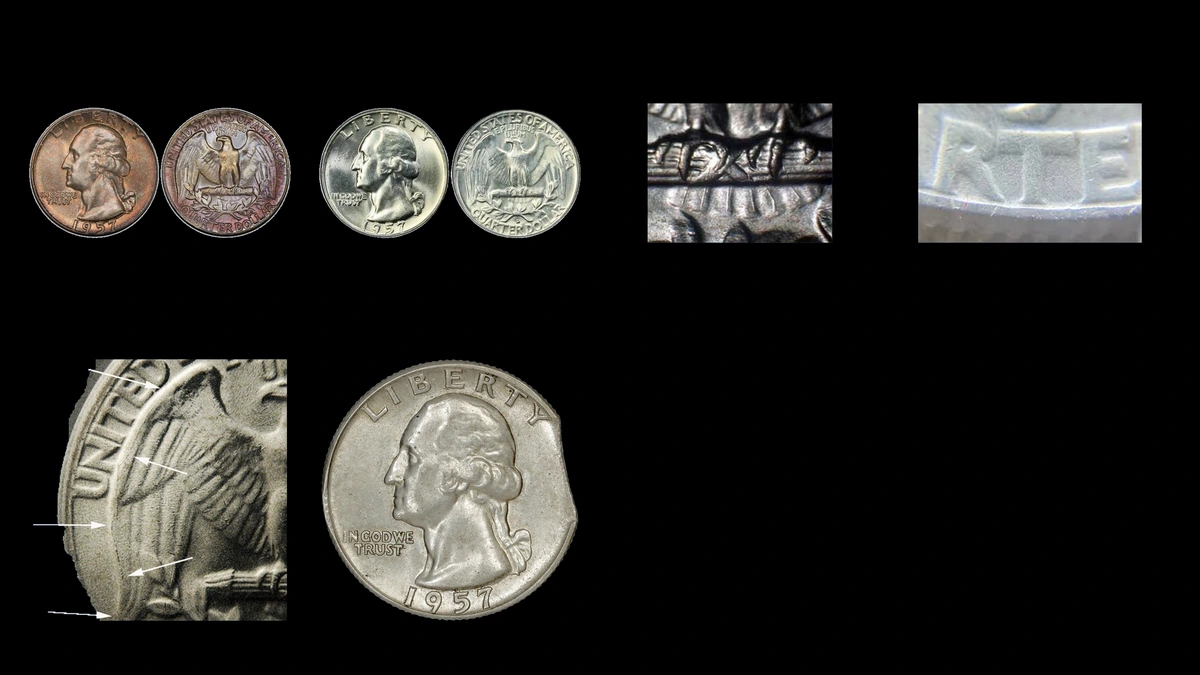
The space between E and S in STATES is a useful way into the Type B reverse variety. The ordinary circulation design nearly joins those letters, while the reverse normally used for Proofs separates them.
Some Philadelphia circulation quarters received that Proof-style reverse. Those pieces are the collectible FS-901 combination discussed here.
How to Identify
Examine the gap and compare the surrounding reverse artwork with an attributed Type B circulation strike. Keep enough of the coin visible to avoid mistaking damage to one letter for a design difference.
Establish that the coin is an ordinary Philadelphia issue with an intact mint-mark area and no D. A Proof carrying its expected reverse does not become this circulation-strike variety merely because its E and S are separated.
What It’s Worth
$20–$300 is the typical supplied estimate, with exceptional preservation estimated at $300–$1,000. An MS67 example recorded by PCGS sold for $423 in January 2015.
A worn coin can retain clear Type B lettering without approaching that grade. The identification and the surface condition answer different parts of the value question.
2. 1957 Quarter An Unusual D Below the Eagle: Misplaced or Repunched Mint Mark Error
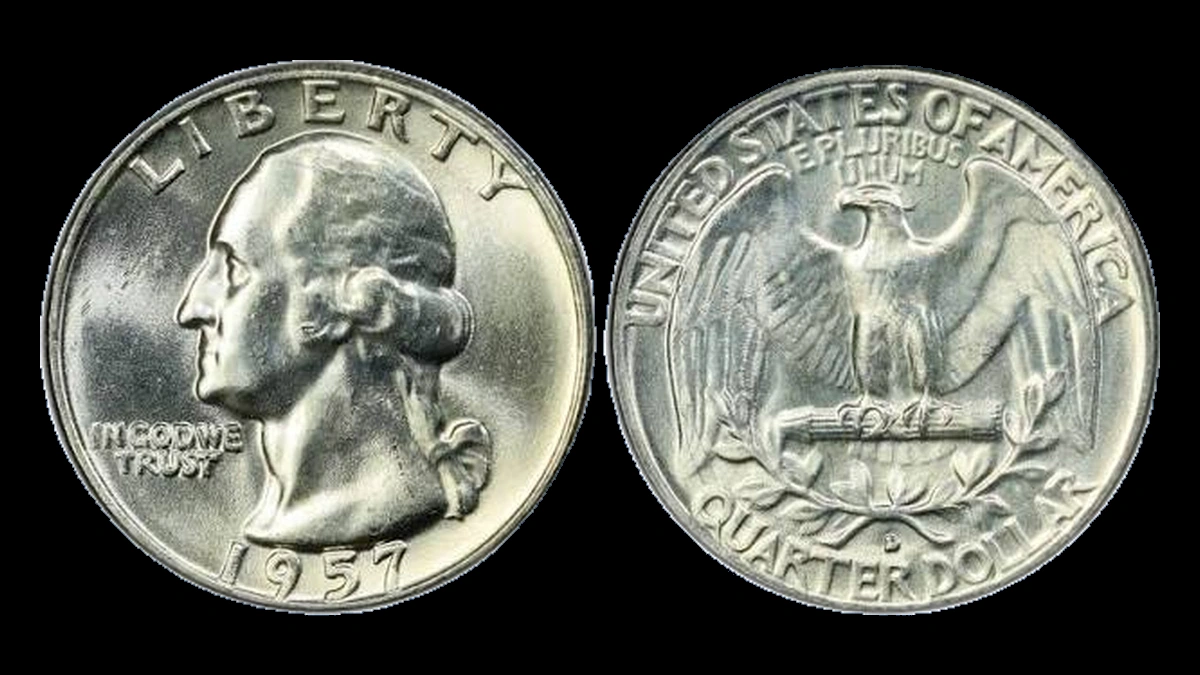
For a misplaced mint mark, the clue is where the D sits relative to the fixed reverse design. For a repunched mint mark, the clue is an additional impression of the letter itself.
These features arose when mint marks were punched into dies by hand. The recognized 1957-D misplaced-mint-mark variety is FS-501; separate repunched-D reports need their own matches.
How to Identify
Compare the complete placement of the D with an attributed FS-501 photograph, using nearby artwork as reference points. Ordinary differences in hand-punched placement do not automatically qualify.
For repunching, look for a recognizable surviving part of another D. A flat ledge, nearby scratch, or impact that pushes the letter sideways does not establish a second punch.
What It’s Worth
$25–$2,000 spans the supplied estimates for these mint-mark features. PCGS records a misplaced FS-501 graded MS66+ selling for $1,860 in July 2021.
That unusually well-preserved misplaced-mark coin is not a price guide for every repeated-D report. Preserve the distinction between the two features when comparing sales.
3. 1957 Quarter Altered Lines in the Eagle’s Tail: Re-engraved Tail Feathers Error
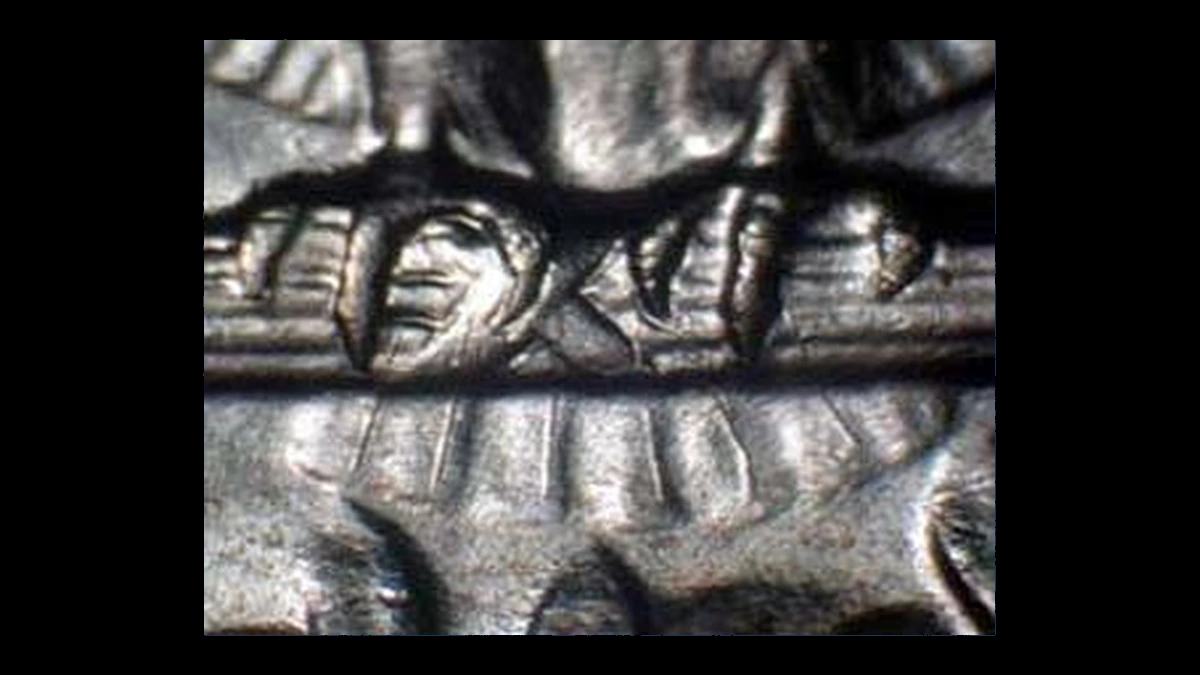
The 1957-D re-engraved tail-feather variety reflects changes cut into the die before it struck the coin. Those altered details then appeared as part of the eagle’s original design on coins from that die.
How to Identify
Match the extra lines and their endpoints to a confirmed 1957-D FS-901 example. Sharply struck ordinary feathers are not enough, and this Denver FS-901 designation must not be confused with the Philadelphia Type B variety.
Look for scratches that cut into the finished coin or continue across unrelated details. Recutting a coin’s tail feathers after minting cannot reproduce the original die variety.
What It’s Worth
$40–$2,500 is the supplied estimate for attributed examples. PCGS lists an MS64 eBay sale of $2,200 in October 2021.
That record is a high comparison for this specific variety. Faint, worn, or unconfirmed tail lines should not inherit its price.
4. 1957 Quarter Rounded Repetition in Letters or Wings: Doubled Die Error
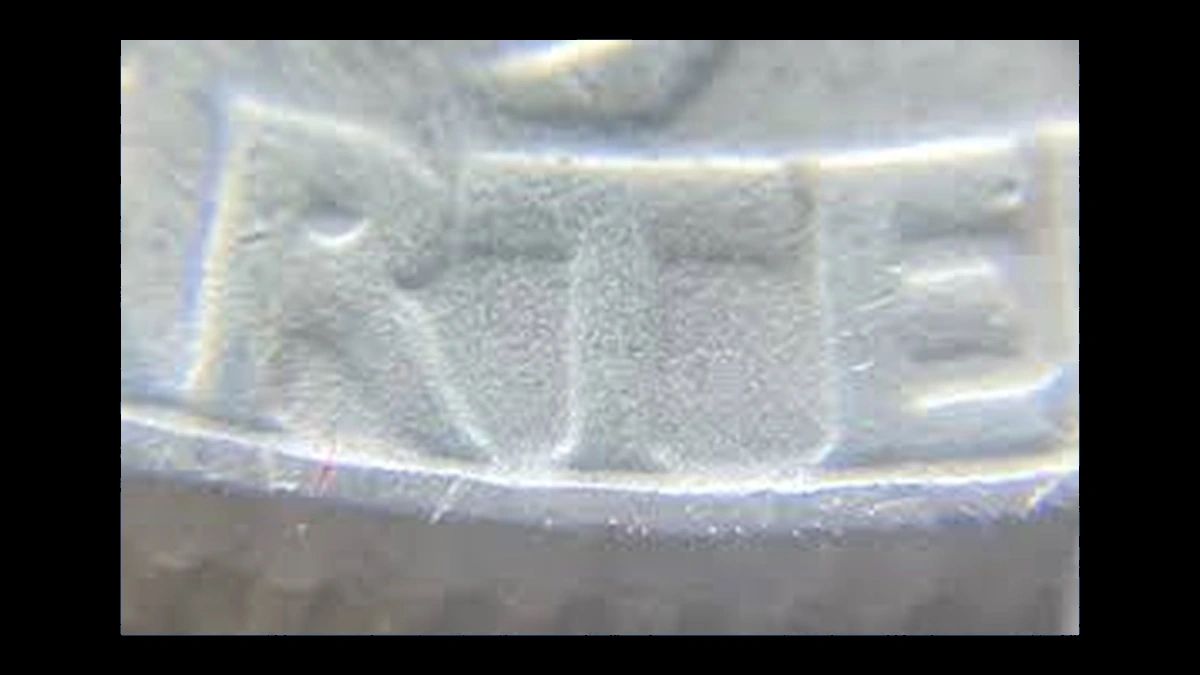
A doubled die already contains a repeated design before a blank enters the press. Reports for 1957 include front doubling and a separate Denver reverse claim involving QUARTER DOLLAR and eagle-wing details.
How to Identify
Choose the appropriate face before comparing enlarged pictures. Several rounded repeated edges or split corners should agree with one documented example.
Flat shelves beside letters can result from movement during the strike rather than a doubled die. The front and Denver reverse reports do not establish a single coin carrying every reported feature.
What It’s Worth
$30–$600 is the supplied range for confirmed 1957 doubled dies. The strength of the doubling, exact attribution, and wear matter more than the word “doubled” alone.
A different-year 1969-S FS-101 Proof graded PR67 reportedly sold for $312 in March 2018. Its known identity and Proof finish should remain attached to that comparison, rather than being assigned to the 1957 reports.
5. 1957 Quarter A Ridge or Letter-Gap Lump: Die Crack or Break Error
Inspect unexpected raised metal, including any I-like shape between B and E in LIBERTY. That reported “BIE” appearance describes a small die-break shape, not an intentionally added letter.
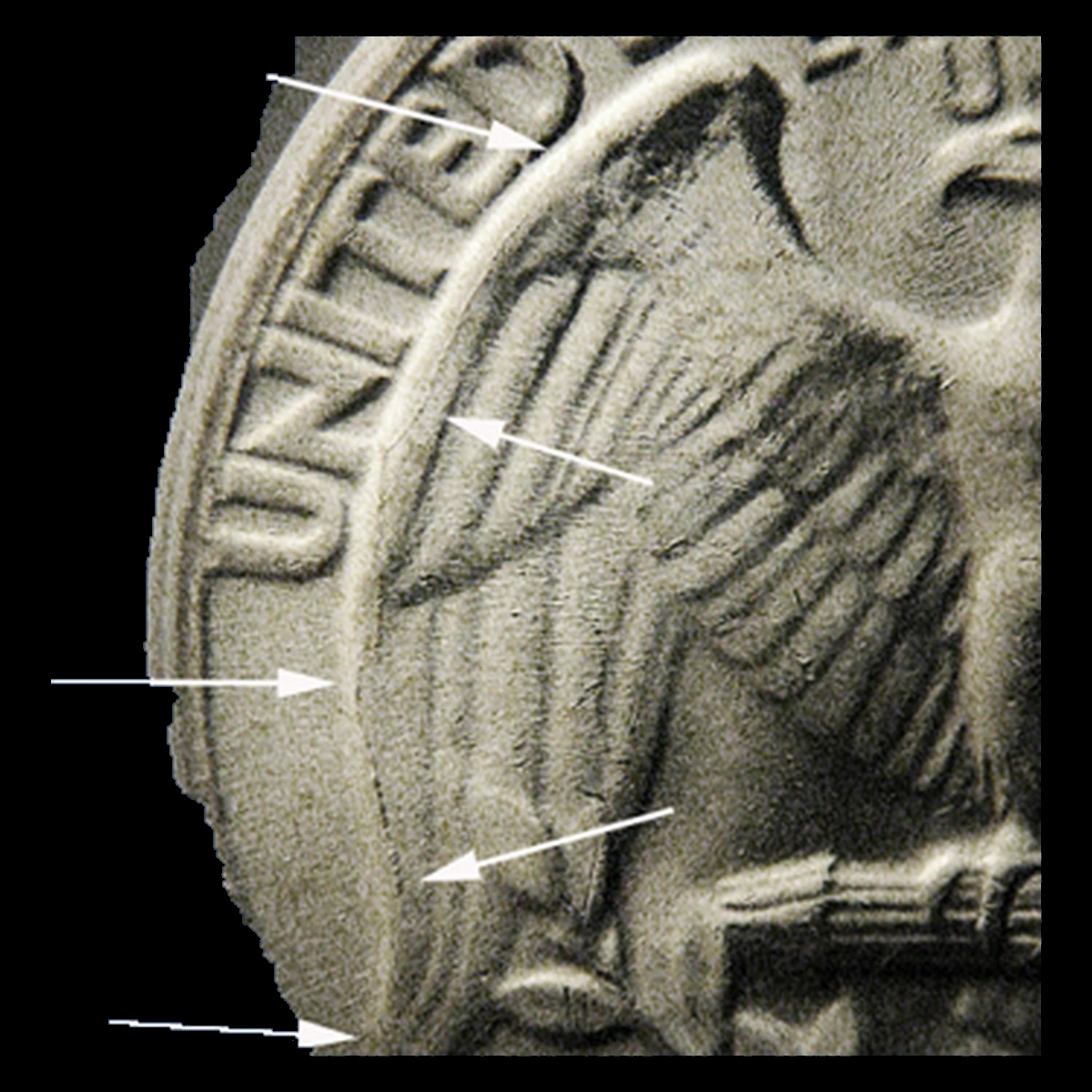
Cracks and broken areas in a die accept metal during striking. They can leave narrow ridges or larger raised patches on the resulting quarter.
How to Identify
Use changing light to distinguish metal rising from the struck surface from a scratch cut into it. A dent beside a lump may explain it as metal displaced by a later impact.
For the BIE report, inspect the actual gap between B and E. Do not scrape an apparent lump, since dirt and residue can imitate a raised feature.
What It’s Worth
$15–$150 is the supplied whole-coin estimate for modest confirmed raised defects, including recognizable letter-gap breaks. The silver coin’s underlying value is included in that range.
A 1970-D nickel with two cuds sold for $63 in October 2022. That different-denomination result offers context for visible die breaks without establishing the price of a specific 1957 quarter crack.
6. 1957 Quarter A Hollow or Missing Detail: Struck Through Material Error
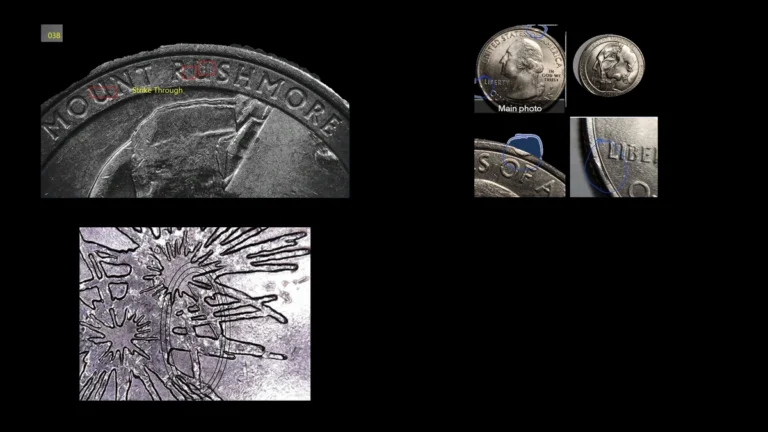
A reported NGC Proof 68 Cameo example has a struck-through error on its front. Material between the blank and die interrupted the design as it formed.
Cameo describes contrast between the raised artwork and reflective fields. Neither that contrast nor the high grade identifies what blocked the strike.
How to Identify
On the recorded Proof, follow the front design into the affected area and examine its boundary under soft light. An original interruption should differ from sharp gouges or rubbed-away detail on a finished surface.
The supplied description does not identify cloth, wire, or retained debris. Assign a material only when the evidence actually supports it.
What It’s Worth
$40–$700 is the estimated range, depending on the visible error, finish, and condition. A dramatic Proof impression and a small weak patch are unlikely to attract the same interest.
A struck-through 1986-P nickel sold for $204 in June 2023. This is a mechanism comparison, not a sale of the Proof 68 Cameo quarter.
7. 1957 Quarter A Curved Bite in the Outline: Clipped Planchet Error
A genuine curved clip starts when the blank-cutting operation overlaps a previous hole in the metal strip. The quarter design is subsequently struck onto the incomplete disk.
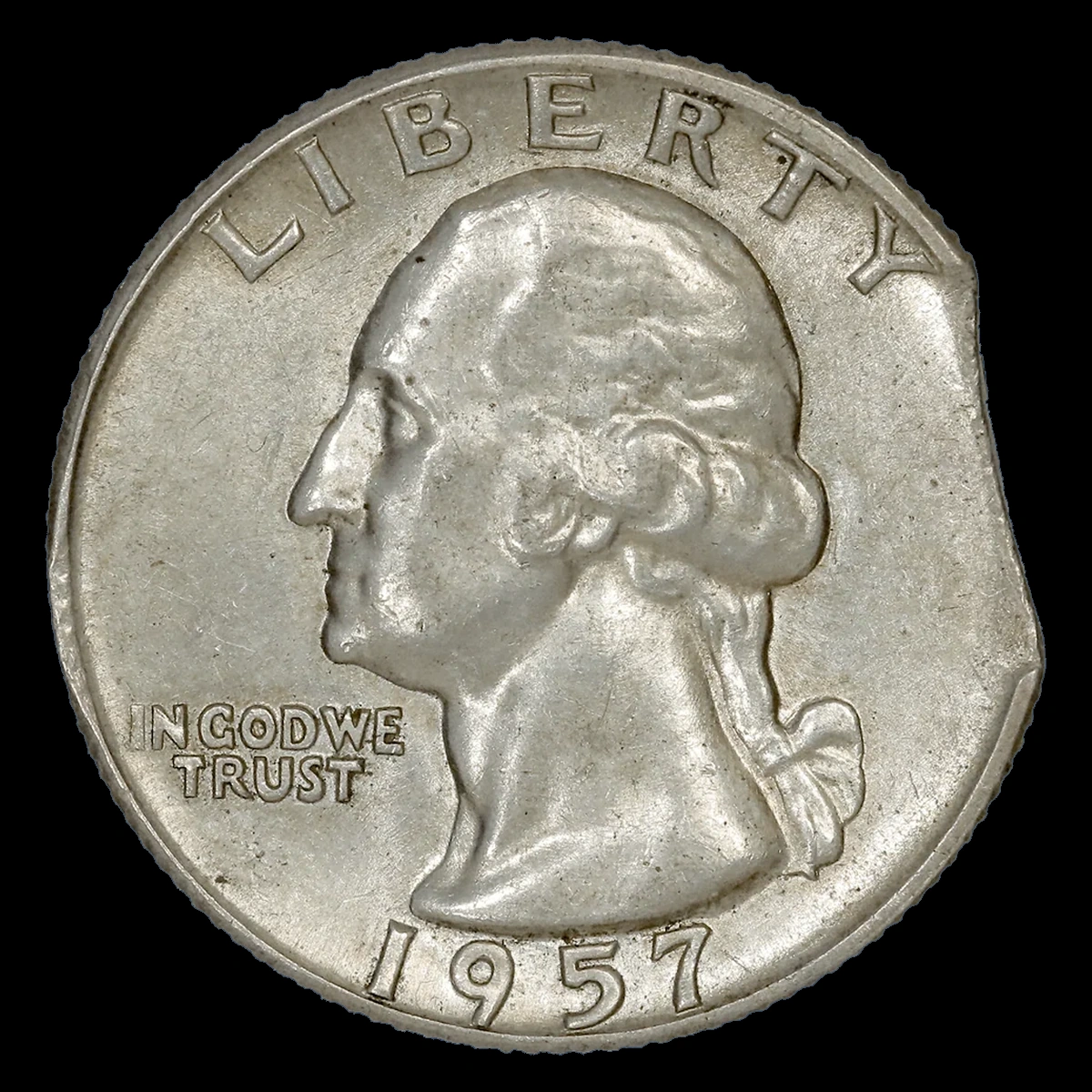
How to Identify
Inspect both ends of the gap for the way the rim and surrounding design formed beside the missing metal. Filing, saw marks, and a cut through already finished details suggest later alteration.
A normal 1957 silver quarter weighs about 6.25 grams and measures 24.3 millimeters across. A clip lowers its weight, but so does cutting a finished quarter, so measurement must be combined with the physical evidence.
What It’s Worth
$25–$300 is the supplied estimate for genuine 1957 curved clips. The size of the gap, remaining date, and preservation help narrow it.
A 1978 quarter with three curved clips sold for $180 in March 2025. That later clad coin has several clips and should not be treated as an exact match for a single clipped silver quarter.
8. 1957 Quarter A Step Around the Edge: Partial Collar Error
The collar is the steel ring that confines the blank during striking. If only part of the blank sits inside it, the exposed portion can spread farther and leave a two-level edge.
How to Identify
Examine the quarter from the side and follow the step around the circumference. Relate changes in the edge grooves to the narrower restrained portion and the wider exposed portion.
Reports mention unusual rim areas on the front and toward the top of the back, but a face-only rim picture cannot settle the diagnosis. A single dent or a high rim lacks the structural evidence of a partial collar.
What It’s Worth
$40–$350 is the estimated range for a confirmed 1957 partial-collar quarter. A clearly formed edge step is more persuasive than a slight unevenness.
A 1990-P nickel with a partial collar sold for $99 in June 2025. It demonstrates collector interest in the mechanism while differing in denomination, date, and composition.
9. 1957 Quarter A Wider Coin with Its Design Intact: Broadstrike Error
Without effective collar restraint, the metal can spread beyond the normal quarter diameter. A broadstrike can retain the full intended design even when the design sits unevenly within the expanded outline.
How to Identify
Trace the outside lettering and artwork to confirm that they remain on the coin. Loss of design beyond an edge requires an off-center comparison instead.
Inspect the edge for absent or incomplete grooves and the faces for natural striking detail. Hammering can widen a coin while crushing the design, so excess diameter alone is not conclusive.
What It’s Worth
$50–$400 is the supplied broadstrike estimate for 1957. More obvious spread and undamaged surfaces can support stronger interest.
A 1965 Type One blank broadstrike graded PCGS MS61 sold for $192 in June 2024. The later coin’s clad composition and specific blank description should not be transferred to a 1957 silver example.
10. 1957 Quarter An Unstruck Crescent Beside a Cropped Design: Off-Center Strike Error
When the blank misses the center of the dies, part of the design can fall beyond the available metal. The opposite portion of the blank receives no design, leaving the characteristic unstruck crescent.
How to Identify
Read the surviving date, then compare both faces to see whether the lost design agrees with the misplaced blank. If the mint-mark area was never struck, the absence of a D cannot establish Philadelphia origin.
No single angle or percentage is supplied for all reported 1957 examples. A shifted-looking rim on just one face is not enough to prove that the entire blank was off center.
What It’s Worth
$100–$1,200 is the estimated range for genuine, identifiable 1957 off-center quarters. The amount of displacement must be considered alongside the readable date and surface condition.
A 1965 quarter struck 25% off center sold for $180 in December 2025. Its displacement belongs to that later clad example, not to every 1957 report.
11. 1957 Quarter The Quarter Design Outgrows Its Silver Disk: Dime Planchet Error
A silver dime blank is too small to hold Washington’s full quarter design. A documented 1957 example graded NGC MS64 weighs 2.5 grams, making the wrong blank much more evident than its silver color alone would suggest.
How to Identify
Check that the surviving design establishes the quarter denomination and 1957 date. Its natural termination at the small blank’s edge matters as much as the light weight.
A silver dime blank starts near 17.9 millimeters in diameter, although the metal may spread during a quarter strike. Examine the boundary for cutting or filing that could make a normal quarter artificially small and light.
What It’s Worth
$800–$3,000 is the supplied range for comparable authenticated pieces. The recorded 2.5-gram NGC MS64 quarter sold for $1,920 in December 2023.
This is the value of the complete wrong-planchet coin. A clipped or altered ordinary quarter does not receive the same premium simply by approaching a dime’s weight.
Conclusion
The eagle side is a productive starting point for a 1957 quarter: letter spacing, the D, and tail-feather lines can identify distinct varieties. Keep those comparisons separate from accidents that interrupt the design or change the blank’s shape.
For a physical error, include the edge and both faces in the examination. A matching original strike explains far more than an unusual color, isolated scratch, or low scale reading.