Rare 1999 Quarter Errors (List & Pictures)
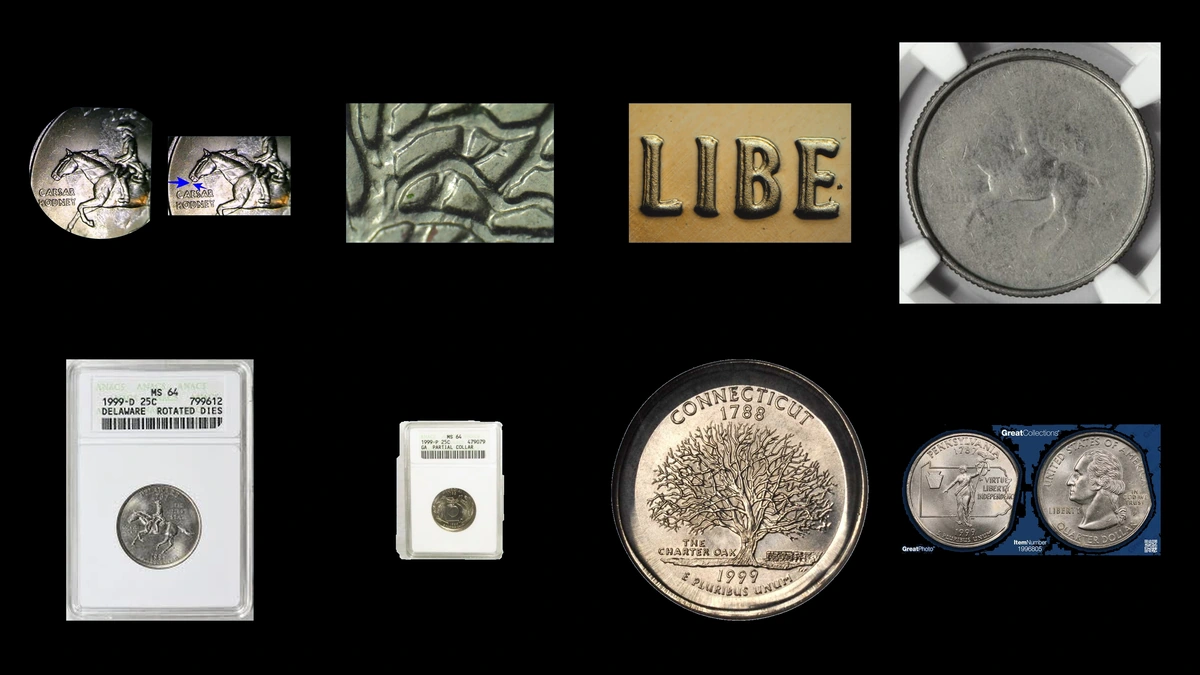
The first state quarters offer far more than Delaware’s familiar Spitting Horse line. A Georgia quarter struck on an experimental alloy sold for $7,200 in January 2020, while other errors involve tiny die cracks or incomplete blanks.
Estimated values for these 1999 quarter errors run from $2–$15,000. Use the state design to identify the issue, then follow the surface, edge, and metal clues below.
1. 1999 Quarter A Raised Line Leaves the Horse’s Mouth — Die Cracks and Cuds Error
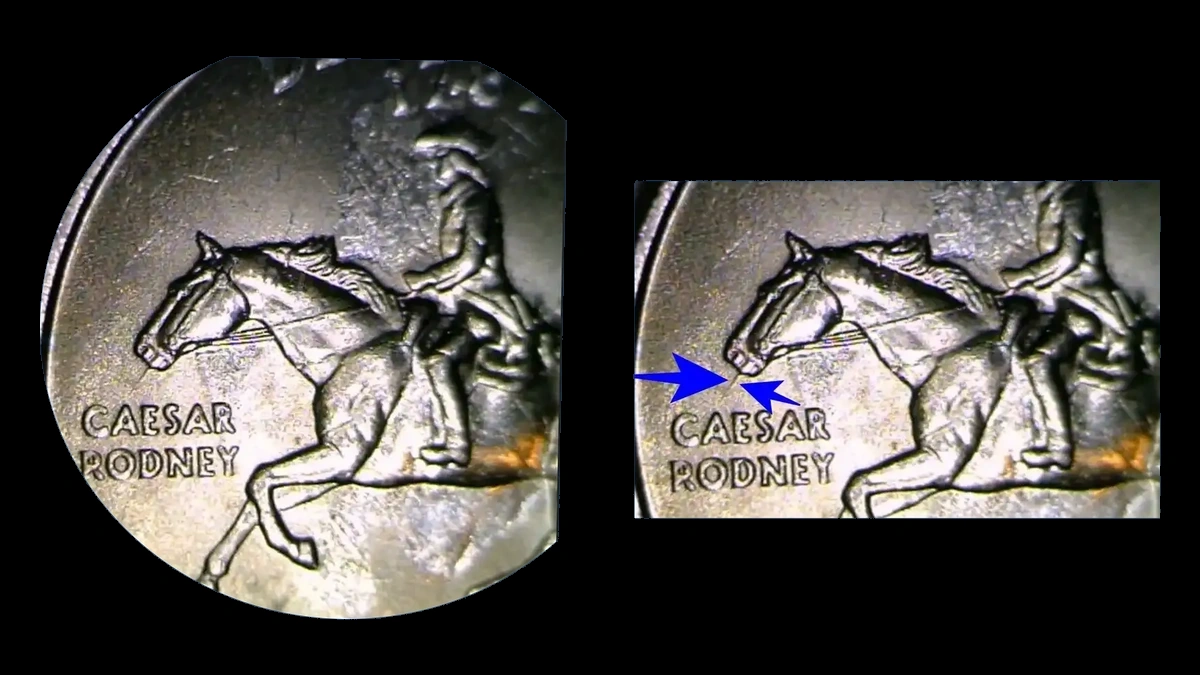
The Spitting Horse nickname describes a raised crack line extending left from Delaware’s horse mouth. Metal filled a crack in the die rather than forming new artwork.
Georgia has developing, retained, and larger rim-connected breaks from both mints. Connecticut also has a developing front-rim break.
How to Identify
Follow the horse-mouth line under angled light to confirm a ridge rather than a scratch. A large cud should replace design with a raised patch joined to the rim.
A retained break can preserve detail because the damaged die piece stayed in place. Compare the actual stage instead of matching an early line to a later large patch.
What It’s Worth
$2–$500 spans minor cracks and stronger breaks. Small lines or chips generally fit $2–$50, while clear large cuds can reach $50–$500.
The nickname alone does not make the Delaware feature rare.
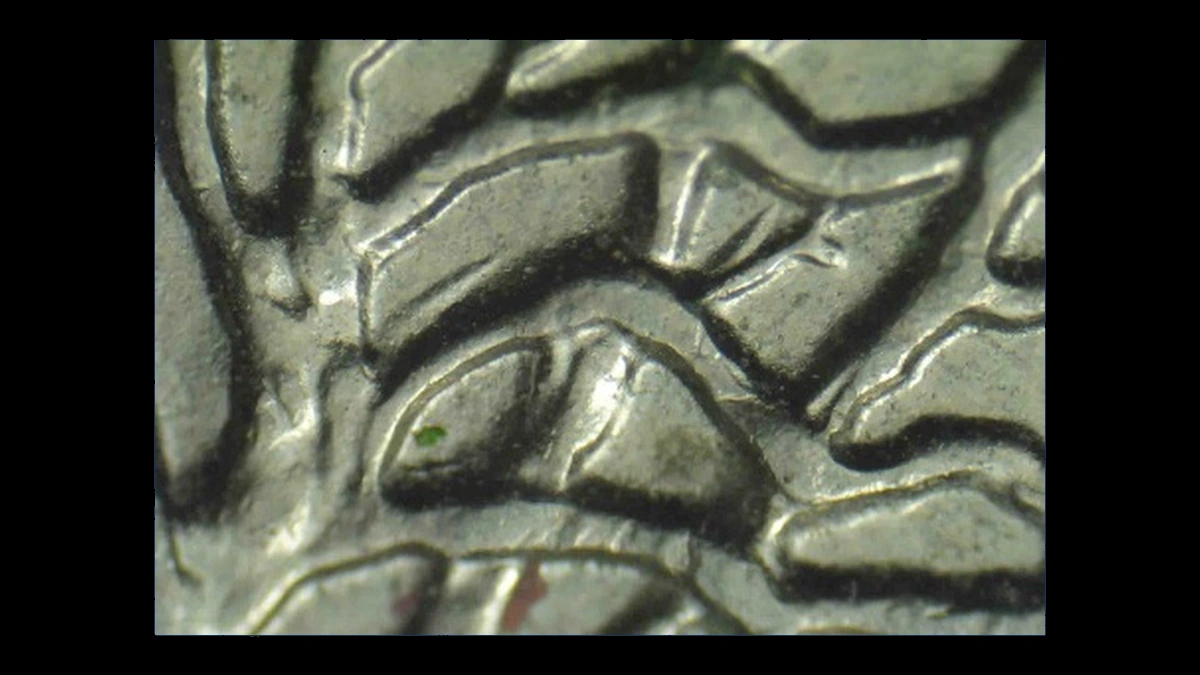
2. 1999 Quarter Extra Lines among Connecticut’s Branches — Die Clash Error
Several Philadelphia Connecticut features once listed as doubled dies were later reidentified as clashes. The dies touched without a blank between them and acquired traces of the opposing design.
Later coins copied those marks. The withdrawn labels should not turn each line into a separate doubled-die variety.
How to Identify
Learn the normal branch pattern first, then compare extra lines with Washington’s side. Both shape and position should fit an opposing-design trace.
The updated Connecticut catalog explains the change in identification. Random scratches or ordinary branches cannot be matched from an old number alone.
What It’s Worth
$10–$150 is the estimate for a recognizable clash. Clear transferred shapes and sharp original surfaces offer the better comparisons.
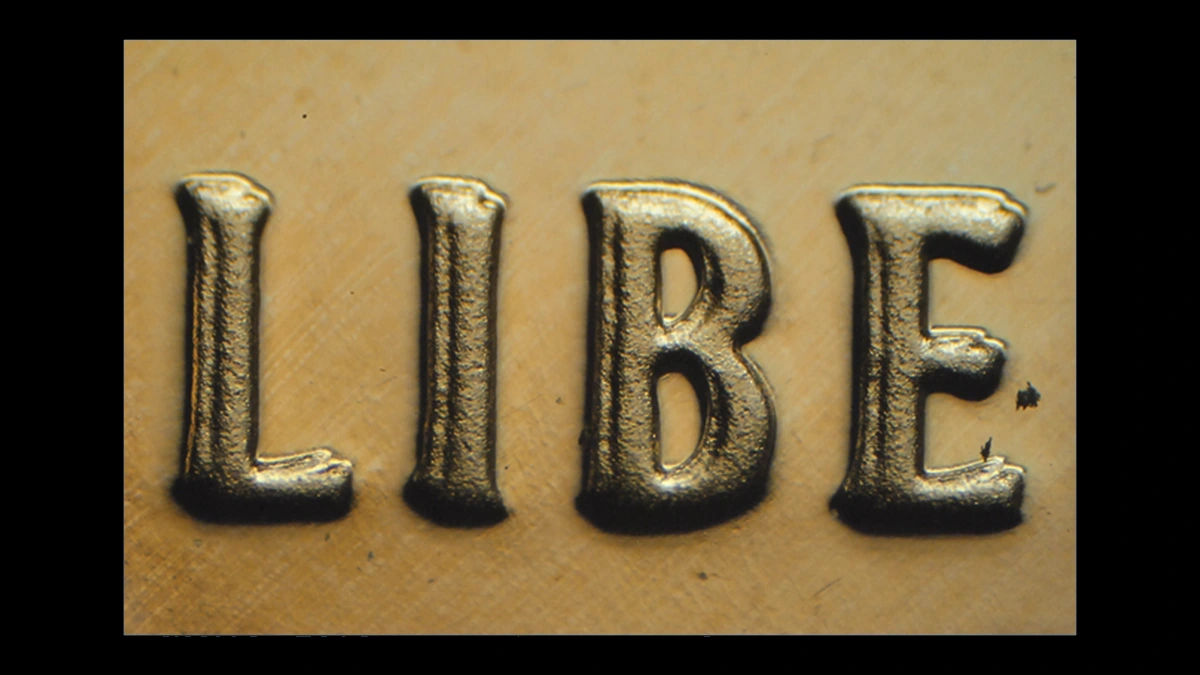
3. 1999 Quarter A Small Extra Ear Outline or Strong Proof Lettering — Doubled Die Error
Ordinary ear-doubling reports cover P and D Delaware, Pennsylvania, and Georgia, plus P New Jersey and D Connecticut. Delaware also has doubled saddlebag edges.
One Philadelphia Georgia variety combines ear doubling with extra peach-leaf detail. A separate S Pennsylvania clad Proof shows much stronger front lettering doubling.
How to Identify
Match the lower ear edge to the correct state and mint. On the Georgia combination, check the upper peach-leaf edge as a second feature on that same coin.
For the Pennsylvania Proof, compare the strongly repeated left-side lettering and weaker motto and S details. A New Jersey S Proof ear variety is separate, with its metal not specified by the catalog.
What It’s Worth
$5–$1,000 spans ordinary minor varieties and the stronger clad Proof. Ordinary features generally fit $5–$150, while the Pennsylvania Proof is estimated at $100–$1,000.
A flat shelf from strike movement does not justify the same doubled-die range.
4. 1999 Quarter The Horse and Portrait Are Extremely Faint — Weak Strike Error
A reported Delaware quarter carries an ANACS error description for a very weak strike. Its mintmark is not established in the supplied report.
The name die-adjustment strike is sometimes used, but it does not prove deliberate testing. The visible feature is shallow design transfer.
How to Identify
Compare both high and protected low details for broad shallow striking. Normal wear first rubs down the more exposed parts.
Inspect for polishing, corrosion, or other later metal removal. Delaware’s 1787 is an admission year; the actual issue date is 1999.
What It’s Worth
$25–$300 is the estimated range for an identified extreme weak strike. Enough surviving original detail to recognize the issue improves its appeal.
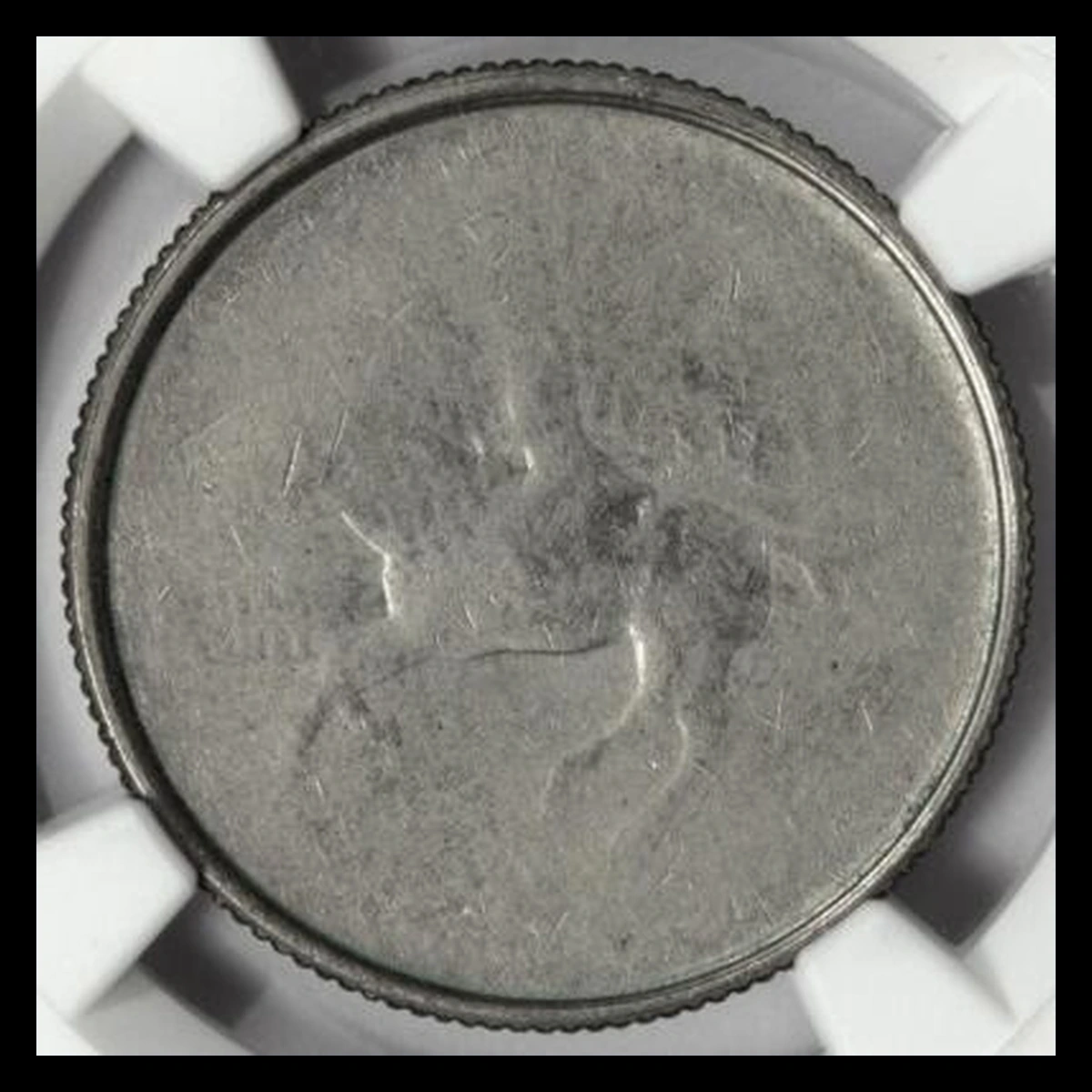
5. 1999 Quarter A Local Patch or Both Faces Lose Detail — Struck Through Error
Philadelphia New Jersey records include a grease-related example and a separate coin affected on both faces. Material blocked part of the design transfer during striking.
The grease-described coin also has later scratches. The two-face specimen does not establish grease as its blocking material.
How to Identify
Compare the boat scene with a normal New Jersey quarter and follow each affected boundary. Later scratches cut through finished surfaces rather than simply preventing design from forming.
Map both faces separately when both are affected. Leave retained material intact instead of cleaning away evidence.
What It’s Worth
$10–$300 is the estimated span. Minor grease weakness generally fits $10–$50, with larger original or clear two-face effects around $50–$300.
The scratched coin needs a condition discount, and a two-face error still receives one whole-coin price.
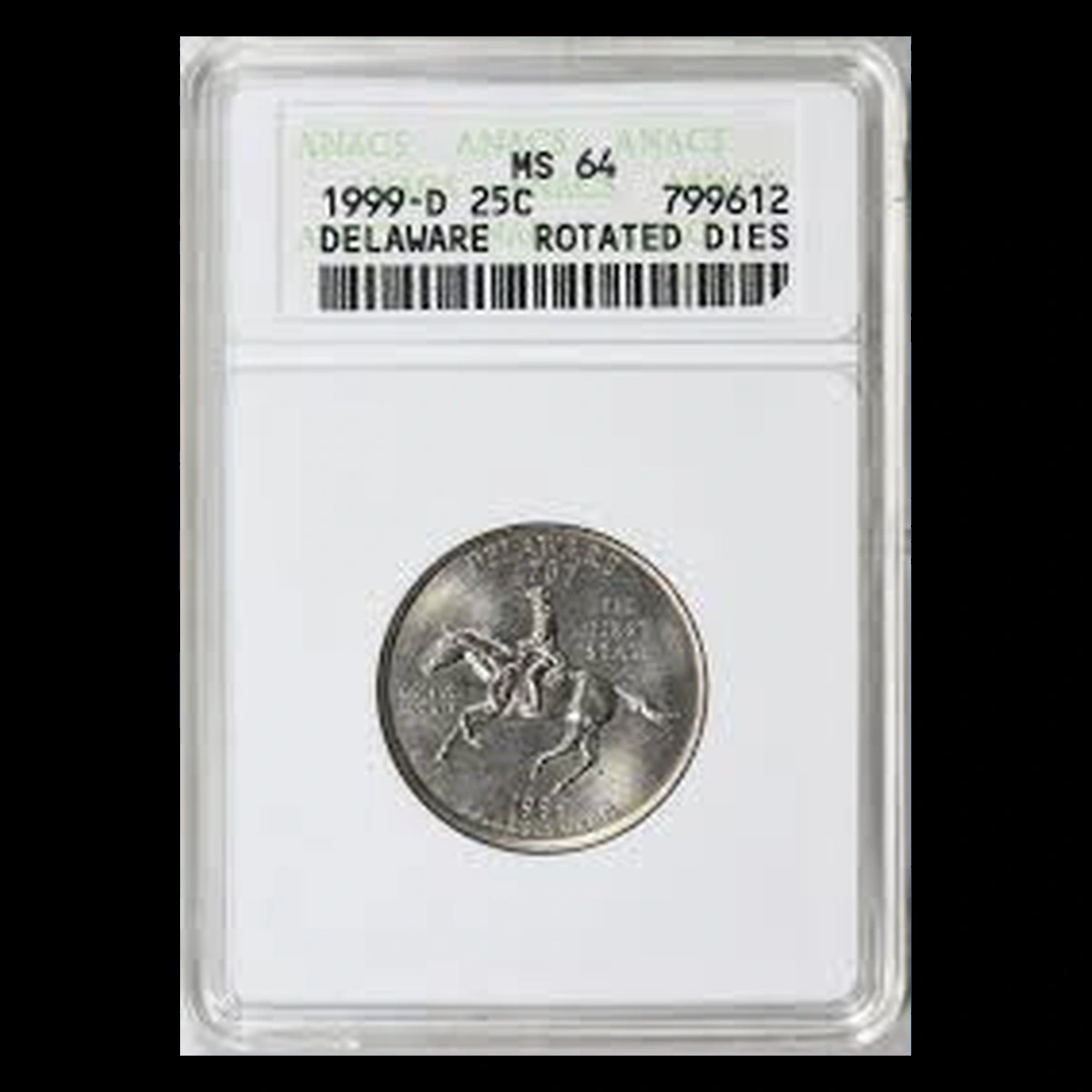
6. 1999 Quarter The Back Finishes at an Angle — Rotated Dies Error
Rotations are reported for both Delaware mints and for Denver Georgia and Connecticut. One Philadelphia Delaware example was corrected from a claimed half-turn to about 170 degrees.
Other Delaware examples reach a true 180-degree turn. Different angles describe different coins.
How to Identify
Hold Washington upright and flip the coin top to bottom without twisting it. A normal state design should finish upright.
Photograph the resulting tilt without straightening the coin. Measure its actual departure from upright, preserving the corrected 170-degree identification where appropriate.
What It’s Worth
$25–$1,000 is the estimate for noticeable genuine rotations. A large repeatable turn is easier to display than a slight deviation.
Wear, state, mint, and surfaces remain part of the price comparison.
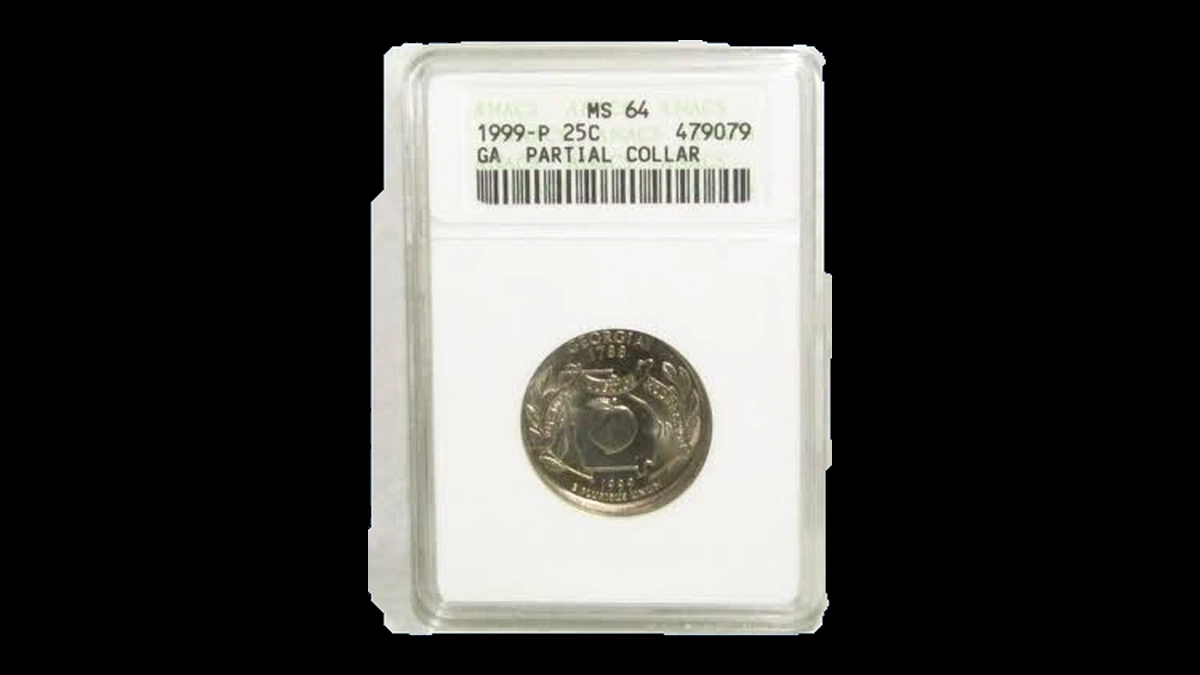
7. 1999 Quarter Grooves and Expanded Metal Form a Step — Partial Collar Error
Examples include Denver Pennsylvania, both mints of New Jersey and Georgia, and Philadelphia Connecticut. Only part of the blank’s edge was restrained by the collar ring.
The Pennsylvania report describes a tilted partial collar. Its stepped band’s height changes around the edge rather than rotating the reverse design.
How to Identify
Use a side view to follow the grooved section beside the expanded band. Rotate the view to see whether the transition stays level or slopes.
Check for cuts, filed grooves, or crushed metal. Keep the state and mint identified with every edge photograph.
What It’s Worth
$15–$300 is the estimated range for simple partial-collar errors. A strong original step on a clean coin generally displays better than a slight irregularity.
A combined collar error needs one overall comparison with its other features included.
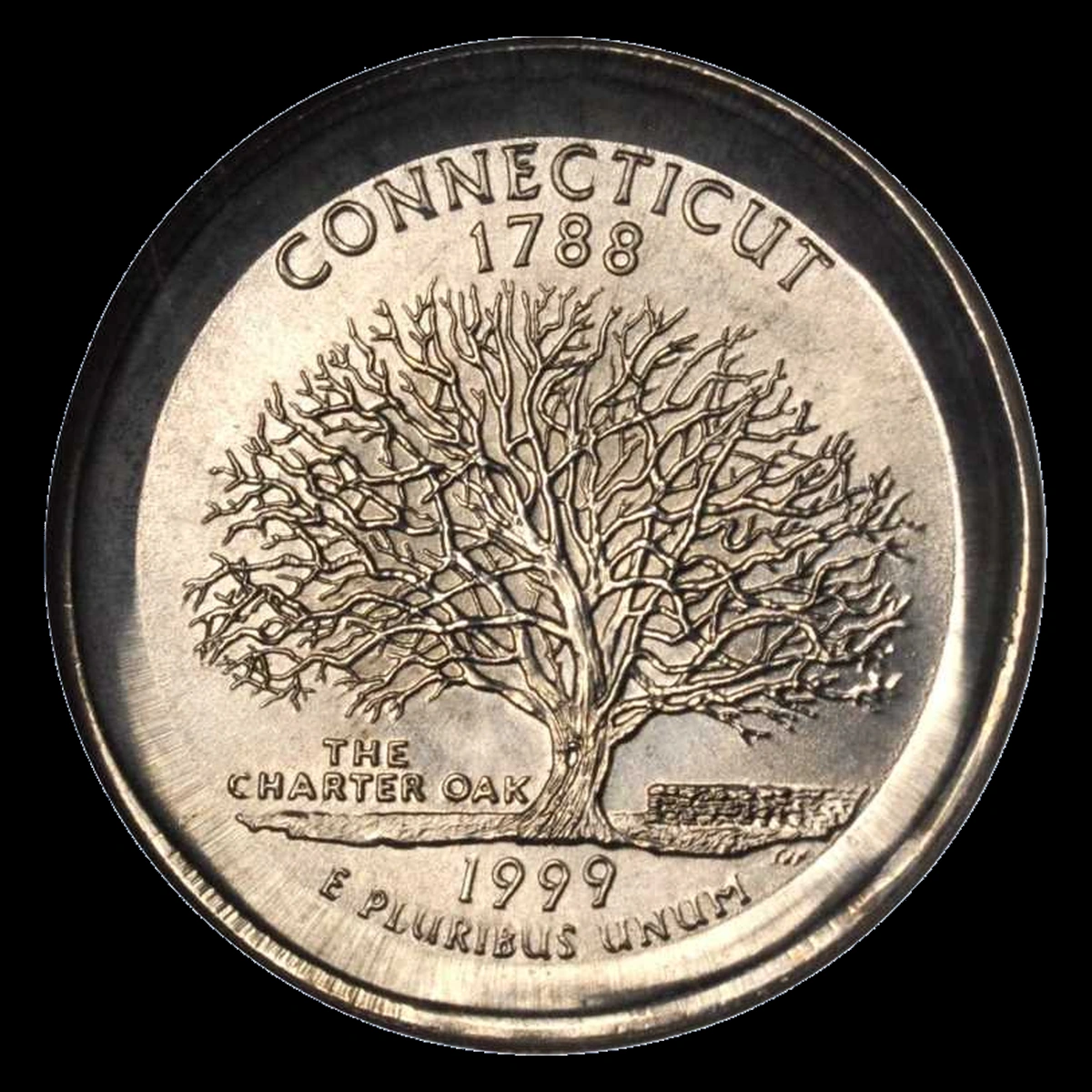
8. 1999 Quarter A Complete Design inside a Wide Border — Broadstrike Error
Broadstrikes are recorded for P and D New Jersey and Georgia, plus Philadelphia Connecticut. The collar failed to contain the metal during striking.
The design can sit unevenly inside the expanded outline while still remaining complete. Unequal border width alone does not make it off center.
How to Identify
Trace the portrait and state design to make sure they fit on the available metal. Measure the enlarged outline against the ordinary quarter’s roughly 24.3 mm diameter.
Look for original spreading rather than flattened letters and later pressure marks. Off-center coins lose design beyond one side and retain untouched metal opposite it.
What It’s Worth
$25–$500 is an estimate for simple genuine broadstrikes. Greater clear expansion and readable state detail support stronger examples.
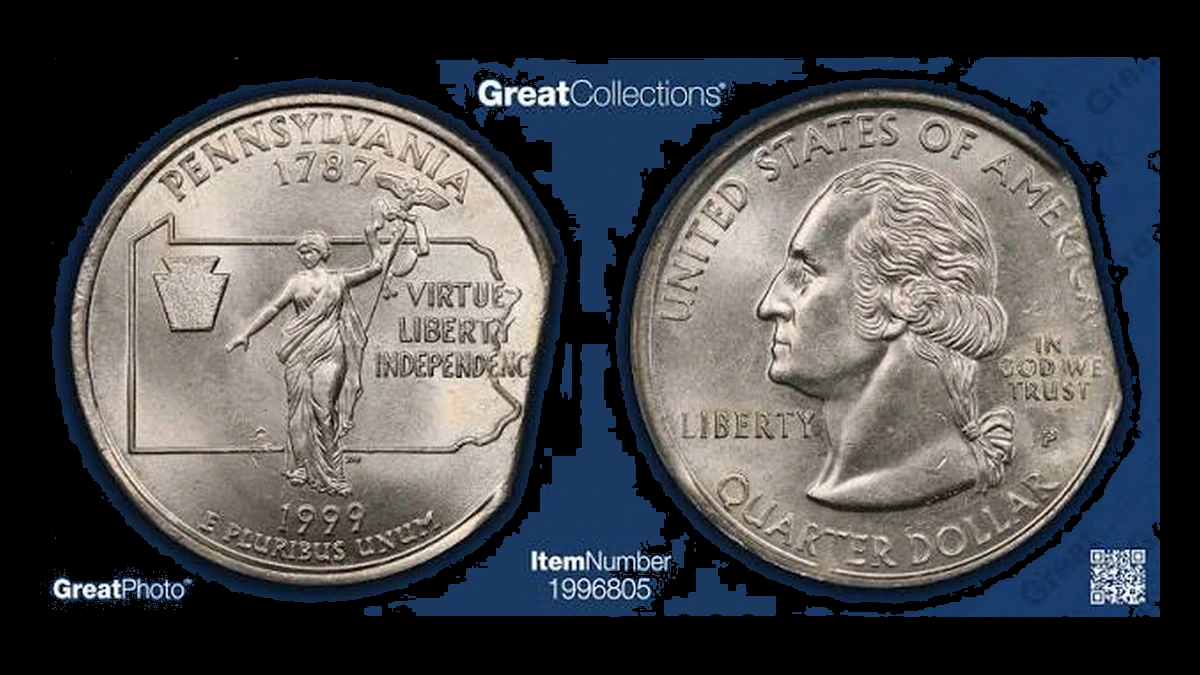
9. 1999 Quarter Curved Gaps, Corners, or an Oval Shape — Incomplete Blank Error
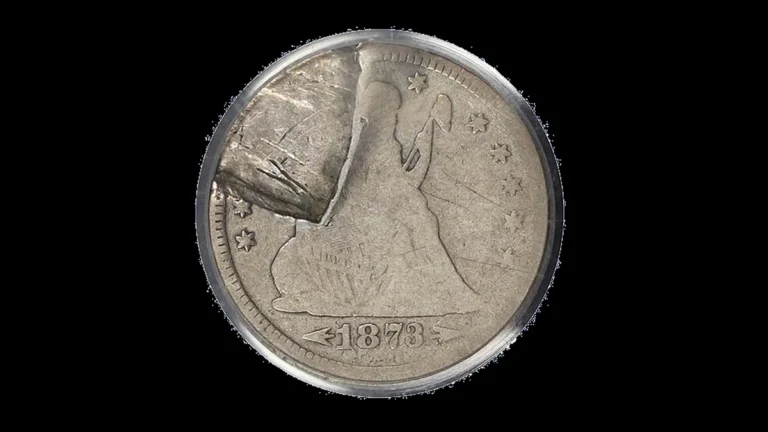
Delaware and New Jersey include multiple clips, while Pennsylvania includes curved and corner losses. Georgia has double clips and oval pieces; Connecticut includes straight-loss and bow-tie shapes.
Some examples also have off-center or expanded strikes. Missing metal and changed strike position can coexist on one coin.
How to Identify
Follow each incomplete boundary through both faces and the edge. A curved punch overlap, straight strip edge, and corner preserve different preparation clues.
On a clipped off-center coin, distinguish the empty gap from the solid unstruck metal. Check for burrs or filing, and do not calculate the clip percentage from weight alone.
What It’s Worth
$25–$1,500 is an estimate across modest clips and dramatic incomplete shapes. Readable state detail, original boundaries, and preservation guide the comparison.
Additional collar or strike effects remain part of one whole-piece price.
10. 1999 Quarter A Plain Crescent Remains beside the Design — Off-Center Strike Error
All five state designs appear in off-center records. A Denver New Jersey quarter is described as about half off center, while Georgia includes smaller Philadelphia shifts and a separate 85% example with no mint established.
The unused metal stays present because the blank was misplaced, not cut after minting.
How to Identify
Find the untouched crescent opposite design that runs beyond the edge, then check the other face for the same displacement. One shifted face can instead indicate a misaligned die.
A surviving state scene may identify a severely shifted issue even when the 1999 date misses the metal. Do not invent a missing mintmark.
What It’s Worth
$25–$2,000 is the estimate for simple off-center examples. Historical dealer asks included $135 for a 15% Philadelphia Georgia coin and $250 for a 20% example.
Those offers are not realized prices, and a larger shift does not override condition or date visibility.
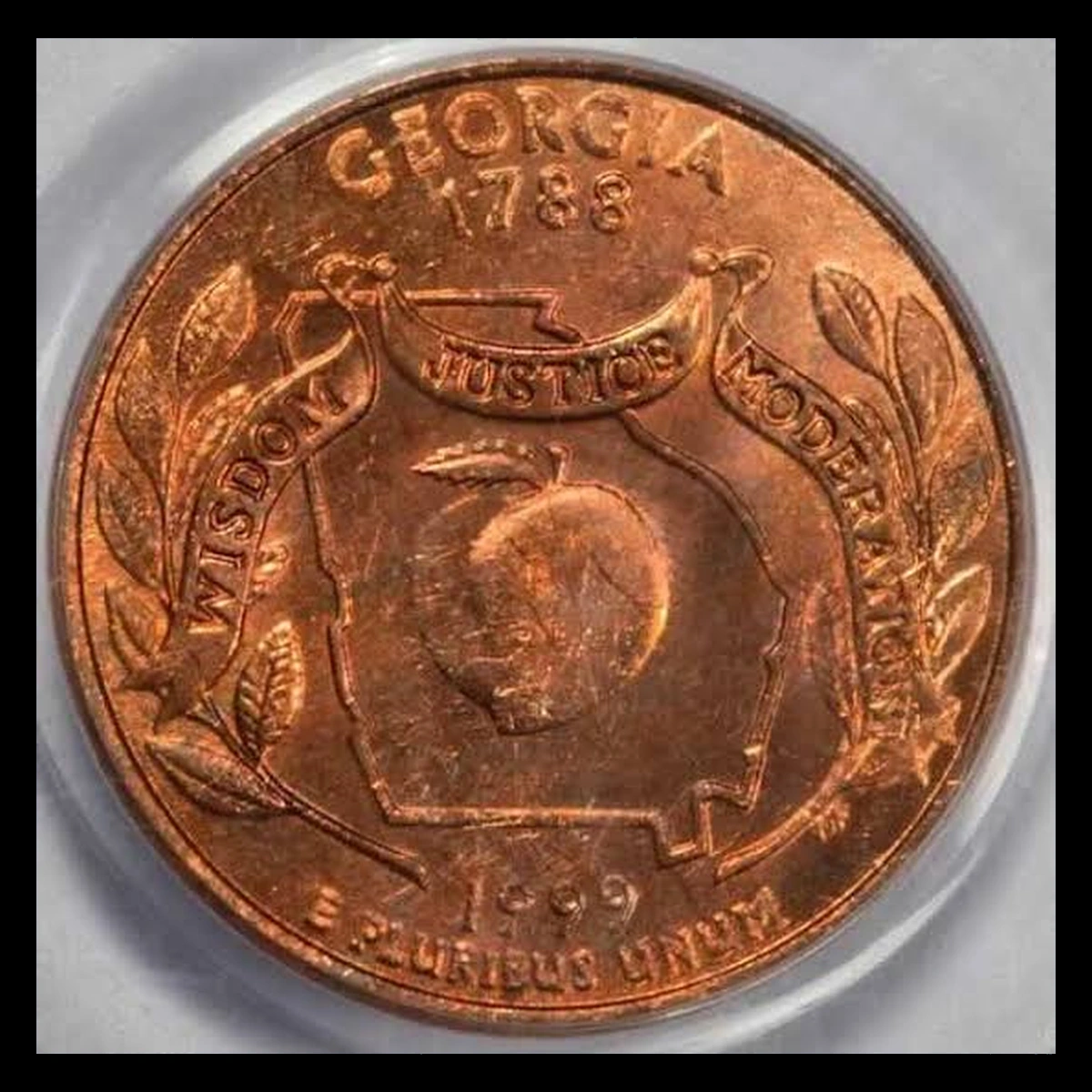
11. 1999 Quarter Copper Appears on One Face — Missing Clad Layer Error
Delaware records include reverse-layer losses, Georgia front and partial losses, and Connecticut both front and tree-side losses. The copper-colored Connecticut tree is sometimes called Burning Bush.
That nickname describes missing-layer appearance rather than a separate variety. One Denver Georgia coin weighs 4.62 grams, but other losses need their own readings.
How to Identify
Compare both faces and inspect the edge’s remaining layers. A normal clad quarter weighs 5.67 grams, but partial loss does not require every coin to be exactly 20% lighter.
Check for scraping, plating, or chemical damage. Normal 90% silver Proofs weigh 6.25 grams and lack the clad copper-core stripe, so they require a separate metal comparison.
What It’s Worth
$150–$2,000 is the estimated range for genuine layer loss. Historical asks were $250 for a Philadelphia Connecticut front loss, $575 for a Denver tree-side loss, and $1,650 for a Philadelphia Delaware reverse loss.
These were separate coins offered for sale, not one shared auction result.
12. 1999 Quarter Only a Thin State-Side Sheet Survives — Separated Clad Shell Error
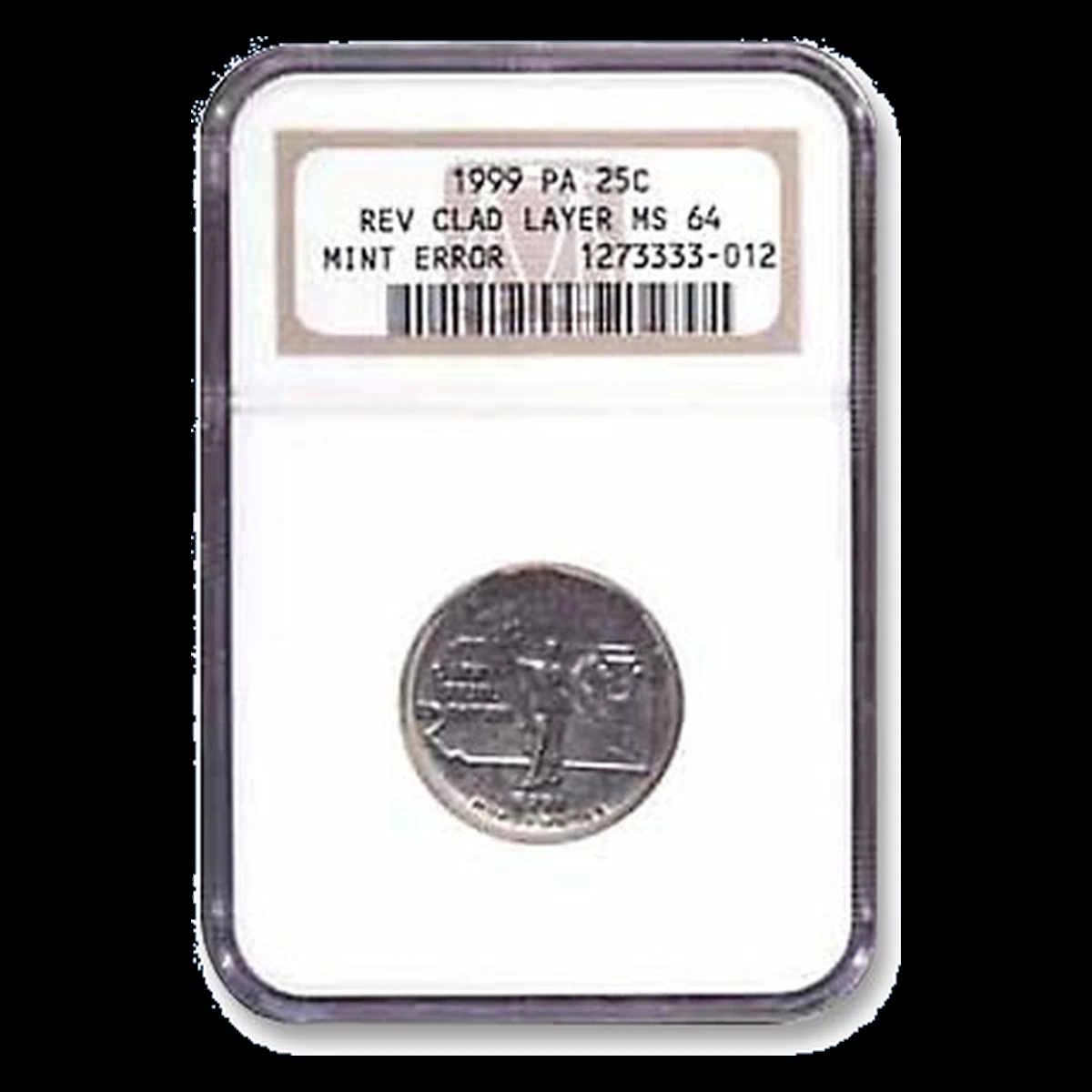
The documented Pennsylvania object is the detached reverse layer itself, illustrated by NGC as MS64. It retains the state design on a thin sheet of metal.
It is not a complete quarter missing its reverse layer. No matching remainder is established by this record.
How to Identify
Photograph the outer state design and inner separation surface without flattening the shell. Its edge should show a much thinner object than the complete layered coin.
Inspect for grinding or chemical removal that could artificially thin a quarter. Keep a certified shell sealed and do not flex it to test its structure.
What It’s Worth
$100–$2,000 is an estimated range for an authenticated separated layer. Recognizable design, an intact outline, and an undamaged inner surface support stronger examples.
The estimate covers the shell alone unless its actual matching remainder is present.
13. 1999 Quarter A Broad Hollow beside an Off-Center Design — Indent Combination Error
NGC illustrated a New Jersey quarter about 15% off center with an indentation covering roughly half the front. Another blank blocked that area during striking.
The hollow and displaced strike belong to the same coin. A plain depression does not automatically mean a mirror image was transferred.
How to Identify
Map the unstruck crescent and cut-off design first, then follow the separate front depression. Its boundary should fit the original strike rather than a later impact.
Search inside the hollow for recognizable transferred detail. A smooth indent and a sunken backward design are different findings.
What It’s Worth
$200–$2,000 is an estimate for a comparable authenticated combination. The clarity of the hollow, state detail, and original surfaces guide its overall value.
14. 1999 Quarter A Distorted Front and Stepped Edge — Struck through a Die Cap Error
A Philadelphia Connecticut quarter received its front design through a coin stuck over the die. It also shows a partial-collar step around the edge.
This is the receiving coin beneath the cap, not the cup-shaped object that covered the tool. A cap-related error can therefore remain fairly flat.
How to Identify
Compare the broadly weakened or distorted portrait with the more directly struck tree side. Wear on a few high points does not explain the same blocking pattern.
Inspect the collar step as a separate feature of that coin. The step alone cannot prove that the front was struck through a cap.
What It’s Worth
$200–$2,000 is an estimate for this clear covered-die and collar combination. The range values the receiver as a whole rather than borrowing the price of a tall cap.
15. 1999 Quarter Several Portraits or State Images Overlap — Multiple Strikes Error
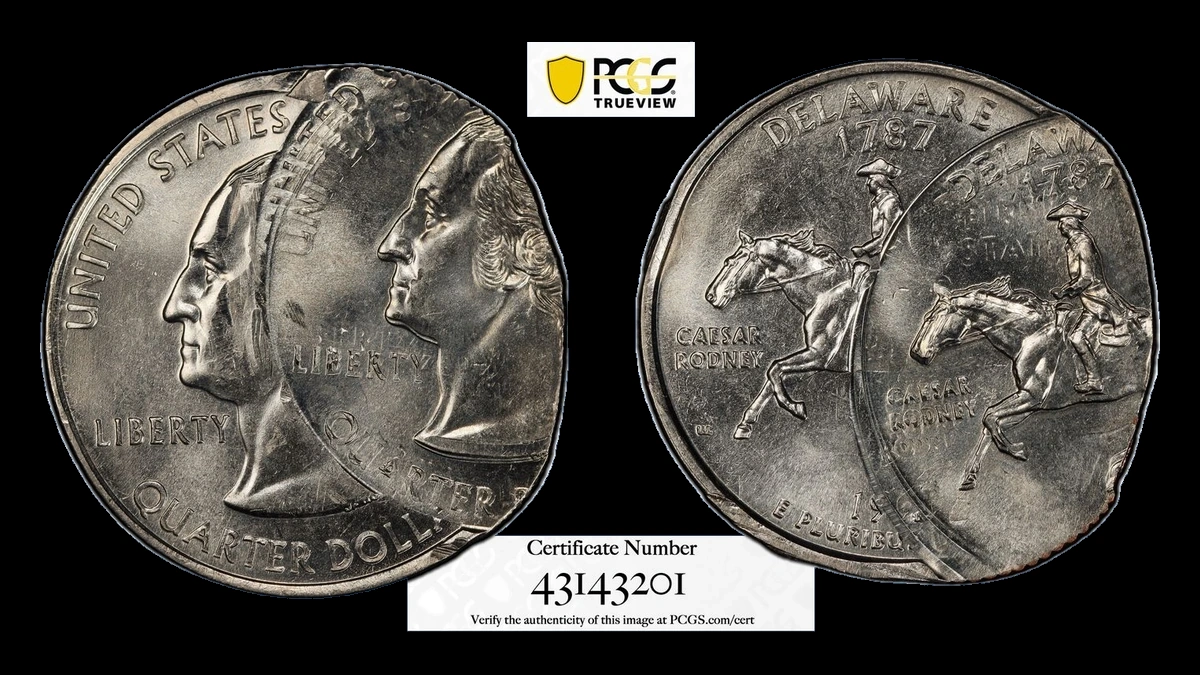
Repeated-strike records cover all five states and one Philadelphia piece with no state identified. A Denver Pennsylvania coin is cataloged with at least 26 blows in two overlapping groups.
Other specimens have three or four strikes, and a Georgia report describes eight. New Jersey includes a second strike with a partly blocked reverse.
How to Identify
Trace connected details into distinct design positions instead of counting every bright edge. Compare the front and back to see whether they support the same movements.
On the New Jersey combination, record which later areas carry design and which were blocked. Do not invent missing impressions to reach a strike count.
What It’s Worth
$200–$4,000 is the estimated range for these repeated-strike combinations. A historical dealer asked $2,850 for the Denver Pennsylvania piece with at least 26 strikes.
That was an asking price, and more blows do not always bring more money. Two readable separated images can display better than many crowded impressions.
16. 1999 Quarter A Cup Forms around a Stuck Coin — Die Cap Error
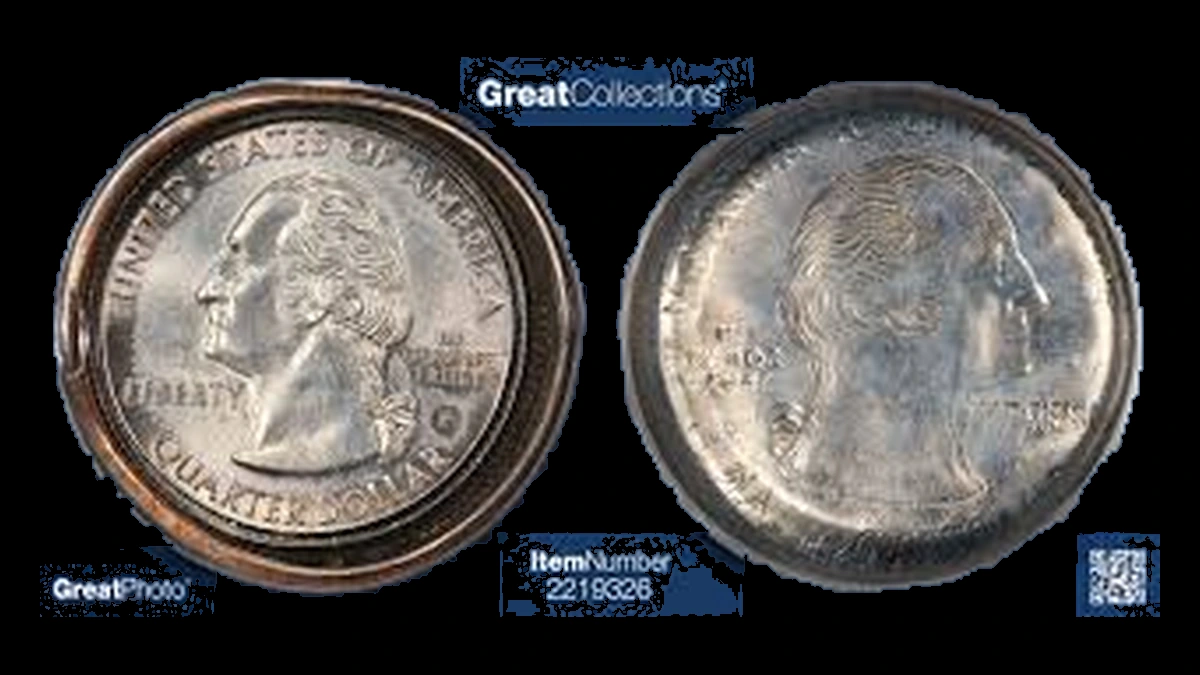
Recorded caps include Philadelphia Delaware and Connecticut, plus Georgia examples whose mint is not always readable. A Philadelphia Georgia piece combines a deep cap and double strike.
Another Georgia coin began with a sunken mirror impression before staying on the tool and expanding further. The transferred peach belongs to that same cap.
How to Identify
Use side views to follow the rising wall and stretched design. A complete naturally formed cup differs from one edge segment bent upward after minting.
Do not press the wall or assume an unreadable mintmark. For the mirror-impressed Georgia cap, keep the backward peach and cup shape connected in photographs of the same object.
What It’s Worth
$500–$6,000 is the estimate for genuine caps and combinations. A Georgia price history reports $4,200 on August 28, 2022 for a deep double-struck example.
Wall height, completeness, state visibility, and preservation matter. Several effects on one cap still receive one overall price.
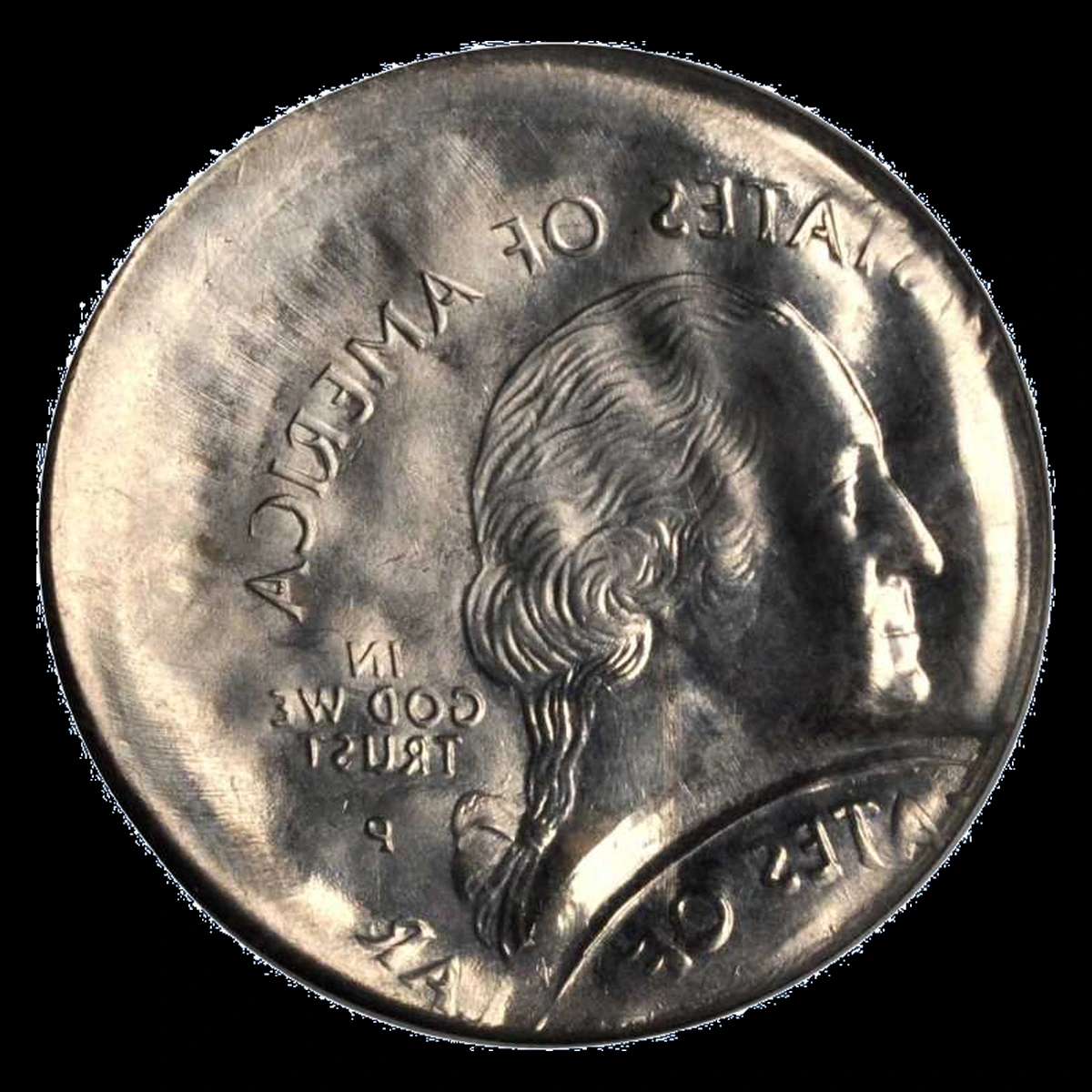
17. 1999 Quarter A Backward Tree or Boat Is Sunken into the Coin — Brockage Error
A finished coin caught against a new blank can press a mirror image into it. Connecticut reports include a tree where Washington’s portrait should be.
Philadelphia New Jersey examples combine brockage with expansion or a partial collar. One expanded specimen was struck on a blank whose edge had not yet been raised during preparation.
How to Identify
Find recognizable backward detail and confirm that it lies below the surface. A plain hollow does not establish brockage.
Compare both faces and the edge for original striking relationships. Later squeezing of finished coins can also transfer images, often with surrounding crushed details.
What It’s Worth
$200–$6,000 is the estimated range for genuine partial or larger brockages and their combinations. Clear backward lettering or a recognizable scene makes the error easier to understand.
Any broadstrike or partial-collar feature stays within the same complete-coin valuation.
18. 1999 Quarter Two Separate Coins Have Matching Marks — Georgia Mated Pair Error
A Philadelphia Georgia pair preserves related collar, indent, and stretched-strike effects. One piece helps explain the shape left on the other.
The historical auction offered them as an uncertified pair. They are separate coins, not a permanently bonded object.
How to Identify
Compare the contact boundaries in photographs, looking for a relationship that explains the same press event. Two coins with merely similar damage do not form a mated pair.
Do not force the pieces together. Store them so their surfaces cannot rub while keeping the pair’s identification together.
What It’s Worth
$1,500–$5,000 is an estimate for a comparable matching pair. Published results list $2,415 for both Georgia coins together in the 2001 ANA auction.
The price is for the set, not for each piece individually.
19. 1999 Quarter Coins Remain Physically Joined — Reported Bonded Error
The 1999 year list includes bonded coins without establishing a state or a verified specific pair. Its wording overlaps with descriptions of separate mated coins.
A bonded error requires an actual connection formed during striking. Matching impressions alone establish neither a bond nor its timing.
How to Identify
Photograph the joint and both outer faces without pulling the pieces apart. The squeezed metal and nearby struck detail need to support a mint-made connection.
Check for glue, solder, or later forced attachment. If the coins remain separate but their impressions match, examine them as a mated pair instead.
What It’s Worth
$2,000–$10,000 is the conditional estimate for an authenticated 1999 bonded pair. It is not a recorded sale of the unidentified category entry.
The joined object receives one value, with its original joint and readable outer designs intact.
20. 1999 Quarter The Quarter Design Does Not Fit the Blank — Nickel or Foreign Planchet Error
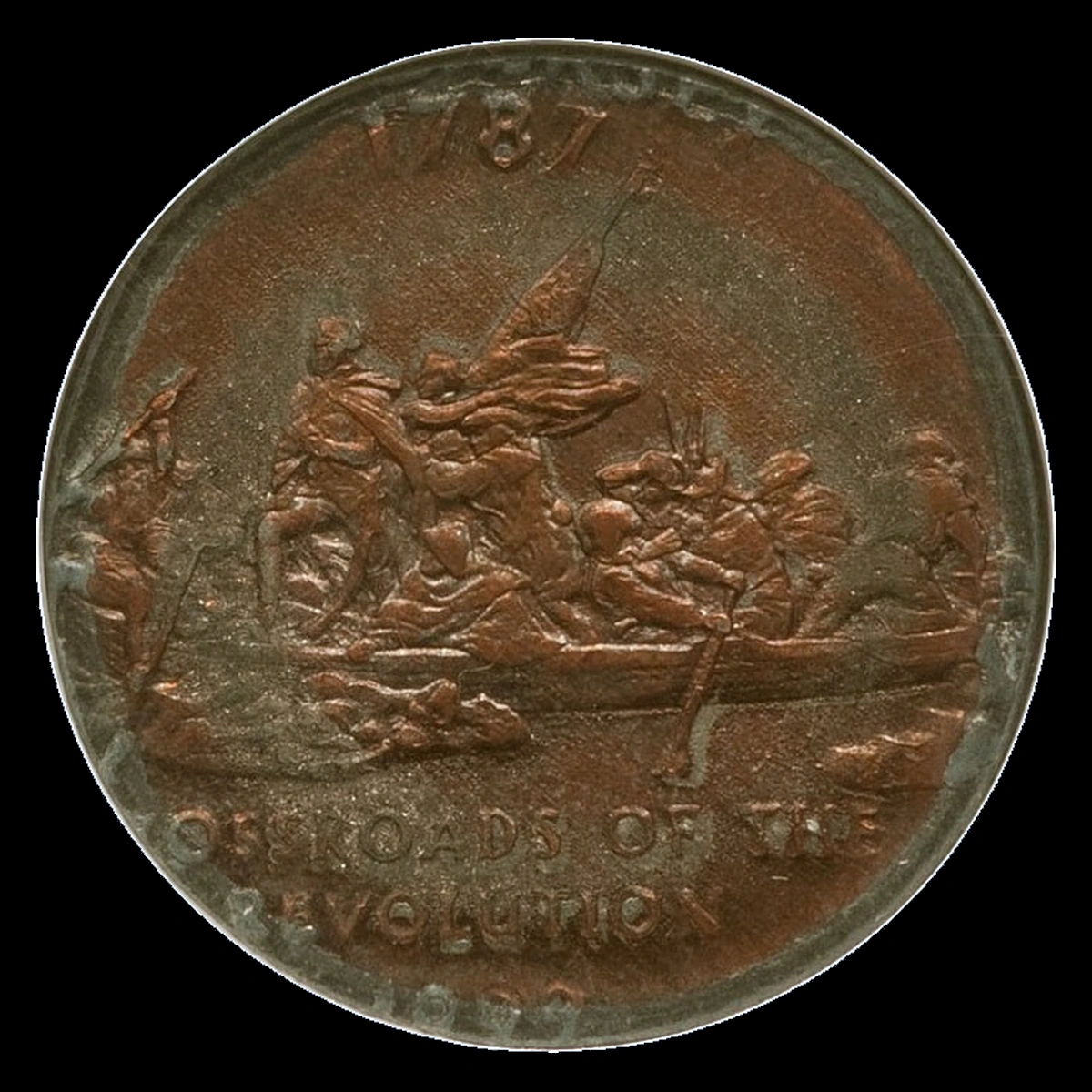
Nickel-blank records include Denver Delaware, Philadelphia New Jersey, and Philadelphia Connecticut. A Philadelphia Georgia specimen combines a nickel blank with a mirror impression.
A separate Denver Georgia example is described on a foreign blank. The supplied record does not establish its foreign denomination or country.
How to Identify
Compare actual weight, outline, and edge metal with the proposed blank. A normal nickel blank weighs 5 grams, while a standard clad quarter weighs 5.67 grams.
Uniform nickel-alloy metal and naturally cropped quarter details should support the nickel-blank explanation. The Georgia combination also needs its original sunken mirror image.
Material analysis is needed before naming the foreign blank. Color or size alone cannot supply a country.
What It’s Worth
$500–$7,000 spans these reported groups. Nickel-blank examples are estimated at $500–$3,000, with a strong mirror combination potentially reaching about $5,000.
The Denver Georgia foreign-blank record lists a $4,080 sale in April 2021. Its category is estimated at $2,000–$7,000 without establishing the blank’s denomination.
21. 1999 Quarter Designs Appear on Irregular Machine Metal — Feeder-Finger Fragment Error
A broken part of the feeding mechanism can enter the press and receive coin designs. Delaware and Connecticut examples are recorded on these feeder-finger fragments, sometimes with several strikes.
The Delaware auction piece shows repeated portraits and horses plus another partial motto. Connecticut reports include light aluminum fragments.
How to Identify
Examine the object’s material and broken outline before counting impressions. A machine fragment differs from round layered coin stock, even when both carry incomplete designs.
Photograph every edge without scraping or bending it. The material identification must explain the unusual object as well as its genuine struck details.
What It’s Worth
$700–$7,000 is an estimate for comparable authenticated fragments. The Delaware piece sold for $1,057.50 at Heritage on August 12, 2016.
A historical dealer asked $3,250 for a separate Philadelphia Connecticut fragment. The asking price and realized result belong to different pieces.
22. 1999 Quarter Golden Color with an Unusual Alloy — Experimental Planchet Error
Certified Philadelphia examples from all five states were struck on unusual alloys during golden-dollar development. The metals can contain copper and zinc with manganese and nickel, and some pieces retain a copper core.
The Georgia coin sold in 2020 had a consistent lemon-gold color and sharp design. Its appearance is not a rule for every state or alloy.
How to Identify
Record weight, thickness, and edge structure without damaging the surface. The 2020 Georgia specimen weighed 105 grains, about 6.80 grams, which is one coin’s measurement.
A plated souvenir can also look gold, and an experimental piece can retain a copper core. Professional alloy testing and a recognized attribution must connect the metal with the documented experiments.
What It’s Worth
$3,000–$15,000 is the estimate for authenticated experimental pieces. The PCGS MS67 Georgia example sold for $7,200 on January 10, 2020.
The strongest comparison needs the correct alloy, state, and condition rather than golden color alone.
Conclusion
A raised horse-mouth line, a thin detached shell, and a joined pair each tell a different story about a 1999 quarter. Begin with the state and surviving design, then identify what the physical object actually is.
Keep grades, measurements, and combined features with their own specimens. Protect thin layers, tall caps, and original joints, because the shape and undisturbed boundaries often provide the clearest evidence.