Rare 1859 Quarter Errors (List & Pictures)
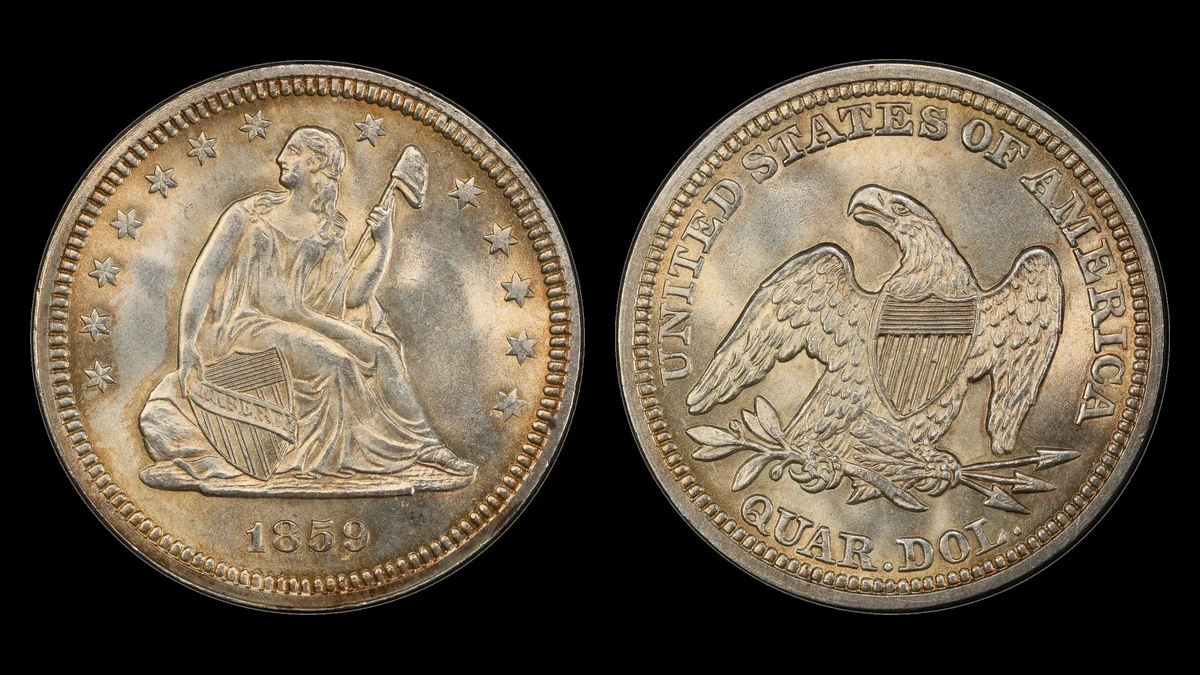
One Proof coin supplies all three features in this guide to 1859 quarter errors. The NGC PR66 Cameo example sold for $6,462.50 on April 24, 2013, with fine die lines, recut reverse lettering, and a small fiber impression.
The estimated $1,000–$8,000 range values a comparable complete Proof, not each feature separately. Examine the reverse lettering and front die markers first, then the individual mark beside Liberty’s knee.
1. 1859 Quarter Extra Edges in the Denomination: Recut Lettering Error
The abbreviated denomination at the bottom of the reverse means quarter dollar. The documented Briggs 2-C Proof shows evidence that this lettering was reworked in the die before striking.
Recutting the tool could leave extra strokes or edges that then appeared on the coins it produced. This is different from engraving a finished silver coin after it left the press.
How to Identify
Begin with the full denomination beneath the eagle, keeping the spaces and punctuation in view. Compare the group with an attributed Briggs 2-C Proof before isolating the edges of individual letters.
Move the light across the reflective surface to see whether the extra strokes remain fixed. A bright reflection can create an apparent second edge that disappears when the lighting changes.
Check for cuts across completed letters or disturbance of the surrounding surface, which could indicate later alteration. The three front die lines described next provide an additional variety match.
The ordinary pairing of front and reverse design versions is not another error to add to this list. The relevant feature here is the actual recutting within the denomination.
What It’s Worth
$1,000–$8,000 is an estimated whole-coin range for comparable genuine 1859 Proofs with the recut lettering. Preservation and the condition of the reflective fields matter more than counting strengthened letters.
The PR66 Cameo specimen’s $6,462.50 result includes this feature along with its die lines and fiber mark. It does not establish a second sale or an amount to add to those other observations.
2. 1859 Quarter Three Fine Lines near the Rock: Die Scratch Markers Error
The front die used for Briggs 2-C has three fine lines running from the rock’s tip toward the first star. These small marks help identify the tool that struck the coin.
A scratch recessed into a steel die can fill with metal during striking, producing a raised line on the quarter. A handling scratch made directly on the coin instead cuts into its finished surface.
How to Identify
Locate the pointed end of the rock beneath Liberty and the neighboring first star. Keep both landmarks in a photograph when comparing the placement and relationship of all three lines.
Use gentle side lighting to inspect the relief without touching the mirrored background. Three unrelated scratches in the general area are not enough to establish the marker.
The documented coin is PR66 Cameo, a Proof with strong preservation and frosted designs contrasting with reflective fields. Cameo describes that contrast, not another die defect.
What It’s Worth
$1,000–$8,000 remains the estimated range for the complete comparable Proof. The Heritage PR66 Cameo sale realized $6,462.50 on April 24, 2013.
The lines support attribution without establishing an independent premium for each one. Cleaning or new hairline scratches can harm both appearance and the clarity of the original markers.
3. 1859 Quarter A Backward Question-Mark Shape: Lint Strike-Through Error
A curved impression lies in the open field just right of and slightly below Liberty’s knee. The auction description identifies it as a lint mark resembling a backward question mark.
A fine fiber between die and blank can interrupt their contact and leave an impression. Unlike a line permanently cut into the die, this shape belongs to an individual striking event.
How to Identify
Use the full portrait to locate the knee, then enlarge the field beside it rather than the knee itself. Match both the position and the curved outline with the recorded specimen.
Inspect the impression under changing light for evidence of later cutting or pushed-up edges. Do not rub it away or try to clean the surrounding reflective field.
Another Briggs 2-C Proof need not have this mark. Use the repeatable die features to identify the variety and the lint impression only as a clue to this particular coin.
What It’s Worth
$1,000–$8,000 is the estimated value of a comparable complete Proof with original features and suitable preservation. Most of that value belongs to the Proof coin itself, and the lint mark does not have a separately established price.
A different fiber impression on another coin needs its own assessment. Its presence does not make that coin identical in condition or value to the PR66 Cameo example.
Conclusion
The reverse recutting and three front lines help identify the Briggs 2-C dies, while the curved lint impression helps recognize one particular 1859 Proof. That distinction prevents a specimen-specific mark from becoming a supposed requirement for the variety.
Preserve the reflective surfaces and compare each feature in its stated location. The recorded $6,462.50 was one whole-coin sale, and the three observations should remain part of that single valuation.