Rare 1796 Draped Bust Penny Errors (List & Pictures)
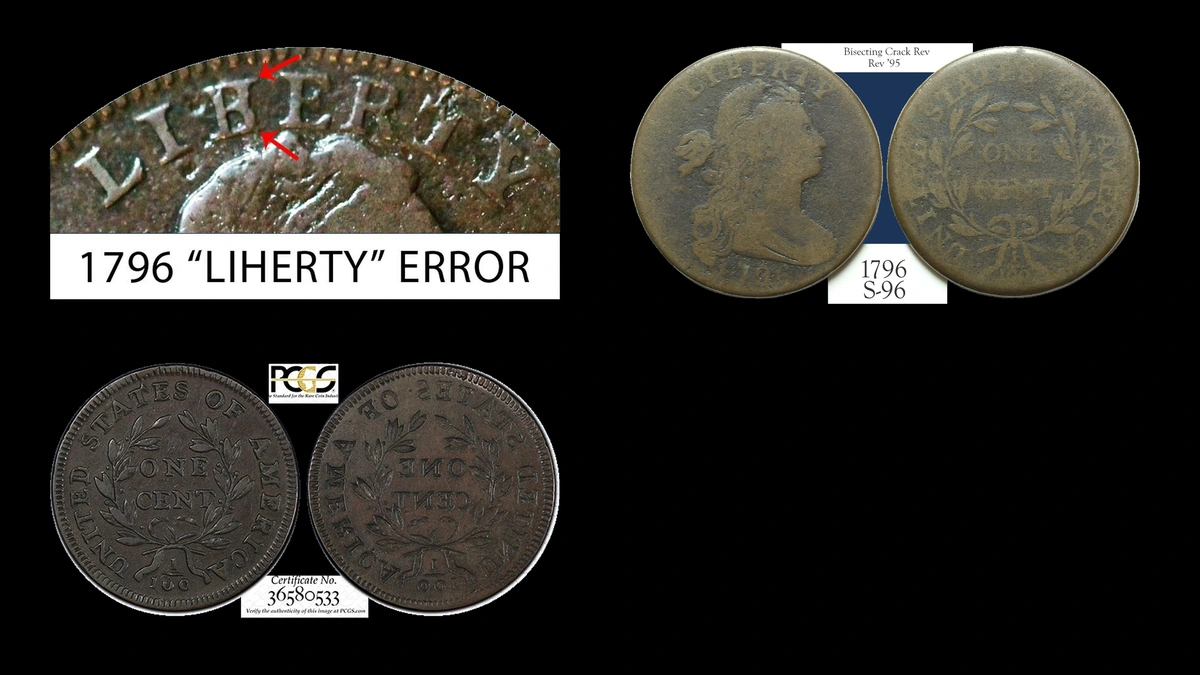
The shape of the B in LIBERTY, a split in the copper and a backward wreath each tell a different story. This 1796 Draped Bust penny error guide covers estimated whole-coin values of $250–$25,000.
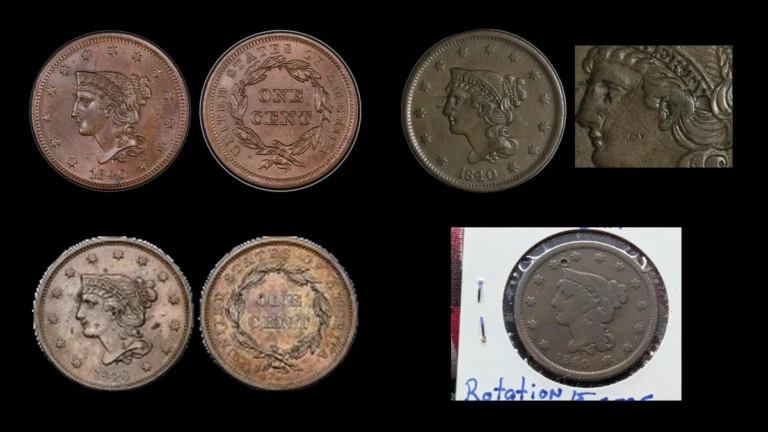
A lightly worn S-92 cent with a doubled profile and other features sold for $20,700 in February 2008. Use the lettering and surface first, then inspect missing metal and displaced or reversed designs; the separate 1796 Liberty Cap design is outside this guide.
| Visible feature | Category | Estimated whole-coin value |
|---|---|---|
| B appears like H | LIHERTY letter-punch error | $800–$20,000 |
| Lines or patches rise above the copper | Die crack or break | $300–$15,000 |
| Faint fragments of opposing design | Die clash | $300–$25,000 |
| A broad second portrait contour | Doubled profile, possible second strike | $500–$25,000 |
| Flakes or thin surface separation | Lamination | $250–$10,000 |
| A curved or straight missing edge section | Clipped planchet | $300–$1,500 |
| Bare area beside displaced design | Off-center strike | $2,000–$20,000 |
| A backward, recessed wreath | Reverse brockage | $4,000–$15,000 |
1. 1796 Penny LIBERTY Appears to Read LIHERTY: Letter-Punch Error
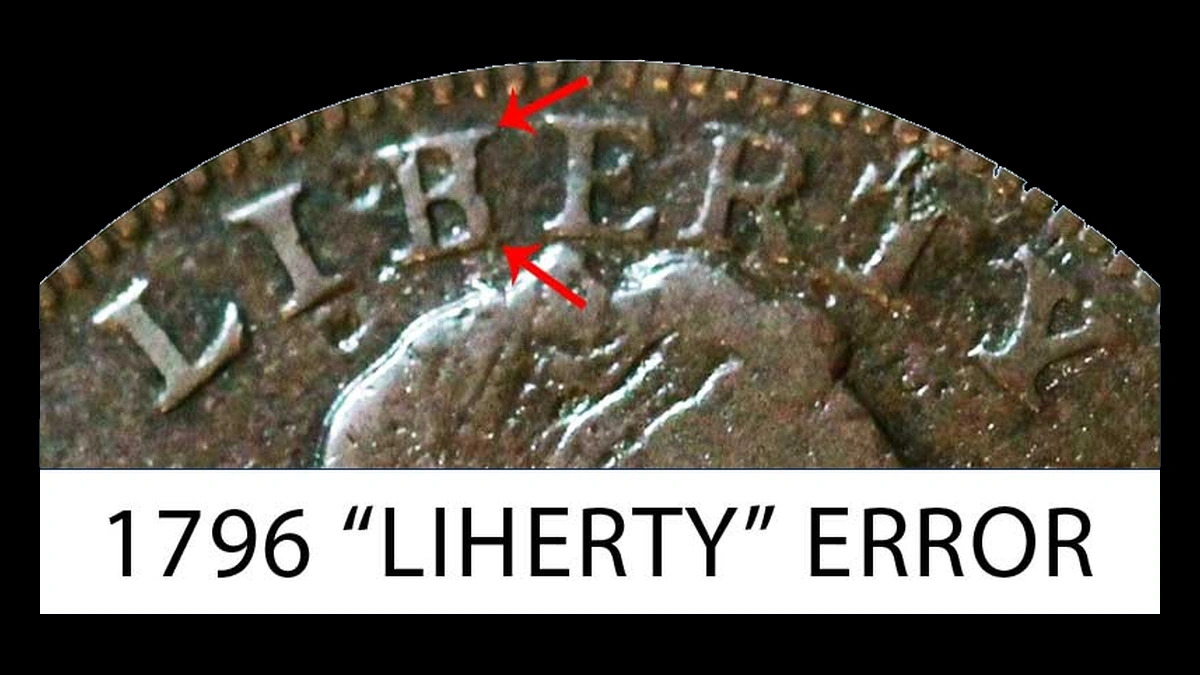
The unusual letter is an overlapping B, rather than an H mistakenly substituted into the word. An inverted B was punched into the die and then corrected with an upright B, leaving an H-like combination of strokes.
Two cataloged varieties share that obverse die but use different reverses. Identifying the letter therefore does not complete the identification of the die pair.
How to Identify
Compare the whole word with a known LIHERTY example, then examine the curved remnants of the overlapping B punches. A damaged ordinary B can look unusual without matching this pattern.
Inspect the surrounding copper for cuts or smoothing that might have reshaped the letter. Use a separate wreath comparison for each reverse pairing instead of requiring both varieties to match the same back photograph.
What It’s Worth
$800–$6,000 is an estimate for worn examples with a recognizable letter pattern, with $6,000–$20,000 for attractive pieces retaining more detail. These ranges value the entire early cent.
No single transaction is assigned to either pairing here. Availability of the particular variety and surface quality may influence the price much more than the letter’s apparent resemblance to an H.
2. 1796 Penny Raised Lines and Broad Edge Patches: Die Crack and Break Error
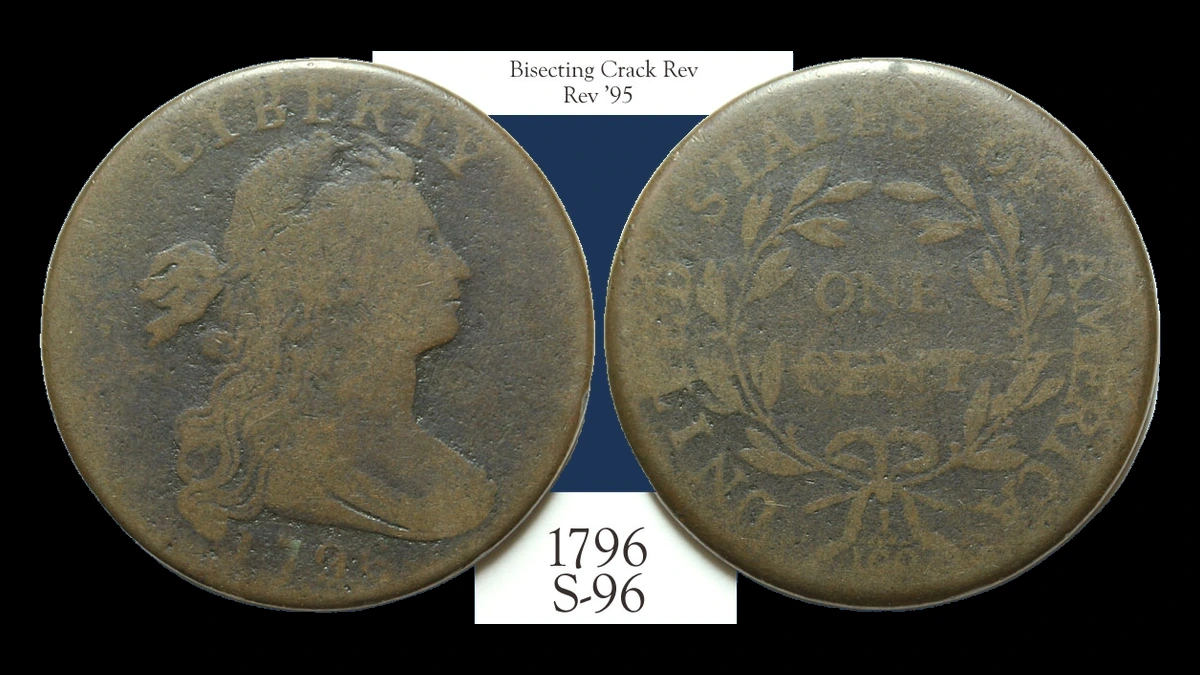
Reported examples include cracks through LIBERTY, a broad rim break above TY and a separate reverse break above TES. These features belong to different coins and should not be combined into one required pattern.
Copper entering a die crack forms a raised line, while a missing edge section of the die can produce a cud. In a retained break, the broken steel stays partly in place and can preserve design inside the affected area.
How to Identify
For the S-92 crack comparison, inspect the bases of RTY and tops of BER under angled light. The line should rise above the surface rather than cut into it.
The larger obverse patch needs a view of the rim above TY and the adjacent edge to exclude impact damage. The reverse example instead requires a TES photograph showing the boundary and any design surviving within the retained section.
What It’s Worth
$300–$3,000 is estimated for worn cents with die cracks or breaks, rising to $3,000–$15,000 for scarcer varieties or better-preserved examples. The ranges include the date, variety and condition of the cent.
The front break above TY is documented on a PCGS VF30 coin, and the retained reverse break occurs on a different VF30 specimen. Their moderate-wear grades do not establish identical rarity, surfaces or value.
3. 1796 Penny Faint Opposing Design Fragments: Die Clash Error
The S-92 cent with the broad doubled profile also has multiple sets of clash marks on both faces. These can accumulate when dies contact each other without a blank and then transfer the resulting marks to later coins.
Repeated die contact does not require repeated blows on the coin being examined. Other 1796 Draped Bust varieties are also reported with clashes.
How to Identify
Find a real part of the opposing portrait or wreath that explains the suspected extra outline. Side lighting and full-face photographs help show placement that a tight crop can hide.
A scratch has no necessary relationship to a wreath leaf or portrait shape. Counting faint lines without tracing that relationship cannot establish either clashes or a number of strikes on this cent.
What It’s Worth
$300–$4,000 is estimated for worn clashed cents, with $4,000–$25,000 for attractive lightly worn examples. Much of that range reflects the early date, variety and preservation.
The S-92’s $20,700 auction result also includes its profile doubling and other features. It should not be treated as a separate clash premium to add to another whole-coin price.
4. 1796 Penny A Second Outline from Forehead to Chin: Doubled Profile Error
A recorded S-92 shows widely separated portrait contours extending from the forehead almost to the chin, accompanied by repeated strokes at RTY. Heritage proposed an additional obverse strike as an explanation for this arrangement.
That is an interpretation, not an established doubled-die classification. A doubled die contains duplicated details before striking, whereas a second strike would add another impression to the coin itself.
How to Identify
Follow the second profile along its full length and compare its spacing with the repeated lettering. An isolated extra chin line gives much less information than the combined pattern.
View the relief under changing light to distinguish a rounded contour from a flat shelf caused by movement during one blow. Both faces should remain available for assessment even though the published argument emphasizes the obverse.
What It’s Worth
$500–$5,000 is an estimate for worn cents with convincing repeated profile detail, with $5,000–$25,000 for strong lightly worn examples. The PCGS AU55 S-92 specimen sold for $20,700 in February 2008.
Its attractive preservation, profile, lettering, cracks and clashes all belong to that one sale. The result does not settle the mechanism that produced the doubled appearance.
5. 1796 Penny Shallow Flakes and Thin Separations: Lamination Error
One worn cent has a shallow flake near Liberty’s chin as well as a small curved clip. A different PCGS VF30 example has a thin original separation at OF on the reverse, along with a retained reverse break.
Both involve local weakness in the copper rather than a complete separation into two thinner discs. A layer can detach or remain partly connected to the surrounding metal.
How to Identify
Keep the chin flaw separate from the same coin’s later dig beneath O in ONE. Their boundaries and locations represent different kinds of damage or metal separation.
On the VF30 comparison, examine OF for the actual thin layer rather than transferring the other specimen’s chin location. Leave any attached sheet untouched.
Normal starting references for a loose cent are 10.89 grams, roughly 28–29 millimeters across and a plain edge. Measurements can support the examination, but avoid pressure on fragile layers and keep certified pieces in their holders.
What It’s Worth
$250–$2,000 is estimated for worn examples with modest original flakes, while scarcer varieties in better condition may fit $2,000–$10,000. The difference is not simply a price for more peeling copper.
The chin-flake coin with the curved clip sold for $408 including fees in January 2023. Its separate features are already included in that complete-coin result.
6. 1796 Penny Curved or Straight Metal Loss at the Edge: Clipped Planchet Error
The curved clip on the worn example lies to the right of Liberty’s bust. A different cent has a straight missing section near L on the front and UNI on the reverse, with later surface damage also noted.
These openings began in incomplete blanks before striking. Their different shapes need their own comparisons to distinguish original blank cutting from removal of finished coin metal.
How to Identify
Locate the same opening on both faces and inspect its wall and endpoints. Saw teeth or regular file lines suggest a later cut rather than an original blank boundary.
Softness around the gap or opposite border may support a clip when it agrees with the rest of the strike. Do not use the straight-clip specimen’s later surface damage as an explanation for how its blank became incomplete.
What It’s Worth
$300–$1,500 is an estimated whole-coin range for worn cents with modest clips. The VG7 curved-clip S-92 sold for $408 including fees in January 2023.
That heavily worn coin also has the shallow flake and a later small dig. The straight clip requires a separate assessment that accounts for its own surface problems.
7. 1796 Penny Most of LIBERTY Misses the Blank: Off-Center Strike Error
The recorded PCGS F12 error retains the complete 1796 date even though only L survives from LIBERTY. A 40% shift toward the upper right placed Liberty’s facial features outside the struck copper.
How to Identify
Use the complete date and surviving L to orient the photograph, then trace the boundary between struck design and unstruck metal. Scraping or grinding an ordinary cent can erase detail but leaves a different surface.
Compare the reverse using the same physical edge as a reference. The missing design on both sides should fit one displaced blank, and the edge should not show later trimming.
What It’s Worth
$2,000–$8,000 is an estimate for worn identifiable 1796 off-center cents, with $8,000–$20,000 for stronger examples. No completed price is supplied for the recorded 40% F12 coin.
A dateless 1808 Classic Head cent, described as AU55 and 30% off center, sold for $6,462.50 in February 2018. Its different design and lighter wear prevent displacement percentage alone from setting the 1796 value.
8. 1796 Penny A Backward Wreath Replaces the Portrait: Reverse Brockage Error
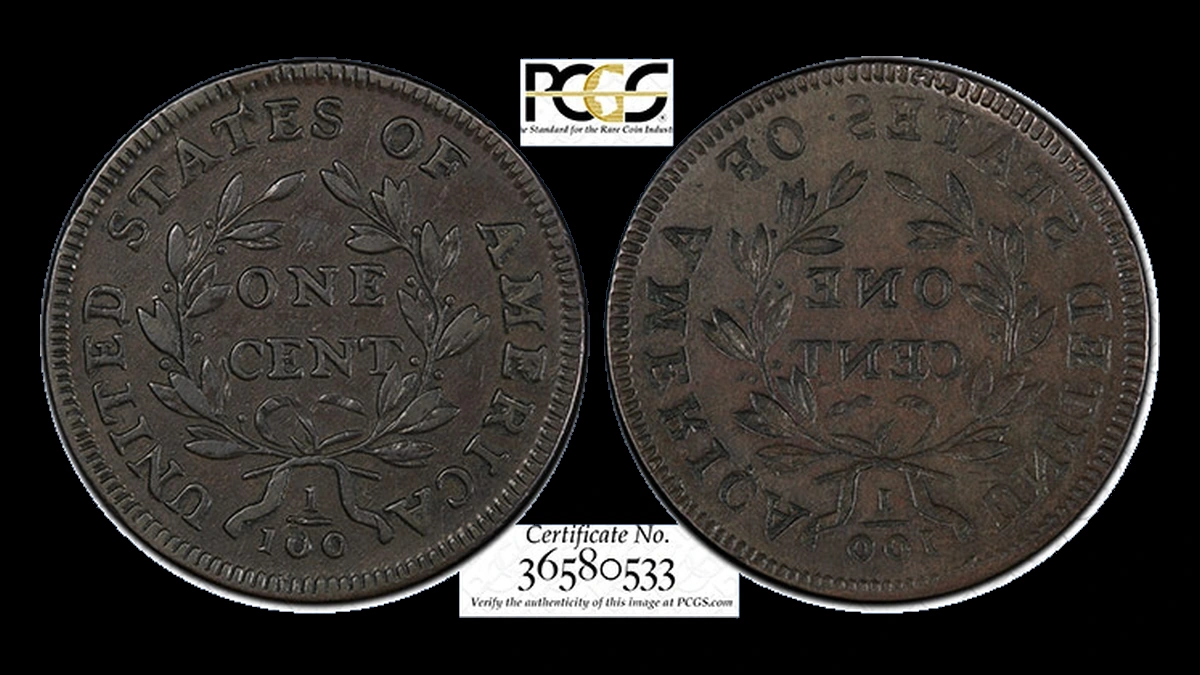
The documented brockage has a normal raised reverse on one face and a sunken mirror image of that design on the other. An already struck coin pressed its raised reverse into another blank during minting.
Neither face supplies a normal dated obverse. Attribution to 1796 instead depends on the reverse design and a matching break at the second T in STATES.
How to Identify
Check that ONE CENT is raised and normally reading on one side, but recessed and backward on the other. Two normal raised wreaths would require a different explanation.
Compare the normal face with the Reverse of 1797 used on some 1796 Draped Bust cents, including the specific T break. A general wreath resemblance alone does not establish the date of a dateless piece.
What It’s Worth
$4,000–$15,000 is estimated for an identifiable reverse brockage of this type. PCGS describes the VF35 specimen, which brought $5,280 at Heritage in December 2018.
The complete impression and reliable die attribution are central to that comparison. Another dateless brockage requires its own identification before borrowing the result.
Conclusion
For these early cents, variety and surface preservation contribute heavily to value alongside the visible error. A modest flake on scarce, attractive copper can accompany a higher price without the flake itself creating that difference.
Separate raised design from recessed design, missing metal from missing detail, and observation from a proposed striking sequence. When several features share one cent, their auction result remains one whole-coin price.