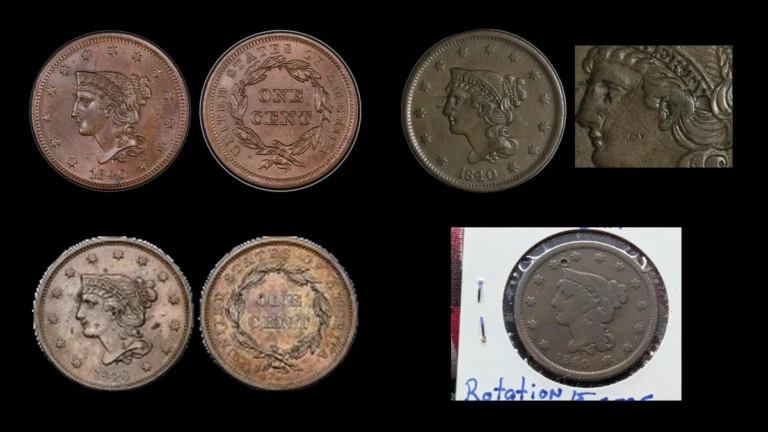
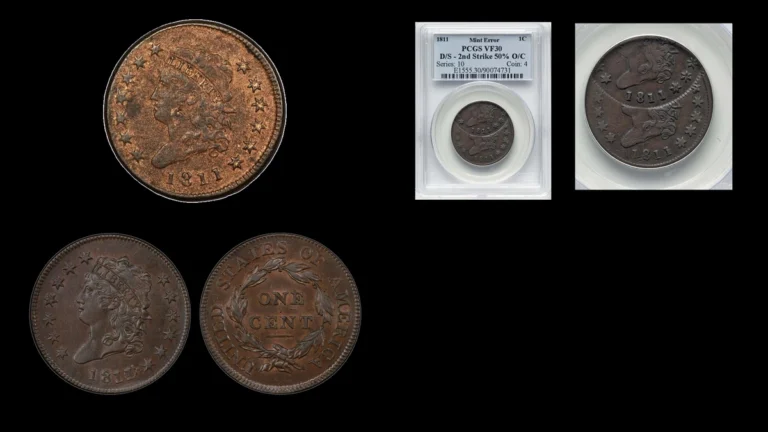
Rare 1838 Penny Errors (List & Pictures)
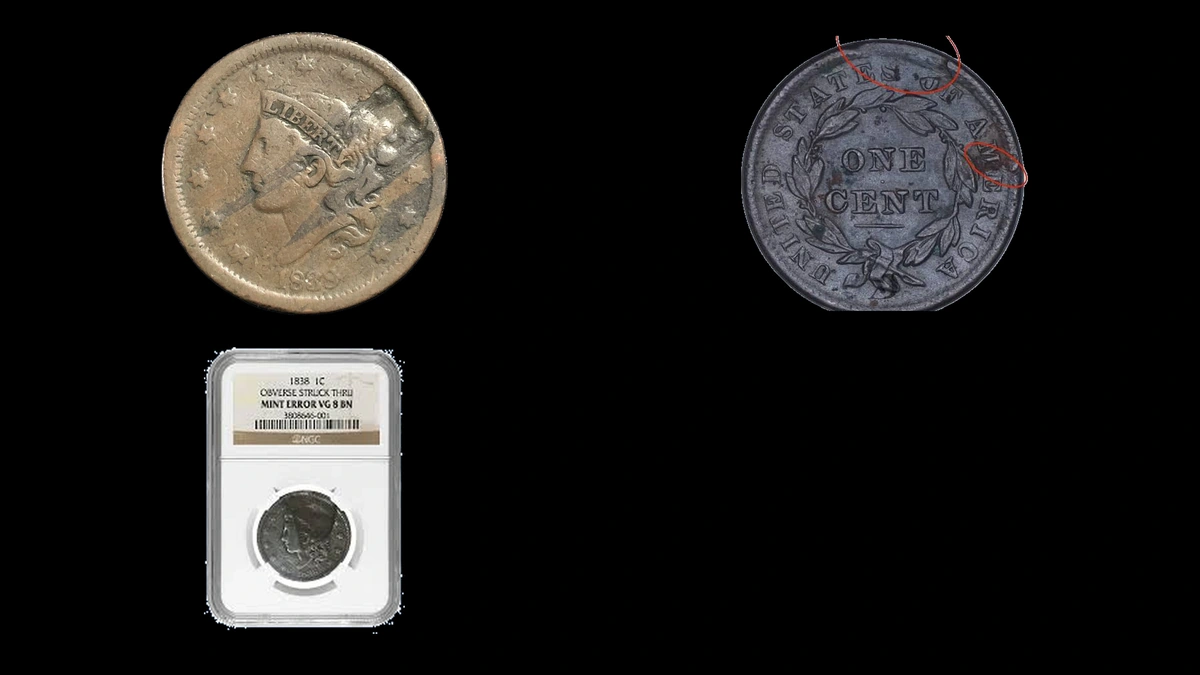
A hollow near the edge, a tilted wreath, or an extra stroke in UNITED can each point to a different member of the 1838 penny errors group. The supplied whole-coin estimates span $25–$5,000.
An unworn cent with prominent die damage sold for $1,762.50 in September 2016, but preservation contributed heavily to that result. Examine the depth of an unusual feature first, then compare the faces and small letter details before choosing a price comparison.
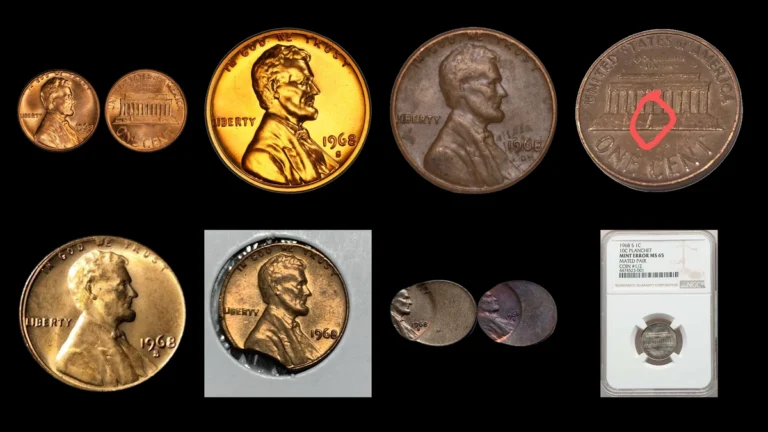
1. 1838 Penny A Curved Hollow Near the Edge: Indent Error
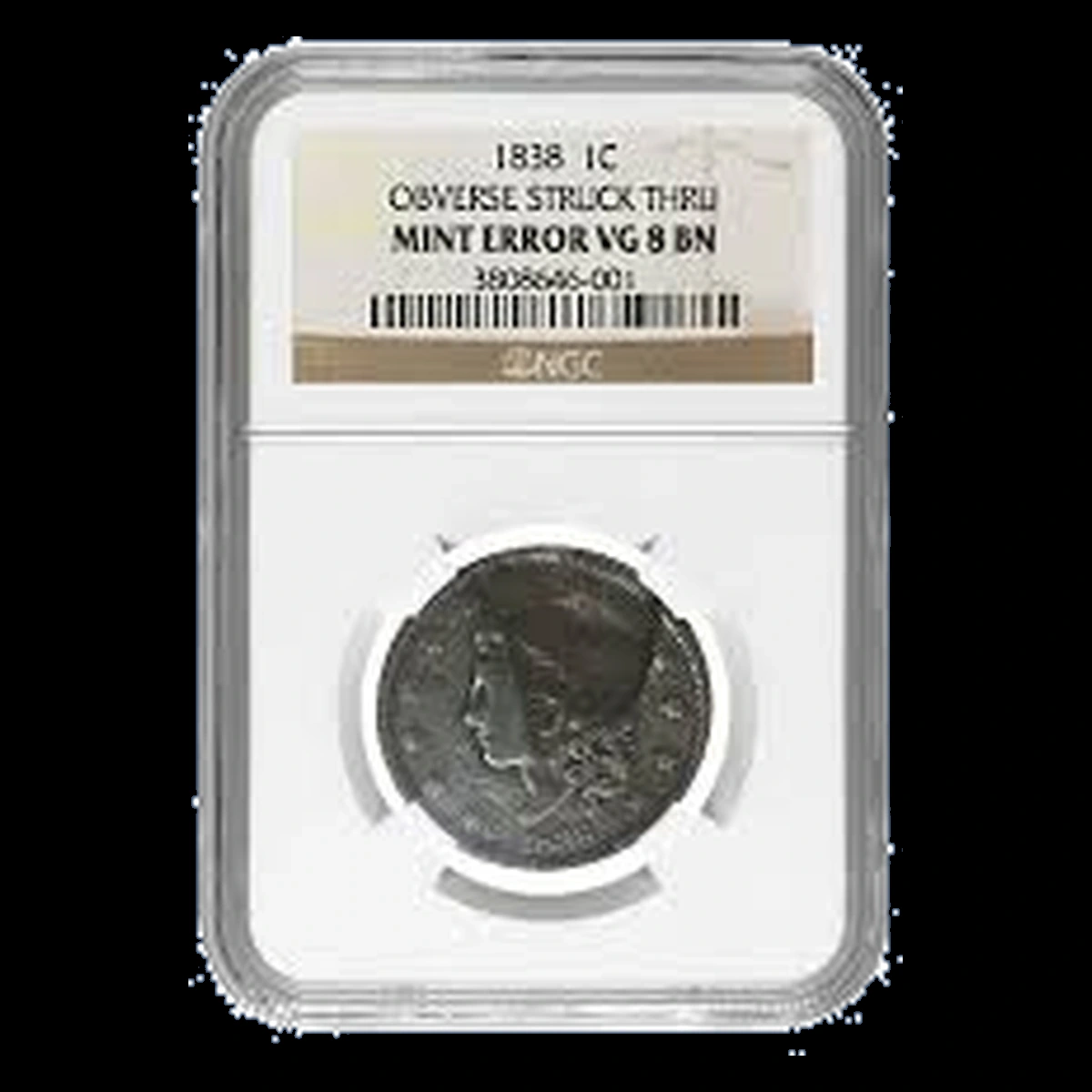
The documented indent is on the front of an 1838 cent, near 2 o’clock with Liberty upright. It covers about 10% of that face and leaves copper beneath the depression rather than an open gap.
A second blank overlapping the cent during striking can make this shape. It blocks the die from reaching part of the lower blank while pressing into the copper.
How to Identify
Follow the curved boundary and note where it interrupts the portrait-side design. Then inspect the corresponding reverse area and the nearby edge for evidence of later crushing, scraping, or cutting.
A clip removes a section of the original disc; an indent retains metal under its hollow. The cataloged position and percentage help compare that particular example but cannot turn an unrelated dent into the same error.
An ordinary loose 1838 cent can be compared with about 10.89 grams, roughly 28 millimeters in diameter, and a plain edge. Measurements describe the object, while the surfaces explain how the feature formed.
What It’s Worth
$250–$1,500 for worn indents and $1,500–$5,000 for sharper, attractive examples are the supplied estimates. The brown, heavily worn VG08 specimen appeared in a 2006 catalog with a $260 minimum bid.
That minimum was an opening requirement, not a recorded winning price. A readable date and clear overlap boundary matter when comparing the coin with another indent.
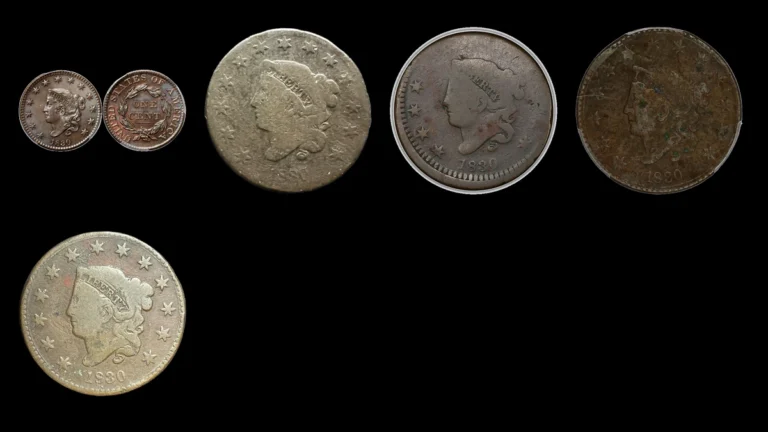
2. 1838 Penny Thin Copper Separates From the Surface: Lamination Error
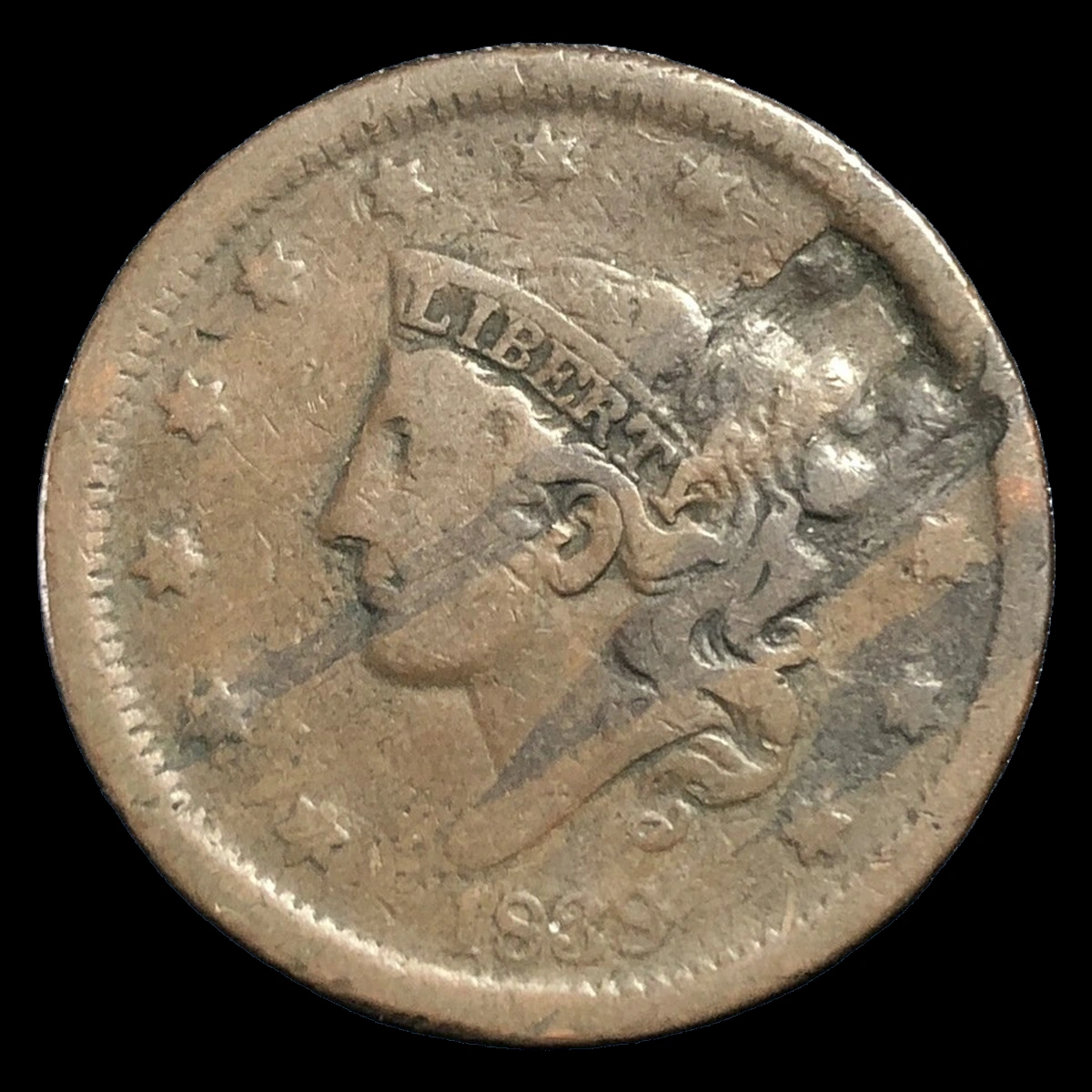
A peeling sheet or a shallow opening with an uneven layered boundary may come from weakness inside the original copper blank. This separation is called lamination and can leave some of the layer still attached.
The supplied 1838 seller description claims mint-made lamination but does not locate it on the portrait or wreath. Identification therefore depends on the surface of the coin being examined, not an assumed location.
How to Identify
Use low-angle light to examine where the loose layer meets solid copper. The boundary should support separation within the metal, rather than simply resemble a scrape, pit, or drilled opening.
Keep fingers and measuring tools away from an attached flap. Lost copper may reduce weight, whereas a layer still attached can leave little measurable change.
What It’s Worth
$40–$300 for worn examples and $300–$1,000 for attractive unworn pieces are the estimates for genuine 1838 laminations. An unworn 1841 large cent with front laminations sold for $564 in December 2021, providing a different-year comparison.
A separation across important design details may reduce appeal rather than add value. Consider what remains of the coin as well as the size of the flaw.
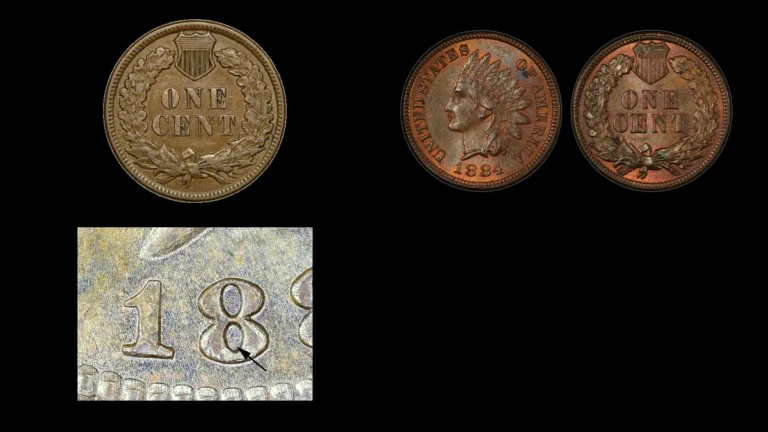
3. 1838 Penny Ridges and Raised Patches Cross the Design: Die Cracks and Breaks Error
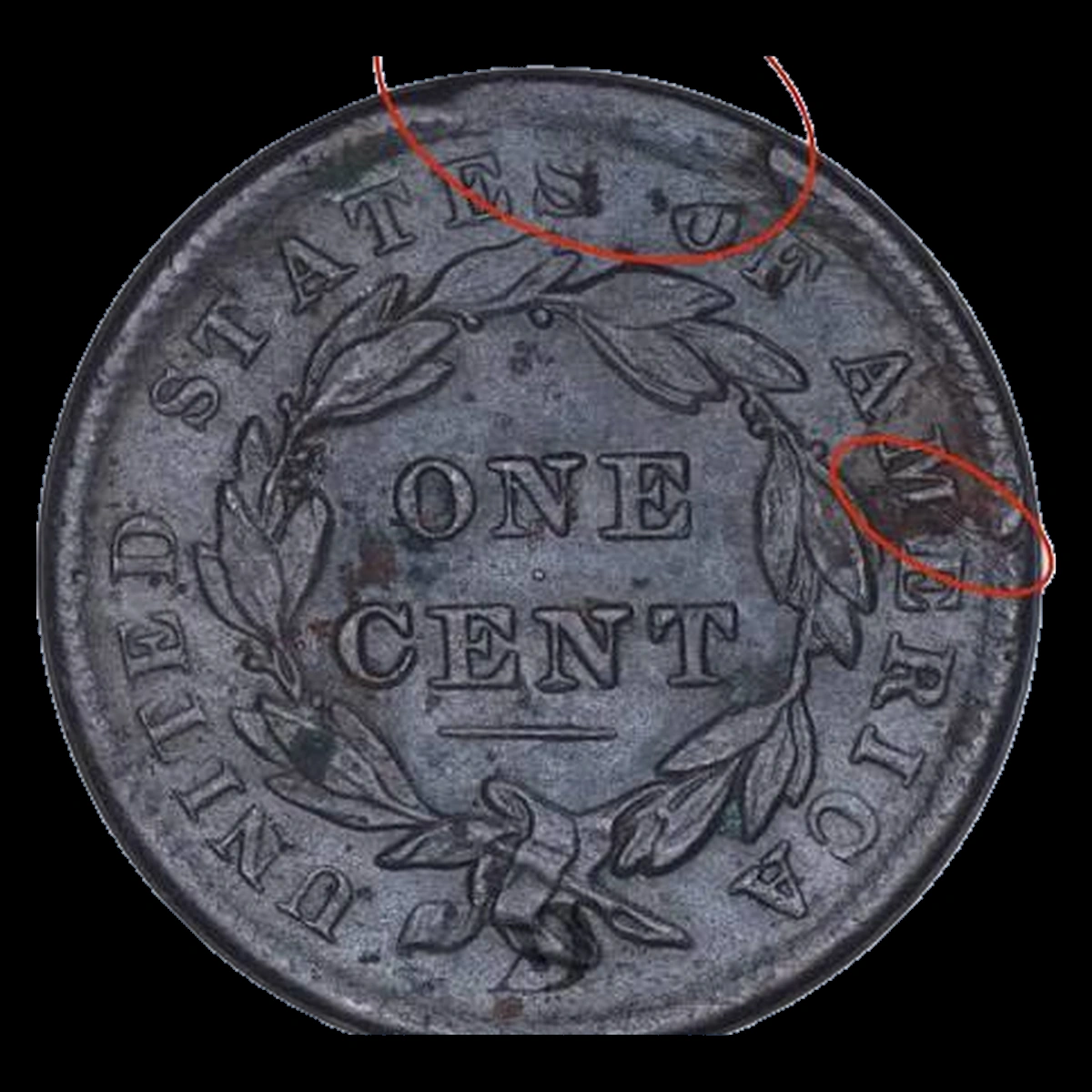
Unlike peeling copper, a die break creates extra raised metal on the struck surface. Copper enters a crack or missing portion of the steel stamping tool, reproducing the damage in reverse.
The N-4 example has breaks near the curl below the bust and beneath 83 in the date, with additional damage near stars nine and twelve. A separately reported first-star break belongs to another example.
How to Identify
With Liberty upright, count stars from the lower left and compare all the stated N-4 locations. Matching a pattern is more useful than finding one unexplained bump.
Move the light across a suspected line to distinguish a raised ridge from the cut floor of a scratch. For a broad patch, follow it toward the border: only a rim-connected die break is called a cud.
Inspect the edge beside a patch for an impact that displaced copper. An interior lump does not become a cud simply because it is prominent.
What It’s Worth
$30–$750 for worn examples and $750–$4,000 for attractive unworn coins are the supplied ranges. The PCGS MS65 Brown N-4 cent brought $1,762.50 in September 2016.
That result includes the coin’s well-preserved unworn detail, brown surfaces, and variety. It is not a fixed premium to attach to every small 1838 crack.
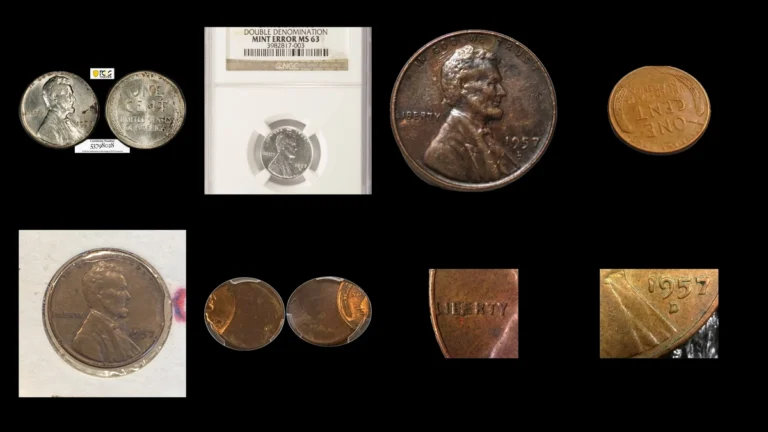
4. 1838 Penny Local Detail Is Missing Without a Clear Object Outline: Filled Die Error
A blocked recess in a die cannot fill with copper normally, so the affected coin may lack a small part of its intended design. This filled-die effect can be subtle, particularly on a heavily circulated cent.
The supplied year guide describes an 1838 example in Good 6 condition but names no particular missing letter. That level of wear makes a local mint-made weakness harder to separate from ordinary loss of detail.
How to Identify
Compare the weak patch with similarly exposed details nearby. If the portrait and lettering are broadly smooth, circulation wear may explain the appearance without a blocked die.
Inspect the boundary between stronger and weaker areas for scraping, polishing, corrosion, or pressure damage. Keep a full-face photograph beside the close view so the general condition remains visible.
Missing detail may support a blockage without revealing what filled the recess. Avoid naming grease or another material unless the evidence establishes it.
What It’s Worth
$25–$150 for a genuine local blockage on a worn cent and $150–$600 for a clearer effect on a better-preserved coin are estimates. No completed sale is supplied for the Good 6 report.
Faint lettering alone does not justify an error premium. The local interruption must remain distinguishable from the coin’s overall wear.
5. 1838 Penny The Wreath Tilts After a Controlled Turn: Rotated Dies Error
A rotated die changes the relationship between the two faces without necessarily changing either design’s appearance. Liberty may be upright while the wreath finishes tilted after a normal top-to-bottom flip.
The supplied seller report identifies a rotated reverse but gives no measured angle. Neither a quarter-turn nor a clockwise direction should be assumed.
How to Identify
Practice a top-to-bottom turn with an ordinary United States coin, then repeat it with Liberty upright on the suspected cent. Keep the turning axis fixed and check whether the wreath consistently finishes at the same angle.
Film the turn or otherwise preserve the relationship between the faces. Independently rotated photographs cannot establish the actual alignment, and a normal weight cannot rule out joined or altered faces.
Inspect the edge for a seam and confirm the date separately. A design shifted toward the rim is a different issue from one turned around its center.
What It’s Worth
$40–$400 for worn rotations and $400–$1,500 for attractive examples with little or no wear are the supplied estimates. No sale price is given for the seller’s specimen.
A small departure may add little to the ordinary cent’s value. A stronger angle must be demonstrated before it can support a comparison with a more dramatic rotation.
6. 1838 Penny An Extra Upright Stroke in UNITED: Recut Letter Error
The reported N-1 variety has an additional trace at the upright stroke of I in UNITED. Recutting during die preparation left that feature in the tool, allowing it to repeat on coins struck from it.
N-1 names a particular pair of dies rather than a separate date or denomination. The small recut feature does not mean the finished cent received two strikes.
How to Identify
Find UNITED on the reverse and compare the I with a clear photograph of the N-1 variety. Include neighboring letters so that the extra stroke’s position can be judged in context.
A fixed feature belonging to the letter differs from a random scratch or a reflection that moves with the light. The supplied description does not specify the direction of the additional stroke, so do not invent one when attributing the coin.
What It’s Worth
$30–$350 for worn examples with a clear match and $350–$2,000 for better-preserved coins are estimated whole-coin ranges. No specific sale is supplied for this recut-letter example.
Much of the value of an attractive unworn early cent comes from its condition. The extra stroke is an identification feature, not an explanation for the whole price by itself.
Conclusion
For an unusual 1838 cent, first decide whether the feature is raised, recessed, missing, or part of a separated layer. Then test how it relates to the surrounding design and the opposite face.
Exact variety markers and controlled rotation checks make descriptions more useful than dramatic labels. Preserve loose copper, record the overall condition, and keep minimum bids and estimates separate from completed auction results when judging value.