Rare 1798 Dollar Errors (List & Pictures)
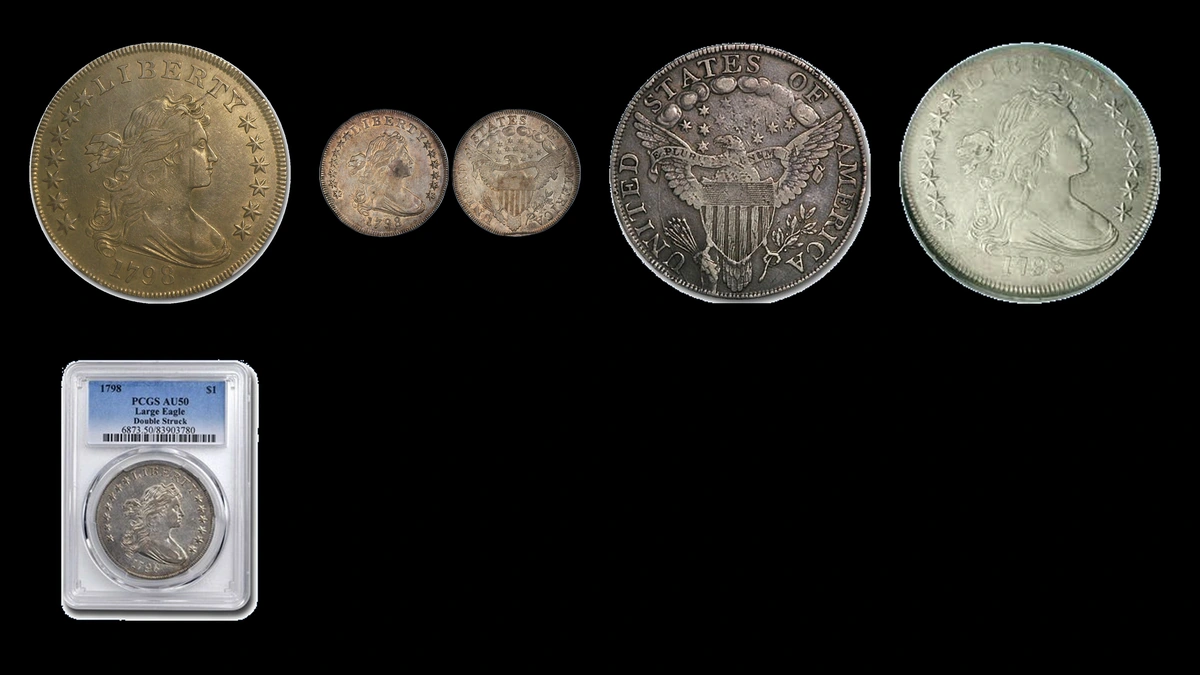
A lightly worn BB-102 dollar sold for $20,400 in March 2023. This guide to 1798 Draped Bust dollar errors covers the large-eagle design, with estimated whole-coin values of $1,000–$100,000.
Distinguish original metal flaws, recessed clash traces, raised cracks, and displaced strikes before applying a variety-and-condition comparison.
| Visible clue | Category | Estimated range |
|---|---|---|
| Uneven hair patch above forehead | Planchet flaw | $1,000–$15,000 |
| Local front design interruption | Strike-through | $1,200–$20,000 |
| Sunken teeth above ES and OF | Die clash | $1,000–$25,000 |
| Raised routes or border-connected lump | Die cracks and breaks | $1,000–$50,000 |
| Eagle tilted after fixed flip | Rotated die | $1,000–$20,000 |
| Unused metal beside displaced designs | Off-center strike | $3,000–$50,000 |
| Several repeated features on both faces | Double strike | $5,000–$100,000 |
1. 1798 Dollar An uneven patch interrupts the hair: planchet flaw Error
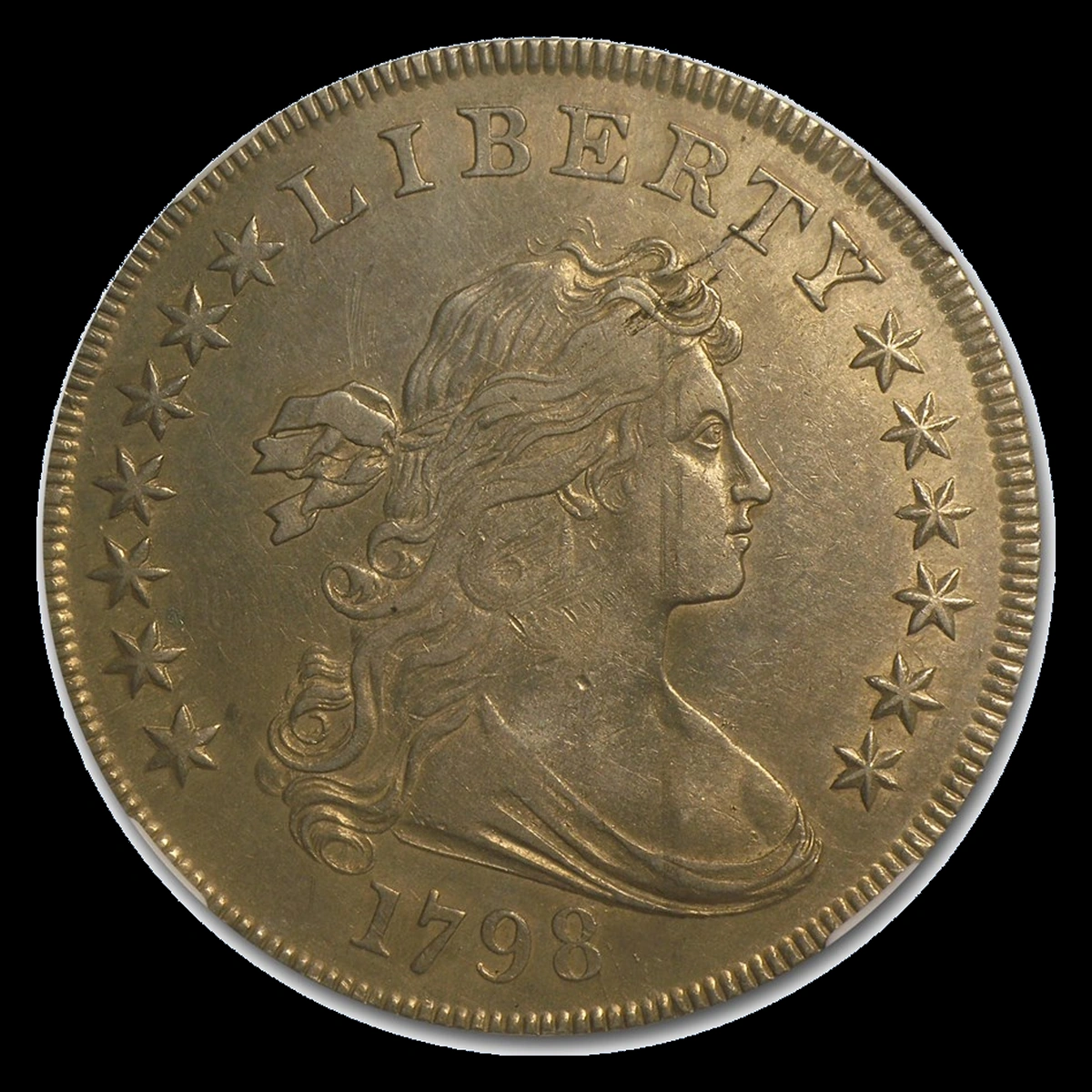
The documented large-eagle dollar has a flaw immediately above Liberty’s forehead. The irregularity is described as originating in the blank metal.
APMEX listed the coin in an NGC AU Details holder, indicating lightly worn detail with a noted condition problem. A shallow hollow is not automatically a peeling layer or a crack through the disc.
How to Identify
Compare the full front with the dealer’s photographed specimen. Keep the neighboring curls visible while tracing the patch boundary.
Struck detail meeting or continuing into an uneven surface can help establish that the defect preceded the strike. A later cut may slice across hair and push up a lip.
Change the lighting before judging depth, since a dark stain can resemble a hollow. Do not scrape the area or lift material to test it.
What It’s Worth
Comparable genuine blank flaws on worn through lightly worn dollars are estimated at $1,000–$15,000.
No completed sale was supplied for the dealer specimen. An original flaw may reduce value if it distracts from the design, so its presence does not guarantee a premium over an undamaged coin.
2. 1798 Dollar A small patch blocks the front design: strike-through Error
A BB-107 Ten Arrows dollar was cataloged with a front strike-through in PCGS VF25. Material between the blank and die interrupted the intended design.
Ten Arrows names the normal design variety, not the striking mistake. The source does not establish whether the obstruction was cloth, wood, grease, or another substance.
How to Identify
Use the full front of the reported BB-107 to locate its impression. Then examine the boundary where ordinary detail gives way to the affected area.
Broad circulation wear usually smooths exposed design rather than leaving one bounded interruption. Scraping lines, pushed metal, or a separating layer may support other explanations.
What It’s Worth
Authenticated examples in worn through lightly worn condition have an estimated range of $1,200–$20,000.
The supplied listing gives no selling price. Size, clarity, and the early dollar’s underlying condition should be compared without inventing the trapped material.
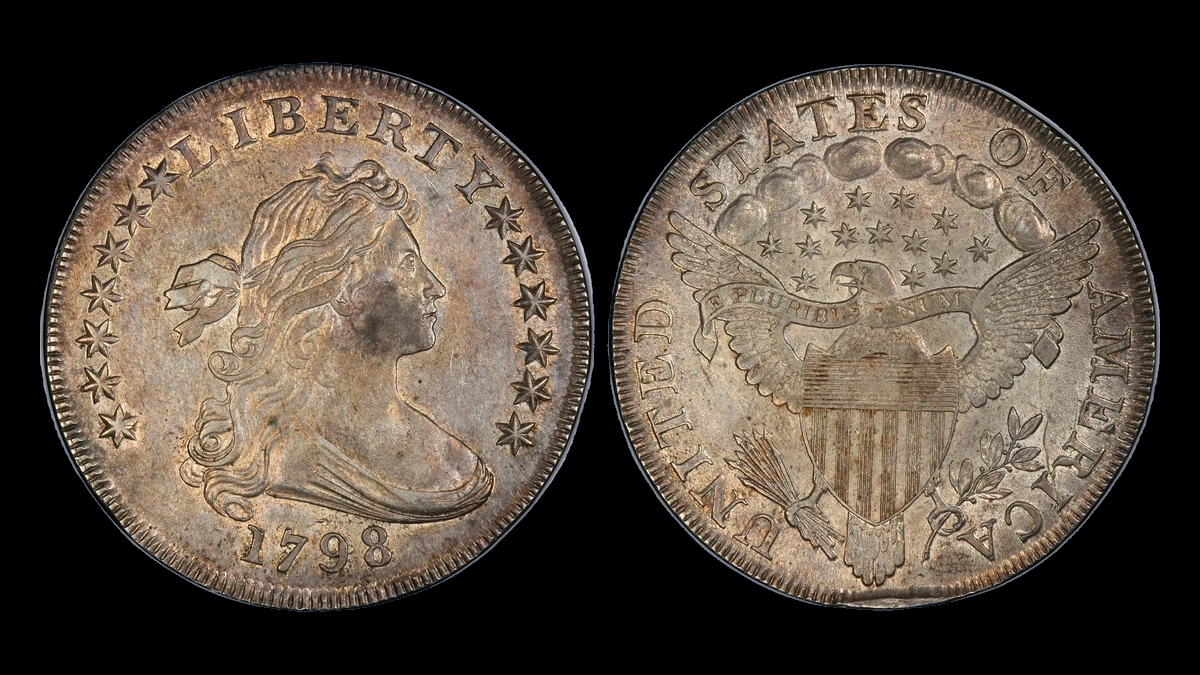
3. 1798 Dollar Tiny sunken teeth appear above letters: die clash Error
BB-102 can show tooth-like depressions above ES at the end of STATES and above OF. The specialist account identifies them as border-tooth traces transferred from the front die.
The dies acquired clash marks by meeting without a blank. These particular traces are described as sunken, so a rule that all clashes must be raised would misidentify them.
How to Identify
Compare the marks’ shape and spacing with the normal inner-border teeth. Keep several impressions in view rather than interpreting one depression alone.
Check their positions above ES and OF against a known BB-102 image. Under side light, the individual tooth shapes should be recessed.
A circular scrape or another object pressed into the finished coin can create unrelated marks. The repeated shapes and correct locations must agree.
What It’s Worth
Matching worn through lightly worn BB-102 dollars are estimated at $1,000–$25,000.
An AU55 BB-102 realized $20,400 at Stack’s Bowers in March 2023. That whole-variety result does not measure a separate price for its tooth traces.
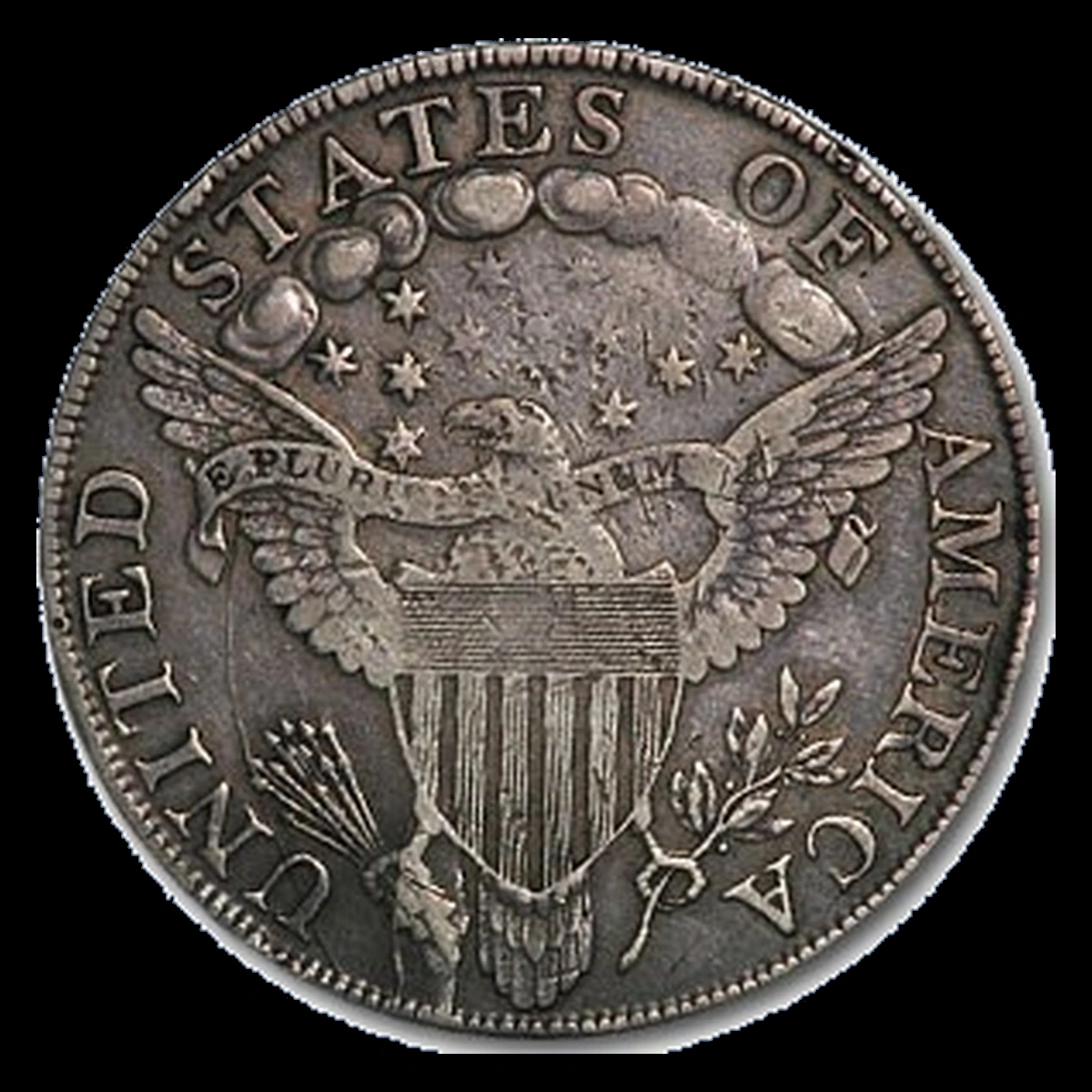
4. 1798 Dollar Raised lines reach lettering or the rim: die cracks and breaks Error
BB-102 crack routes include the right wing through I in AMERICA to the rim, below ER, and between OF and the first S in STATES. A larger break below the eagle’s tail can leave a rim-connected mass called a cud.
A separate BB-110 has a major front break. Its outline cannot be taken from the reverse of BB-102.
How to Identify
For a large raised patch, follow its boundary to the rim and compare the correct face and variety. Inspect the edge for pushed-over metal or seams from an addition.
For the thin BB-102 routes, trace the right wing toward AMERICA’s I, then check the other two stated areas separately. Side lighting should reveal ridges rather than scratched channels.
Do not merge different break stages or varieties into one required pattern. Match the actual raised outline with the relevant photograph.
What It’s Worth
Coins with the recorded cracked or broken dies have an estimated range of $1,000–$50,000.
PCGS lists the $20,400 AU55 BB-102 result from March 2023. It is the same variety comparison used above, not a second sale or a price for every possible break stage.
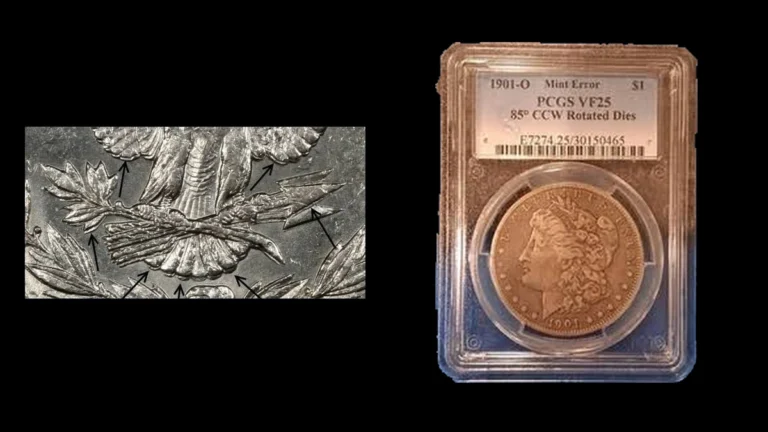
5. 1798 Dollar The reverse keeps a clockwise lean: rotated die Error
A cataloged PCGS AU53 BB-111 has about twenty-five degrees of clockwise reverse rotation. The angle describes the relationship between the two dies, not movement between two strikes.
The amount belongs to that individual example. A coin shifted between photographs can falsely appear to have the same rotation.
How to Identify
Align Liberty upright with a fixed reference and flip the coin top to bottom without twisting sideways. Repeat the movement to see whether the eagle consistently leans in the same direction.
Measure from photographs taken square to the coin with the starting orientation preserved. A short controlled-flip video can also demonstrate the relationship.
Rotation between two strikes would leave overlapping design evidence on a face. This test compares one face’s orientation with the other.
What It’s Worth
Circulated dollars with confirmed moderate rotation are estimated at $1,000–$20,000.
The PCGS archive records $6,463 for the described AU53 at Stack’s Bowers’ 2013 Baltimore sale. It prices the whole BB-111 rather than an isolated twenty-five-degree feature.
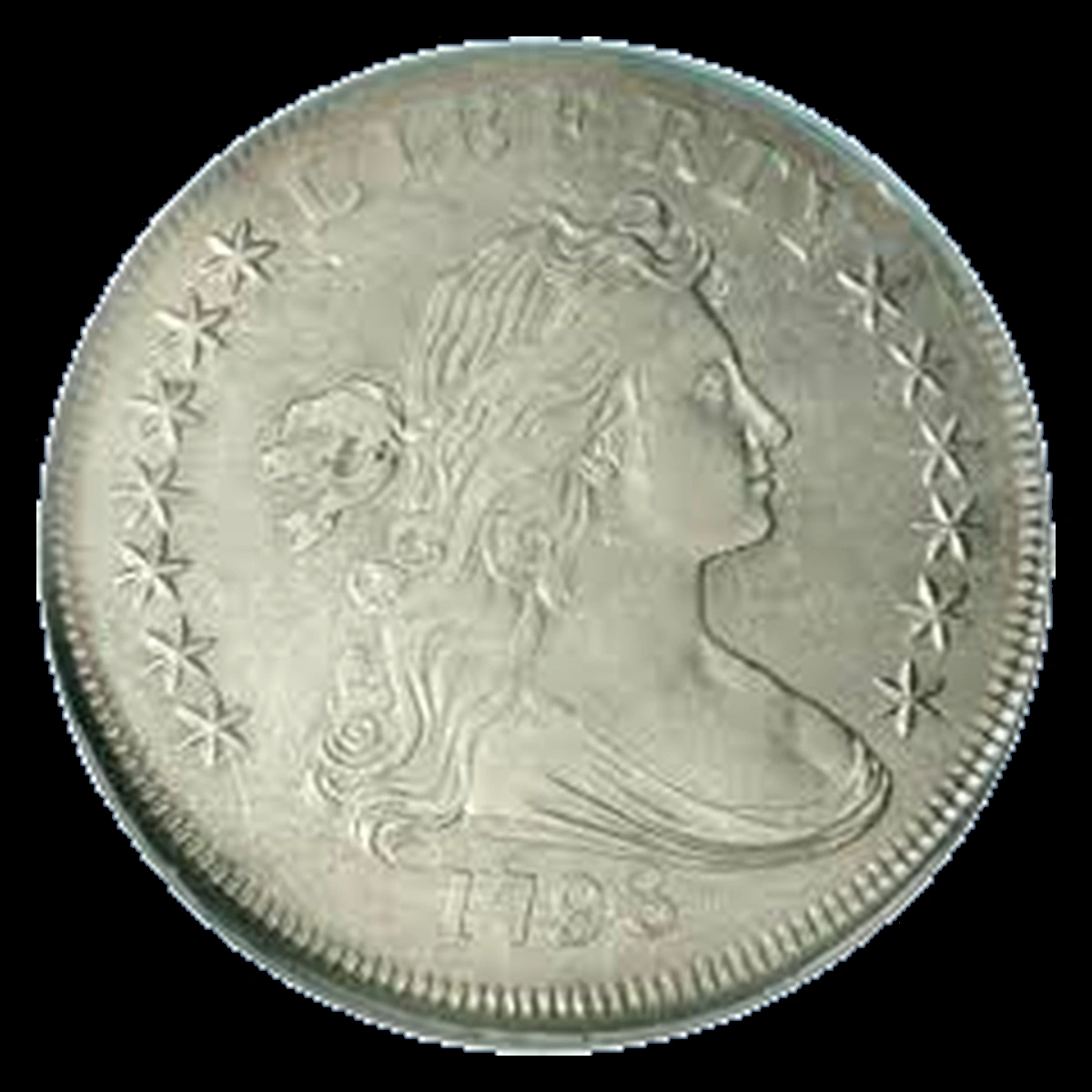
6. 1798 Dollar Unused silver borders a displaced picture: off-center strike Error
Heritage cataloged a PCGS AU55 BB-96 as three percent off center. An older source separately reported a ten-percent example without establishing the same grade or direction.
The blank’s position caused the shift. Early dollars can also have naturally uneven borders, so unequal margins alone do not settle the diagnosis.
How to Identify
Confirm 1798 and the large eagle with its shield. A Small Eagle dollar is a different design version.
Compare uncropped views of both faces, tracking the same physical margin. Look for unused metal and whether intended design extends beyond the disc.
One shifted face suggests die misalignment, while a complete design on expanded metal may indicate an uncentered broadstrike. Do not infer a clock direction from a percentage.
What It’s Worth
Authenticated examples in worn through lightly worn condition are estimated at $3,000–$50,000.
No exact sale amount was supplied for the three-percent AU55 or older ten-percent report. Larger displacement does not automatically outweigh a lost date or serious surface damage.
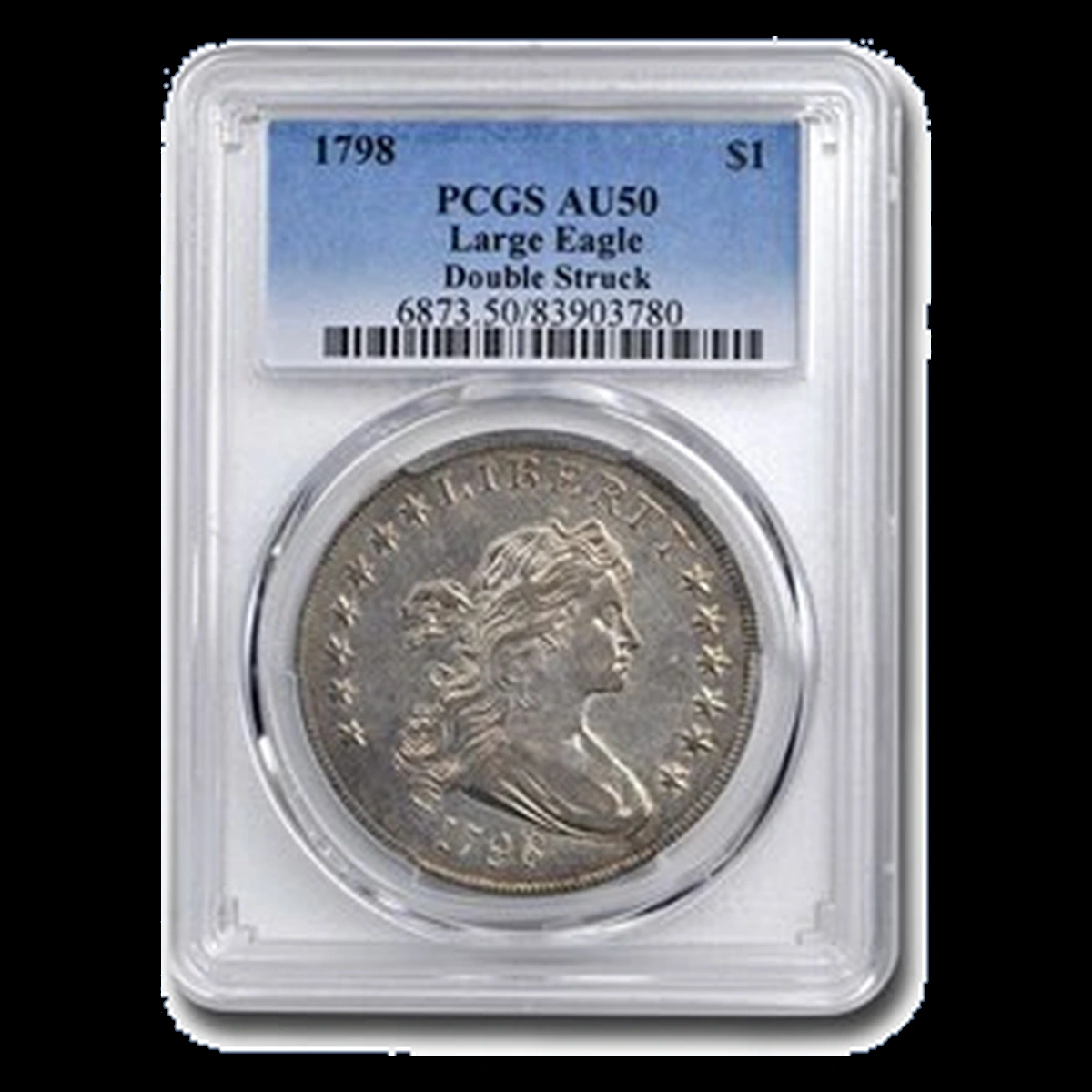
7. 1798 Dollar Several features repeat across both faces: double strike Error
The reported AU50 dollar carries much of its design twice after a slightly displaced second strike. The repeated portrait-side and large-eagle-side features reflect one whole-coin event.
The shift is small rather than two widely separated portraits. Its exact direction and distance must be read from the specimen.
How to Identify
Begin with sharp full-face views and trace several remnants sharing the same displacement. Compare the portrait and lettering, then the eagle and reverse wording.
The second blow and later wear can obscure parts of the earlier image. Use the published AU50 photographs to follow the actual surviving details.
A blurry image that duplicates bright edges is not the same evidence. A fixed doubled feature in one die likewise needs a different explanation from repeated design across both faces.
What It’s Worth
Authenticated double strikes have an estimated whole-coin range of $5,000–$100,000 across damaged worn through strongly detailed examples.
A heavily worn and countermarked 1795 Flowing Hair double strike sold for $6,037.50 in January 2007. That different-year and different-design comparison does not price the better-preserved 1798 AU50.
Conclusion
A recessed tooth trace, raised crack, original metal flaw, and repeated strike leave different physical evidence. Keep the large-eagle design and exact variety in view while comparing their locations.
The $20,400 BB-102 record is one variety-and-condition transaction, even when several die features occur together. For displaced or repeated strikes, complete two-face photographs are more informative than one enlarged letter or an unexplained uneven border.