Rare 1819 Half Dollar Errors (List & Pictures)
Repeated designs and a reported absence of edge words lead to different checks for 1819 half dollar errors. Estimates extend from $150–$2,500 across the varieties and conditions below.
A documented double-struck 1819/8 brought $2,280 in July 2025, combining a shifted design with an overdate. Begin with the portrait and date, then inspect the entire edge to assess the unconfirmed missing-lettering report.
| What to notice | Where it appears | Category | Estimated value |
|---|---|---|---|
| Separated stars and repeated LIBERTY | Front design | Double strike | $1,500–$2,500 |
| Remains of an 8 | Beneath the final 9 | 1819/8 overdate | $150–$2,200 |
| No edge inscription | Entire edge | Reported missing edge lettering | $500–$1,500 if authenticated |
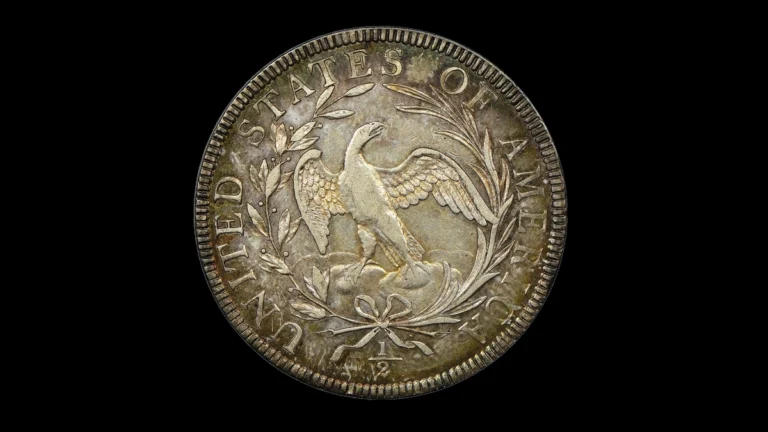
A normal 1819 half dollar has the edge inscription FIFTY CENTS OR HALF A DOLLAR. Before wear, its standard weight is 13.48 grams and its diameter about 32.5 mm.
1. 1819 Half Dollar LIBERTY and Stars Appearing Twice: Double Strike Error
Several widely separated stars make the front of the documented 1819/8 coin look unusual even before close inspection. LIBERTY also repeats, while the eagle on the back lacks a corresponding second outline.
This Small 9 O-101 coin received two strikes. Between them, the front die shifted southeast while the back die stayed in place; a die is the steel tool that stamps one face.
How to Identify
Choose several stars and letters as reference points. Their repeated impressions should follow a consistent direction of movement rather than appearing as unrelated extra edges.
Use a magnifier to inspect the space between the impressions. Flat shelves beside individual details can result from movement during a single strike and do not establish the documented double strike.
Examine the eagle after studying the front. On this particular coin, the absence of matching duplication on the back agrees with the reported movement of only the front tool.
Do not confuse the old 8 in the date with the second impression of the design. That smaller feature was already present in the date on the die and has a separate cause.
What It’s Worth
Estimated range: $1,500–$2,500 for similarly clear circulated double strikes. Strong separation makes the error easier to appreciate, while wear and damaged surfaces affect the comparison.
The PCGS XF45 Small 9 O-101 sold at Heritage for $2,280 in July 2025. XF45 means light circulation wear with much design detail remaining.
The catalog also cited an 1823 XF40 double strike sold for $1,645 in October 2016. That second result is a different-year comparison, not another 1819 transaction.
2. 1819 Half Dollar Extra Curves Beneath the 9: 1819/8 Overdate Error
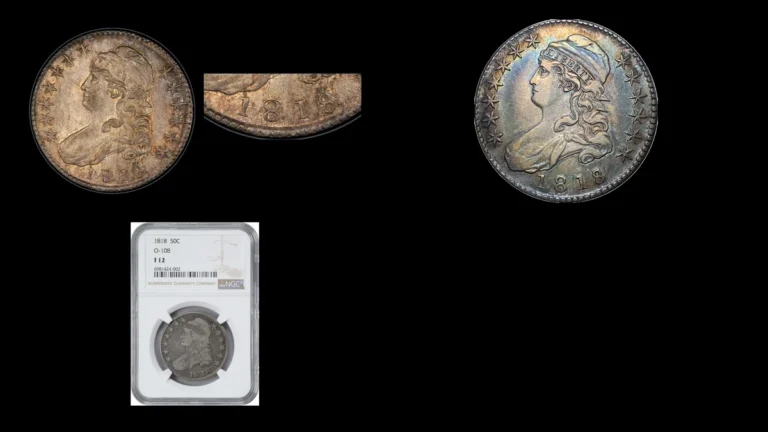
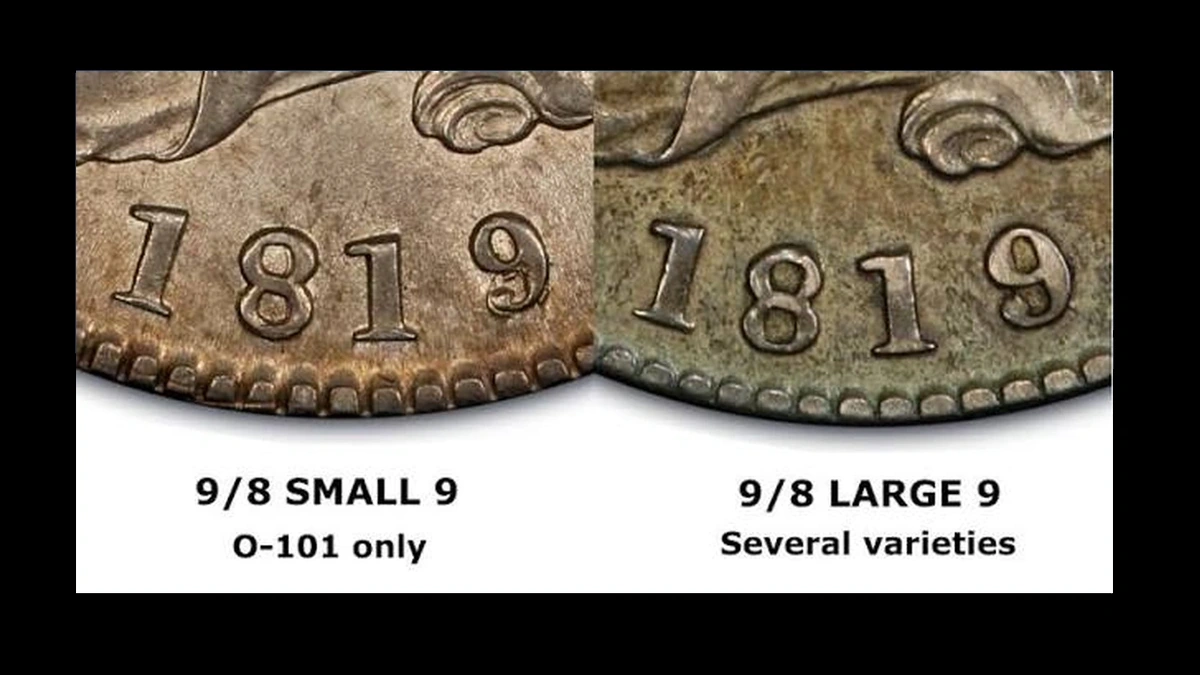
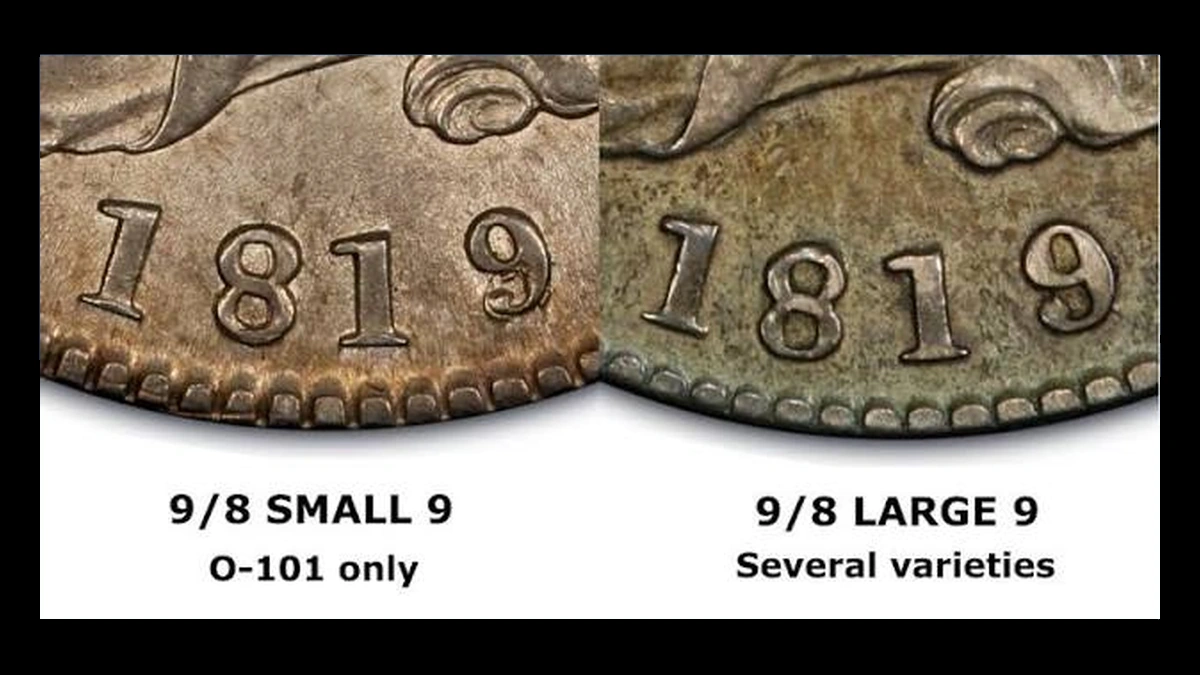
Focus now on the final digit rather than the entire front. Pieces of an earlier 8 can remain under the 9, which gives this variety its 1819/8 name.
The 9 was punched over an 8 in the die before coins were made. Small 9 and Large 9 versions exist, with different final-digit shapes.
The double-struck coin above also has an overdate. One finished coin can carry both features without their having formed at the same stage.
How to Identify
Start with the lower part of the 9 and look for raised curves that belong to the older 8. Keep all four date digits visible so their size and spacing remain easy to compare.
The 1819 variety listing distinguishes the Small 9 and Large 9 overdates from normal dates. Select the correct version before trying to match tiny strokes.
Change the direction of the light to check whether the extra curve has real height. A scratch or dent through the date does not reproduce the raised shape of the older numeral.
What It’s Worth
Estimated range: $150–$2,200 for common 1819/8 varieties, from worn examples through lower unworn grades. This range does not automatically cover rare die pairings or additional major errors.
A PCGS MS61 Small 9 O-101 sold for $2,040 at Heritage in April 2019. MS61 indicates no circulation wear, though the coin can have noticeable surface marks.
A heavily worn example should be compared near the worn end of the range. An identifiable 8 beneath the 9 does not remove the effect of wear on the rest of the coin.
3. 1819 Half Dollar A Plain Edge Where Words Belong: Reported Missing Edge Lettering Error
A collector reported an 1819 half dollar without the usual edge words. The report does not establish that the coin was professionally authenticated.
Early halves received their edge inscription in a separate operation before the faces were stamped. Missing that operation could leave a plain edge, but later removal of the words can produce a similar appearance.
How to Identify
Rotate the coin through a complete turn and photograph the edge in overlapping sections. No hidden section can be assumed blank merely because the visible part has no readable words.
Check for faint letter bottoms, straight filing lines, or signs of a former jewelry mount. A seam or disturbed metal where the edge meets either face may reveal later alteration.
The documented 1812 plain-edge half dollar shows this error on an earlier date. It provides a visual comparison, but does not authenticate the reported 1819 coin.
Record the weight and diameter of a loose example alongside its full edge photographs. A specialist must consider wear and possible metal removal as well as the complete date and face designs.
What It’s Worth
Estimated range: $500–$1,500 for an authenticated circulated 1819 example. No supplied sale establishes the value of the reported coin itself.
A 2007 Jefferson dollar with missing edge lettering brought $84 at Heritage in July 2025, graded PCGS MS66. That unworn modern dollar belongs to another denomination and series.
The $84 result only illustrates the broad error category. An early silver half dollar would need its own assessment of rarity, condition, and evidence that the lettering was omitted at manufacture.
Conclusion
Repeated front designs, an 8 beneath the 9, and an entirely plain edge are three separate clues. The $2,280 auction coin demonstrates that a double strike and overdate can occur together.
Estimated values span $150–$2,500 across the conditions discussed. The edge-lettering report remains unconfirmed, so authentication comes before applying its estimated range or treating the apparent omission as a mint error.