Rare 1821 Dime Errors (List & Pictures)
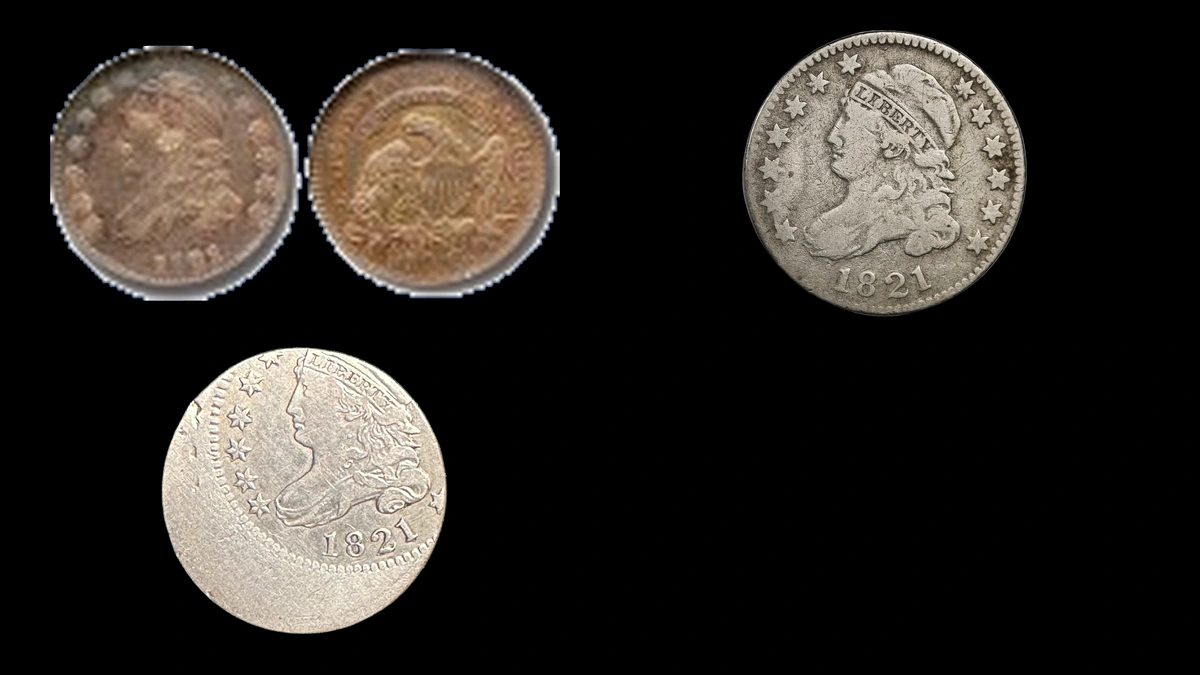
A high-grade 1821 JR-9 dime brought $7,200 in August 2025, though it was not identified as the specific clash example discussed below. Estimated whole-coin values for 1821 dime errors range from $80 to $8,000.
Begin at Liberty’s face and the stars, then inspect the reverse, edge, and overall centering. Keep Small Date and Large Date examples separate when matching features and prices.
| Visible clue | Possible identification | Estimated whole-coin range |
|---|---|---|
| Curved hollow before the eye | Strike-through | $150–$2,500 |
| Raised line through lower-left stars | Die crack | $80–$1,200 |
| Extra shapes around eagle’s head | Die clash | $100–$8,000 |
| Irregularity crossing face and edge | Reported rim and edge flaw | $100–$1,500 if Mint-made |
| Plain crescent and missing design | Off-center strike | $1,000–$6,000 |
A normal Capped Bust dime of this year weighs about 2.70 grams and measures 19 millimeters. Wear and an unusual strike can affect the measurements, so neither figure alone identifies an error.
1. 1821 Dime A curved depression before Liberty’s eye: struck-through line Error
The 2024 Houston auction catalog described a curved strike-through directly in front of Liberty’s eye on an NGC AU55 Small Date JR-8. A strike-through forms when intervening material affects the design as the coin is struck.
The catalog also noted two later fine scratches. They are separate surface problems and should not be included in the Mint-made feature.
How to Identify
Compare the curved depression with the Houston catalog photograph, using the eye as a fixed landmark. Follow that particular curve instead of grouping nearby lines together.
A later scratch may show sharp disturbed edges, while a die crack generally produces a raised ridge. Changing the light helps establish whether the suspected feature is a hollow impression.
The object responsible was not identified. Calling it a wire solely because the mark curves would claim more than the supplied evidence supports.
What It’s Worth
The estimated range is $150–$2,500 for worn through lightly worn dimes with a small confirmed strike-through. The whole coin’s surfaces remain important, including any later scratches.
An NGC AU55 Small Date JR-8 appears in April 2025 sale records at $1,080. It is a useful same-variety condition comparison, but is not established here as the Houston coin or as a sale of that curved feature.
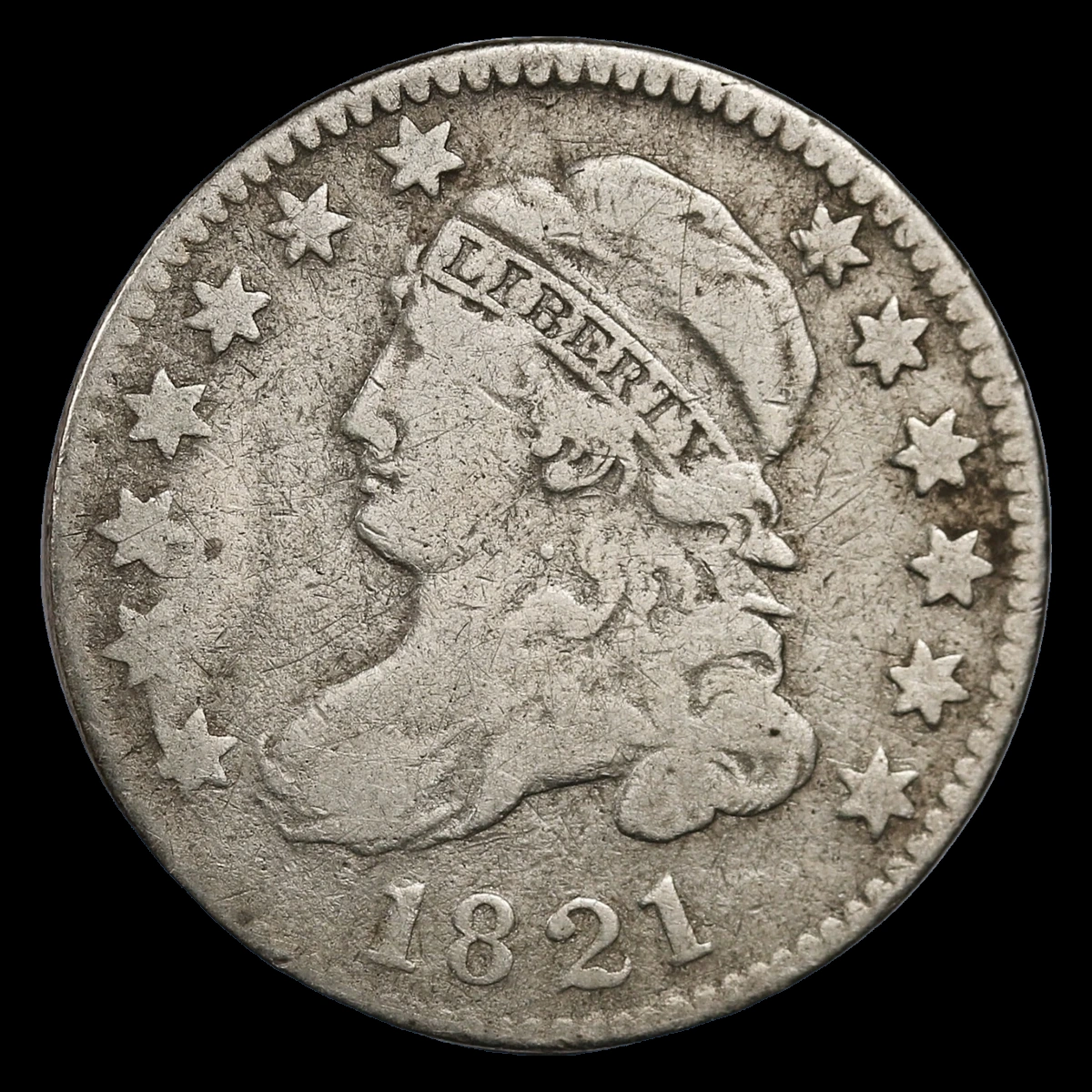
2. 1821 Dime A ridge through the stars: obverse die crack Error
A reported Large Date dime has a raised line through the lower-left stars. Unlike the hollow mark near the eye on the Small Date coin, this line records an opening in the stamping die.
Metal entered that opening and formed a ridge during striking. The die could continue making coins while the cracked portion remained in place.
How to Identify
Establish the Large Date style, then examine the lower-left star group. The date designation alone does not prove the presence of the crack.
Trace the line across the affected area and check that it rises from the surface. Dirt can make a dark line, and a scratch can have raised metal beside its cut, so inspect the center of the feature as well as its edges.
Compare the complete route with an identified specimen. A different line elsewhere on the front should not inherit this attribution.
What It’s Worth
A worn Large Date dime with a small genuine crack has an estimated whole-coin value of $80–$1,200. The ridge does not automatically add a large amount to the underlying dime.
The $1,080 AU55 sale is a Small Date example, so it is only broader date-and-condition context here. Use Large Date comparisons where possible and allow for cleaning, scratches, and loss of detail.
3. 1821 Dime Faint foreign shapes near the eagle: reverse die clash Error
An NGC MS64 Small Date JR-9 was described with clash marks around the eagle’s head. These traces originate when the dies collide without a blank between them.
The collision can leave part of one design impressed into the opposing tool. Later strikes then carry a faint trace of that unintended shape alongside the normal design.
How to Identify
Study the flat background around the eagle’s head and distinguish intended feathers from added shapes. A useful clash match relates to the opposite face’s design, rather than simply being an unexplained line.
Use changing light to follow the faint outline, then compare its orientation with the front portrait. Random scratches or a straight die crack do not establish that relationship.
Confirm the Small Date JR-9 circulation variety independently. The reported coin is not a Large Date specimen or a special collector Proof.
What It’s Worth
Estimated whole-coin values span $100–$8,000 from worn examples through well-preserved unworn Small Date coins with clear clash marks. Condition explains much of the distance between those endpoints.
A PCGS MS64+ JR-9 with CAC approval brought $7,200 at Stack’s Bowers in August 2025. It is not identified here as the earlier NGC MS64 clash coin, so its result supplies high-grade variety context rather than a measured clash premium.
4. 1821 Dime An irregularity crossing the rim: reported rim and edge flaw Error
One collector’s dime has a flaw crossing the front rim and edge, with a related mark near ST on the reverse. The discussion of the coin offered possible explanations without establishing a grading-service attribution.
A separating layer of imperfect metal, called lamination, was one suggestion. Material caught during striking was another, and the two should not be presented as proven simultaneous errors.
How to Identify
Follow the irregular area continuously from the front to the edge and then toward ST. Look for a thin lifting layer, a pressed-in impression, or sharp impact damage that might distinguish the possible causes.
Inspect the neighboring edge grooves for filing, added metal, or repair. A later alteration can cross the rim too, so location alone is not proof of a Mint-made flaw.
Leave any loose layer attached and document it from several angles. A small loss may barely affect the weight, making close surface examination more useful than the scale alone.
What It’s Worth
A genuine Mint-made flaw on a worn example has an estimated whole-coin range of $100–$1,500. That conditional estimate does not apply to a later cut or repaired edge.
The $1,080 Small Date AU55 sale offers underlying coin context, not a transaction for the collector’s specimen. Until the cause is settled, separate the value of the identifiable dime from any proposed error premium.
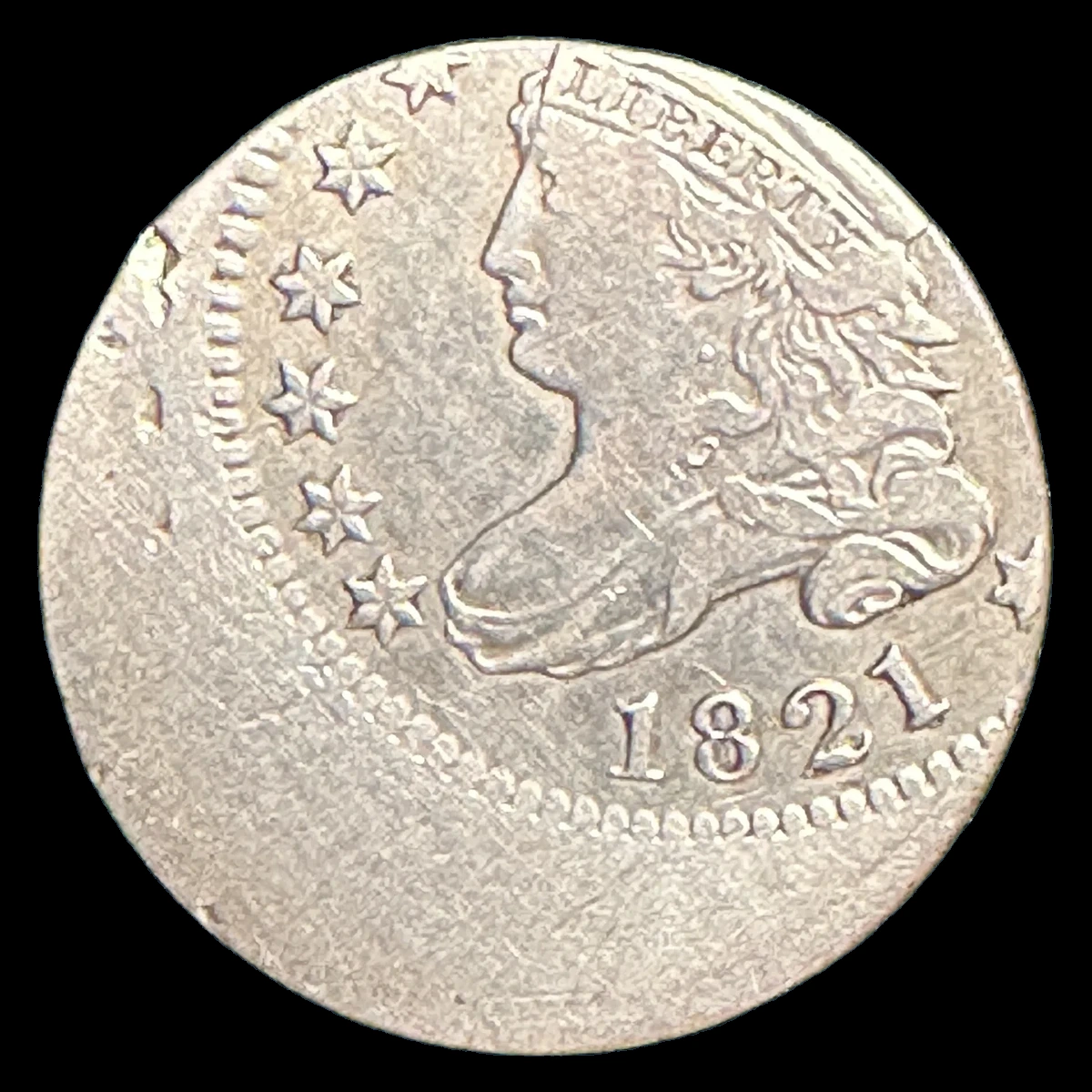
5. 1821 Dime A blank crescent beside the design: off-center strike Error
A blank that sits outside its proper position receives only part of the design. The finished coin can retain an unstruck crescent while the portrait and reverse run beyond the opposite edge.
One collector-reported 1821 example has no supplied percentage of displacement. A separate auction coin, a Large Date JR-4, was described as 30% off-center.
How to Identify
Inspect both faces and relate the missing design to the surviving plain metal. An uneven border on only one face can reflect a misaligned die instead.
Make sure enough of the date remains to establish 1821. Examine the boundary of the struck area for natural detail, checking the rim for filing or hammer damage.
Do not transfer the auction coin’s 30% description to another specimen. Its date style, die pair, displacement, and surface condition belong to that specific coin.
What It’s Worth
An identifiable 1821 off-center dime has an estimated whole-coin range of $1,000–$6,000. The amount depends on the visible displacement, readable identification, and preservation.
The 30% off-center Large Date JR-4 sold for $2,640 at Heritage in December 2022. NGC graded it XF Details and noted cleaning, so the result includes that condition problem.
This is a direct same-year error sale, but a minor centering difference is not equivalent to its substantial blank crescent. Compare the amount of missing design before applying the price.
Conclusion
Raised, hollow, and missing features point toward different explanations on an 1821 dime. Use their location and surface shape together, then confirm the Small Date or Large Date attribution.
The off-center sale is direct evidence for one clearly described error coin. Other figures provide broader context, and the reported edge flaw still needs its cause established before an error premium can be justified.