Rare 1952 Half Dollar Errors (List & Pictures)
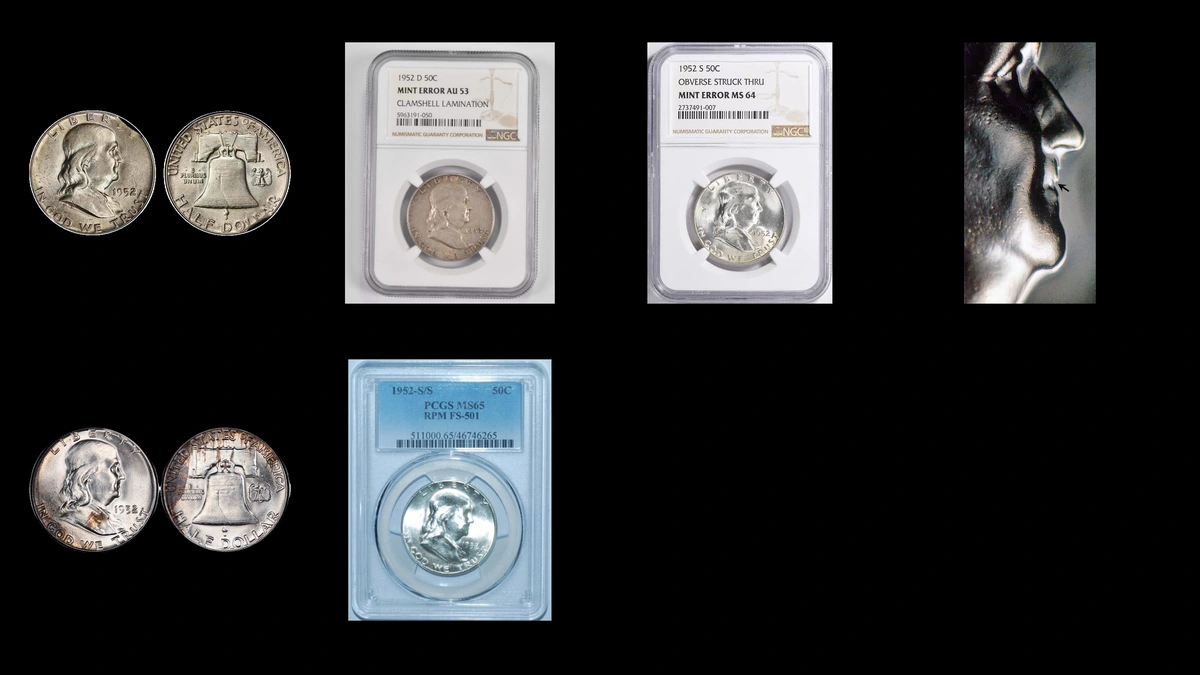
Some 1952 half dollar errors change the coin’s size, while others add tiny shapes to Franklin’s face or the mintmark. The supplied estimates span $50–$5,000, with a high-grade Scarface Full Bell Lines example recorded at $4,250 in December 2020.
A different documented error, a 1952-D on a quarter blank, sold for $1,150 in June 2010. Inspect the outline and edge before moving to surface layers, facial features, and lettering.
| Starting clue | Category | Estimated whole-coin range |
|---|---|---|
| Small size and very low weight | Silver quarter planchet | $1,200–$5,000 |
| One or two rim gaps | Clipped planchet | $75–$500 |
| Deep opening with joined edge | Clamshell split | $300–$1,000 |
| Thin peeling layer | Lamination | $50–$300 |
| Hollow or interrupted detail | Strike-through | $75–$500 |
| Mouth or nose projection | Die clash | $75–$3,500 by mint and finish |
| Raised backward J on cheek | Scarface die break | $150–$4,250 |
| Extra front design contours | Reported doubled die obverse | $75–$600 if identified |
| Additional S or D fragments | Repunched mintmark | $75–$2,000 |
Confirm Franklin and the Liberty Bell first, since a Carver-Washington commemorative also bears the 1952 date. A normal Franklin half weighs 12.50 grams, measures about 30.6 millimeters, and has a grooved edge.
1. 1952 Half Dollar Half-dollar designs on a much smaller coin: Silver quarter planchet Error
Two cataloged 1952 halves were struck on quarter blanks and weigh 6.2 grams. Both were graded NGC AU58, but only one is explicitly identified as Denver.
The other has a shift toward seven-thirty and loses portions of the obverse motto and reverse national name. Its catalog title’s lack of a mintmark does not establish Philadelphia if the mintmark area itself is incomplete.
How to Identify
A silver quarter blank begins at 6.25 grams and about 24.3 millimeters, making weight a useful first distinction from a normal half. It can spread under the larger dies, so the finished diameter need not remain exactly that of an unstruck quarter blank.
Inspect the missing outer lettering and surviving edge for natural metal flow. A half filed or ground down later can also become small and light, but should show altered borders or surfaces.
Photograph every remaining date digit and the actual area above the bell. Identity must come from surviving detail rather than assumptions based on an abbreviated listing title.
What It’s Worth
Comparable lightly worn through attractive unworn quarter-blank strikes are estimated at $1,200–$5,000. The 1952-D NGC AU58 sold at Heritage for $1,150 on June 4, 2010.
The other AU58 is a separate specimen and has no second $1,150 sale established here. Preservation and how clearly the year and mint remain identifiable affect the comparison.
2. 1952 Half Dollar Curved pieces missing from the rim: Single and double clips Error
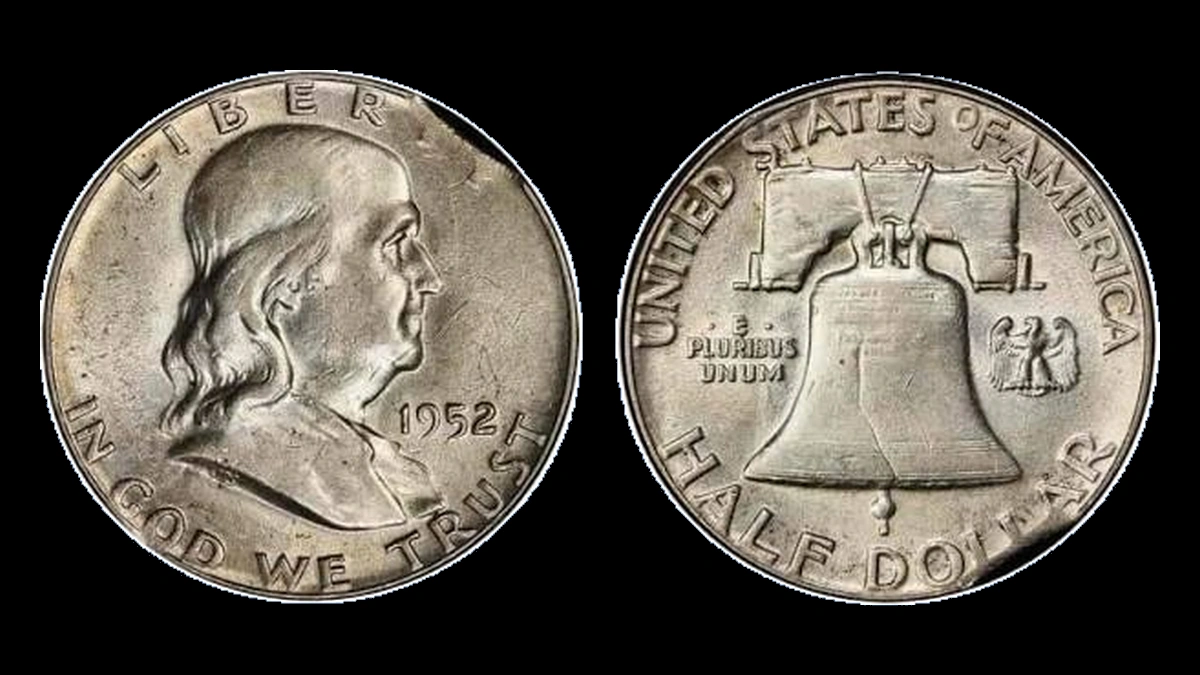
A PCGS illustration shows a 1952 half with a 1% clip near two o’clock and weakness at the opposite rim. Other reports concern a Philadelphia clip at six o’clock, a Denver clip at four o’clock, and a separate ANACS MS64 with two clips.
The gaps originated in blanking, when the punch overlapped metal already missing from the strip. The incomplete blank was then struck with those gaps in place.
How to Identify
Inspect the ends of each missing section for original rim formation rather than sharp cuts, filing, or saw marks. Opposite-rim weakness supports a clip but can be faint or inconspicuous.
On a double clip, assess both boundaries independently. Do not combine positions from the three single-clip reports into an invented description of the MS64 coin.
What It’s Worth
Modest single clips are estimated at $75–$200, with larger or clearer double clips around $150–$500. These ranges include the coin’s condition as well as its missing metal.
A 1952-D MS62 minor clip had a reported $99 asking price. No realized price is used for the ANACS MS64 double clip, and the number of gaps alone does not determine value.
3. 1952 Half Dollar A deep split with one edge still joined: Clamshell Error
A clamshell split separates much of the coin’s thickness while leaving an intact connection like a hinge. The reported 1952-D was described as AU53, but the account gives no exact opening location.
How to Identify
View the internal opening and remaining connection together. A natural separation through the alloy should differ from saw tracks, an added seam, or a solid coin that has simply been bent.
Do not pry the layers apart to improve the view. Retain photographs of the date, D above the bell, and both faces so the edge feature remains linked to the same specimen.
The coin may still weigh close to normal if all its metal remains attached. An open shape does not necessarily mean that silver has been lost.
What It’s Worth
Genuine attractive splits on lightly worn Franklin halves are estimated around $300–$1,000. The year account reports the AU53 1952-D listed at $599.
That is an asking price, not a completed sale. Preserved design and an undisturbed natural connection matter more than an opening forced wider after minting.
4. 1952 Half Dollar A silver flake lifting from one face: Lamination Error
A shallower alloy weakness can release a thin surface layer rather than opening most of the coin. This lamination may retain a flap or leave a rough patch where one detached.
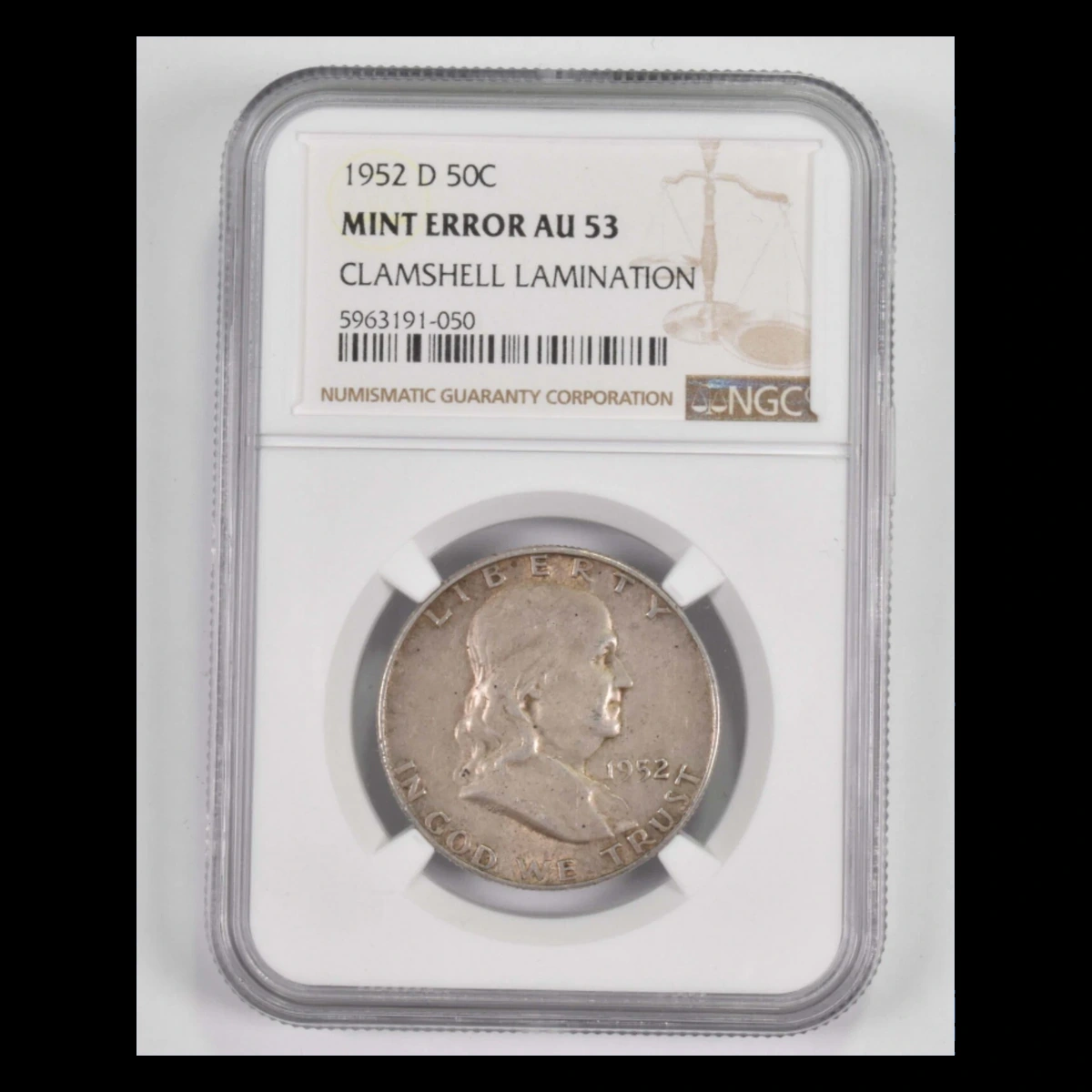
How to Identify
Trace the thin separation where intact detail meets the affected area, without lifting any attached metal. Scraping may leave parallel cuts, while corrosion can produce irregular pits instead of a coherent layer.
Inspect the edge to determine whether the problem remains near the surface or continues deeply through the coin. The supplied 1952 reports do not establish one mint or fixed position for every example.
What It’s Worth
A modest genuine lamination is estimated at $50–$300 for circulated through ordinary unworn coins. A 1957 NGC MS63 obverse lamination realized $74.49 including fees at Pristine in January 2021.
That result is a different-year comparison near the lower end. Losing more metal can damage visual appeal, so a larger missing area does not automatically bring a higher price.
5. 1952 Half Dollar A hollow or weak patch at the design: Strike-through Error
The 1952 reports include a San Francisco NGC MS64 with an obverse strike-through and separate descriptions of debris near the bell’s lower-left corner and clapper. The supplied evidence does not settle whether the two reverse views show different coins.
An obstruction present during striking prevents normal contact between die and blank. Its effect can be an impression or an area where detail fails to form.
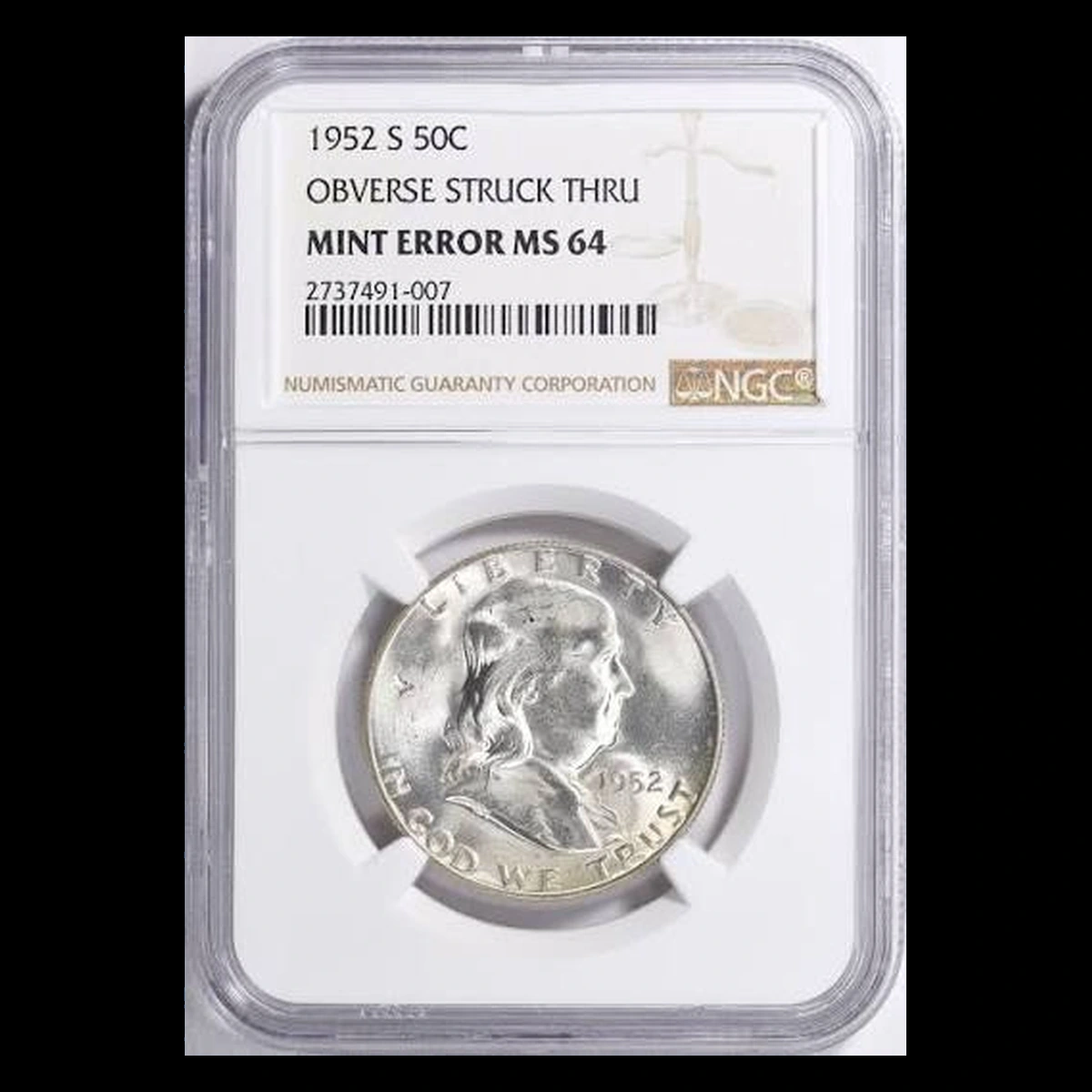
How to Identify
Match the face first: the 1952-S MS64 record concerns the front, not the bell-side illustrations. For the reverse reports, locate the lower-left corner or the clapper, the hanging piece inside the bell.
Examine the boundary of the interruption under changing light rather than relying on a dark patch. The crack shown in the bell’s normal design is not evidence of a strike-through.
Neither a location nor a weak patch identifies the obstructing material by itself. Do not label cloth or wire unless the shape or surviving material supports that conclusion.
What It’s Worth
Modest visible examples are estimated around $75–$500. Greysheet records a 1951-S NGC MS64 obverse strike-through at $134 in April 2026, a different-year comparison.
A larger recognizable impression may attract more interest than an ambiguous weak area. The reported 1952-S specimen has no sale result established by that 1951-S record.
6. 1952 Half Dollar A mouth “tooth” or a hook near the nose: Die clashes Error
Philadelphia Bugs Bunny examples carry mouth-area projections, while the separate Denver Booger variety has a hooked mark near the nose. Both arise when empty dies collide and part of the eagle design marks the obverse die.
A Philadelphia proof Bugs Bunny discovery was publicized in 2015 at PCGS PR65. Its FS-403 identity differs from the cited FS-401 ordinary-strike varieties.
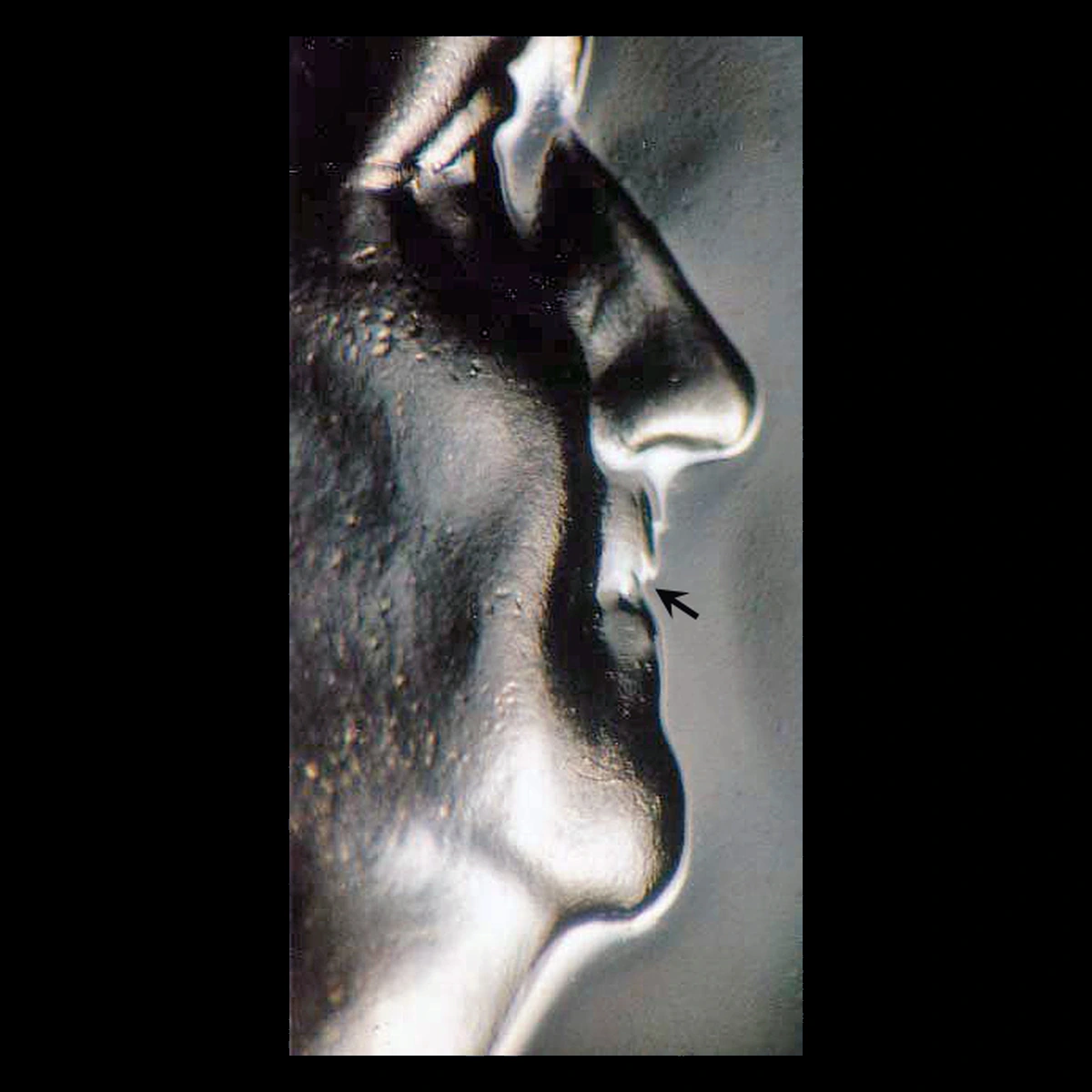
How to Identify
Use the appropriate mouth or nose landmark, then match the raised feature to the correct mint and finish. A nick, cut, or random lump on the face is not enough.
A reflective ordinary strike is not automatically a proof, and the proof needs its own FS-403 comparison. The lower-cheek Scarface feature discussed next also has a different origin.
What It’s Worth
Identified Philadelphia ordinary-strike Bugs Bunny coins are estimated at $75–$1,500, ordinary Denver Booger examples at $75–$1,000, and the separate proof variety at $500–$3,500. These categories should not share one undifferentiated price.
A 1950 Bugs Bunny MS64 Full Bell Lines sold for $390.40 in April 2026, offering a different-year ordinary-strike comparison. The 1952 proof estimate instead relies on published variety-guide levels, with its surfaces and mouth feature assessed separately.
7. 1952 Half Dollar A backward J near the lower cheek: Scarface die break Error
The raised backward-J shape near Franklin’s lower cheek and jaw identifies the FS-402 Scarface variety. A damaged area of the die allowed extra metal to rise during striking.
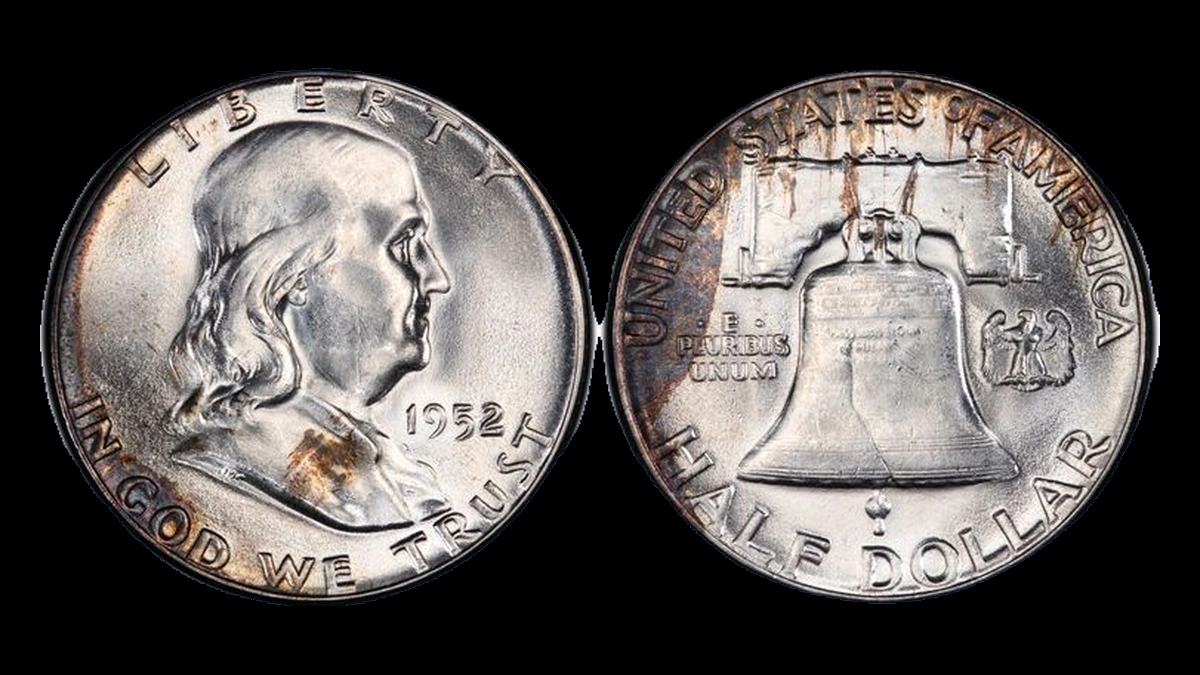
How to Identify
Follow the complete shape under light from opposite directions and establish that it rises above the face. A scratch may have raised borders but still retain a cut center.
Compare the mark’s position with a clear FS-402 image rather than applying the nickname to any conspicuous facial damage. If a mouth clash is also claimed, examine it independently.
What It’s Worth
Ordinary identified examples are estimated at $150–$1,000, with substantially better preservation around $1,000–$4,250. PCGS records an MS66+ Full Bell Lines example at $4,250 on eBay in December 2020.
That result includes exceptional preservation and sharp bell detail. A worn or damaged half with the correct die-break shape still requires a condition-appropriate comparison.
8. 1952 Half Dollar Repeated outlines in the front design: Reported doubled die obverse Error
An owner lists a Philadelphia ANACS MS65 Full Bell Lines half as having a doubled obverse. The entry supplies neither close-ups of the extra contours nor a checked variety label, leaving the attribution a report.
How to Identify
Seek repeated rounded shapes or separated corners that form a consistent pattern in the obverse design. A flat shelf alongside a reduced letter can result from striking movement instead.
Compare with a normal 1952 Philadelphia half and obtain the reported coin’s full label or clear photographs. A cataloged die from 1951 or 1954 cannot establish this coin’s identity.
Full Bell Lines describes reverse detail at the bell’s base. It does not authenticate the origin of any extra front-side outline.
What It’s Worth
Once identified, an ordinary collectible minor doubled-die example is estimated around $75–$600. The owner’s MS65 Full Bell Lines entry supplies no transaction or fixed doubling premium.
Preservation and a clear variety match support stronger comparisons. Thick letters or flat striking shelves should not be assigned the range for established doubled-die contours.
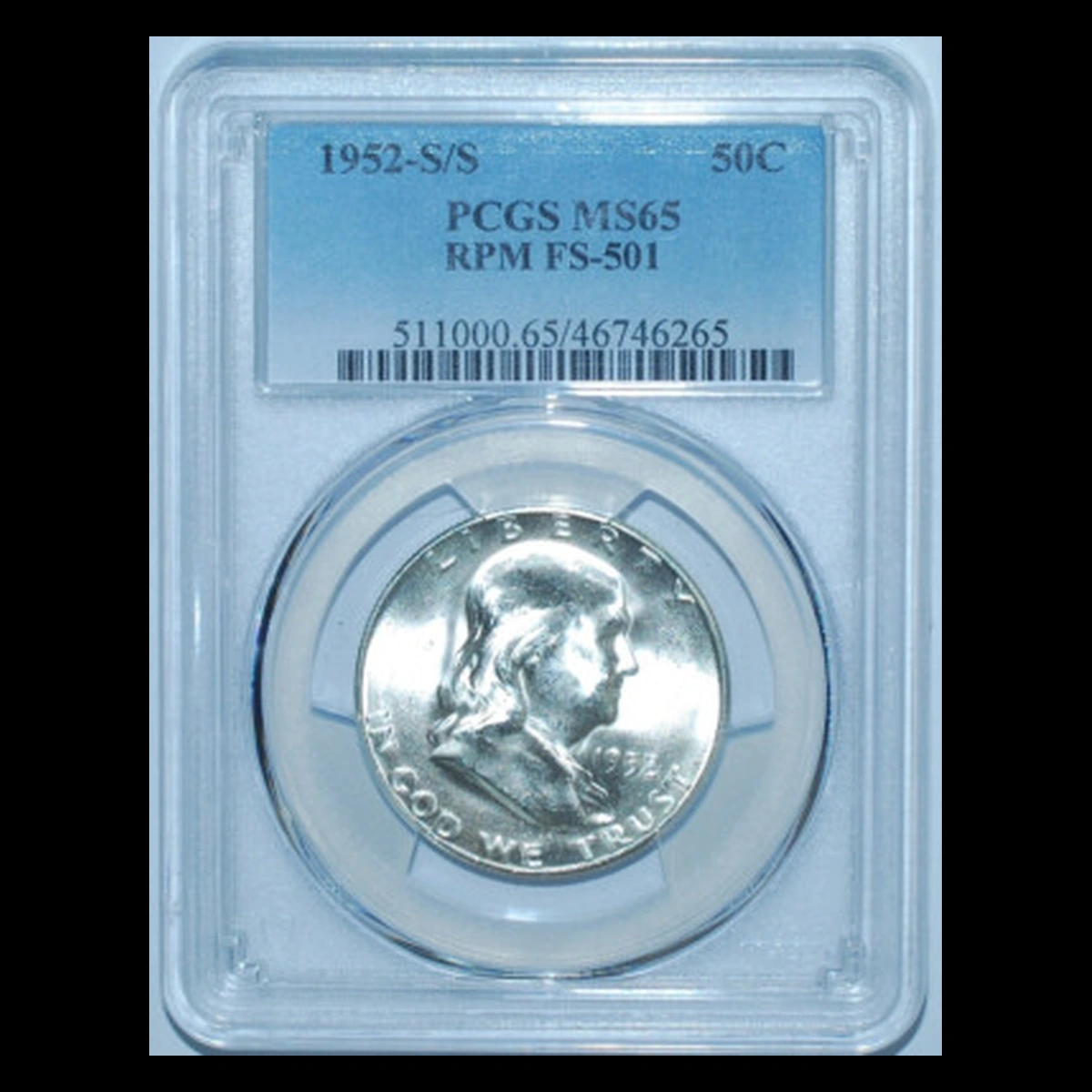
9. 1952 Half Dollar Extra S or D curves above the bell: Repunched mintmarks Error
The prominent San Francisco S/S/S shows remnants on both sides of the final S. Other S varieties have tilted or left-shifted impressions, while Denver reports include tilted, downward, leftward, and multiple D placements.
These are separate patterns left by repeated hand-punching of mintmarks into dies. One letter should not be expected to contain all the reported positions.
How to Identify
Trace the main letter and its additional fragments using one complete entry from the Wexler Franklin RPM catalog. For the prominent S/S/S, check both the left and right remnants.
One reported S variety also has a conspicuous flat shelf from striking movement. Separate that shelf from the true earlier-punch curve even if the shelf is easier to see.
Catalog numbers from different reference systems need not be interchangeable. Match the visible pattern and full description, not just a similar number.
What It’s Worth
Ordinary collectible repunched mintmarks are estimated at $75–$750, with especially desirable, well-preserved San Francisco examples around $750–$2,000. PCGS records a 1952-S FS-501 MS65 eBay transaction at $590 in May 2021.
The many D and S varieties do not all command the same price. Strong bell lines and overall surface quality contribute independently of the extra mintmark fragments.
Conclusion
Size and edge structure distinguish a wrong blank, a clip, a deep split, and surface peeling before magnification is needed for the smaller varieties. On Franklin’s face, location separates mouth clashes, nose clashes, and the lower-cheek Scarface break.
Keep each mint, finish, and specimen attached to its own evidence. A matching nickname or certification grade is less useful than a clear view of the physical feature and an appropriate condition comparison.